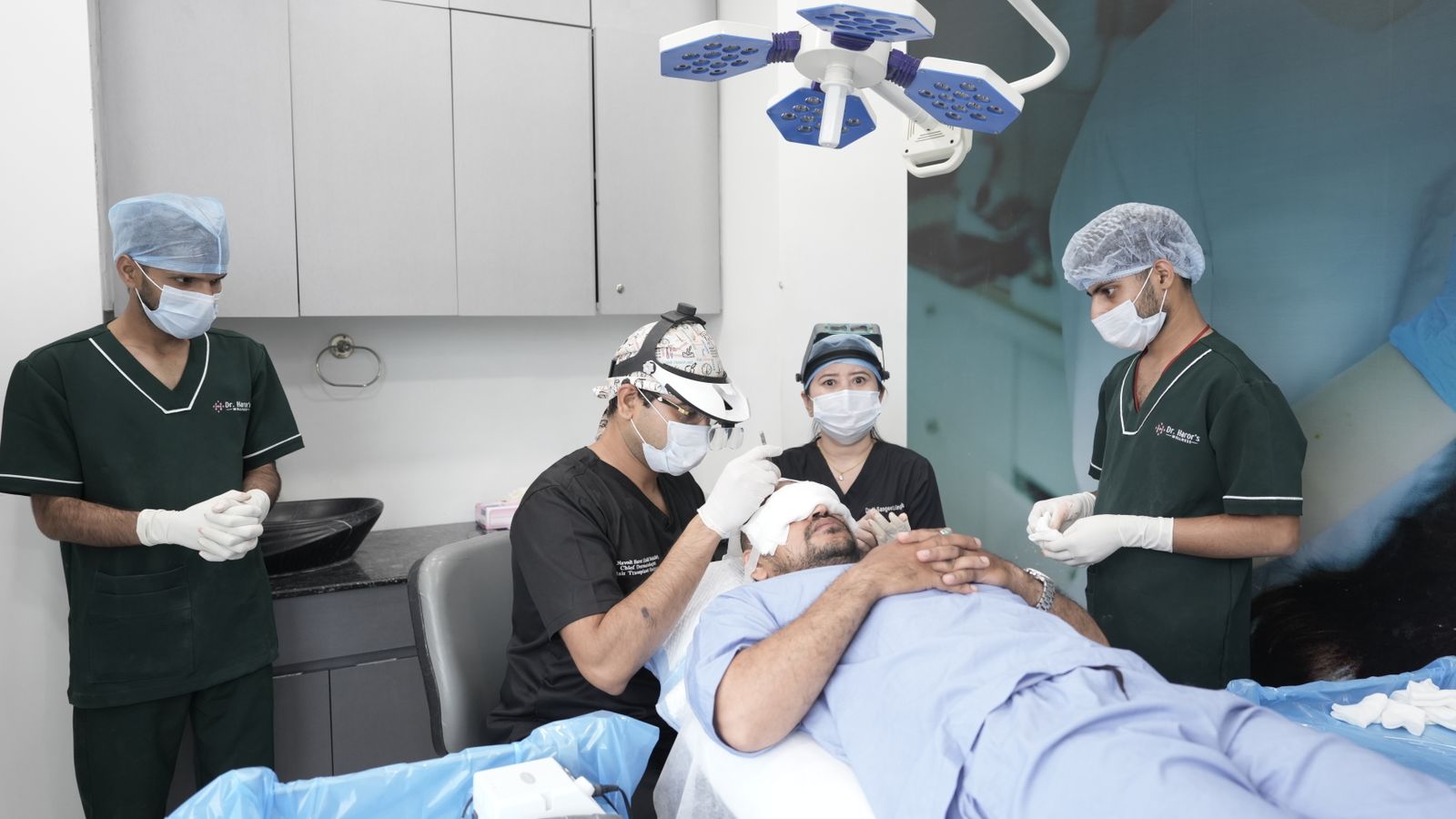
FUE vs FUT Hair Transplant: Which Is Right for You?
The FUE vs FUT hair transplant question comes down to how the donor hair is taken from the back of your head. FUE removes follicular units one at a time with a small punch, leaving scattered dot scars. FUT removes a thin strip of scalp, which is then divided into grafts under a microscope, leaving one thin line. Neither is better in the abstract. The right answer depends on your donor supply, how short you wear your hair, and how much coverage you need.
Our hair growth shampoo
Grow Me® Hair Growth Shampoo, £14.95. A sulphate free daily shampoo that supports a healthy scalp environment and helps reduce breakage, so lengths hold on and look fuller.
Key takeaways
- FUE means follicular unit extraction. FUT means follicular unit transplantation, also called the strip method.
- The transplanting half of the operation is identical in both. Only the harvesting differs.
- FUE leaves many tiny round scars. FUT leaves one linear scar that hair normally covers.
- If you shave to a grade one or two, FUE usually hides better. If you wear your hair longer, FUT's single line disappears.
- FUT often yields more grafts in a single session, which matters for larger areas of loss.
- Neither method stops ongoing pattern loss. Transplanted hair stays, but untouched native hair can keep thinning around it.
- This is surgery. Check the surgeon's registration and get the plan in writing before you commit.
- Choose the surgeon first. The FUE vs FUT hair transplant decision should follow from your donor area, not from a clinic's marketing.
What is the difference in an FUE vs FUT hair transplant?
Both operations move your own hair from an area that is genetically resistant to pattern loss, usually the back and sides, to an area that is thinning. Both then place those follicular units, natural groupings of one to four hairs, into tiny incisions in the recipient area. That second half of the procedure is essentially the same whichever route you take.
The difference sits entirely in the harvest. In FUE, a punch typically under a millimetre wide cuts around each follicular unit, which is then lifted out individually. In FUT, a strip of scalp is removed from the back of the head, the wound is closed, and technicians dissect that strip into individual grafts under magnification.
So when people compare an FUE vs FUT hair transplant, they are really comparing two things: what the donor area looks like afterwards, and how many usable grafts the method can produce.

How does FUE work, step by step?
FUE is done under local anaesthetic, usually across one long day, sometimes two for larger cases.
- The donor area is shaved, often the whole back and sides, so the surgeon can see follicle angles clearly.
- Local anaesthetic is given to the donor area.
- A punch scores around each follicular unit, following the natural angle of growth, and the unit is extracted with fine forceps.
- Grafts are sorted by hair count and kept in a holding solution.
- Recipient sites are made in the thinning area, with angle and density planned to look natural rather than uniform.
- Grafts are placed, singles at the hairline and larger units behind for density.
The donor area settles into hundreds or thousands of small round scars, each roughly the width of the punch. Individually they are hard to see. Collectively, at very short lengths, they can produce a moth eaten look if too many were taken from too small an area, which is why over harvesting is the main thing to ask a surgeon about.
How does FUT work, step by step?
FUT is also done under local anaesthetic and usually takes a comparable amount of time.
- A strip of scalp is marked out at the back of the head, sized to the number of grafts planned.
- Local anaesthetic is given and the strip is removed.
- The wound edges are brought together and closed, often with a trichophytic closure designed to let hair grow through the line.
- The strip is dissected under microscopes into individual follicular units, which is where much of the skill lies.
- Recipient sites are made and grafts placed exactly as in FUE.
Because the surrounding donor hair is not shaved, many people can go back to normal life looking unchanged from the back, with the line hidden under existing hair. The trade off is a single scar that will always be there, and which becomes visible if you later decide to shave your head. Either way, the technique matters less than when to book a hair transplant, because clinics want a settled pattern before they operate.

How do the two methods compare directly?
This table is the practical summary. Read the scarring and haircut rows first, because for most people that is what decides it.
| Factor | FUE | FUT (strip) |
|---|---|---|
| Donor harvest | Individual punches | One strip, then dissected |
| Scarring | Many small dots, diffuse | One thin line |
| Best if you wear hair | Very short, grade 1 to 3 | Longer than about grade 4 |
| Shaving needed | Usually the whole donor area | Only the strip, hidden by hair above |
| Grafts per session | Good, but limited by extraction time | Often higher in one sitting |
| Donor discomfort | Usually milder, more surface soreness | More tightness for a week or two |
| Stitches | None | Yes, removed or dissolving |
| Typical UK cost | Higher per graft | Often lower per graft |
Which method gives you more usable hair?
This is where the FUE vs FUT hair transplant argument gets genuinely technical. Your lifetime donor supply is finite, and protecting it matters more than any single session. This is the argument FUT surgeons make: a strip taken from the densest, safest band at the back tends to produce a high yield of intact grafts in one go, and if the strip is well planned, a second strip can later be taken through the same scar rather than adding a new one.
The FUE counter argument is that extraction can be spread across a wider area, no linear scar is created, and someone who may want to shave their head one day keeps that option open.
Both are reasonable. What is not reasonable is a clinic that offers only one method and tells you it is universally superior. A surgeon who does both, and who explains why they are recommending one for your specific donor density and hair calibre, is a better sign than any before and after gallery.

How do recovery timelines compare?
Recovery in an FUE vs FUT hair transplant follows the same broad shape, with the donor area being the main difference.
- Days 1 to 3. Swelling around the forehead is common in both. Grafts are at their most fragile. Sleep propped up.
- Days 5 to 10. Crusts form and lift. The donor area is itchy in FUE and tight in FUT. Stitches, where used, come out around now.
- Weeks 2 to 4. Most transplanted hairs shed. This is expected and alarms almost everyone. The follicle stays put.
- Months 3 to 4. New growth begins, fine and often slightly wiry at first.
- Months 6 to 9. Meaningful density becomes visible.
- Months 12 to 18. Final result, with texture and thickness settling last.
Time off work is usually similar, roughly a week if you would rather not explain a red scalp, though FUT's unshaved donor area makes it easier to look normal sooner from behind.
Get a discount on the thinning hair range
Join the Watermans mailing list and we will email a discount code straight to your inbox, so you can try the thinning hair range for less. Made in the UK, over 6.5 million bottles sold since 2012.
What does a hair transplant cost in the UK?
The cost of an FUE vs FUT hair transplant is quoted either per graft or as a package, and it varies enormously by clinic, city and surgeon experience. UK clinics commonly advertise several thousand pounds for a modest hairline case and well into five figures for extensive work. FUE is generally priced higher per graft than FUT because extraction is more labour intensive.
Two things matter more than the headline number. First, insist on a written plan stating the number of grafts, the method, who is actually performing each stage, and what a revision would cost. Second, be sceptical of very low overseas package prices. Cost differences that large usually reflect who is doing the work and how many operations run in a day, and this is not a procedure to buy on price alone. NHS guidance on cosmetic procedures is a sensible starting point for the questions to ask, and hair transplant surgery is not normally available on the NHS. If your question is about products or a routine rather than a medical one, you can talk to Gail Waterman, our co-founder, as an AI avatar on the Watermans homepage.
Before you commit, check all of these
- The surgeon is on the GMC register, and you have their name, not just a clinic brand.
- The clinic is registered with the relevant regulator, the Care Quality Commission in England.
- You have met the surgeon who will operate, not only a sales adviser.
- The written plan states graft numbers, method, and who performs extraction and placement.
- You have been told honestly what happens to your untouched hair over the next ten years.
- You have seen results from this surgeon at a similar level of loss to yours, at least a year post operative.
What can a transplant not do?
This is the part good surgeons raise early and poor ones skip. A transplant redistributes hair, it does not create more of it, and it does nothing to the follicles that were left in place.
If you have progressive pattern loss, the native hair around and behind your new hairline can carry on thinning. That is how people end up with an island of dense transplanted hair and a gap behind it, then need further surgery they had not planned or budgeted for. It is the single most common regret, and it is entirely predictable. Our guide to pattern hair loss and how it progresses explains the pattern this follows.
It also helps to be sure of what is actually happening to your hair before considering surgery at all, because not every kind of thinning is permanent. The three mechanisms behind thinning hair separates follicle loss from temporary shedding and from breakage, and telogen effluvium in particular recovers on its own. Nobody should have surgery for a shedding phase that would have settled by itself.

How should you look after your hair afterwards?
Follow your surgeon's post operative instructions to the letter, and use nothing at all on the grafts until they clear it. That usually means a specific washing routine for the first couple of weeks, no scrubbing, no hot water, and no products of your own choosing.
Once you are signed off and back to normal washing, the everyday job is looking after the hair you have, transplanted and native alike. Harsh detergents and rough handling cost you strands through breakage, and after spending several thousand pounds on density, losing hair to a comb is a poor outcome. A gentle sulfate free shampoo and a conditioner with real slip are the sensible baseline. Where a strip scar is the part that bothers you, scalp micropigmentation for scar camouflage is the cosmetic route people most often pair with a transplant.
To be clear about what these are: Watermans products are cosmetic. They do not alter follicles, they play no part in surgery, and they are not an alternative to it. What they do is keep hair looking fuller and reduce breakage. Where the shedding follows a scalp procedure rather than an illness, our guide to shock loss and its recovery timeline sets out why the fall arrives two to four months later. Before choosing a method, it is worth reading what a hair transplant really costs in the UK, including the extras outside the quote. Whichever method you choose, our guide to protecting transplant grafts covers handling, storage and aftercare.

Grow Me® Hair Growth Shampoo, £14.95
Sulfate free, vegan and made in the UK, with biotin, caffeine, rosemary and niacinamide. A gentle daily cleanse for a scalp you would rather not irritate, formulated for fuller looking hair.

Condition Me® Hair Growth Conditioner, £13.95
Slip so strands separate instead of tearing. Fewer hairs lost in the comb is the least glamorous and most reliable way to keep density you have paid for.
Over 6.5 million bottles sold since 2012. Made in the UK.
Frequently asked questions
Is an FUE vs FUT hair transplant more painful?
Both are done under local anaesthetic, so the procedure itself is not painful, though it is long and tedious. Afterwards, FUE donor areas tend to feel sore and itchy on the surface, while FUT donor areas feel tight for one to two weeks and are the more uncomfortable of the two for most people. Simple pain relief is usually enough for either.
Which one leaves less visible scarring?
It depends entirely on your haircut. At a grade one or two, FUE's scattered dots blend better than a strip line. At anything longer than about a grade four, FUT's single line is completely hidden while FUE's dots are equally invisible. The mistake is choosing FUE because it is marketed as scarless, which it is not.
Can you have FUT after FUE, or the other way round?
Yes, and combinations are common in larger cases. Sequencing matters though, because heavy FUE extraction can reduce donor laxity and make a later strip harder to close well. That is a conversation to have with a surgeon who performs both, before the first session rather than after it.
Does transplanted hair fall out again?
The transplanted hairs shed within the first month, which is normal and expected, and the follicles then produce new hairs from around month three. Because donor hair is taken from an area resistant to pattern loss, those follicles usually keep growing long term. Your untouched native hair is a separate question and can continue thinning.
How many grafts will I need?
It depends on the area, your donor density and your hair calibre, and only an in person assessment can answer it. As a very rough orientation, a modest hairline may need one to two thousand grafts, while extensive crown and mid scalp work can need several thousand across more than one session. Regard any number quoted from a photograph alone with caution.
Am I too young for a transplant?
Age itself is not the barrier, but stability is. Operating early in an aggressive pattern of loss risks building a hairline that ends up marooned as the hair behind it recedes. Many surgeons prefer to see how loss is progressing before designing a permanent hairline, and a surgeon willing to operate on a twenty year old without that conversation is a warning sign.
Is a hair transplant available on the NHS?
Not for pattern hair loss, which is considered cosmetic. There are rare exceptions, for example reconstruction after burns or trauma, decided case by case. For everything else this is a private procedure paid for by you.
What is the biggest mistake people make?
Choosing the clinic before understanding their own hair loss. Deciding between an FUE vs FUT hair transplant is the last step, not the first. Work out what is causing the change, whether it is still progressing, and what your donor area can realistically supply over a lifetime. Then choose a surgeon, and let them recommend the method. Both methods are limited by how much donor hair you have, which is the problem hair cloning research is trying to solve.
What is the bottom line on fue vs fut hair transplant?
In an FUE vs FUT hair transplant, the transplanting is identical and only the harvest differs. FUE takes follicles one by one and leaves scattered dots, which suits very short haircuts. FUT takes a strip and leaves one line, which suits longer hair and often yields more grafts per session. Choose the surgeon first and let the method follow from your donor area and your haircut. And remember that surgery moves hair without stopping ongoing pattern loss, so plan for the next ten years, not just the next twelve months. Before choosing between the two methods, it is worth settling whether surgery suits you at all, which we cover in what to check before a hair transplant.
The shampoo is the step you actually repeat, which is why Grow Me hair growth shampoo is the one worth getting right. Vegan, made in the UK.
Sources & references
- NHS, Cosmetic procedures. NHS guidance on considering a cosmetic procedure and the questions to ask before going ahead.
- NHS, Cosmetic surgery. NHS guidance on cosmetic surgery, its risks and choosing a provider.
- NHS, Hair loss. NHS guidance on hair loss, what happens at a GP appointment and what is available on the NHS.
- Care Quality Commission, CQC. The regulator you can use to check that a clinic in England is registered to carry out surgery.
- British Association of Dermatologists, Information leaflets on skin, hair and scalp conditions. Dermatologist reviewed leaflets, including hair and scalp topics.
- International Society of Hair Restoration Surgery, Information for the public. Background on hair restoration methods and how to find a qualified surgeon.
Watermans products are 100% cosmetic and do not treat medical hair loss. Individual results may vary. Watermans is a hair care company, not a clinic, and does not perform or advise on surgery. This article is general information, not personal medical advice. Please speak to your GP or a GMC registered surgeon about any procedure.