HRT Hair Care Routine: What Changes and What Helps
An HRT hair care routine is not a special product range, it is a set of adjustments that suit hair which has become finer, drier and more fragile while hormones are shifting. The practical goal is retention: keep the length and the apparent density you already have while the hormonal picture settles, and give the follicle cycle the six to nine months it usually needs before any judgement is fair.
Our hair growth shampoo
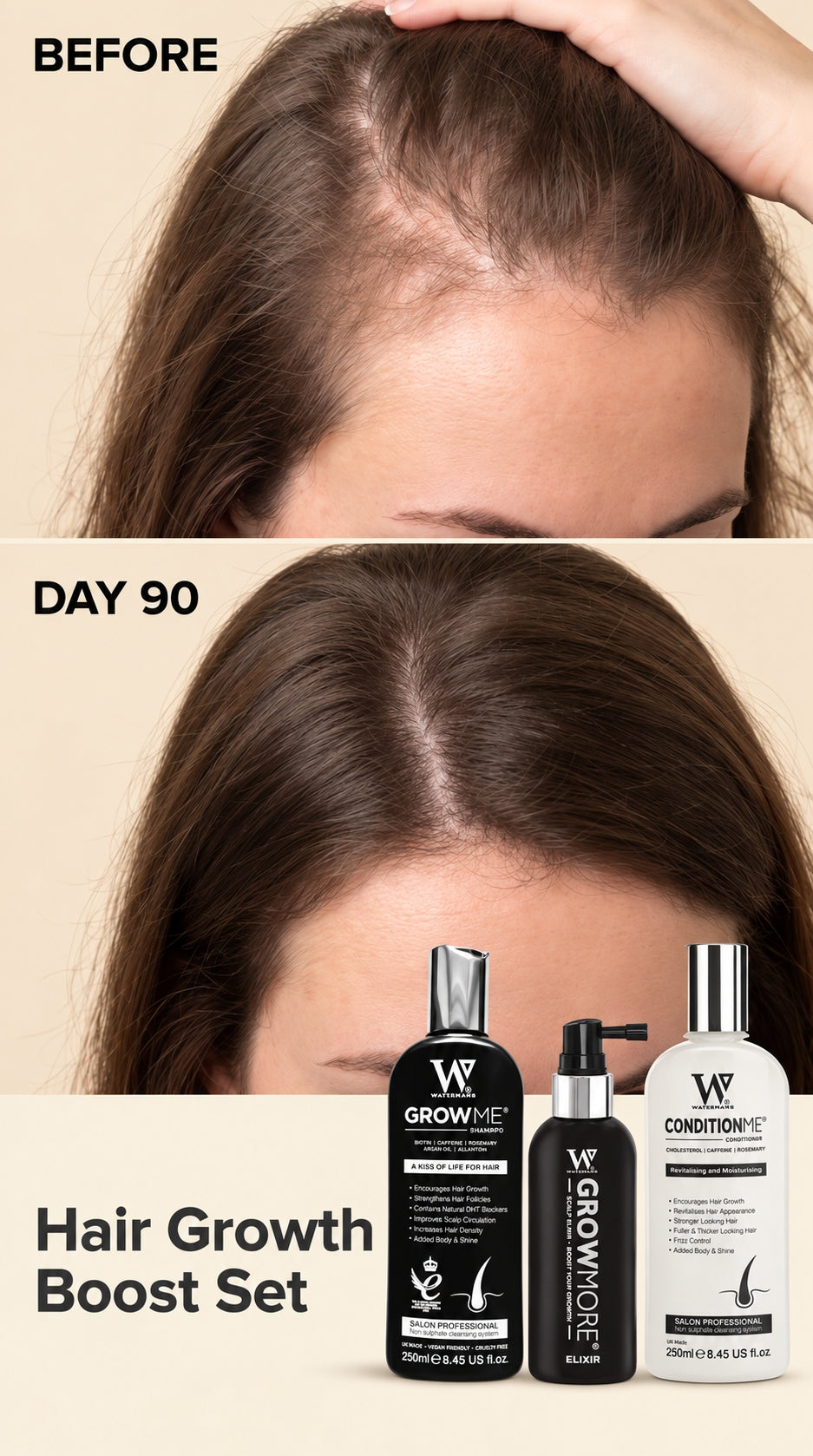
Grow Me® Hair Growth Shampoo, £14.95. A sulphate free daily shampoo that supports a healthy scalp environment and helps reduce breakage, so lengths hold on and look fuller.
In short: A good HRT hair care routine is gentle cleansing, conditioner on the mid lengths and ends every wash, detangling from the ends upward, lower heat, looser styling and a protein adequate diet. Expect a shed around two to three months after starting, changing or stopping hormone therapy, because follicles respond to hormonal change on a delay. Judge the routine on a monthly parting photograph at six months, not on what the shower looks like this week.
Key takeaways
- A shed two to three months in is the expected pattern, not a sign the therapy is failing.
- Texture change is a real effect. Finer, drier hair breaks at handling levels that thicker hair tolerated.
- Conditioner is the workhorse. Most visible density lost during this period is lost to breakage, not the follicle.
- Six to nine months is the honest review window. Anything judged at six weeks is being judged on noise.
- Take hormone questions to the clinician managing your HRT, never to a product page, and never change a dose over hair.
- Photograph the parting monthly. It is the only measurement that survives a bad morning.
What does hormone therapy actually change about hair?
Oestrogen and androgens pull hair in different directions, and hormone therapy changes the balance between them rather than acting on hair directly. Higher oestrogen exposure is associated with hair staying in its anagen growing phase longer, which is why hair often feels thicker in pregnancy and thinner after it. Androgen exposure drives the opposite in androgen sensitive follicles on the scalp, gradually miniaturising them.
Three separate things then get described with the same words, and an HRT hair care routine only addresses one of them. Hair loss means follicles producing less or nothing. Hair shedding means the cycle releasing a batch of hairs at once. Hair breakage means the fibre snapping along its length. Hormones drive the first two. Handling, heat and dryness drive the third, and that is the one a routine can genuinely fix. Our guide to what HRT can and cannot change about hair loss covers the mechanism in full.
Why did the shedding start months after the change?
Follicles respond to hormonal change on a delay of roughly two to three months. A batch of follicles is pushed out of the growing phase into the resting phase at the time of the change, and those hairs then sit in place before releasing together. DermNet describes this pattern, telogen effluvium, as typically appearing two to three months after a trigger and settling over about six to nine months once the trigger has passed.
That delay explains the two most common misreadings. People starting hormone therapy blame the therapy for a shed that was actually set off by the illness, surgery or weight change three months earlier. People stopping it panic at week eight when nothing has happened yet. Work backwards three months from the first heavy day and the picture usually resolves itself.

What does a good HRT hair care routine look like on wash day?
Wash day is where most of the avoidable damage happens, and the fix is about force rather than frequency. Washing does not cause shedding: it collects hairs that had already detached, which is why a twice weekly routine makes wash day look alarming. The order below is the whole routine, and none of it needs a specialist product.
- Wash as often as your scalp needs. A comfortable, flake free scalp matters more than a rule about frequency.
- Cleanse the scalp, not the lengths. Shampoo the roots with fingertips rather than nails; the ends get cleaned by the rinse.
- Condition the mid lengths and ends every single wash. On finer hair this is the difference between keeping length and watching it snap off.
- Detangle with conditioner in, from the ends upward, in sections, with a wide tooth comb. Never from the roots down through a knot.
- Blot, do not rub. A cotton T shirt or microfibre towel causes far less cuticle damage than a bath towel and vigorous rubbing.
- Let it dry most of the way before heat, and use a heat protection product at a lower setting.
- Sleep on satin or silk, which cuts overnight friction on fragile fibres.
Our step by step on how to use conditioner properly and the four step routine for dry hair expand the two steps that matter most here.
Tension is the quiet one
Tight ponytails, buns, clips and repeated slicked styling concentrate force on the hairline exactly where hair is already finer. Traction damage recovers while the follicles are intact and can become permanent if the tension continues for years, so if a style is sore or leaves a headache, it is too tight. Vary the position, lower the height, and give the hairline days off.
How should styling change as hair gets finer?
Finer hair needs less product, less heat and less tension than the hair you are used to handling, and the adjustments are unglamorous. Heat styling at a lower temperature with a protection spray, air drying to eighty per cent before a dryer touches it, and choosing volume at the root rather than weight through the lengths all keep more hair attached.
Colour is the trade off worth thinking about honestly. Lightening opens the cuticle and weakens the fibre, and finer hair has less fibre to lose, so the same bleach that was fine five years ago now costs visible length. Going a shade closer to your base, spacing appointments further apart, and asking for the ends to be left alone are all reasonable requests to make in the chair.

Get a discount on the hormonal hair change range
Join the Watermans mailing list and we will email a discount code straight to your inbox, so you can try the hormonal hair change range for less. Made in the UK, over 6.5 million bottles sold since 2012.
Does food and supplementation belong in an HRT hair care routine?
Food belongs in it; unfocused supplementation mostly does not. Hair is made almost entirely of keratin protein, so an adequate protein intake is the one dietary factor that consistently matters, and it is the one most likely to slip during a period of appetite or weight change. Iron status matters too, particularly for anyone who has had heavy periods in the years before the menopause.
| Factor | Why it matters for hair | Practical step |
|---|---|---|
| Protein | Hair fibre is keratin, a protein, so intake is a hard floor rather than an optimisation | Include a protein source at each meal rather than only at dinner |
| Iron stores | Low ferritin is associated with diffuse shedding, and NICE names ferritin as the test for iron deficiency | Ask your GP for ferritin with a full blood count rather than self supplementing |
| Vitamin D | Low status is common in the UK through the darker months | The NHS advises a 10 microgram daily supplement in autumn and winter |
| Thyroid function | Both underactive and overactive thyroid cause diffuse hair loss and overlap with menopausal symptoms | Ask for thyroid function testing if you have fatigue, weight or temperature changes |
| Very high dose single nutrients | Excess vitamin A and selenium are both associated with hair shedding rather than benefit | Avoid stacking several products that contain the same nutrients |
What can cosmetic products realistically do here?
Cosmetic products work on the hair fibre and the surface of the scalp, so they cannot alter what hormones are doing inside a follicle. What they change is how much of the hair you grow actually stays on your head, and how full the hair you have looks. On finer, drier hair that is a bigger share of the problem than most people expect.

Grow Me® Hair Growth Shampoo · £14.95
A sulfate free daily shampoo with biotin, caffeine, rosemary and niacinamide. It supports a healthy scalp environment and reduces breakage so hair looks and feels fuller, which is the cosmetic half of an HRT hair care routine and not a hormonal one.

Condition Me® Hair Growth Conditioner · £13.95
A breakage defence conditioner with cholesterol, shea butter, glycerin and hydrolysed lupine protein, for the mid lengths and ends every wash. Its job is slip: less force through the comb means less length in the sink.
Our round up of menopause hair products compares the categories, and how to measure hair density on HRT explains how to tell whether any of it is working.

How long should you give an HRT hair care routine before judging it?
Six months of consistent handling, reviewed against monthly photographs, is the fair test. Scalp hair grows at roughly one centimetre a month, and a follicle pushed into its resting phase takes two to three months to release and several more to produce a visible replacement, so the arithmetic simply does not allow a verdict at six weeks.
What you should see earlier is less breakage: fewer short snapped pieces on the shoulders, less hair left in the comb, ends that stay blunt rather than fraying. That is the cosmetic half working. Density changes, if they come, arrive behind it and show up on the photographs rather than in the feel of a ponytail. If you have not started yet, how to prepare your hair before HRT covers baseline photos and the checks worth doing first. If you are still deciding on a product, our bioidentical HRT guide sets out regulated versus compounded options.
When should you speak to a doctor rather than change your routine?
A routine is the wrong answer to several of these, and some of them need a same week appointment. Speak to your GP, or to the clinician managing your hormone therapy, if you notice any of the following.
- Round or oval bald patches appearing over weeks.
- Loss at the crown with tenderness, burning, itching or a smooth shiny scalp, which can indicate a scarring condition where the window to preserve follicles closes as it advances.
- Heavy shedding that is still worsening beyond nine months.
- New coarse facial hair, acne or voice change alongside scalp thinning.
- Fatigue, weight change, heavy bleeding or low mood alongside the hair change.
Never adjust a hormone dose because of hair. Hormone therapy is balancing several things at once and hair is only one of them, so that conversation belongs with the clinician managing your care.
Frequently asked questions
Does HRT thicken hair?
Sometimes, indirectly, and not predictably. Higher oestrogen exposure is associated with hair spending longer in its growing phase, which can show as better density over months in some people. Others notice no hair change at all, and a minority notice thinning, particularly where the regimen has a more androgenic profile. Hair is not the reason hormone therapy is chosen or adjusted.
Why is my hair shedding after starting HRT?
A shed that begins two to three months after starting, switching or stopping hormone therapy is the classic delayed pattern. Follicles are pushed into their resting phase at the time of the change and release together months later. It typically settles over six to nine months. If it is still worsening after that, it is worth a medical conversation rather than a routine change.
What should an HRT hair care routine include?
Gentle scalp focused cleansing, conditioner on mid lengths and ends every wash, detangling from the ends upward with a wide tooth comb, lower heat with protection, looser styling, a satin or silk pillowcase, and adequate protein. That is the whole list. Anything sold as a hormone acting cosmetic product is overstating what a cosmetic can do.
Should I take supplements for menopausal hair thinning?
Test rather than guess. Ferritin with a full blood count and thyroid function are the useful starting tests, and the NHS advises a vitamin D supplement through autumn and winter for everyone. Stacking high dose single nutrients without testing is a genuine risk, since excess vitamin A and selenium are themselves associated with shedding.
Can I colour my hair during this?
Yes, with adjustments. Lightening weakens the fibre and finer hair has less to spare, so stay closer to your base shade, leave longer between appointments, and ask for the ends to be protected. Colour does not cause hair loss at the follicle, but it can cost you visible length through breakage at exactly the point where you can least afford it.
Is scalp massage or rosemary oil worth doing?
Scalp massage is pleasant, free and low risk, and the evidence for density change is thin rather than absent. Rosemary appears in cosmetic formulations for scalp comfort and there is some early research interest, but nothing that justifies presenting it as an alternative to a medical conversation. Both are comfort measures inside a routine.
How long until I can tell if the routine is working?
Six months, judged on monthly photographs of the same parting in the same light. Breakage improvements show sooner, often within six to eight weeks, as fewer short broken pieces and less hair in the comb. Density is slower because of how long the cycle takes, so a verdict earlier than that is measuring a bad week rather than a trend.
Does washing less often reduce shedding?
No. Washing collects hairs that had already detached from the follicle, so washing twice a week simply concentrates several days of shedding into one frightening moment at the basin. Washing less tends to make scalp comfort worse without changing the number of hairs released, and an uncomfortable scalp makes everything else harder.
What is the bottom line on an HRT hair care routine?
An HRT hair care routine earns its place by protecting what you grow rather than by changing your hormones. Condition every wash, detangle from the ends upward, turn the heat down, loosen the styling, sleep on satin, and eat enough protein. Expect a delayed shed two to three months after any hormonal change and give it six to nine months before drawing conclusions. Ask your GP for ferritin, a full blood count and thyroid function rather than guessing at supplements. And take every hormone question to the clinician managing your care, because hair is never the right reason to change a dose. If your question is about products or a routine rather than a medical one, you can talk to Gail Waterman, our co-founder, as an AI avatar on the Watermans homepage. We look at medical reasons hair wont grow separately, with the practical steps.
The breakage half of this is fixable from tomorrow. Our hair growth conditioner is built for exactly this job: slip through the comb on finer, drier hair so less length ends up in the sink.
Sources & references
- NHS, hair loss: common causes, the usual daily range and when to see a GP.
- NHS, hormone replacement therapy: what HRT is, its recognised effects and how it is reviewed.
- DermNet, telogen effluvium: the two to three month delay, recognised triggers and typical duration.
- DermNet, female pattern hair loss: the widening central parting and follicular miniaturisation.
- NICE, Clinical Knowledge Summaries: menopause: symptom range and review intervals.
- NICE, Clinical Knowledge Summaries: iron deficiency anaemia: on ferritin as the test for iron stores.
- NHS, vitamin D: the 10 microgram autumn and winter recommendation.
- NHS, vitamin A: on the risks of high intakes from supplements.
Important: Watermans products are 100% cosmetic and do not treat medical hair loss. Individual results may vary.