


How Much Sunscreen to Use: The Teaspoon Rule and the Spots You Miss
The short answer: about six to seven teaspoons to cover an adult body, and roughly half a teaspoon for the face and neck alone. Most people apply somewhere between a quarter and a half of that, which is the single biggest reason a bottle labelled SPF 50 behaves more like SPF 15 on real skin.
Sunscreen is one of the few skincare products with genuinely strong evidence behind it. It is also one of the easiest to use badly. This guide covers how much to apply, how to read a UK label properly, when to reapply, and the sites almost everybody misses, including the one that matters most if your hair is thinning.
Key takeaways
- Quantity is the whole game. SPF is tested at 2mg of product per square centimetre of skin. Apply half and you lose far more than half the protection.
- Use the teaspoon rule. Half a teaspoon each for face and neck, each arm, and each of the front and back of the torso; one teaspoon each for each leg.
- SPF only tells you about UVB. In the UK, check the UVA logo in a circle or the star rating for the ageing rays.
- Reapply every two hours and immediately after swimming, heavy sweating or towel drying. Water resistant is tested at 40 minutes in water, not all day.
- The scalp parting is the most missed site of all, and it becomes more exposed as hair thins.
- Sunscreen is one layer, not the whole strategy. Shade, clothing, a hat and sunglasses do the heavy lifting between 11am and 3pm.
Why does the amount of sunscreen matter so much?
Every SPF number on every bottle in the world comes from the same laboratory standard: the product is applied at 2mg per square centimetre of skin before testing. That is a thick, visible layer, considerably more than most people would ever put on by instinct.
Studies of real world use consistently find people applying between 0.5 and 1.0mg per square centimetre, which is a quarter to a half of the tested amount. The protection does not fall away neatly in proportion. Because of how UV filtering works, applying half the tested quantity of an SPF 50 product typically leaves you with effective protection nearer SPF 10 to 15.
The practical consequence is worth stating plainly: a generous layer of SPF 30 will protect you better than a mean layer of SPF 50. If you are going to be stingy with anything, be stingy with the price, not the quantity.

The teaspoon rule: how much sunscreen for each body part
The teaspoon rule is the most usable translation of 2mg per square centimetre into something you can actually measure in a bathroom. It was developed to give people a target they can picture.
| Area | Amount | Easy comparison |
|---|---|---|
| Face, neck and ears | Half a teaspoon | Two full finger lengths of product |
| Each arm | Half a teaspoon | A 2p coin sized blob |
| Each leg | One teaspoon | Roughly a 50p coin |
| Front of torso | One teaspoon | Spread, do not rub in to nothing |
| Back of torso | One teaspoon | Ask someone, or use a long handled applicator |
| Whole adult body | Six to seven teaspoons | About 35ml, roughly a shot glass |
Two sanity checks that follow from that table. A 200ml bottle contains only about six full body applications, so if your holiday bottle lasted a fortnight for two people, you were not using enough. And a face sized amount really is around half a teaspoon, which is far more than the pea sized dot most people use under makeup.
Tip: the two finger rule for your face
If teaspoons feel awkward, squeeze sunscreen along the length of your index and middle fingers, from base to tip. Two full finger lengths is a close match for half a teaspoon and is much easier to judge at the sink. Do one finger length for the face and the second for the neck, ears and the back of the neck.
How to read a UK sunscreen label
Most sunscreen advice online is written for a US audience, where labelling rules differ. Here is what actually appears on a bottle bought in Britain.
- SPF number. This measures protection against UVB, the wavelengths chiefly responsible for burning. SPF 30 filters roughly 97 per cent of UVB and SPF 50 roughly 98 per cent, which is why the jump from 30 to 50 is smaller than the number suggests.
- UVA in a circle. This logo means the product meets the EU and UK recommendation that UVA protection is at least one third of the labelled SPF. UVA penetrates more deeply and is the main driver of photoageing.
- Star rating. The UK star system, up to five stars, describes UVA protection relative to the SPF. A five star SPF 15 is not better than a four star SPF 50, because the stars are a ratio rather than an absolute.
- Water resistant. Tested over 40 minutes of water immersion. Very water resistant means 80 minutes. Neither means waterproof.
- Period after opening. The open jar symbol with a number, usually 12M. Last summer's half used bottle may no longer perform as labelled.
The NHS advice for the UK is at least SPF 30 with good UVA protection, applied generously. That is a sensible floor for everyday use, not a ceiling.
When should you apply and reapply sunscreen?
- Apply 15 to 30 minutes before going out if you use a product with organic filters, which need to settle into an even film. Mineral filters based on zinc oxide or titanium dioxide work as soon as they are spread, but the head start does no harm either way.
- Reapply every two hours of sun exposure, regardless of what the SPF number says.
- Reapply immediately after swimming, heavy sweating or towel drying. Towelling is the biggest single remover of sunscreen and is routinely forgotten.
- Reapply after about 40 minutes in water even with a water resistant product.
- Do not skip cloudy days. A large share of UV passes through light cloud, and UV levels in the UK are worth protecting against from roughly late March to September.
Reapplying over makeup is the usual sticking point. A powder or mist SPF is better than nothing but rarely delivers anything near the tested quantity, so on a genuinely sunny day a proper cream reapplication is the honest choice.

The spots almost everyone misses
Studies that photograph people under UV cameras after they apply sunscreen find the same gaps again and again. Several of them are also common sites for skin cancer, which is what makes this section more than a tidiness point.
- The scalp parting and any thinning areas. The most exposed skin on the body and the least protected.
- Ears, and especially the rim and the top edge.
- The back of the neck, particularly if you wear your hair up.
- Eyelids and the area under the eyes. Around one in ten skin cancers occur on the eyelid. Sunglasses with wide arms help.
- Lips. Use an SPF lip balm. The lower lip takes the most direct sun.
- Tops of the feet and the ankle bone, missed by nearly everyone in sandals.
- Backs of the hands, which is where sun ageing shows earliest and where the sunscreen you wash off at lunchtime never gets replaced.
- Under thin or wet clothing. A wet white t shirt offers far less protection than a dry one.
Your scalp and hair: the sun protection nobody talks about
This is where a hair brand can tell you something a general sunscreen guide will not.
The scalp faces almost straight up. On a summer day it receives more direct ultraviolet than nearly any other part of you, and it is usually the only skin left completely unprotected because hair is assumed to do the job. Hair helps, but a parting is a bare strip of skin, and if your hair has thinned at the crown or the hairline has receded, the exposed area grows year on year. Scalp sunburn is genuinely painful, and repeated burning there carries the same long term risks as anywhere else.
What to do about it:
- A hat is the best answer. A wide brim beats a baseball cap because it also shades the ears and the back of the neck.
- Apply sunscreen along the parting itself if you are not wearing a hat. A spray or a light fluid formula is far more pleasant in hair than a thick cream.
- Do not forget the hairline and temples, which people skip to avoid greasy roots.
- Sun also damages the hair fibre, not just the scalp. UV degrades keratin and oxidises melanin, which is why summer hair looks lighter, feels rougher and tangles more, and why colour fades faster on holiday.
If your hair already feels straw like after a week away, our guides to rescuing dry hair and keeping your scalp healthy cover the repair side. If you have noticed the parting widening rather than simply feeling dry, that is a different question, and what causes thinning hair is the better starting point.

Protect Me Leave In Spray
A lightweight leave in with panthenol, niacinamide, lupine protein and sunflower oil. Sprayed through mid lengths and ends it helps seal in moisture and defend colour against the fading that sun, heat and chlorine cause.
Please read this clearly: this is a hair product, not a sunscreen. It is not SPF rated, it does not protect skin, and it is no substitute for sunscreen on your scalp, face or body. It is for the condition of the hair fibre only.
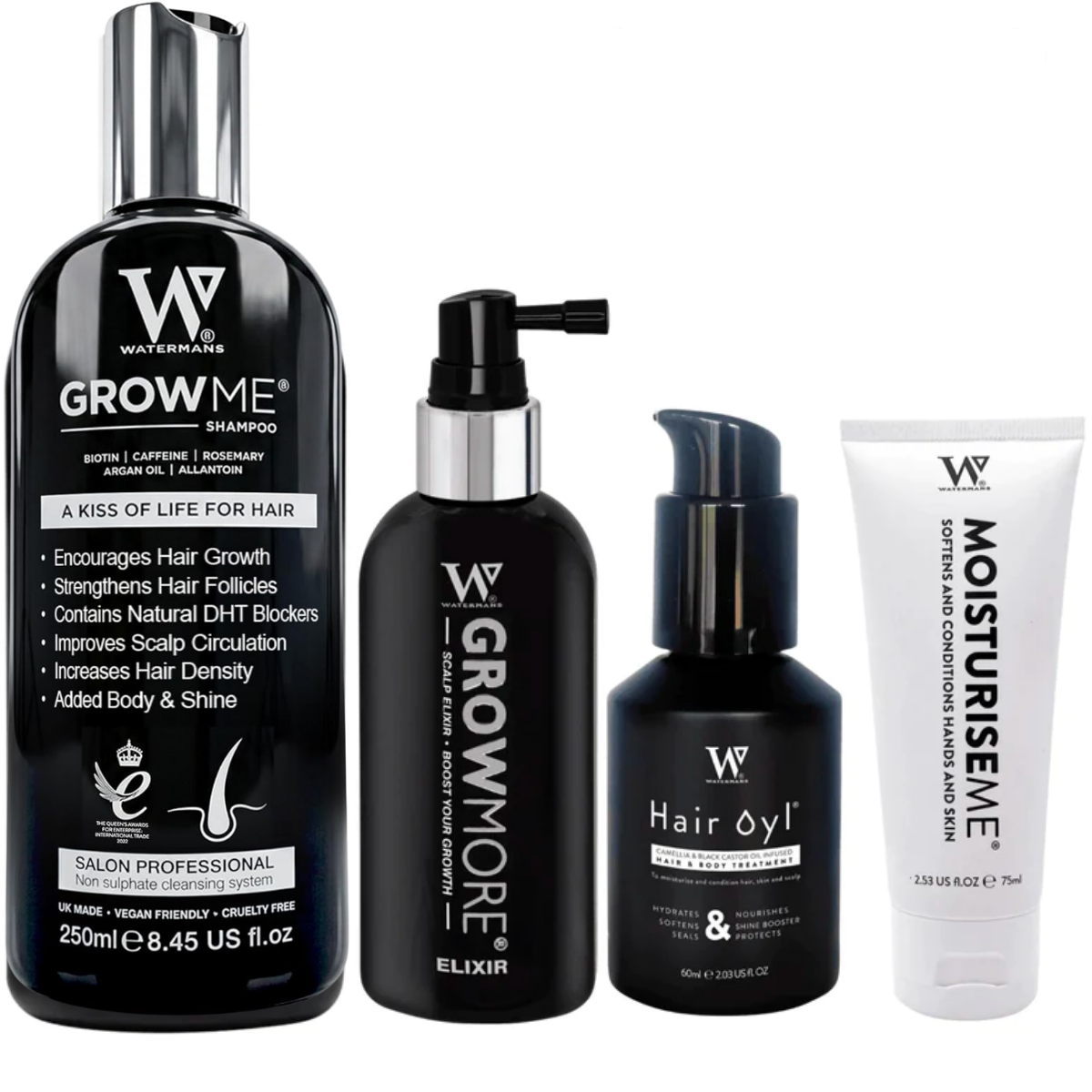
For dry, sun stressed lengths, our Camellia and Black Castor Hair and Body Oil is the other useful option as a pre swim or post beach conditioning layer. Again, cosmetic care for the hair, not sun protection for skin.

Choosing a sunscreen you will actually use
The best sunscreen is the one you will reapply without resenting it. Beyond SPF 30 and good UVA protection, match the format to your skin and your day.
| If you have | Look for | Watch out for |
|---|---|---|
| Oily or acne prone skin | Non comedogenic fluid or gel textures | Rich creams that sit on the surface |
| Sensitive or reactive skin | Fragrance free mineral filters | Alcohol heavy sprays and strong perfume |
| Deeper skin tones | Tinted or hybrid formulas that avoid a grey cast | High percentage zinc creams used alone |
| A thinning parting | A light fluid or spray you can part hair and apply | Thick creams that make roots look greasy |
| Children in tow | SPF 50, water resistant, easy to reapply | Relying on sunscreen instead of shade and clothing |
If pigmentation is your main concern rather than burning, a tinted formula has a genuine extra mechanism worth understanding, which we cover in does tinted sunscreen help hyperpigmentation. For where SPF fits in the wider routine, see building a simple skincare routine.
What about vitamin D?
This is a fair question and it deserves a straight answer rather than a dismissal. Sunscreen used in the real world, at real world quantities, has not been shown in trials to cause vitamin D deficiency. But the UK has a bigger and unrelated problem: from roughly October to March the sun sits too low for our skin to make meaningful vitamin D at all, whatever you do.
The NHS position is to consider a daily 10 microgram vitamin D supplement through the autumn and winter, and year round for people who cover up, have darker skin or are rarely outdoors. That is a far more reliable route than deliberately burning yourself in July.
When to see your GP
Sunscreen advice is prevention, not diagnosis. Book an appointment if you notice a mole or patch that is asymmetrical, has an irregular border, uneven colour, a diameter above about 6mm, or is evolving in size, shape, colour, itch or bleeding. The same applies to a scaly or crusted patch that will not heal, including on the scalp, ear or lip. Most turn out to be nothing, and the ones that are not are far easier to treat early.
Frequently asked questions
How much sunscreen should I use on my face?
About half a teaspoon, or two full finger lengths of product squeezed along your index and middle fingers. That covers the face, neck and ears. It is noticeably more than the pea sized amount most people use.
How much sunscreen do I need for my whole body?
Six to seven teaspoons, roughly 35ml or a shot glass. Half a teaspoon each for face and neck and for each arm, one teaspoon each for each leg, the front of the torso and the back of the torso.
Is SPF 50 twice as good as SPF 30?
No. SPF 30 filters about 97 per cent of UVB and SPF 50 about 98 per cent. The difference between them is far smaller than the difference between applying a generous layer and a thin one, so quantity matters more than the number on the bottle.
How often should I reapply sunscreen?
Every two hours in the sun, and immediately after swimming, heavy sweating or towel drying. Water resistant products are tested over 40 minutes in water and very water resistant over 80 minutes, so neither lasts a full day at the beach.
Do I need sunscreen on cloudy days in the UK?
A significant proportion of UV passes through light cloud, so yes on days when the UV index is 3 or above, which in Britain is broadly from late March through September. The Met Office publishes a daily UV index if you want to check.
Should I put sunscreen on my scalp?
Yes if you are not wearing a hat. Apply along the parting and any thinning areas using a spray or a light fluid formula, which is far less greasy in hair than a thick cream. A wide brimmed hat is the easier option and also shades the ears and the back of the neck.
Does sunscreen expire?
Yes. Check the open jar symbol, usually 12M, meaning 12 months after opening. Bottles left in a hot car or in direct sun degrade faster. Last year's half used bottle is a false economy.
Does sunscreen stop me making vitamin D?
Trials using sunscreen in normal real world quantities have not found it to cause vitamin D deficiency. In the UK the bigger issue is that the winter sun is too low to allow much vitamin D production at all, which is why the NHS suggests a 10 microgram daily supplement from October to March.
The bottom line
You almost certainly own a good enough sunscreen. What you probably need is more of it, more often, and on a few places you have never thought about. Use the teaspoon rule, check for the UVA circle or stars as well as the SPF, reapply every two hours and after every towel dry, and treat your parting and your ears as skin rather than as hair.
Caring for sun stressed hair afterwards? Watermans has made vegan, cruelty free haircare in the UK since 2012, with over five million bottles sold. Protect Me leave in spray and the Camellia and Black Castor Oil help keep the hair fibre in condition through summer. They are cosmetic hair products and are not sunscreens. For any changing mole, a burn that blisters, or a scalp patch that will not heal, please see your GP.