Scalp Serum on Wet Hair: Does It Work?
Should you put a scalp serum on wet hair? No. Use it on dry hair, or at most towel-dried and barely damp. A scalp serum on wet hair is diluted before it reaches the skin, and the mixture runs down your neck and forehead instead of staying where you aimed it. That one rule fixes most of what goes wrong with scalp products, whether it is a serum, an oil or a leave-in tonic.
Our overnight scalp elixir
Grow More® Overnight Scalp Elixir, £25.50. A leave in scalp serum worked into the roots at night, supporting a healthy scalp environment while you sleep.
Key takeaways
- Dry or barely damp scalp. Wet hair dilutes the product and carries it away from where you put it.
- The target is skin, not hair. If it is sitting on your strands it is doing nothing.
- Part the hair into rows. Tipping product onto the top of your head reaches almost none of the scalp.
- Less than you think. Most people use two to three times more than they need and end up with greasy roots.
- Consistency beats technique. Four days a week for three months beats a perfect application you abandon in a fortnight.
- Leave-on serum and pre-wash oil are opposite jobs. Do not use one as if it were the other.
Why does a scalp serum on wet hair not work?
Three separate things go wrong at once when you use a scalp serum on wet hair, which is why this is the single most common mistake.
It gets diluted. A scalp serum is formulated at a particular strength. Adding water thins it, and a thinned product spread over the same area gives every part of that area less than it was meant to get.
It migrates. This is the one people underestimate. Water on hair behaves like a wick. A serum applied to a wet head does not stay on the patch you targeted, it travels along the strands, follows gravity, and ends up on your forehead, behind your ears and down the back of your neck. You paid for scalp coverage and got face coverage.
It cannot sit. Anything designed to stay on the skin needs time in contact with the skin. A wet surface is already occupied. The product sits on a film of water rather than the scalp itself, and much of it goes down the sink with the next towel pass.
Towel-dried and barely damp is genuinely fine, and for some products slightly damp skin is even a little more receptive. The line to avoid is dripping. If you can squeeze water out of your hair, wait.
How do you actually apply a scalp serum?
The method matters more than the product, and it takes about ninety seconds once you have done it a few times.
- Start dry, or towel-dried and barely damp. If you have just washed, give it fifteen to thirty minutes, longer for thick or curly hair.
- Make a parting down the middle with a comb or your fingers, exposing a clear line of scalp.
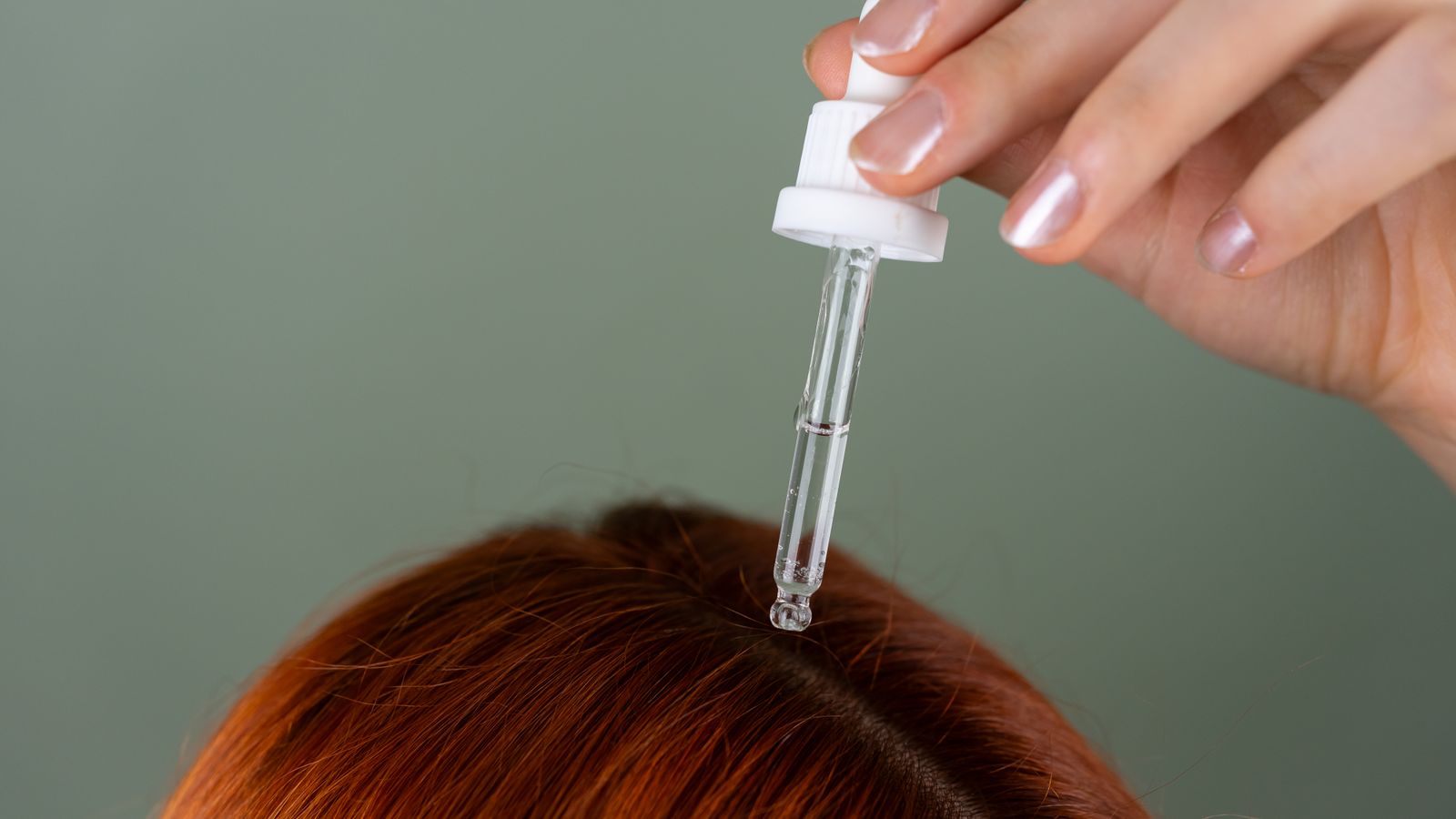
- Apply along the line, a few drops at a time, aiming at the skin. With a dropper, hold it close and release slowly. With a spray, get the nozzle right down at the parting rather than misting the whole head from a distance.
- Move the parting about two centimetres and repeat, working across the area you care about. Four to six partings covers a crown or a widening middle parting properly.
- Massage it in with fingertips, not nails, for thirty to sixty seconds. This spreads it across the gaps between your partings and is the difference between coverage and stripes.
- Wash your hands.
- Let it dry before pillows, hats or styling products. Twenty minutes is usually plenty for a light serum.

How much should you use?
Less than you are currently using. The instinct is that more product equals more benefit, and with anything leave-on the opposite is true, because excess has nowhere to go and simply sits on the hair looking greasy. That is the main reason people abandon scalp serums: not that nothing happened, but that their roots looked oily and they gave up in week two.
| Product type | Roughly how much | When | Wash out? |
|---|---|---|---|
| Leave-on scalp serum | Around 1ml, six to ten drops | Evening, on dry scalp | No |
| Pre-wash scalp oil | A teaspoon or so | 20 to 60 min before washing | Yes, always |
| Leave-in spray for lengths | Two to four spritzes | Damp hair, before styling | No |
| Deep conditioning mask | A generous palmful | Mid-lengths and ends only | Yes |
The row people get wrong most often is the second one. A pre-wash oil is not a leave-on product. Left on the scalp for days it traps sebum and dead skin, and on a scalp already prone to flaking it makes things noticeably worse rather than better, because the yeast that drives that kind of flaking is quite happy to feed on the oil you just added.
Get a discount on the scalp care range
Join the Watermans mailing list and we will email a discount code straight to your inbox, so you can try the scalp care range for less. Vegan, made in the UK, over 6.5 million bottles sold since 2012.
When should you apply it, and how often?
Evening suits most people, for a practical reason rather than a biological one: you are not about to style your hair, so nothing is going to be dragged through it, and it has hours of undisturbed contact time. If you apply in the morning, allow it to dry fully before a hat, a helmet or a hot tool.
On frequency, honesty matters more than optimism. Daily is fine for a well-formulated light serum. But four consistent days a week sustained for three months will do considerably more for you than seven days a week for eleven days followed by nothing. Pick the frequency you will genuinely keep to on a bad week, not the one you would manage on a good one.
Which mistakes actually cost you the bottle?
- Applying to soaking hair. Covered above, and easily the most common.
- Aiming at the hair rather than the skin. Tipping serum into your palm and smoothing it over the top of your head puts almost all of it on strands. Part and target.
- Using far too much. Greasy roots are the number one reason people quit, and greasy roots are almost always a dosing problem, not a formula problem.
- Doubling up after a missed day. There is nothing to catch up on. Just carry on as normal.
- Piling it under a hat or a helmet while still wet. That is how you get transfer and an uncomfortable scalp.
- Leaving a pre-wash oil on for days. A different product doing a different job, and the mismatch makes flaking worse.
- Changing four things at once. New serum, new shampoo, new supplement and a new brush in the same week means you will never know which one earned its place.
- Judging it at three weeks. Too early to mean anything either way.
If your scalp is itchy, flaking or sore rather than simply dry, applying more product is not the answer and can make it worse. Our guide to keeping your scalp healthy covers what to do first, and if the scalp is broken or bleeding, leave products off it altogether and speak to your GP or a pharmacist.
What order does everything go in?
If you use several things, the order is not arbitrary. The general principle is thinnest to thickest, and scalp before lengths.
- Pre-wash oil, if you use one, twenty to sixty minutes before you get in the shower.
- Shampoo, concentrating on the scalp rather than the lengths, which get cleaned by the runoff.
- Conditioner or mask, mid-lengths and ends only, kept off the scalp.
- Towel dry and wait until barely damp.
- Leave-in spray or heat protectant through the lengths.
- Scalp serum on the partings, last, so nothing gets applied over the top of it.
If you also use something microneedling-based, sequence and timing matter more, and we cover that separately in our guide to using a derma stamp safely.

What can a cosmetic scalp product honestly do?
It is worth being plain about this, because the category is full of overclaiming. A cosmetic serum works on the scalp surface and the hair you can see. It can support a comfortable, well-conditioned scalp, and it can leave hair looking fuller and feeling stronger. It is not a medicine and it does not change what is happening inside a follicle. If your hair loss has a medical cause, a bottle is not the answer to it, and the honest advice is to see your GP alongside whatever routine you keep. If your question is about products or a routine rather than a medical one, you can talk to Gail Waterman, our co-founder, as an AI avatar on the Watermans homepage.

Grow More® Elixir
The leave-on serum this page is written around. A dropper bottle, which is exactly what you want for parting work, with caffeine, rosemary, niacinamide and biotin. Six to ten drops across four to six partings on a dry scalp in the evening. Light enough not to leave roots looking greasy, which is the failure mode that ends most serum routines.
Shop Grow More Elixir
Grow Me® Shampoo
The wash that comes before the serum. Sulphate-free, so it cleans the scalp without stripping it, which matters when you are then leaving something on that skin overnight. Concentrate it on the scalp and let the runoff handle the lengths.
Shop Grow Me Shampoo
Protect Me® Leave-In Spray
Step five in the order above. Goes through the lengths on damp hair, before the scalp serum, and protects to 230°C if you are using hot tools afterwards. Keep it off the scalp, it is a product for the hair rather than the skin.
Shop Protect MeWatermans is a UK family business and has sold over 6.5 million bottles since 2012. Every product is cruelty free and made in the UK.
Frequently asked questions
Should I use a scalp serum on wet hair or dry hair?
Dry, or towel-dried and barely damp. A scalp serum on wet hair is diluted on contact and wicked away from the scalp onto your face and neck. If you can squeeze water out, wait fifteen to thirty minutes first.
How long should I leave a scalp serum on?
A leave-on serum stays on until your next wash, which is the point of it. A pre-wash oil is the opposite and should be rinsed out the same day, ideally within an hour.
Can I use a scalp serum every day?
Most light leave-on serums are formulated for daily use. Whether you should is a different question, and the honest answer is to pick the frequency you will still be keeping to in month three rather than the most ambitious one.
How much serum should I use?
Around six to ten drops across four to six partings for a crown or middle parting area. If your roots look oily the following morning, you used too much, not the wrong product.
Should I wash my hair after applying a scalp serum?
No. A leave-on product needs contact time, so applying it and then washing a couple of hours later defeats the purpose. Apply it after washing, not before.
Can I apply serum and then use a hairdryer?
Let it dry naturally if you can. If you are drying anyway, keep the heat low and the nozzle away from the scalp, and never take a straightener near a wet product.
Does scalp massage make a serum work better?
Massage genuinely helps with even distribution, which is worth doing for that reason alone. Use fingertips rather than nails, and thirty to sixty seconds is plenty. Vigorous scrubbing adds tangling and breakage without adding benefit.
Why does my scalp feel greasy the next morning?
Almost always too much product, or product applied to hair instead of skin so it has nowhere to absorb. Halve the amount, part more carefully, and see if it resolves before changing product.
Can I use a scalp serum on colour treated hair?
Yes. A leave-on scalp serum sits on the skin rather than the lengths, so it has little contact with your colour. If you have just had colour done and your scalp feels sensitive, give it a couple of days before you restart.
Sources & references
- Robbins CR (2012). Chemical and Physical Behavior of Human Hair, 5th edition, Springer. The reference text for how the hair fibre swells with water and how that changes what sits on the surface.
- Lee Y and colleagues (2011). Hair shaft damage from heat and drying time of hair dryer. Annals of Dermatology, 23(4), on why drying technique matters after any leave on product. PubMed record: pubmed.ncbi.nlm.nih.gov/22148012
- NHS. Hair loss: causes and when to get advice. nhs.uk/conditions/hair-loss
- NHS. How to get medicines advice from a pharmacist. nhs.uk/nhs-services/pharmacies
What is the bottom line on scalp serum on wet hair?
Dry scalp, skin not hair, part in rows, less product than feels right, massage it in, wash your hands, let it dry. Keep to a frequency you can sustain, photograph it monthly, and give it three months before you decide anything. Most scalp routines fail on dosing and consistency rather than on the bottle, and both of those are free to fix. If you remember one thing from this page, let it be that a scalp serum on wet hair mostly ends up on your face.
If you want a routine that is easy to keep to, start with the Grow More Elixir in the evenings, and read our guide to building a routine for fuller looking hair for the rest of the week.