Heat Damage to Hair: How to Spot It and Prevent It
Looking for information about a prescription medicine? We cannot help with medicines. Here is what we can help with.
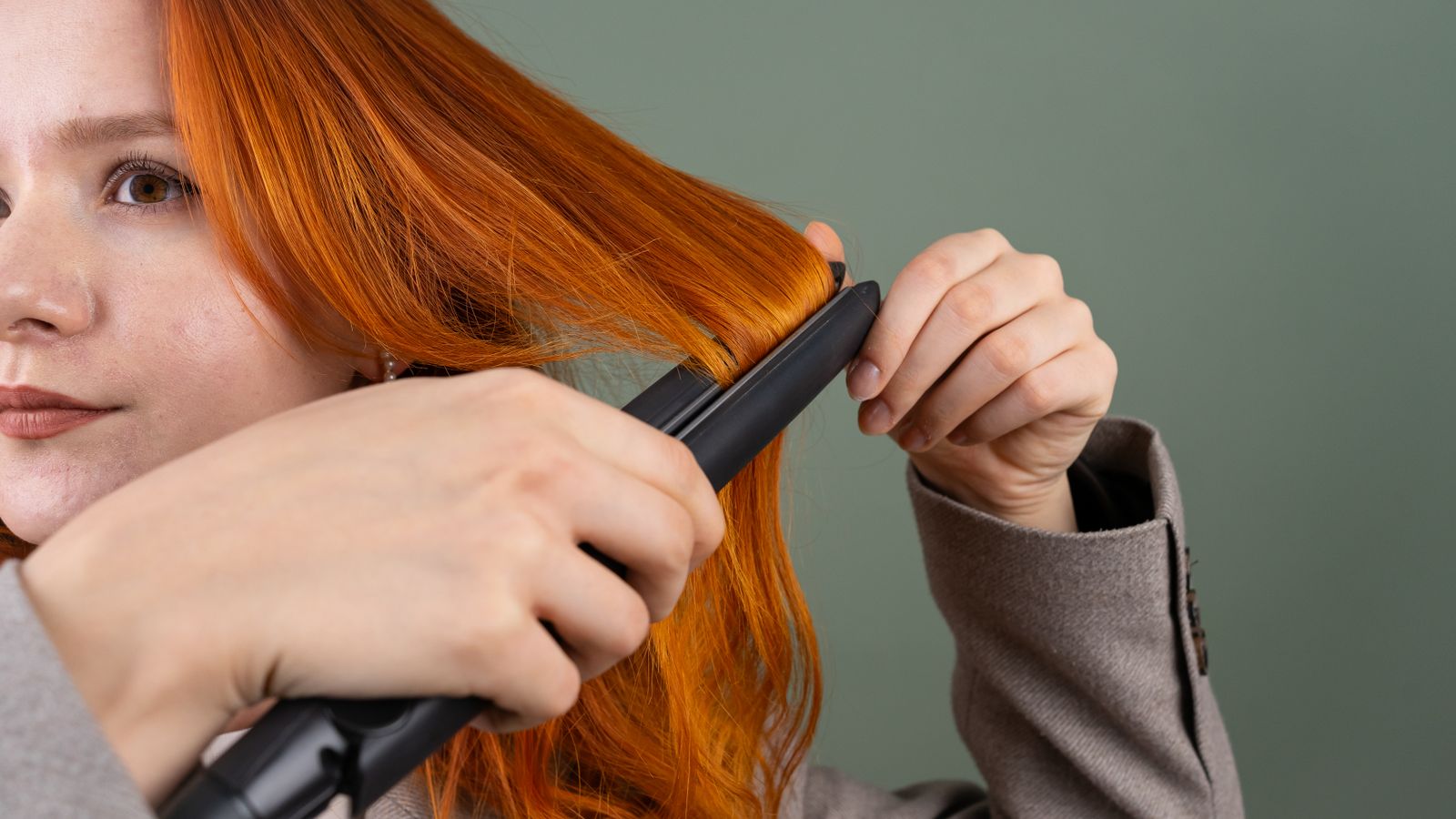
Heat damage is physical, permanent change to the hair fibre caused by styling tools running hotter than the fibre can tolerate. Above roughly 150C the keratin inside a strand begins to change shape, the cuticle scales crack, and the water held inside is driven out faster than it can be replaced. The result is hair that feels rough, looks dull, will not hold a curl and snaps partway along its length. Heat damage cannot be undone by any product, which is why prevention is the whole game.
Our heat protection spray
Protect Me® Heat Protection Spray, £13.95. A leave in spray that shields hair from heat styling, helps control frizz and keeps colour looking fresher for longer.
Key takeaways
- Damage starts well below the maximum setting on most straighteners. 185C is plenty for most hair.
- The two variables that matter most are temperature and how many passes you make, not the brand of tool.
- Straightening hair while it is still damp is the single most damaging thing you can do to it.
- No product rebuilds a broken fibre. Conditioners and masks make damaged hair behave better, which is worth having, but the fix is scissors.
- One study found a dryer held at 15cm and kept moving did less surface damage than letting hair dry naturally, so air drying is not automatically the safe option.
What does heat damage actually do to a strand?
Heat works on three parts of the fibre at once. The cuticle, the overlapping outer scales, lifts and then cracks, which is what makes damaged hair feel rough when you run a finger from tip to root. The cortex underneath holds the keratin that gives hair its strength and its shape, and heat above the fibre's tolerance rearranges that protein permanently. The cell membrane complex, the glue between the internal cells, degrades, and once it goes the fibre splits lengthways.
Water is the hidden factor. Hair normally holds around ten percent of its weight in water. Apply a hot plate to a damp strand and that water turns to steam inside the fibre, forcing its way out through the cuticle. At extreme temperatures this leaves visible cavities along the shaft. This is why straightening damp hair is so much worse than straightening dry hair, and why the "gets it done faster" logic backfires.
Confocal Raman work on human hair keratin has mapped how the protein structure reorganises as the fibre takes on and loses water, which is the mechanism sitting underneath everything in this article.

How do you tell heat damage from other problems?
Damage from hot tools has a recognisable signature. The ends and mid lengths are affected while the roots look normal, because the roots are newest and have been through fewer styling sessions. The hair feels rough in one direction and smooth in the other. Curls loosen or drop out entirely in patches, which is often the first thing curly haired people notice. Strands snap when stretched gently instead of springing back.
Three different problems get confused with each other constantly, and the difference decides what you should do next.
| What it is | Where it happens | What you see |
|---|---|---|
| Hair loss | At the follicle | A widening parting, more visible scalp, a thinner ponytail. Nothing to do with styling. |
| Hair shedding | At the follicle | Whole hairs with a small white bulb at the root, roughly 50 to 100 a day is normal. |
| Hair breakage | Along the shaft | Short broken pieces with no bulb, frizzy halo, ends that will not grow past a certain length. |
Damage from styling belongs squarely in the third row. If you are collecting short broken pieces with no white bulb, your hair is not falling out, it is snapping, and the answer is in your styling routine rather than at your GP surgery. If you are seeing whole hairs with bulbs in unusual numbers, or more scalp than you used to, that is a different question and worth raising with your GP. Our guide to what causes hair breakage goes through the non heat causes too. If your question is about products or a routine rather than a medical one, you can talk to Gail Waterman, our co-founder, as an AI avatar on the Watermans homepage.
What temperature is actually safe?
Temperature tolerance depends on hair type, but the useful rule is to use the lowest setting that does the job in one or two passes. Most tools go far higher than any domestic head of hair needs, because a high maximum number sells tools.
| Hair type | Sensible ceiling | Notes |
|---|---|---|
| Fine, colour lightened or already damaged | Up to 150C | Bleached hair has lost cuticle already and tolerates far less. |
| Normal, healthy, medium thickness | 150C to 180C | One slow pass beats three fast ones at the same setting. |
| Coarse, thick or very curly | 180C to 200C | Section properly. Poor sectioning is why people reach for more heat. |
| Any hair, any type | Never on damp hair | Steam inside the fibre causes the worst structural damage of all. |
Counterintuitive finding worth knowing. A 2011 study in Annals of Dermatology compared natural drying with hair dryers used at different distances. Hair dried naturally kept its cell membrane complex swollen with water for longer, and came out with more surface damage than hair dried with a dryer held about 15cm away and kept in continuous motion. Air drying is gentler on the fibre only if you are not leaving hair sopping wet for hours.
Get a discount on your next order
Join the Watermans mailing list and we will email a discount code straight to your inbox. Made in the UK, over 6.5 million bottles sold since 2012.
How do you prevent heat damage without giving up styling?
Prevention is a sequence rather than a product. Six steps cover almost all of it.
- Dry to at least eighty percent before any hot tool touches your hair. Rough dry with a dryer on medium, or squeeze with a microfibre towel and wait.
- Apply a heat protection spray to damp hair, not dry hair, and comb it through so it is actually distributed rather than sitting in one patch.
- Section properly. Thin, tidy sections straighten in one pass. Grabbing a thick handful means three or four passes over the same fibre.
- Turn the dial down and check. Start twenty degrees lower than usual for a week. Most people find no difference in the result.
- Keep the dryer moving and at a distance, roughly a hand span from the head, with the nozzle pointing down the hair shaft rather than into it.
- Give it days off. Two heat free days a week roughly halves your annual exposure, and nothing else on this list comes close to that for effort spent.
Summer adds its own load on top of tools. Sun, salt and chlorinated water all strip lipids from the cuticle before a straightener ever gets involved, so hair that survives styling in February can suffer in August. Our guide to summer hair care covers that side.
Can heat damage be repaired?
It cannot be repaired in the literal sense. A hair fibre has no blood supply and no living cells above the follicle, so it cannot mend itself, and nothing you put on it rebuilds cracked cuticle or rearranged keratin. Anyone promising otherwise is selling you a cosmetic effect and calling it a repair.
What conditioners, masks and bond building products genuinely do is worth having anyway. They lay down a smoothing film, reduce friction between strands, add slip so combing does less further harm, and temporarily improve elasticity so the fibre survives the next brush. That buys you time. It does not put the fibre back.
The only thing that removes it is cutting it off, and the practical approach is a maintenance trim every eight to twelve weeks while you fix the routine that caused it. Damaged ends do not stay put. They keep splitting upwards.
Porosity is worth understanding here, because damaged hair is high porosity hair by definition and behaves differently with every product you own. Our explainer on hair porosity covers what to change. If the visible result is a frizzy halo rather than snapping, our guide to calming frizzy hair is the closer match.

Which Watermans products help here?
Three of ours are relevant, and the honest order of value is prevention first, management second. If you buy one thing, buy the protection spray, because it works on damage that has not happened yet.

Protect Me® Heat Protection Spray
A leave in spray for damp hair, rated to 230C. Comb it through before drying so it reaches the mid lengths and ends, which take the most heat.

A weekly deep conditioning step for hair that is already rough. Improves how damaged hair behaves and feels. It does not rebuild the fibre, and we would rather say so.

The every wash step. Adds slip so detangling causes less snapping, which is where a lot of avoidable breakage actually happens.
Watermans is cruelty free and made in the UK, with over 6.5 million bottles sold since 2012.
Frequently asked questions about heat damage
How long does it take to grow out damaged hair?
Scalp hair grows roughly one centimetre a month, so shoulder length hair takes about two to three years to replace fully. Most people cut the damage out in stages rather than waiting.
Does a heat protection spray completely stop damage?
No. A protection spray slows heat transfer and adds a lubricating film, which reduces damage substantially. It does not make 230C safe, and it is not a licence to turn the dial up.
Is a ceramic or titanium straightener less damaging?
Plate material affects how evenly heat is delivered, which matters, but temperature and number of passes matter far more. A cheap tool at 160C is kinder than an expensive one at 220C.
Why has my curl pattern disappeared in patches?
Loss of curl pattern in patches is a classic sign of heat damage, because the keratin that holds the curl has been rearranged. Those sections will not return to their old pattern and need cutting out.
Can I straighten my hair if I use protection every time?
Yes, with limits. Protection plus a moderate temperature plus heat free days is a routine most hair tolerates indefinitely. Daily straightening at maximum heat is not.
Do bond building products undo heat damage?
Bond builders can reform some chemical links inside the fibre and often improve strength measurably, which is genuinely useful. They do not restore a cracked cuticle or bring back a lost curl pattern.
Is air drying always safer than a hair dryer?
Not necessarily. Research comparing the two found that leaving hair wet for a long time caused more surface damage than a dryer used at about 15cm with continuous motion. Very wet hair is fragile hair.
What is the bottom line on heat damage?
Heat damage is one of the few hair problems that is almost entirely within your control. The fibre cannot repair itself, so every degree and every extra pass you avoid is permanent benefit. Dry to eighty percent first, protect while damp, section properly, drop the temperature twenty degrees and take two days off a week. Products help around the edges and we sell some good ones, but the dial on your straightener is doing more than any bottle.
If the styling tools are staying, the Protect Me heat protectant spray is the one thing you should not skip. Made in the UK, with over 6.5 million bottles sold since 2012.
Watermans products are 100% cosmetic and do not treat medical hair loss. Individual results may vary.
Sources and References
- Hair shaft damage from heat and drying time of hair dryer, Annals of Dermatology, 2011. pmc.ncbi.nlm.nih.gov/articles/PMC3229938
- Conformation changes in human hair keratin observed using confocal Raman spectroscopy, International Journal of Cosmetic Science, 2019. pmc.ncbi.nlm.nih.gov/articles/PMC6852583
- The shampoo pH can affect the hair: myth or reality?, International Journal of Trichology, 2014. pmc.ncbi.nlm.nih.gov/articles/PMC4158629
- Physiology, Hair, StatPearls, National Center for Biotechnology Information. ncbi.nlm.nih.gov/books/NBK499948
- American Academy of Dermatology, tips for healthy hair. aad.org