Grey Hair Care: Keep Silver Hair Soft, Bright and Strong
Looking for information about a prescription medicine? We cannot help with medicines. Here is what we can help with.
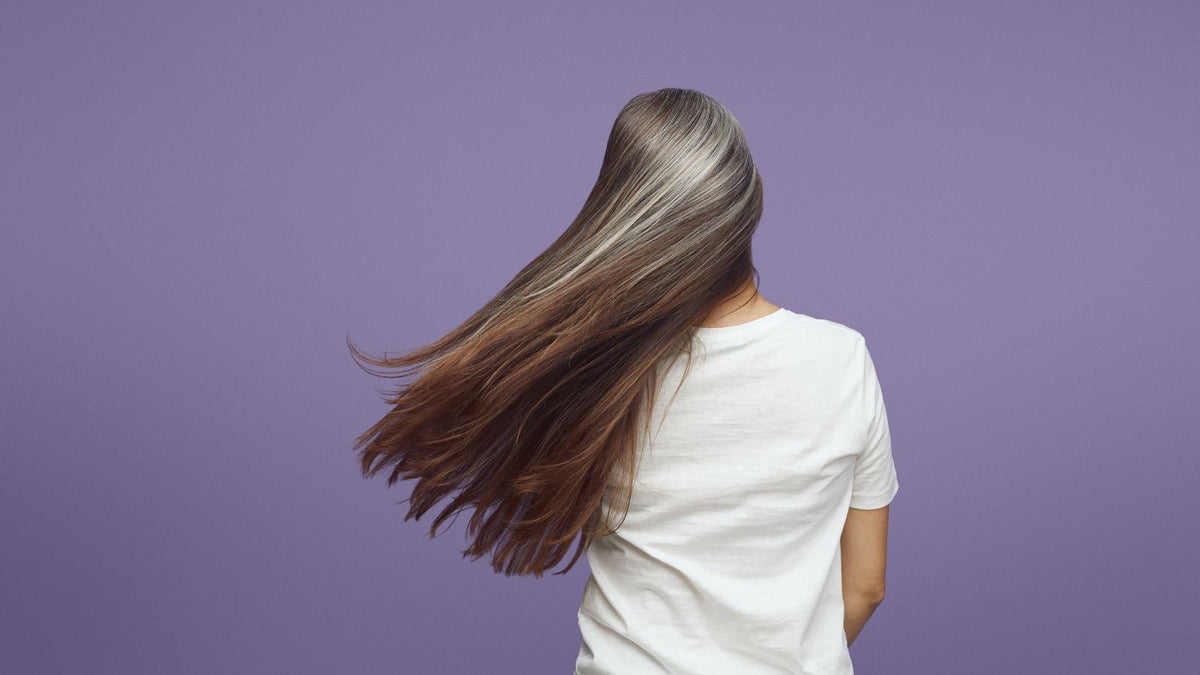
Grey hair care differs from ordinary hair care because a grey strand is not just an uncoloured version of the hair you used to have. It has lost the melanin that gave it colour and a degree of built in sun protection, it often grows with a different shape and a coarser feel, and it shows dryness and yellowing far more readily. Good grey hair care therefore concentrates on three things: moisture, protection from light and minerals, and gentle handling.
Our hair growth conditioner
Condition Me® Hair Growth Conditioner, £13.95. Detangles and strengthens the hair fibre so lengths snap less on the brush and look thicker through the ends.
Key takeaways
- Grey hair is not more fragile by nature, but it looks dry sooner because it has no pigment to hide it.
- Yellowing comes from outside the hair, mostly sunlight, minerals in tap water, smoke and product build-up.
- Purple toning products correct tone visually. Use them sparingly or silver hair turns lilac.
- Nothing applied to the outside of hair brings pigment back. Anyone claiming otherwise is guessing or selling.
- Coarseness is usually about shape and moisture, and conditioning changes how it behaves within a week or two.
What actually changes when hair turns grey?
Pigment cells at the base of the follicle, called melanocytes, gradually stop supplying melanin to the growing strand. The fibre keeps growing at much the same rate, but it emerges without colour. That single change has several knock on effects that matter for how you look after it.
Melanin absorbs ultraviolet light. Without it, the keratin in a white or grey strand is more exposed to sunlight, which is one reason grey hair can pick up a yellow cast over a summer. Research on oxidative stress in ageing hair describes how the follicle's own antioxidant defences decline with age, which is part of why pigment production stops and why the fibre that emerges behaves differently. If you are going grey early and wondering whether a specialist can help, our Huddersfield guide to premature grey hair sets out what is normal and which signs need a GP. For the hair side of the decision, see our guide to what hormone therapy can and cannot do for hair density.
Texture often changes at the same time, though not because grey hair is inherently wiry. The follicle can change shape slightly with age, producing a strand with a different cross section, and scalp oil production tends to fall, so less natural lipid travels down the shaft. Drier, coarser feeling hair is the result, and both parts of that are addressable.

Why does grey hair go yellow, and what fixes it?
Yellowing is almost always something deposited on the hair rather than something happening inside it. With no pigment to mask it, every deposit shows. The four usual culprits are ultraviolet light, minerals in hard tap water, airborne pollutants including cigarette smoke, and residue from styling products.
| Cause of yellowing | Tell tale sign | What to do |
|---|---|---|
| Sunlight | Worse on the top and the parting, worse after summer | A hat, or a UV protective leave in on bright days. |
| Hard water minerals | Dull, slightly rough, worse in limescale areas | Clarify every two to four weeks. Consider a shower filter. |
| Chlorine | Green or brassy tint after swimming | Wet hair with clean water before you swim, rinse straight after. |
| Product build-up | Flat, coated feel, worse with heavy styling products | Clarify, then use lighter products from the ears down. |
| Smoke and pollution | General dinginess with no obvious pattern | Wash a little more often and clarify monthly. |
Purple or blue toning shampoos work by depositing a small amount of colour that sits opposite yellow on the colour wheel, cancelling it visually. They are genuinely effective and genuinely easy to overdo. Once a week is plenty for most people, and leaving one on for ten minutes because five did not seem like enough is how silver hair ends up lilac. Our guide to protecting hair from chlorine and hard tap water covers the mineral side in more detail.
What does a good grey hair care routine look like?
A grey hair care routine is a normal routine with the moisture and protection dialled up. Six habits cover almost all of it.
- Wash when your scalp needs it, not to a rule. Research on wash frequency found no single correct interval across different groups, so let your scalp decide.
- Condition every single wash, mid lengths to ends, left on for two full minutes. This is the highest value habit for coarse feeling hair.
- Add a weekly mask if the ends feel rough or straw like. Grey hair benefits from it more than pigmented hair because it starts drier.
- Tone sparingly. One purple wash a week, timed with a clock rather than by eye.
- Protect from sun with a hat or a leave in on bright days. Ultraviolet light is the main driver of that summer yellow cast.
- Cut the heat. Grey hair shows heat damage sooner because there is no pigment to disguise a rough surface.
If you are still part way through the transition and blending new root growth with existing colour, that is a different job with different rules. Our guide to transitioning to grey hair with highlights covers the growing out phase. This page is about looking after grey hair once it is yours.
Get a discount on your next order
Join the Watermans mailing list and we will email a discount code straight to your inbox. Made in the UK, over 6.5 million bottles sold since 2012.
Is grey hair actually coarser, or does it just feel that way?
Coarseness in grey hair is partly real and partly a matter of contrast. Some greys do emerge with a slightly different cross section and a more irregular surface, which genuinely feels rougher between the fingers. Alongside that, scalp oil production falls with age, so there is less natural lubricant coating the strand, and dryness reads as coarseness.
The practical consequence is that grey hair responds unusually well to conditioning. People who were used to skipping conditioner on fine pigmented hair often find that a grey head needs it every wash and tolerates a weekly mask without going limp. Two weeks of consistent conditioning is usually enough to tell whether the coarseness was really dryness.
What conditioning cannot do is change the fibre that is growing. Grey hair care manages the surface. It does not alter the follicle, and it will not bring colour back.
Why are grey hair and thinning two separate things?
Greying and thinning often start around the same stage of life, which leads people to lump them together as one problem. They are not related, and confusing them wastes time. Three distinct things are worth separating.
- Hair loss happens at the follicle. Hair is not replaced at the rate it leaves, so the parting widens and the ponytail thins. Greying has no bearing on it.
- Hair shedding is the normal cycle releasing old hairs, roughly 50 to 100 a day, and it rises temporarily after illness, stress or a big change.
- Hair breakage is the fibre snapping along its length, leaving short pieces with no root bulb. Dry, coarse, heat styled grey hair is prone to it, and this is the one grey hair care genuinely addresses.
If your parting is widening, if you can see more scalp than a year ago, or if shedding has stayed heavy for more than three months, that is worth raising with your GP rather than solving with shampoo. The NHS has a straightforward overview of the common causes. We sell hair care, we do not run clinics, and there is no cosmetic answer to a medical question. If your question is about products or a routine rather than a medical one, you can talk to Gail Waterman, our co-founder, as an AI avatar on the Watermans homepage.
Do supplements or diet slow down greying?
Supplements do not stop or slow greying in the general population, and we would rather say so than sell you a jar. When pigment production winds down, it is overwhelmingly a matter of genetics and age. Studies of ageing hair point to a decline in the follicle's own antioxidant defences over time, and no oral product has been shown to hold that off in otherwise healthy people.
There are narrow exceptions worth knowing about. Marked deficiency in vitamin B12, or an untreated thyroid problem, has been associated with early pigment loss in some people, and both are checked with a simple blood test. If you went grey noticeably early, in your twenties or early thirties, that is a reasonable thing to mention to your GP, not because grey hair is a problem in itself but because the underlying cause might be worth knowing.
For everyone else, the money is better spent on the conditioning and protection side of grey hair care, where the effect is visible in a fortnight rather than hypothetical.

Which Watermans products suit grey hair care?
Three of ours fit here, and none of them is a toning product, so you will still want a purple shampoo from somewhere for the tone side. What these do is the moisture and slip half of the job.

The every wash step. Adds slip so combing coarse hair does less damage, and softens the dry feel that greys pick up first.

The weekly step for ends that feel rough or straw like. Use it on the lengths only and rinse thoroughly, since residue shows more on light hair.

Camellia & Black Castor Hair & Body Oil
One drop on the ends as a finish, or a pre wash oiling for very dry lengths. Go lightly. Oil weighs down fine grey hair quickly.
Watermans is cruelty free and made in the UK, with over 6.5 million bottles sold since 2012.
Frequently asked questions about grey hair care
Does plucking a grey hair make more grow back?
No. Each follicle produces one hair, and pulling one out does not affect its neighbours. Repeated plucking can damage the follicle over time, which is a reason to leave them alone.
Can any product bring my colour back?
No cosmetic product brings pigment back to a grey strand. Pigment is made inside the follicle, and nothing applied to the outside of the hair reaches it. Only dye changes the colour you see.
How often should I use a purple shampoo?
Once a week suits most people, alternating with a normal shampoo. If your hair is picking up lilac tones, cut back to once a fortnight and reduce the time you leave it on.
Why is my grey hair frizzier than it used to be?
Lower scalp oil production and a slightly changed fibre shape both raise the cuticle, and a raised cuticle is what frizz is. Conditioning every wash and rinsing cool make the biggest difference.
Does stress turn hair grey?
Greying is mostly determined by genetics and age. There is research linking stress to pigment loss, but it sits alongside a much larger genetic effect, so stress is a contributor rather than the cause.
Is grey hair weaker than pigmented hair?
Not inherently. Grey hair tends to be drier, and dry hair breaks more easily, but that is a moisture problem rather than a weakness built into the fibre.
Should I still use heat protection on grey hair?
Yes, and arguably more carefully. Without pigment, a roughened surface scatters light and shows as dullness sooner, so heat damage is more visible on grey hair than on dark hair.
What is the bottom line on grey hair care?
Grey hair care comes down to moisture, protection and restraint. Condition every wash, mask weekly if the ends feel rough, tone once a week with a clock in hand, clarify monthly if your water is hard, and keep the sun and the straighteners off it where you can. Do those five things and grey hair looks bright and feels soft. No product will bring the pigment back, and any that claims to is not worth your money.
The conditioner is doing the protective work here, and the Condition Me hair growth conditioner is ours.
Watermans products are 100% cosmetic and do not treat medical hair loss. Individual results may vary.
Sources and References
- Oxidative stress in ageing of hair, International Journal of Trichology, 2009. pmc.ncbi.nlm.nih.gov/articles/PMC2929555
- The impact of shampoo wash frequency on scalp and hair conditions, Skin Appendage Disorders, 2021. pmc.ncbi.nlm.nih.gov/articles/PMC8138261
- Physiology, Hair, StatPearls, National Center for Biotechnology Information. ncbi.nlm.nih.gov/books/NBK499948
- NHS, hair loss overview. nhs.uk/conditions/hair-loss
- American Academy of Dermatology, tips for healthy hair. aad.org