Hormone Therapy Hair Loss: What Happens and When
Hormone therapy hair loss follows a timeline rather than appearing overnight. A hormone change nudges follicles out of their growing phase within days, but the shed hairs only become visible two to four months later, once new growth pushes the resting hairs out. In most people the fall peaks, then tapers back towards normal over six to nine months, which is why the calendar matters more than the brush.
Our hair growth shampoo
Grow Me® Hair Growth Shampoo, £14.95. A sulphate free daily shampoo that supports a healthy scalp environment and helps reduce breakage, so lengths hold on and look fuller.
Key takeaways
- In a healthy scalp about 85% of follicles are growing and 15% are resting, according to DermNet.
- After a trigger, increased hair fall is noticed two to four months later, not immediately.
- Shedding that follows a cycle shift usually tapers back to normal over six to nine months.
- The NHS puts ordinary daily loss at 50 to 100 hairs, so a count alone proves very little.
- Iron, thyroid function, vitamin B12 and folate are worth checking with a GP, and those tests are free.
What does hormone therapy hair loss actually look like?
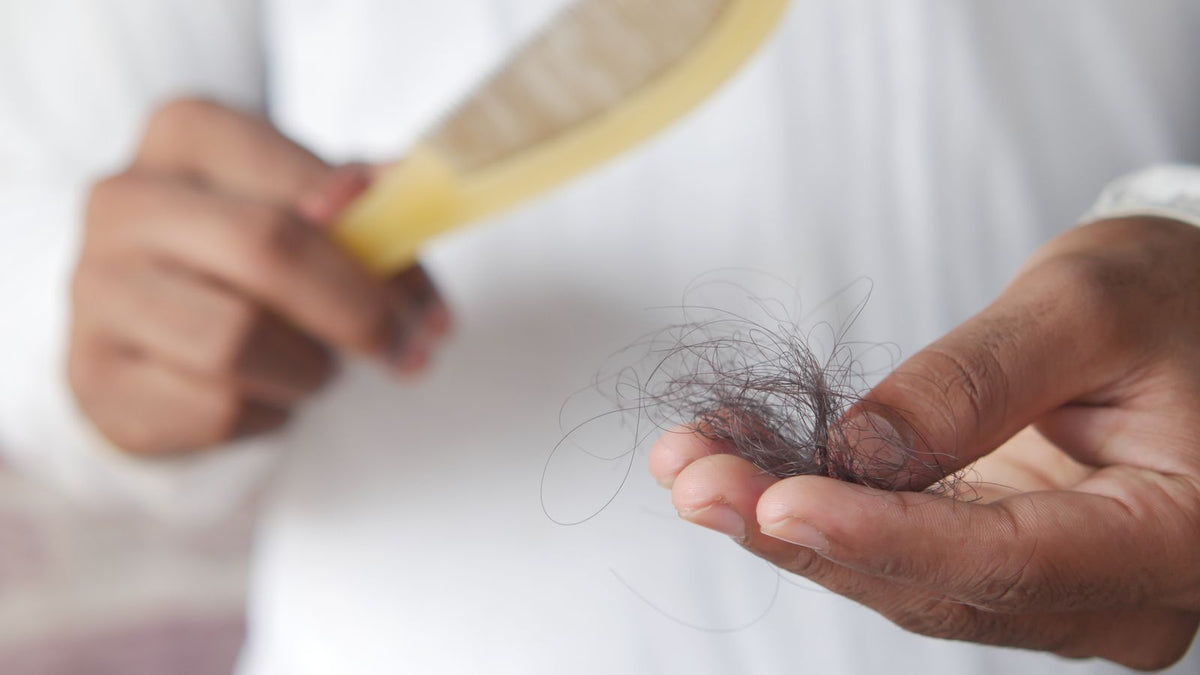
Hormone-related shedding is usually diffuse rather than patchy. Hair comes away evenly from all over the scalp, the ponytail feels thinner at the band, and the parting looks wider in bright light, but no bald patch appears. Each shed hair is full length with a small pale bulb at the root, which marks a hair that finished its resting phase.
That pattern is different from the slow, localised change of inherited pattern loss, where the parting and temples thin over years and the individual hairs become finer. It is also different from breakage, where the hairs snap mid-length and leave short, blunt-ended pieces. Our explainer on the three mechanisms behind thinning hair separates all three in detail.

When does shedding start after a hormone change?
Shedding starts becoming visible two to four months after the hormone change, not in the first fortnight. DermNet describes the sequence plainly: new hairs coming up through the scalp push out the resting club hairs, and increased hair fall is noticed two to four months after the triggering event. The lag is the single most confusing thing about it.
| Time after the hormone change | What is happening in the follicle | What you notice |
|---|---|---|
| Week 0 to 2 | A proportion of growing follicles shift into their resting phase | Nothing at all |
| Month 1 to 2 | Resting hairs sit in place; no new growth has pushed them out yet | Usually nothing; some people report scalp tenderness |
| Month 2 to 4 | New anagen hairs push the resting hairs out | The shed starts, often suddenly and heavily |
| Month 4 to 6 | The fall peaks and begins to lessen | Ponytail thinner, parting wider, fine new hairs at the hairline |
| Month 6 to 9 | Cycling returns towards its usual 85:15 balance | Shedding tapers back to normal for most people |
Because of that lag, people often blame the wrong month. If you are trying to work out whether hormone therapy hair loss explains your shedding, count backwards three months from the day it started, not from the day you noticed. DermNet offers a useful trick for dating a trigger: a fingernail takes about five months to grow from the nail fold to the free edge, so a ridge in the nail roughly dates the same event.
Which kinds of hormone therapy affect hair, and how?
Any therapy that changes the balance of oestrogen and androgens can change the hair cycle, because those hormones influence how long follicles stay in their growing phase. Oestrogen-based therapy tends to lengthen it, androgen-based therapy tends to shorten it at the scalp, and both a start and a stop count as a change the follicle has to absorb.

The practical point is that starting, stopping, switching form or changing strength are all the same kind of event to a follicle. That is why people sometimes shed after beginning therapy and again after coming off it. Our guides to what hormone therapy can and cannot do for hair growth and shedding after stopping HRT cover both ends of that.
Thyroid hormone is worth ruling out separately
Thyroid problems cause diffuse shedding that looks identical to a hormone-therapy shed, and an underactive thyroid is common and easily checked. DermNet advises correcting any abnormality in thyroid function, iron, vitamin B12 and folate before assuming the cause is settled.
Is it shedding, thinning or breakage?
Shedding, thinning and breakage are three different problems that often run at once. Shedding means more hairs than usual leaving the follicle at the end of their cycle. Thinning means the replacement hairs come through finer and shorter than the ones they followed. Breakage means the fibre snaps somewhere along its length and never reaches full length at all.
| Hair shedding | Hair loss or thinning | Hair breakage | |
|---|---|---|---|
| What the shed hair looks like | Full length, pale bulb at the root | Shorter and finer each cycle, bulb present | Blunt or frayed end, no bulb |
| Speed | Sudden, weeks | Slow, years | Builds with heat, colour and tension |
| Usual trigger | A cycle shift such as a hormone change, illness, birth or crash dieting | Genetics plus hormones over time | Chemical and mechanical damage |
| What helps | Time, plus fixing any iron or thyroid problem | A GP conversation, then a long-term plan | Less heat, less tension, better conditioning |
Get a discount on the hormonal hair thinning range
Join the Watermans mailing list and we will email a discount code straight to your inbox, so you can try the hormonal hair thinning range for less. Vegan, made in the UK, over 6.5 million bottles sold since 2012.
What else could explain the shedding at the same time?
Several ordinary triggers cause exactly the same diffuse shed as hormone therapy hair loss, and they often coincide with a hormone change rather than being caused by it. The NHS lists illness, stress, cancer treatment, weight loss and iron deficiency among the temporary causes of hair loss, and any of those can land in the same three-month window as a dose change.
That overlap is why the free blood tests matter. A GP can check ferritin, full blood count, thyroid function, vitamin B12 and folate, and a low result gives you something you can actually act on. Our articles on what causes telogen effluvium and thyroid-related hair loss explain what each result means in practice.
What should you ask the clinician who manages your hormone therapy?
Take four specific questions about hormone therapy hair loss to whoever looks after your hormone therapy, rather than a general worry about hair. Ask whether hair change is a recognised effect of this particular therapy, whether the timing fits, whether a different form or strength is reasonable to consider, and whether blood tests are worth repeating now.
Bring evidence, not impressions. A dated photograph of the parting taken monthly in the same daylight, a note of when the therapy changed, and the shed hairs from one wash a week make the conversation far more useful. Never stop or change hormone medicine on your own because of hair; the hair cycle almost always settles, and stopping abruptly creates a second shed three months later.

What can you do while the hair cycle settles?
The useful jobs during a shed are protective rather than corrective. Nothing speeds a hair cycle up, so the aim is to lose as few of the hairs you still have as possible, keep the scalp comfortable, and make sure nutrition is not adding a second problem on top of the first.
- Wash as often as suits your scalp. Washing does not cause shedding; it collects hairs that had already let go.
- Detangle damp, not soaking, from the ends upwards with a wide-tooth comb.
- Drop the heat setting and use a protectant every time you use an iron or a dryer.
- Avoid tight ponytails, buns and clips that sit in the same spot every day.
- Eat enough protein and iron-containing food, and get any low result checked rather than self-supplementing blindly.

Grow Me® Hair Growth Shampoo £14.95
A sulfate-free daily shampoo with biotin, caffeine, rosemary and niacinamide, made to cleanse gently and reduce breakage so the hair you keep looks fuller.

Grow More® Leave-In Scalp Elixir £25.50
A leave-on overnight scalp elixir for lower-density areas around the parting and temples, designed to support a healthy scalp environment as the cycle settles.
How do you track a shed so the evidence is usable?
Three records turn a worrying few months into something a GP can read in thirty seconds: a dated parting photograph, a weekly shed collection and a one-line note of every change to the therapy. None of it takes more than a minute a week, and together they show whether the fall is rising, peaking or tapering.
- Parting photograph. Same spot, same daylight, same parting line, once a week. Bathroom light at night is useless for comparison.
- Weekly shed count. Keep the hairs from one wash in an envelope and write the date on it. Comparing four envelopes is far more informative than counting once.
- Therapy diary. One line for every start, stop, strength change or change of form, with the date.
- Blood results. Ask for the actual numbers, not just "normal". Ferritin in particular is often reported as normal at a level many dermatology sources consider low for hair.
Four weeks of that record answers the question most people cannot answer in the consulting room: is this getting worse, or has it already peaked? A shed that has peaked needs patience and protection. A shed still climbing after six months needs a fresh look at causes.
When should you get medical advice quickly?
Some signs should not wait for the nine-month timeline. Book a GP appointment promptly if the scalp is sore, scaly, inflamed or losing hair in discrete round patches, if eyebrows or eyelashes are thinning too, or if the shedding is accompanied by fatigue, weight change, palpitations or changes to your periods.
The NHS is direct about the order of things: see a GP to get an idea about what is causing your hair loss before thinking about going to a commercial hair clinic. That advice is worth following even when a hormone change is the obvious suspect, because the free tests either confirm it or find something more actionable. If your question is about products or a routine rather than a medical one, you can talk to Gail Waterman, our co-founder, as an AI avatar on the Watermans homepage.
Frequently asked questions
How long does hormone therapy hair loss last?
In most people the shed peaks around four to six months after the trigger and tapers back towards normal over six to nine months, which is the usual course DermNet describes for a cycle-driven shed. Shedding that is still heavy after twelve months deserves a fresh GP conversation.
Will the hair come back after hormone therapy hair loss?
Hair lost through a cycle shift is not lost from the follicle, so the follicle keeps producing. What returns may look finer for a while because the new hairs are short and growing, and density usually looks normal again once those hairs reach a few inches.
Should I stop my hormone therapy because of my hair?
No, not on your own. Speak to the clinician who manages the therapy first, because stopping abruptly is itself a hormone change and tends to produce a second shed about three months later.
How many hairs a day is too many?
The NHS puts normal daily loss at 50 to 100 hairs. A jump well beyond your own usual level that lasts more than six weeks is more informative than any single number, because normal varies with hair length, wash frequency and styling.
Can a blood test show whether hormones are the cause?
There is no single blood test that confirms it. What blood tests do is rule out iron deficiency, thyroid problems, low vitamin B12 and low folate, which cause identical diffuse shedding and are far easier to correct.
Does hormone therapy cause pattern hair loss?
Androgen-based therapy can bring forward inherited pattern change at the temples and crown in people who were going to develop it anyway. That is a different, slower process from a diffuse shed, and it does not follow the two-to-four-month timeline.
Do hair vitamins help during a hormone-related shed?
Supplements help when they correct a genuine shortfall, which is why the blood test comes first. Taking iron without a low reading is not useful and can be harmful, so test rather than guess.
Is scalp tenderness normal during shedding?
Some people report scalp tenderness in the weeks before a shed becomes visible. Persistent soreness, scaling, redness or pain is different and should be looked at by a GP rather than put down to the cycle. For the timings rather than the causes, our month by month hair cycle timeline for hormone therapy sets out what happens in each three month window.
What is the bottom line on hormone therapy hair loss?
The bottom line on hormone therapy hair loss is that the timeline does most of the explaining. Count back three months from the day the shedding started, check that against when your therapy changed, get iron and thyroid function checked for free, and protect the hair you still have while the cycle resets over six to nine months. Take dated photographs so you are judging evidence, not memory.
While the cycle settles, the one change worth making is a gentler daily wash: our hair growth shampoo is sulfate-free and formulated to reduce breakage, so fewer of the hairs you have kept end up in the basin as well.
Watermans products are 100% cosmetic and do not treat medical hair loss. Individual results may vary.