Scalp Micropigmentation: Costs, Sessions and Aftercare
Scalp micropigmentation is a cosmetic tattooing procedure that places tiny dots of pigment into the upper layer of the scalp so that thinning areas, a receding hairline or a scar look like closely cropped hair. It changes nothing about the hair itself. Most people need two or three sessions spaced a couple of weeks apart, and the result softens over several years rather than lasting forever.
Our hair growth shampoo
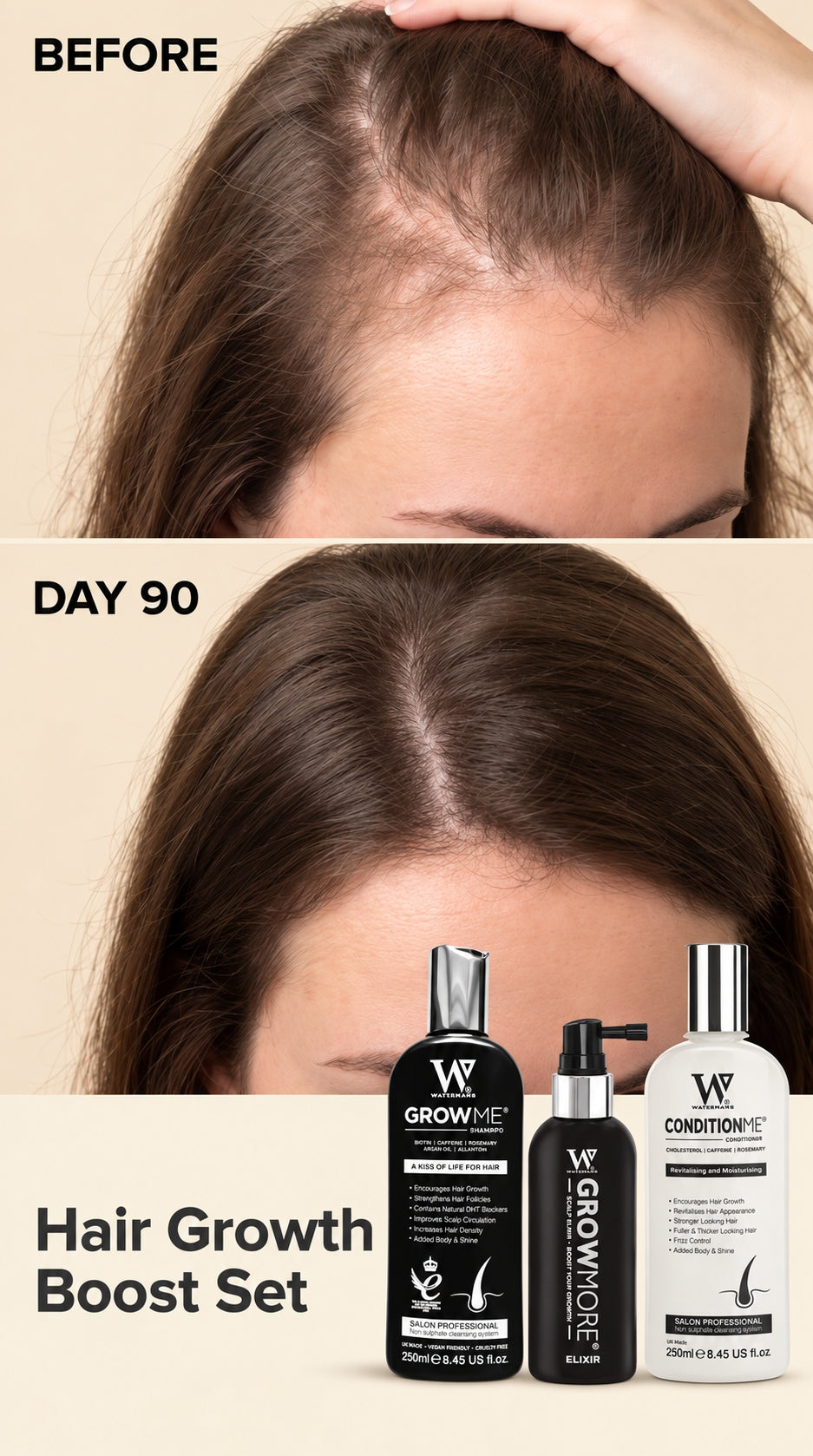
Grow Me® Hair Growth Shampoo, £14.95. A sulphate free daily shampoo that supports a healthy scalp environment and helps reduce breakage, so lengths hold on and look fuller.
Key takeaways
- The procedure is cosmetic tattooing, legally classed as semi-permanent skin-colouring, not a medical procedure.
- In England and Wales a business doing it must be registered with the local authority under section 15 of the Local Government (Miscellaneous Provisions) Act 1982, and must display its registration certificate.
- Expect two or three sessions, usually spaced one to two weeks apart, and budget roughly £700 to £3,000 in the UK depending on how much of the scalp is covered.
- The pigment softens and fades over roughly three to five years, so plan for a top up rather than a one off.
- It disguises the look of thinning. It does nothing for the hair itself, so the hair you still have still needs looking after.
What is scalp micropigmentation, and what does it actually involve?
The procedure places very small dots of cosmetic pigment into the upper scalp with a fine needle, so that the dots read as the shadow of short hair follicles. A practitioner works across the area in layers, matching dot size, depth and colour to your natural hair and skin tone. The effect is optical, not biological.
A first session usually runs between two and four hours depending on the area being covered. The practitioner shaves or trims the area, cleans it, maps the hairline with you, then works in passes. Most people describe the sensation as a scratchy buzzing rather than sharp pain, and it is generally reported as more comfortable over the crown than along the front hairline, where the skin is thinner.

The look only works if it matches the length of hair around it. That is why the technique suits a shaved or very short crop so well, and why it is used more subtly as density shading for people who keep their hair longer. Pigment dots sitting under longer hair add the impression of density at the parting without pretending to be individual strands.
Who does scalp micropigmentation suit?
The procedure suits three groups particularly well: people with pattern thinning who already wear their hair very short, people who want a scar from a hair transplant or an injury made less visible, and people with diffuse thinning who want the parting to look denser. The common thread is that the wearer is content with short hair or wants shadow rather than strands.
It suits people less well if you want to keep long hair and expect the pigment to pass as length, if your thinning is changing quickly and the pattern has not settled, or if you scar unusually or have an active scalp condition. A practitioner should turn you away in those cases rather than work around them.
Worth knowing before you book
Pattern thinning carries on underneath the pigment. If your hairline moves back another two centimetres over the next five years, a hairline drawn at today position can end up sitting oddly. Good practitioners deliberately draw a softer, slightly higher hairline for exactly this reason.
Is it hair loss, hair shedding or hair breakage that brought you here?
Three different problems get called the same thing, and only one of them is the reason people reach for pigment. Getting the label right changes what you should do next, and it is worth five minutes before spending four figures on pigment.
| What it is | What you notice | Where micropigmentation fits |
|---|---|---|
| Hair loss (follicular) | Follicles miniaturise over years. The parting widens, the temples recede, the scalp shows through in good light. | This is the situation the procedure is designed for, because the density is genuinely lower. |
| Hair shedding (cycle) | A sudden increase in hairs coming out, often two to three months after illness, childbirth, surgery or a crash diet. Density is usually normal underneath. | Generally not the moment for it. Shedding often settles on its own, so wait and see what density you are left with. |
| Hair breakage (fibre) | Short broken pieces, frizz along the mid lengths, ends that snap when combed. The hairline looks fluffy rather than thin. | Not relevant. The follicles are fine, the fibre is failing, and that is a hair care problem. |
If the pattern sounds more like the middle row, our guide to sudden shedding and how long it lasts covers what to expect and when it settles. If it sounds like the top row and you want to understand the pattern first, how pattern thinning progresses is the better starting point.
What does scalp micropigmentation cost in the UK?
A full course in the UK generally costs between roughly £700 and £3,000 in total, quoted for the full course rather than per session. Price tracks the area covered and the number of sessions needed, so a small scar camouflage sits at the bottom of that range and full coverage of a completely bald scalp sits at the top.
| What you are having done | Typical UK total | Sessions |
|---|---|---|
| Scar camouflage, small area | £700 to £1,200 | 2 |
| Receding hairline and temples | £1,000 to £1,800 | 2 to 3 |
| Crown and mid scalp density | £1,200 to £2,200 | 2 to 3 |
| Full shaved look, front to crown | £1,800 to £3,000 | 3 |
| Top up, a few years later | £200 to £500 | 1 |
Two things routinely catch people out on price. Quotes are often given per session, so a £450 session price is really a £1,350 course. And a top up in three to five years is not an upsell, it is how the process works, so it belongs in the budget from the start.
For comparison, our breakdown of what a hair transplant actually costs in the UK puts those numbers side by side, and the difference between FUE and FUT is worth reading if you are weighing up a surgical route instead.
Get a discount on the thinning hair range
Join the Watermans mailing list and we will email a discount code straight to your inbox, so you can try the thinning hair range for less. Made in the UK, over 6.5 million bottles sold since 2012.
How do you check a scalp micropigmentation practitioner is legitimate?
Practitioner checks matter more here than price, because this is an unregulated skill sitting inside a regulated activity. In England and Wales, section 15 of the Local Government (Miscellaneous Provisions) Act 1982 covers the business of semi-permanent skin-colouring, which is what this work legally is. Where a local authority has brought that section into force, both the person and the premises must be registered with the council.

The law also gives you a simple thing to look for on the wall. Section 16(9) of the same Act requires a registered person to keep a copy of the registration certificate, and of the council byelaws they work under, prominently displayed where they work. If you cannot see one, ask. Operating without registration where the section is in force is a summary offence carrying a fine up to level 3 on the standard scale.
Five questions worth asking before you pay a deposit
Are you and these premises registered with the council for semi-permanent skin-colouring, and can I see the certificate? How many sessions is that quote for? What pigment do you use, and will you patch test me? Can I see healed photographs taken at least a year on, not day one photographs? What does a top up cost and when will I need one?
Healed photographs are the single most revealing request. Fresh work looks sharp and dark on everybody. Work photographed a year later shows whether the dots have stayed crisp or spread into a bluish haze, which is the main way scalp micropigmentation ages badly.
Does scalp micropigmentation fade, and what is the upkeep?
Fading is normal and expected. The pigment is deposited shallower than a conventional tattoo and is designed to soften, so most people see a noticeable lightening across roughly three to five years, faster on scalps that get a lot of sun. Colour can also shift slightly warm or grey as it fades rather than simply getting paler.
Upkeep is therefore a top up session every few years, plus daily sun sense. Ultraviolet exposure is the single biggest accelerator of fading on a scalp that is, by definition, uncovered. A hat or a high factor sunscreen on the scalp in summer protects both the pigment and the skin underneath it.
What does scalp micropigmentation aftercare look like week by week?
Aftercare is mostly about leaving the area alone while the skin settles. Practitioners vary in detail, so follow the instructions you are given in person over anything you read online, including this page. The shape below is the pattern most UK practitioners work to.

| When | What you do |
|---|---|
| Days 1 to 4 | Keep the scalp dry. No washing, no sweating, no swimming, no sauna. Pat rather than rub if it gets damp. |
| Days 5 to 7 | Short cool rinses with plain water. No shampoo, no scrubbing, no shaving over the area. |
| Week 2 | A mild shampoo is usually allowed. Light moisturiser if the scalp feels tight. Still no scrubbing. |
| Week 3 onwards | Back to normal washing and shaving. Sun protection becomes the long term habit. |
| Between sessions | Expect the colour to look lighter than you wanted. That is why there is a second session. |
One expectation to set now: the colour drops back noticeably about a week after each session. Almost everyone has a moment of panic at that point. The layered sessions exist precisely because the first pass is meant to under deliver.
How should you look after the hair you still have?
Pigment sits in skin, not in hair, so every strand you keep is still doing real work in the finished look. On a shaved scalp the stubble carries the texture that stops the dots looking flat. On a longer style the pigment is only shading behind hair that has to look thick and unbroken. Either way, the hair itself is still the job.
Keep it simple. Wash with something that cleans without stripping, so a short crop does not sit on a dry, flaky scalp that shows through the pigment. Keep length in good condition so it lies smoothly and covers. Avoid the tight styling that causes breakage along the very hairline you have just paid to define, which is the mechanism behind traction alopecia.

Grow Me® Hair Growth Shampoo £14.95
Sulfate free daily shampoo with Biotin, Caffeine, Rosemary, Niacinamide and hydrolysed lupine protein. Cleans without stripping, so hair looks fuller and snaps less on the comb.
A sulfate free daily wash is the sensible choice on a scalp that is shaved or very short, because a stripped scalp flakes and flaking shows through pigment.

Grow More® Leave In Scalp Elixir £25.50
An overnight leave on elixir for lower density areas such as the parting and temples. Applied to the scalp rather than the lengths, with Biotin, Caffeine, Rosemary and Allantoin.
A leave on scalp product for the lower density areas such as the parting and temples, on the days when you are working with hair rather than covering it.

Condition Me® Hair Growth Conditioner £13.95
A breakage defence conditioner with cholesterol, shea butter and silica. It smooths the cuticle so wet combing pulls far less hair out of the brush.
If you keep some length rather than shaving, smoothing the cuticle is what makes that length lie flat and cover properly.
Frequently asked questions
Is scalp micropigmentation permanent?
Not in the way a conventional tattoo is. The pigment is placed shallower and is designed to soften, so most people see clear fading across roughly three to five years and book a top up rather than living with the original work forever.
Does scalp micropigmentation hurt?
Most people rate it as uncomfortable rather than painful, similar to a persistent scratching or buzzing. The front hairline is usually the tenderest part and the crown the easiest. Sessions run two to four hours, so the tiredness is often more noticeable than the sensation.
Will the pigment make my hair grow?
No. The pigment sits in skin and has no effect on follicles, growth or shedding. Anyone telling you otherwise is selling something. Whatever was happening to your hair before carries on happening underneath.
Can it be removed if I hate it?
It can be lightened or removed with laser, usually over several sessions, and removal is slower and more expensive than the original work. This is the strongest argument for healed photographs and a patch test before you commit.
Does it work on grey or white hair?
It works, but the contrast is the difficulty. Pigment is applied in a single grey toned shade, so on hair that has gone substantially white the dots can read darker than the surrounding stubble. A good practitioner will dilute accordingly and may advise keeping the crop very short.
Can I have it after a hair transplant?
Yes, and scar camouflage after a strip procedure is one of its most common uses. Practitioners normally ask you to wait until the surgical site is fully healed, which is usually a minimum of several months, and your surgeon should be the one who says when.
Will it look obvious close up?
Good work reads as stubble at conversational distance and as dots very close up, which is exactly how real short hair behaves. Work that looks obvious usually has dots that are too large, too dark, too evenly spaced, or a hairline drawn too low and too straight.
How soon can I shave over it?
Most practitioners ask you to leave shaving for around two weeks, and to use a foil or electric shaver rather than a wet blade over the area at first. Follow the instructions you were given in person.
What is the bottom line on scalp micropigmentation?
The procedure is a genuinely good answer to a specific question: how do I make thinning look like a deliberate close crop rather than a retreat. It is cosmetic tattooing, it is optical, and within those limits it is one of the most reliable cosmetic options available for pattern thinning. Budget £700 to £3,000, expect two or three sessions, and plan a top up.
What scalp micropigmentation will not do is change your hair. The follicles carry on doing whatever they were doing, which is why the sensible plan pairs the pigment with looking after the hair that is still there rather than treating the pigment as a full stop.
If you are keeping a short crop, start with a hair growth shampoo that cleans without stripping the scalp, because a dry flaking scalp is the quickest way to make pigment look patchy.
Sources & references
Every source below was opened and checked while writing this page.
- Local Government (Miscellaneous Provisions) Act 1982, Part VIII, sections 15 and 16, the registration requirement for semi-permanent skin-colouring and the duty to display the certificate
- NHS: cosmetic procedures, general guidance on checking a practitioner before any cosmetic procedure
- NHS: hair loss, when hair changes are worth seeing a GP about
- DermNet: female pattern hair loss, how pattern thinning progresses and why the pattern matters
Watermans products are 100% cosmetic and do not treat medical hair loss. Individual results may vary.