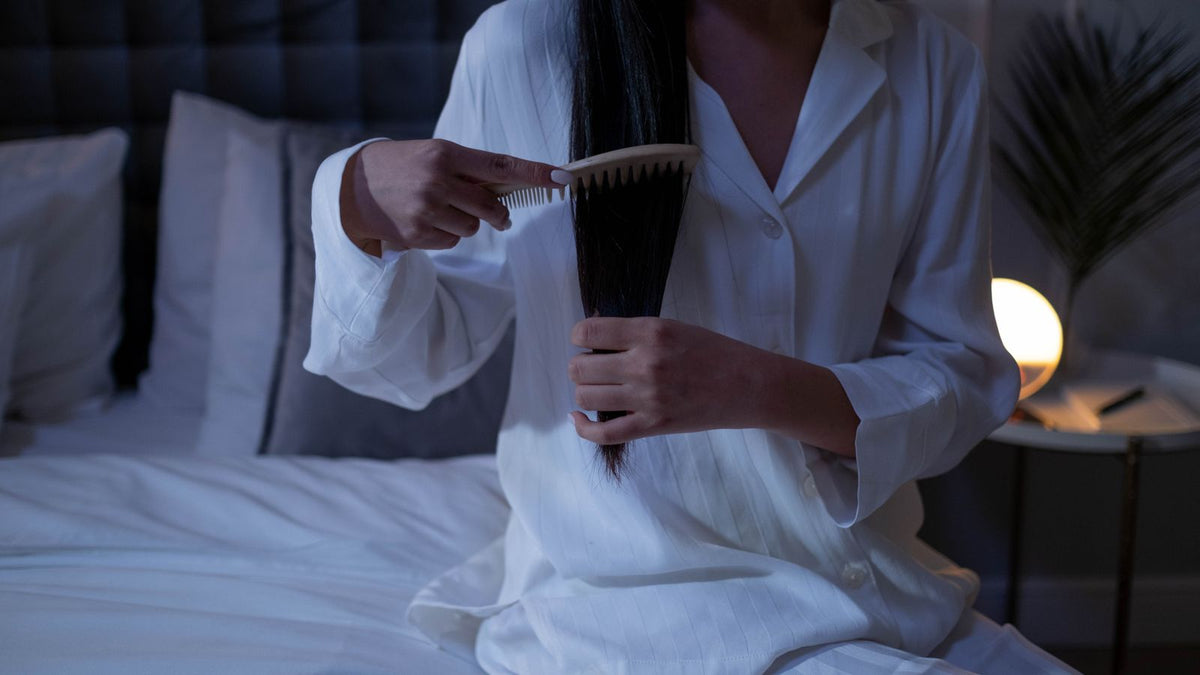
Trichologists Slough: Hair on Your Pillow and Night-Time Breakage
Waking to strands on the pillowcase feels like a warning, but most of them describe your night, not your follicles.
If you are searching for trichologists Slough because you keep waking up to hair on your pillow, sort the strands before you worry. Full-length hairs with a small pale bulb are ordinary shedding, and the NHS puts normal daily loss at 50 to 100 hairs. Short, blunt pieces are breakage, usually from friction against the pillow, damp hair or tight night-time styles. Change the bedtime routine for three months, and speak to your own GP about bald patches, a receding hairline or hair coming out in handfuls.
Our hair growth conditioner
Condition Me® Hair Growth Conditioner, £13.95. Detangles and strengthens the hair fibre so lengths snap less on the brush and look thicker through the ends.
Key takeaways
- The NHS says losing 50 to 100 hairs a day is normal, and the British Association of Dermatologists (BAD) notes that some people first spot heavier shedding as extra hair on the pillow in the morning.
- A shed hair is full length with a pale bulb at the root; a broken hair is a short fragment with no bulb, which points to friction or tension rather than the growth cycle.
- We found no controlled human study showing that silk or satin pillowcases reduce breakage, so see them as a comfort choice rather than an evidence-backed must-have.
- Wet hair swells and stretches easily, and a 2015 review in the International Journal of Trichology says stretching wet hair beyond 30% of its length causes irreversible changes, so dry it before bed.
- Tight buns, clips and tightly tied scarves worn at night can pull on the hairline, and the BAD warns that long-term pulling can cause permanent traction alopecia.
- Try gentler nights for three months before searching for trichologists Slough, but see your GP sooner for patches, soreness or handfuls of hair.
Is hair on your pillow in the morning normal?
Hair on your pillow in the morning is normal in small numbers, because the NHS says most people lose between 50 and 100 hairs every day, often without noticing, and the few that come loose while you turn over at night simply end up on the pillowcase instead of in the shower drain.
Shedding is built into the hair cycle. According to the BAD, around 85% of scalp follicles are growing hair at any moment and around 15% are resting. A resting follicle stays put for two to four months before a new hair pushes the old one out. Those released hairs have to land somewhere, and eight hours of contact with a pillow makes it one of the likelier places.
Sources quote slightly different normal ranges. The NHS gives 50 to 100 a day, while the BAD leaflet on telogen effluvium says most people lose between 30 and 150. The American Academy of Dermatology (AAD) uses the 50 to 100 figure and points out that noticing more hairs on your pillow or hairbrush can simply mean heavier shedding rather than true hair loss.
What changes the picture is a sudden jump. The BAD leaflet notes that some people with telogen effluvium, the medical name for heavy shedding, first notice it as extra hair on the pillow in the morning or around the house, often around three months after a trigger such as illness, surgery or a major life event.
Count for a week, not a morning
Use a plain pillowcase in a colour that contrasts with your hair, check it at the same time each day and write the number down. Seven mornings smooth out wash days and restless nights, and give you real figures to show your GP or a trichologist if the count keeps climbing.
How can you tell shed hairs from broken hairs on your pillowcase?
Shed hairs on a pillowcase are long, whole strands with a small, pale, rounded bulb at the root end, while broken hairs are shorter, uneven fragments with blunt or frayed tips and no bulb at all, so a morning dominated by short pieces points to friction or tension rather than the growth cycle.
Three different things can leave hair behind on the bed, and they need different responses:
- Hair shedding. The growth cycle releases a complete hair from its follicle. Small numbers are normal. The BAD says that in telogen effluvium the share of resting hairs rises from about 15% to 30% or more.
- Hair breakage. The fibre snaps somewhere along its length. The follicle is unaffected and keeps growing, but the ends become thinner, uneven and frizzy.
- Hair loss. The follicle itself changes or is damaged, as in pattern hair loss or long-standing traction alopecia. You see it on the scalp as a wider parting, thinning or patches, not only on the pillow.
| What you find | Breakage | Shedding | Hair loss |
|---|---|---|---|
| Length on the pillow | Short, uneven bits | Full length | May look normal; the change shows on the scalp |
| Root end | Blunt or split, no bulb | Small, pale, rounded bulb | Varies |
| Where it shows on your head | Ends, nape, hairline edges, wherever a band sits | All over the scalp | Hairline, crown, parting or patches |
| Night-time link | Friction, damp hair, tight bands | None; shed hairs just land on the pillow | Tight styles worn night after night for years |
| First move | A gentler night routine | Count for a week; GP if heavy or lasting | Speak to your own GP |
DermNet lists multiple short broken hairs among the signs of traction alopecia, so a cluster of snapped hairs along the hairline deserves attention even when the overall pillow count looks modest. Stiff, powdery roots are another source of snapped hairs, which our Woking guide to dry shampoo and scalp build-up covers.
Does a cotton pillowcase cause more hair breakage than silk or satin?
A cotton pillowcase probably creates more drag on hair than smooth silk or satin, but no controlled human study has measured breakage on different pillowcase fabrics, so switching is a sensible low-risk experiment rather than an evidence-backed fix, and a loose plait or a soft covering may achieve much of the same.
We searched the PubMed database in September 2026 for trials comparing pillowcase fabrics and hair, and found none. The case for silk and satin rests on how hair is built. A 2015 review of hair cosmetics in the International Journal of Trichology explains that the cuticle, the outer layer of overlapping scales, is what gives hair its friction. The review says the cuticle is 6 to 8 scales thick in Asian hair, slightly thinner in Caucasian hair and thinner still in African hair, which makes Afro-textured hair more prone to breakage.
The same review describes weathering, the gradual wear of the hair shaft from daily grooming, as a source of tangling and frizz. A night of turning your head on a textured weave adds a small dose of that wear, repeated around 365 times a year. People with curly, coily, bleached or fine hair are the ones most likely to notice a difference from smoother fabric, if there is one to notice.
| What you sleep on | How it feels to hair | Care and cost | Human evidence on breakage |
|---|---|---|---|
| Cotton pillowcase | Absorbent, textured weave that can grip strands | Hot wash; the cheapest option | Not studied |
| Silk pillowcase | Very smooth natural protein fibre | Delicate wash; the most expensive | No trial found |
| Satin pillowcase | Smooth weave, usually polyester | Machine washable; cheaper than silk | No trial found |
| Bonnet or scarf | Keeps all the lengths off the pillow | Wash with your bedding; keep the band loose | No trial found |

Where pillowcase claims outrun the evidence
Adverts for silk pillowcases often promise fewer breaks, less frizz and longer hair. We could not find a published human trial behind any of those figures. Buy one if you like the feel, but do not expect it to change shedding, which starts inside the follicle and has nothing to do with fabric.
Conditioning matters as much as the fabric under your head. The AAD notes that conditioner moisturises and detangles hair, and suggests applying it to the ends for fine or straight hair and along the full length for dry or curly hair. Hair that goes to bed smooth and detangled has fewer knots for the pillow to tighten. For the daytime side of the same problem, our guide to seven everyday habits that reduce breakage goes into more depth.

Condition Me combines cholesterol and shea butter with glycerin and hydrolysed lupine protein, and costs £13.95 as of September 2026. Use it on every wash so lengths go to bed softer and less tangled, which helps reduce breakage.
Is it bad to go to sleep with wet hair?
Going to sleep with wet hair is harder on the strands than sleeping with dry hair, because water swells the hair shaft and makes each fibre softer and stretchier, so hours of rubbing and tugging against a pillow can snap wet strands that would come through the same night intact if they were dry.
The 2015 International Journal of Trichology review sets out the numbers. Wet, undamaged hair can be stretched by 30% of its length without harm, stretching it between 30% and 70% causes irreversible changes, and stretching it to 80% breaks it. A damp ponytail trapped under your shoulder as you roll over is exactly the kind of slow pull that can take a softened strand past the first of those limits.
Research on the outer layer explains part of the reason. A 2022 study in the International Journal of Cosmetic Science found that the cuticle itself swells as hair takes up moisture, and that it plays a bigger role in managing water at high humidity than had been assumed. Wet hair also dries into whatever shape the pillow presses it into, so you wake with kinks and knots that tempt you into rough brushing. Our Grimsby guide to blow-drying versus air-drying fine hair looks at how to dry hair quickly and gently before bed.
If you wash in the evening, a few changes make the night kinder:
- Wash earlier. Two hours before bed gives most hair time to air-dry.
- Blot, do not rub. The AAD suggests wrapping hair in a towel or T-shirt to absorb the water, because rubbing it roughly can cause damage.
- Finish with cool air. Use a cool or low setting until the roots and mid-lengths feel dry to the touch.
- Never tie it tight while damp. If you must sleep on damp hair, use one loose plait and a smooth covering rather than a tight bun.
Our guide to wet hair care after a shower covers the first half hour after washing in more detail.


A leave-in conditioning spray with panthenol, niacinamide and sunflower oil that also shields hair from heat up to 230°C, £13.95 as of September 2026. Mist it through towel-dried lengths before a quick, cool blow-dry so hair goes to bed dry and soft rather than damp.
Can tight overnight styles cause breakage at the hairline and nape?
Tight overnight styles can cause breakage at the hairline and nape, because a high bun, clip or elastic holds the same few hairs under tension for hours while your head presses and turns on the pillow, and the British Association of Dermatologists warns that repeated pulling from tight styles can lead to traction alopecia.
The BAD leaflet links tight ponytails with hair loss at the front and side margins of the scalp and tight buns with loss at the sides and back, and it lists hair clips and tight head scarves among associated causes. Caught within weeks or months, the hair can recover once the tension ends, and the BAD says new growth may start around three months after the tight styles are dropped. Long-term, repeated pulling can damage the follicles permanently.
The nape takes a particular beating at night. Hair there is often shorter and finer, it sits right where your neck meets the pillow, and a bun or clip worn to bed rests its weight on it. DermNet adds that the likelihood of traction alopecia rises with age, probably because the pulling adds up over years of the same habits. If the damage shows mostly on the side you sleep on, our Taunton guide to hair thinning on one side covers pillows, partings, ponytails and headsets.
- Clear the hardware. Take out clips, pins and metal-joined elastics before bed.
- Go low and loose. Swap a tight top knot for a loose, low plait or a soft scrunchie tied loosely at the crown.
- Move the pull. Change where a daytime ponytail sits so the same hairs are not under strain day and night.
- Listen to your scalp. If a style makes your scalp ache, itch or feel tender, loosen it; the BAD lists itching, soreness and flaking among possible symptoms.

For braids, edges and textured hair in particular, our Bradford guide to textured hair and traction goes further.
Get a discount on the hair breakage range
Join the Watermans mailing list and we will email a discount code straight to your inbox, so you can try the hair breakage range for less. Made in the UK, over 6.5 million bottles sold since 2012.
Are bonnets, scarves and loose plaits worth wearing to bed?
Bonnets, scarves and loose plaits are worth wearing to bed if your hair tangles or snaps overnight, because each one gathers the lengths together and lifts them off a rough pillowcase, although no trial has measured their effect on breakage and a covering tied too tightly can strain the hairline itself.
That trade-off matters. The BAD names tight head scarves among causes associated with traction alopecia, so the band of a bonnet or the knot of a scarf should sit comfortably and leave no deep mark on your forehead in the morning. Look for a wide, soft elastic, or tie a scarf at the nape rather than cinching it over your edges. If you cover your hair during the day as well, our Stevenage guide to caring for hair under a hijab or headscarf covers underscarf tension and fabric choice.
Hair type decides how much a covering is worth. The 2015 review's point about thinner cuticles in African hair means coily and tightly curled hair has the least natural armour against friction, so a satin-lined bonnet earns its place there. Fine, straight hair that does not tangle may need nothing more than one loose plait.
- Start dry. Go to bed with dry or nearly dry hair.
- Smooth the ends. Work a few drops of oil or a little leave-in over the ends only, never the roots.
- Plait loosely. One plait at the nape, or two low plaits if hair is long, fastened with a fabric scrunchie rather than a rubber band.
- Lift curls. Gather curls loosely at the top of the head so you are not lying on them all night.
- Cover if it helps. Add a satin bonnet or scarf if your hair is long, curly, coily or bleached.
- Undo gently. In the morning, loosen the plait with your fingers before you pick up a comb.


Camellia & Black Castor Hair & Body Oil
A blend of black castor and camellia oils with omega 3, 6 and 9 and vitamins A, B, D and E, £24.95 as of September 2026. Smooth two or three drops over the ends before you plait, so they feel softer and glide more easily against the pillowcase.
Does poor sleep or night-shift work make hair shed more?
Poor sleep and night-shift work are linked with hair shedding in some studies, but the link is an association rather than proof, and a 2026 systematic review in Dermatology and Therapy included 29 studies, rated the evidence low to moderate, and found only three that looked at telogen effluvium.
The review's authors describe the relationship as probably running both ways, since hair loss causes distress and distress disrupts sleep, and they call for longer studies before anyone claims that poor sleep causes shedding. Heavy shedding usually shows up months after its trigger, and our guide to what causes telogen effluvium sets out the common triggers and the usual timeline.
If you work early or overnight shifts, perhaps at Heathrow a few miles from Slough, the NHS Every Mind Matters advice still applies: keep a regular sleep routine, going to bed and getting up at similar times even on days off, and try to avoid phones, tablets and computers for an hour before bed. Daytime sleepers can use every tip in this guide for the hours they do sleep, from dry hair to a loose plait and a smooth covering.
When are trichologists Slough or your GP worth contacting for morning hair fall?
Your GP is worth contacting first, and trichologists Slough residents can see privately second, when morning hair fall comes out in handfuls, when bald patches or a receding hairline appear, when the scalp is sore, red or flaky, or when snapping carries on after three months of gentler nights.
The NHS advises seeing a GP to get an idea of what is causing hair loss before thinking about a commercial hair clinic, and lists illness, stress, weight loss and iron deficiency among the causes of temporary hair loss. A GP can arrange blood tests where they are needed, which a trichologist cannot do through the NHS.
Speak to your own GP first if
Hair comes out in clumps or handfuls for more than a few weeks; you find smooth bald patches; your hairline or nape is visibly receding where hair is tied; your scalp is itchy, sore, scaly or weeping; or the shedding arrived with tiredness, weight change or feeling unwell. If you started a new medicine recently, keep taking it and raise the timing with the GP or pharmacist who gave it to you.
A trichologist is a private hair and scalp practitioner rather than a doctor. The best reason to see one for night-time problems is breakage that persists after you have fixed the obvious habits, when you want someone to examine the broken ends under magnification and go through your routine line by line. Watermans does not run clinics or offer consultations; we make cosmetic hair care. If your question is about products or a routine rather than a medical one, you can talk to Gail Waterman, our co-founder, as an AI avatar on the Watermans homepage.
What should you ask trichologists Slough practitioners about night-time breakage?
The questions to ask trichologists Slough practitioners about night-time breakage are whether they will look at the broken hairs under magnification, whether they will go through your bedtime routine and styles, which professional register they belong to, and whether they will send you back to your GP if something medical turns up.
Two UK bodies are worth knowing: the Institute of Trichologists, which runs a Find a Trichologist search on its website, and the Trichological Society. Check membership on the body's own site rather than trusting a logo, and ask about fees before you go. To make a first visit count, bring:
- An envelope of hairs from a week of pillow counts, with short and long pieces kept apart.
- Photos of your hairline, nape and parting, taken in the same light a month apart.
- A written list of what you sleep in: pillowcase fabric, bonnet or scarf, plait or bun, and whether your hair is ever damp at bedtime.
- Any recent blood test results from your GP.
A word on bias: we sell hair care, so read our product suggestions with that in mind. Protect Me is vegan. Watermans products are made in the UK, and over 6.5 million bottles have been sold since 2012. They are cosmetic products that help hair look and feel healthier and reduce breakage; they cannot change what happens inside a follicle.
What are the most frequently asked questions about hair on the pillow?
Should I see one of the trichologists Slough lists about hair on my pillow?
Not as a first step for most people. Count the hairs for a week and sort full-length strands from short broken pieces. Speak to your own GP first about handfuls of hair, bald patches or a sore scalp. A registered trichologist is most useful when breakage carries on after three months of gentler nights.
How many hairs on the pillow is normal?
No source gives a pillow-only figure. The NHS says losing 50 to 100 hairs a day in total is normal, and the British Association of Dermatologists gives a wider range of 30 to 150. A few full-length hairs on the pillowcase each morning usually sit well inside that.
Do silk pillowcases really reduce hair breakage?
We could not find a controlled human study showing that silk or satin pillowcases reduce breakage. Smooth fabric plausibly snags hair less than cotton, so one may help curly, coily or fragile hair, but a loose plait and dry hair at bedtime are cheaper first steps.
Is it bad to sleep with wet hair?
Sleeping with wet hair makes breakage more likely, because water swells the hair shaft, and a 2015 review found that wet hair stretched beyond 30% of its length suffers irreversible changes. Dry it at least most of the way, blot rather than rub, and use a loose plait if it is still damp.
Is it better to sleep with your hair up or down?
Loosely up is usually kindest to long hair. A low plait or a soft scrunchie at the crown keeps the lengths from tangling, while a tight bun, clip or elastic pulls on the hairline and nape for hours. Short hair can simply be left down.
Can a bonnet or headscarf cause hair loss?
A loosely worn bonnet or scarf is unlikely to cause problems, but the British Association of Dermatologists lists tight head scarves among causes associated with traction alopecia. Choose a wide, soft band that leaves no deep mark, and tie scarves at the nape rather than over your edges.
Can lack of sleep make your hair fall out?
Poor sleep has been linked with several types of hair loss, but a 2026 systematic review rated the evidence low to moderate and found only three studies on heavy shedding, so cause and effect is unproven. The BAD says heavy shedding often starts around three months after a trigger.
Why is my hair breaking at the nape of my neck?
Nape breakage often comes from friction where the neck meets the pillow, buns or clips worn to bed, and collars or scarves rubbing during the day. Short snapped hairs there are breakage; skin showing through, especially where hair is tied back, is worth raising with your GP.
Sources & references
- NHS, Hair loss
- NHS Every Mind Matters, How to fall asleep faster and sleep better
- British Association of Dermatologists, Telogen effluvium
- British Association of Dermatologists, Traction alopecia
- DermNet, Traction alopecia
- American Academy of Dermatology, Do you have hair loss or hair shedding?
- American Academy of Dermatology, Tips for healthy hair
- Gavazzoni Dias MF. Hair cosmetics: an overview. Int J Trichology, 2015
- Breakspear S et al. Cuticle: designed by nature for the sake of the hair. Int J Cosmet Sci, 2022
- Boghosian T et al. The intersection of sleep and hair loss: a systematic review. Dermatol Ther (Heidelb), 2026
- The Institute of Trichologists, Find a Trichologist
- The Trichological Society
What is the bottom line on trichologists Slough?
Most hair on the pillow is either ordinary shedding, which the NHS puts at 50 to 100 hairs a day, or breakage from how your hair spends the night: damp, tied tight or rubbing against a textured pillowcase. Go to bed with dry hair and a loose plait, add a smooth covering if your hair is long or textured, and count for a week. Keep trichologists Slough in reserve for breakage that outlasts three months of gentler nights, and speak to your own GP first about patches, soreness or handfuls of hair.
For the ends that take the most friction, a few drops of hair oil such as our Camellia & Black Castor blend, smoothed on before you plait, leave them feeling softer against the pillowcase.
Watermans products are 100% cosmetic and do not treat medical hair loss. Individual results may vary.