Hair Growth Guide: How Hair Grows and What Helps
This hair growth guide is the map you need before you spend money on anything. Hair grows about one centimetre a month from follicles that cycle through growing, transitional and resting phases, which is why every honest routine is judged over months rather than weeks. Understand the cycle, rule out the handful of causes worth testing for, then pick habits that protect what you already have.
Our complete hair growth routine
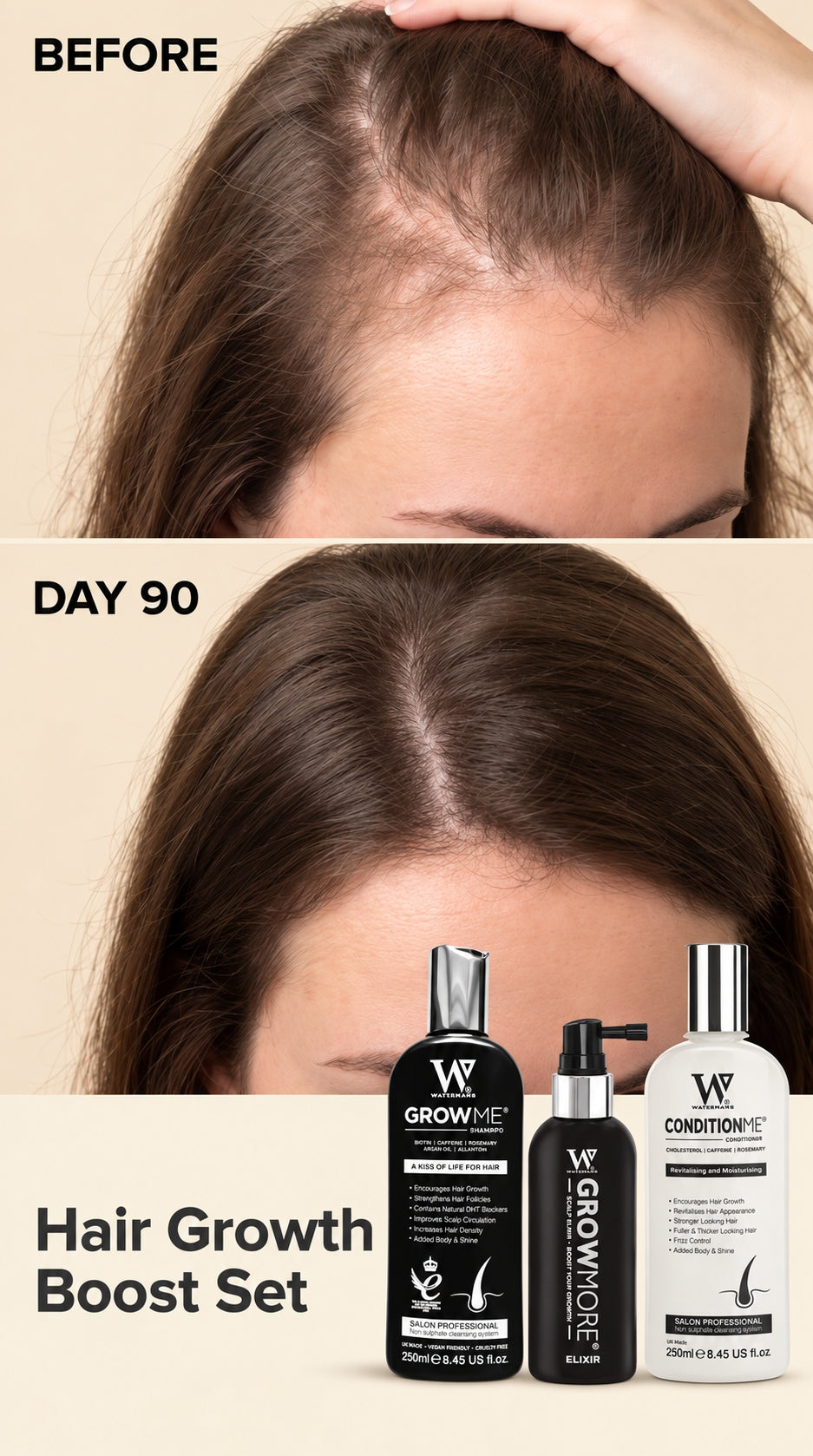
Hair Growth Shampoo, Conditioner & Scalp Elixir Set, £53.40. The full three step routine, cleanse, condition and an overnight scalp elixir, bought together for less than buying each alone.
Key takeaways
- Hair grows roughly 1cm a month, or about 6 inches a year. Nothing safely available changes that rate very much, so any promise of dramatic speed is a warning sign.
- Your maximum length is set by how long your growing phase lasts, which is largely genetic. Some people simply cannot grow waist-length hair, however well they look after it.
- Losing 50 to 100 hairs a day is normal. The question is never whether you shed, it is whether the pattern has changed.
- Most people chasing length actually have a retention problem rather than a growth problem: the hair is growing fine and snapping off at the ends.
- Four blood tests explain a large share of unexplained shedding: ferritin, thyroid, vitamin D and B12.
- Consistency beats intensity. A dull routine done for six months beats an elaborate one abandoned in three weeks.
How does hair actually grow?
Every follicle runs an independent cycle with three phases, and knowing them explains almost every question people ask about length and shedding.
- The growing phase (anagen) lasts between two and seven years on the scalp. This is the only phase in which hair gets longer, and its length is why some people reach waist length and others plateau at the shoulders.
- The transitional phase (catagen) lasts two to three weeks. The follicle detaches from its blood supply and growth stops.
- The resting phase (telogen) lasts around three months. The old hair sits in place until a new hair pushes it out, which is the shedding you see in the brush.
At any moment roughly 85 to 90 percent of your follicles are growing and about 10 percent are resting, and because each one runs its own schedule you shed steadily rather than all at once. Two consequences follow. First, the three-month delay: a stressful event today shows up as shedding around three months later. Second, patience is not optional, since a change you make now cannot appear until hair grown under the new conditions is long enough to see.

How fast does hair grow, and how long can it get?
About one centimetre a month, or six inches a year, with modest variation between individuals. It is slower with age and slightly faster in warm months, and it cannot be meaningfully accelerated by anything you buy. What differs enormously between people is maximum length, which is decided by how long your growing phase runs. A two-year growing phase gives a terminal length around shoulder level. A seven-year phase can reach the waist. No product extends your growing phase, so if your hair has always stopped at the same point, that is your genetics rather than a failure of routine.
Our explainer on the anagen phase and how long hair can grow covers this in more depth.
Is it hair loss, hair shedding or hair breakage?
This is the most valuable distinction in this hair growth guide, because the three problems look similar and have completely different answers. Most people who feel stuck have the third one.
| Hair loss | Hair shedding | Hair breakage | |
|---|---|---|---|
| Where the problem is | The follicle is miniaturising | The hair cycle has been disturbed | The hair fibre itself |
| What you see | Widening parting, thinning temples or crown | Diffuse thinning all over, handfuls in the shower | Split, rough ends and no length gain |
| The hairs themselves | Fewer, finer, shorter | Full length with a pale bulb | Short blunt fragments, no bulb |
| First move | See a GP, then consider cosmetic support | Find the trigger about 3 months back; get bloods | Cut the damage out, reduce heat and tension |
If your hair feels like it "stopped growing" at a certain length but you find no unusual shedding, that is almost always breakage. The hair is growing normally at the root and snapping at the ends at the same rate, so the length stays static. See what causes thinning hair and how much hair loss is normal for the fuller picture.
Which causes are worth testing for?
No hair growth guide can substitute for a blood test, so before buying anything, rule out the causes that no product can fix. If your shedding is diffuse, recent or unexplained, ask your GP about these four.
- Ferritin. Iron stores can be low while a standard full blood count still looks normal, so ask for ferritin specifically rather than only haemoglobin.
- Thyroid function. Both underactive and overactive thyroid cause diffuse shedding, and both are easily identified.
- Vitamin D. Widely low in the UK, particularly through winter.
- Vitamin B12. Worth checking on a vegan or restricted diet.
Other common triggers do not need a test, only recognition: childbirth, surgery, a significant illness, rapid weight loss, crash dieting and periods of severe stress. All of these tend to produce a diffuse shed roughly three months afterwards, and all typically settle on their own once the trigger has passed.
What everyday habits genuinely help?
These are the foundations, and they are unglamorous. They mostly work by protecting hair you have already grown rather than by speeding up the follicle, which is exactly where the winnable gains are.
- Eat enough protein and enough calories. Hair is one of the first things the body deprioritises when energy is scarce, which is why crash diets so reliably cause a shed.
- Handle wet hair carefully. Hair is at its most fragile when soaked. Detangle from the ends upwards with a wide-tooth comb, and never drag a brush from the roots down through wet hair.
- Cut the heat. Every straightener pass costs you fibre integrity. Lower the temperature, style less often, and always use heat protection.
- Reduce tension. Tight ponytails, buns and extensions cause traction damage at the hairline, which can become permanent if it continues for years.
- Trim on schedule. Trimming does not make hair grow faster, but removing split ends stops splits travelling up the shaft and costing you more length than the trim did.
- Condition every wash. Conditioner reduces the friction that causes breakage during combing and styling. This is the single highest-return habit for anyone chasing length.
- Protect it overnight. A silk or satin pillowcase reduces the friction that roughens the cuticle while you sleep.
- Sleep and manage stress where you can. Not a cure for anything, but severe ongoing stress is a genuine shedding trigger.

Get a discount on the hair growth range
Join the Watermans mailing list and we will email a discount code straight to your inbox, so you can try the hair growth range for less. Made in the UK, over 6.5 million bottles sold since 2012.
Where do products fit into a hair growth guide?
Honestly and in proportion. Cosmetic hair care works on the scalp environment and on the condition of the fibre. It does not change follicle biology and it is not a medical answer to pattern loss, so the useful question is not "will this grow my hair" but "will this stop me losing the length I grow".
- Shampoo keeps the scalp clean and comfortable, which is the environment hair grows from. Wash as often as suits your scalp.
- Conditioner reduces friction and therefore breakage. For anyone trying to gain length, this is where the real return is.
- Heat protection is worth using every single time you apply heat.
- Supplements are useful mainly when correcting an actual deficiency. Taking more of a nutrient you already have enough of does nothing, and some, including too much of certain vitamins, can cause shedding of their own.

The three-step routine: Grow Me® shampoo, Condition Me® conditioner and the Grow More® scalp elixir. A sensible way to run one consistent routine for the several months a fair trial actually takes.

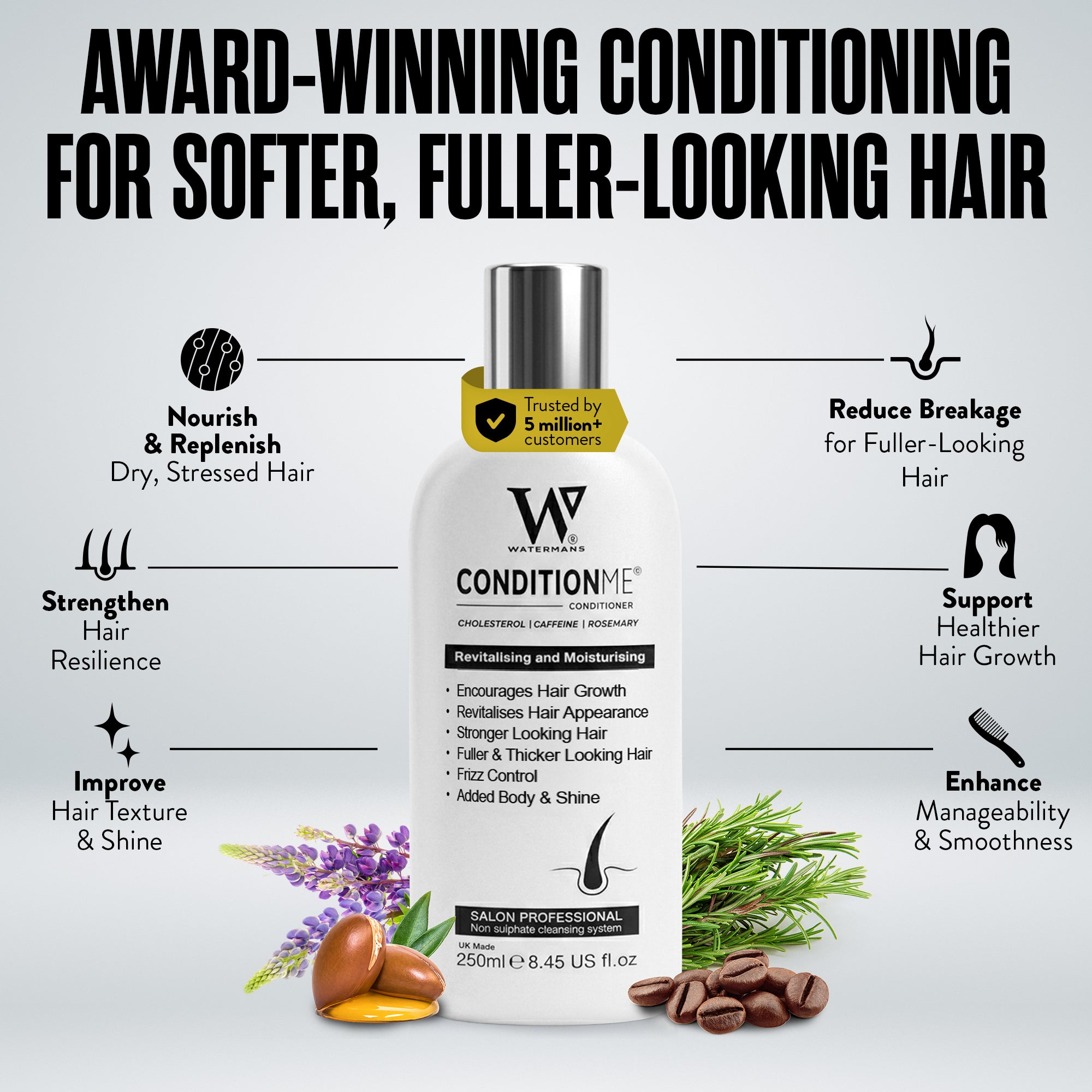
Condition Me® Hair Growth Conditioner, 13.95
Breakage defence for the mid-lengths and ends. If you are chasing length rather than density, this is the more important half of the routine.
Please note: Watermans products are 100% cosmetic and do not treat medical hair loss. Individual results may vary.
How should you measure progress?
Measurement is the part of a hair growth guide that everyone skips, and it is why most people quit at exactly the point where results would have started to show. The mirror is a terrible instrument for slow change, so measure properly instead.
- Take photographs monthly in the same place, same light, same parting, dry hair. Once a month, not once a week.
- Measure from a fixed point. Run a tape from your crown to the ends, and record it. Expect roughly 1cm a month.
- Count the shed for three days. Collect what comes out and count it. Consistently over 100 a day, or a clear change from your own baseline, is worth a GP conversation.
- Change one thing at a time. Start four things at once and you will never know which one worked.
- Give it six months before judging anything. Three is the earliest you can see a signal at all.
When should you see a doctor?
See a GP if shedding is sudden or heavy, if it continues beyond three months, if you are losing hair in defined patches rather than diffusely, if your scalp is painful, scaly or scarring, or if hair change comes alongside fatigue, weight change or feeling the cold. Pattern loss at the parting or temples is also worth raising early, because options are discussed with a clinician rather than chosen from a shelf, and time matters with all of them. If your question is about products or a routine rather than a medical one, you can talk to Gail Waterman, our co-founder, as an AI avatar on the Watermans homepage.
Frequently asked questions
How long can hair actually grow?
Until your growing phase ends, which is genetic and lasts between two and seven years. That sets a terminal length somewhere between the shoulders and the waist for most people. Once hair reaches that length it stops appearing to grow, because new growth and shedding balance out.
What improves hair growth most?
Correcting a genuine deficiency, if you have one. After that, the biggest wins come from keeping the hair you grow: less heat, less tension, gentler wet handling and conditioning every wash. There is no safe way to make the follicle produce hair meaningfully faster.
Do hair growth shampoos work?
They support the scalp environment and improve how hair looks and behaves, which is genuinely worth something. They do not change follicle biology, and any product marketed as making hair grow dramatically faster is overselling.
Is DHT bad for hair?
Only for people whose follicles are genetically sensitive to it, and only on the scalp. In those people it drives the miniaturisation behind pattern loss. In everyone else it does nothing to the hair, and it plays normal roles elsewhere in the body.
Does trimming make hair grow faster?
No. Growth happens at the follicle and cutting the end has no influence on it. Trimming still helps you keep length, because removing splits stops them travelling up the shaft and costing you more than the trim.
How much hair loss per day is normal?
Between 50 and 100 hairs a day, and more on wash days simply because washing dislodges hairs already released. What matters is a change from your own normal, not the absolute number.
Can hair growth be stimulated naturally?
Scalp massage is pleasant, harmless and may modestly help circulation. A good diet supports normal hair. Beyond that, most natural claims outrun their evidence. Treating the foundations well is a better use of effort than chasing an ingredient.
How long before I see results from a new routine?
Three months at the earliest for a signal, six months for a fair verdict. That is set by the hair cycle rather than by the product, and it is the same for any routine.
Sources and references
- NHS, Hair loss, on normal shedding, common causes and when to seek advice.
- British Association of Dermatologists, Telogen effluvium, on the hair cycle, resting-phase shedding and the three-month delay after a trigger.
- British Association of Dermatologists, Traction alopecia, on tension damage from tight styling.
- NHS, Iron deficiency anaemia, on iron status and testing.
- NHS, Underactive thyroid, on thyroid symptoms including hair changes.
What is the bottom line on hair growth guide?
The short version of this hair growth guide: hair grows about a centimetre a month whatever you do, your maximum length is mostly genetic, and the winnable battle is retention rather than speed. Work out whether you are dealing with pattern loss, a shed or breakage, because most people stuck at one length have breakage. Get ferritin and thyroid checked if shedding is diffuse or recent. Then run a dull, consistent routine that reduces heat, tension and friction, photograph it monthly, and give it six months before you judge it. That is genuinely the whole thing, and anyone promising faster is selling you something. We look at how to grow hair faster black male separately, with the practical steps.
Watermans is a UK-made hair care brand with over 6.5 million bottles sold since 2012.
If you would rather not assemble it yourself, our hair growth routine set is the ready made version.