

Hair Elasticity: What It Is and How to Test It
Hair elasticity is the ability of a strand to stretch under tension and return to its original length without snapping, and it is the single most useful measure of whether your hair will survive being brushed, tied up and styled. Hair with good elasticity bends and springs back. Hair that has lost it either snaps at once or stretches like chewing gum and stays stretched. You can test hair elasticity at home in about ten seconds with one wet strand, and the result tells you what your hair needs next.
Key takeaways
- Elasticity is stretch plus recovery. Stretch on its own is not a good sign.
- Healthy wet hair stretches by roughly a quarter to a third of its length and returns. Dry hair stretches far less.
- One wet strand and ten seconds gives you a usable answer, and it costs nothing.
- Snapping instantly means the hair is dry and brittle. Stretching a long way and staying stretched means it has had too much protein and not enough moisture.
- Bleach, heat above about 150C, hard water and brushing wet hair roughly are the four biggest everyday causes of lost elasticity.
- Elasticity is a property of dead fibre, so it is maintained and protected rather than restored to new. The part you can change is what happens from today onwards.
What is hair elasticity, in plain terms?
Elasticity describes how far a strand can be pulled before it deforms permanently, and how completely it returns when you let go. A single hair is mostly cortex, a bundle of keratin protein arranged in long coiled chains. Those chains are held to each other by three kinds of link: hydrogen bonds, which water breaks and reforms every time you wash and dry your hair, salt bonds, which respond to pH, and disulphide bonds, which are the permanent structural ones and the reason bleach and perms change hair for good.
When you stretch a wet hair, the coiled keratin chains straighten and the hydrogen bonds slide and reform. Let go, and the chains recoil. That recoil is elasticity. Once enough disulphide bonds have been broken, usually by chemical processing, the chains can straighten but there is nothing strong enough left to pull them back, so the fibre stays long and thin and then breaks.

How do you test hair elasticity at home?
The wet stretch test takes one shed hair and about ten seconds. Take a strand from your brush rather than pulling one from your head, wet it thoroughly, hold it between the thumb and forefinger of both hands with roughly five centimetres between them, and pull gently and steadily. Do not yank. What happens next puts your hair in one of three groups.
| What the strand does | What it means | What it needs |
|---|---|---|
| Stretches a little, springs back fully | Good elasticity. The cortex is intact. | Maintenance. Do not change anything drastically. |
| Stretches a long way, stays stretched, feels slack | Too much moisture and not enough structural protein. Often called over-conditioned or mushy hair. | A protein-containing conditioner or mask, and fewer heavy leave-ins. |
| Snaps almost immediately with no stretch at all | Dry, brittle, low moisture. The most common result on bleached, heat-styled or hard-water hair. | Moisture, oils and a gentler routine. Protein will make this worse in the short term. |
| Stretches, then snaps at the halfway point | Mixed condition, usually older ends on healthier mid-lengths. | Test again using a strand from the ends only, and act on that result. |
Test wet, not dry
Dry hair stretches by only a few per cent before breaking even when it is in excellent condition, so a dry strand snapping tells you very little. Water breaks the hydrogen bonds and lets the keratin chains move, which is exactly the property you are trying to measure. Always wet the strand first, and always test a hair from the ends as well as one from the root, because they are years apart in age.
What makes hair lose its stretch in the first place?
Loss of elasticity comes from cumulative damage to the cortex, and four everyday causes account for most of it. None of them is dramatic on any single day, which is exactly why they are easy to miss. Our fuller guide to what causes hair damage covers the chemistry in more depth.
Bleach and lightening. Lightening works by breaking into the cortex and oxidising pigment, and it breaks disulphide bonds on the way through. This is the largest single cause of lost elasticity and it is not undoable. Hair that has been lifted several shades will always need more careful handling than virgin hair.
Heat above roughly 150C. Keratin begins to change structurally somewhere around 150C to 170C, and most straighteners run far hotter than they need to. The damage is cumulative across hundreds of sessions rather than obvious after one.
Hard water. Calcium and magnesium deposit on the fibre surface, making hair feel rough and coated, which increases friction during brushing and makes the strand behave as though it is stiffer than it is. Much of the UK sits in a hard water area, and it is a genuinely underrated variable.
Handling wet hair roughly. Wet hair is at its most extensible and its most fragile at the same time. Dragging a fine-tooth comb from the roots down through a wet tangle does more mechanical damage in thirty seconds than a week of ordinary wear.
Does your hair need moisture or protein?
This question decides your entire routine, and getting hair elasticity backwards is the most common self-inflicted hair problem there is. The stretch test answers it directly: hair that snaps without stretching needs moisture, and hair that stretches and stays stretched needs protein. Adding protein to brittle hair makes it more brittle. Adding more moisture to slack hair makes it mushier.
| Sign | Needs moisture | Needs protein |
|---|---|---|
| Feel when dry | Straw-like, rough, crunchy | Soft, limp, almost gummy |
| Feel when wet | Squeaky, tangles instantly | Slimy, stays slippery after rinsing |
| Wet stretch | Snaps with almost no give | Stretches a long way, does not recover |
| Response to a rich mask | Improves noticeably | Gets worse, goes flatter |
| Typical cause | Bleach, heat, hard water, sun | Too many protein products, or bond builders used weekly |
| What to do first | Oils, richer conditioner, lower heat | Pause protein for a fortnight, then reintroduce monthly |
The elasticity reset plan
One email with the four week plan on a single page: the stretch test scoring chart, exactly which product goes on which day depending on your result, the heat settings that matter, and the five handling habits that undo most of the damage between washes.
How do you rebuild hair elasticity week by week?
You cannot rebuild a broken disulphide bond at home, so the honest goal is to stop losing ground, fill the gaps in the fibre cosmetically, and let better-condition hair grow through. Most people see a real difference in how their hair behaves within four weeks, because most of the day to day problem is surface condition and handling rather than deep structural loss.
Week one, stop the bleeding. Drop your heat tools by twenty degrees, use a heat protectant every single time, and switch to detangling with a wide-tooth comb from the ends upwards. Change nothing else, so you can see what these three alone do.
Week two, correct the imbalance. Act on your stretch test result. If the hair snapped, add a richer conditioner and an oil on the last few inches. If it stretched and stayed stretched, pause every protein product and leave-in for two weeks.
Week three, deal with the water. If you live in a hard water area, a final rinse with filtered or bottled water on wash days, or a shower filter, removes a variable most people never consider. It is not a miracle and it is not expensive to try.
Week four, retest and trim. Run the stretch test again on an end strand. Then book a trim, because split and stretched ends do not recover and they travel upwards. Cutting a centimetre routinely saves inches later, and our piece on how to prevent split ends explains why a split spreads.

Which products actually support elasticity?
Cosmetic products cannot rebuild the cortex, and anyone telling you otherwise is selling something. What they can do is reduce the friction that causes mechanical damage, add slip so detangling stops snapping strands, and put a protective layer between your hair and the heat. That is a smaller claim than the category usually makes, and it is the one that holds up. If you are not sure you are getting the basics right, start with how to use conditioner properly, which is where most of the benefit sits.

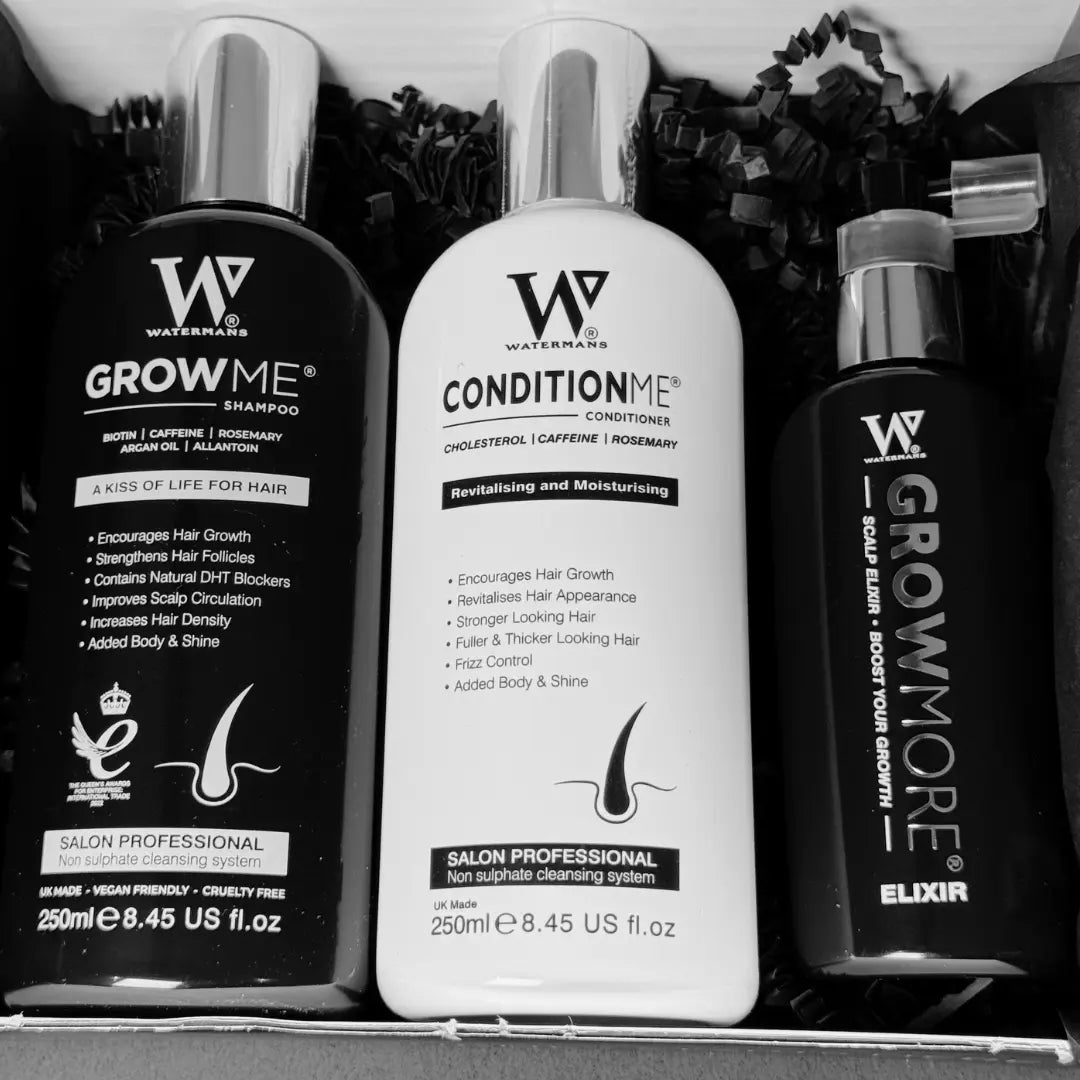
Condition Me® Conditioner, for slip and everyday breakage defence
Cholesterol, shea butter, glycerin and hydrolysed lupine protein. Detangling is where most avoidable damage happens, so a conditioner that lets a comb pass through without tugging is doing more for your elasticity than anything marketed as a repair product.

Masque Me® Mask, weekly, on the last three inches only
Use it on the oldest part of the hair, ten minutes, once a week. If your hair feels limp and slack rather than smooth afterwards, that is the over-conditioned result from the stretch test and you should drop to fortnightly.

Protect Me® Heat Protection Spray, every time heat touches your hair
Protection to 230C. This is the least glamorous product in any routine and the one with the clearest job: keeping the fibre below the temperature at which keratin changes structurally.
Which habits quietly destroy elasticity?
Habits matter more than products for hair elasticity, and all of these are free.
- Brushing wet hair from the roots down. Start at the ends and work upwards, always.
- Rubbing hair dry with a rough towel. Squeeze it in a cotton t-shirt instead.
- Tying hair in the same place every day with a tight elastic. Vary the height and use a soft tie.
- Straightening hair that is not completely dry. The water inside the fibre turns to steam.
- Sleeping with long hair loose on cotton. A loose plait or a smoother pillowcase reduces friction.
- Skipping trims for a year. Damage at the ends spreads upward into hair that was fine.
Is it broken elasticity, shedding, or something else?
These three get confused constantly, and they need completely different responses, so it is worth separating them properly.
Hair breakage is the fibre snapping along its length. Look at what comes out: short fragments with blunt ends and no bulb, plus flyaway pieces standing up around the parting. This is the elasticity problem, and it responds to conditioning and gentler handling, often quickly.
Hair shedding is whole hairs leaving the follicle at the end of their cycle. Those strands have a small pale bulb at one end and are full length. Fifty to a hundred a day is normal, and a temporary increase after illness, childbirth or a stressful period is a recognised pattern called telogen effluvium.
Hair loss from the follicle itself, showing as a widening parting, a receding line or visible scalp, is a medical matter rather than a conditioning one. No mask, oil or conditioner addresses it, and it is worth raising with your GP rather than working through products.
Watermans products are 100% cosmetic and do not treat medical hair loss. Individual results may vary.
Frequently asked questions
What is a normal elasticity result?
Wet hair in good condition stretches by roughly a quarter to a third of its length and returns to close to its original length when released. Dry hair stretches far less, only a few per cent, which is why the test must be done on a wet strand.
Can elasticity be restored once it is lost?
Not structurally. Broken disulphide bonds inside a dead fibre cannot be rebuilt by a cosmetic product. What genuinely improves is surface condition, friction and handling, and hair that grows in afterwards. Most people notice better behaviour within four weeks even though the underlying damage is still there.
Does bond building repair elasticity?
Bond builders work on the fibre and can make damaged hair feel and behave better, which is a real cosmetic benefit. They do not return the hair to its undamaged state, and using them weekly on hair that is already slack tends to make it feel stiffer rather than springier.
How often should I test my hair?
Once a month is plenty, and always after any colour service or a period of heavy heat styling. Test a strand from the ends and one from near the root, since they can give different answers.
Why does my hair stretch and stay stretched?
That is the over-moisturised result. The fibre has plenty of water and not enough structural support, which usually follows months of rich masks, leave-in creams and co-washing. Pausing protein-free heavy conditioners and adding a protein-containing product monthly usually corrects it.
Does hard water really affect elasticity?
It affects how hair behaves rather than the cortex itself. Mineral deposits raise surface friction, so brushing causes more mechanical damage, and hair feels stiff and rough. Filtering the final rinse is a cheap way to test whether it matters for you.
Is fine hair less elastic than thick hair?
Not inherently. Fine hair has a smaller cross section, so the same amount of damage removes a larger proportion of its strength, and it shows problems sooner. The underlying keratin structure is the same.
Does elasticity change with age?
Yes. Older hair tends to have a slightly different lipid profile and a thinner cuticle, and grey hair in particular often feels coarser and less pliable. Handling and heat still matter far more than age for most people.
Can I do the test on a hair I pull out?
Use a shed hair from your brush or pillow instead. Pulling a hair out gives you a strand still attached to its root sheath, which behaves differently, and there is no reason to pull out hair you would rather keep.
Sources and references
- Robbins, C. R., Chemical and Physical Behavior of Human Hair, Springer, the standard reference work on hair fibre mechanics, keratin bonding and tensile behaviour.
- Journal of Cosmetic Science, the peer-reviewed literature on hair tensile strength and the effect of bleaching and thermal styling on the cortex.
- British Association of Dermatologists public information leaflets on hair and scalp care.
- NHS guidance on hair loss, for the distinction between normal shedding, telogen effluvium and hair loss that should be discussed with a GP.
The short version
Hair elasticity is stretch plus recovery, and it is the most honest single measure of hair condition you can take at home. Wet one shed strand, pull gently, and read the result: instant snapping means moisture, endless stretch means protein, springy recovery means carry on as you are. Then protect what you have, because the cortex is dead tissue and every bit of damage is permanent. Lower the heat, detangle from the ends, get the water off the ends faster, and trim regularly. Those four habits will do more for your hair elasticity over a year than any product on any shelf.
Watermans is vegan, UK made, and has sold over 5 million bottles since 2012.