Hair Pigmentation: Why Hair Goes Grey, and What Actually Helps
Hair pigmentation is the colour built into the hair fibre while it grows, and it is decided entirely inside the follicle before the hair ever reaches the surface. That single fact explains almost everything people find confusing about going grey: the hair on your head cannot change colour, only the hair that grows next can, and once pigment cells at a follicle stop working, the strands that follow come through white.
Hair pigmentation comes from melanin deposited into the growing fibre by pigment cells at the base of the follicle. Once a hair has emerged it is biologically inert, so its colour is fixed for life. Grey and white hair appears when those pigment cells reduce or stop production, which DermNet describes in localised form as poliosis, a lack of melanin in the hair shafts. Nothing applied to existing hair can restore colour that was never deposited in it.
Key takeaways
- Hair pigmentation is deposited during growth, so an existing strand can never change colour.
- Grey hair is not grey: it is a mix of pigmented and white strands read together by the eye.
- DermNet notes that white patches of hair can repigment in some situations, such as after alopecia areata.
- Colour change and hair thinning are separate processes that happen to arrive in the same decades.
- Cosmetic products cannot restore pigment. They can improve how grey hair looks, feels and behaves, which is a real and different benefit.
How does hair pigmentation actually get into the hair?
Pigment cells sitting at the base of the follicle produce melanin and hand it to the cells that build the hair fibre, so colour is laid down as the strand is constructed. Two forms of melanin do the work in different proportions: eumelanin gives brown and black, phaeomelanin gives red and yellow tones, and the mix plus the amount determines everything from jet black to pale blond.
Because the fibre leaving the scalp is dead tissue, no biological process can add pigment to it afterwards. DermNet makes the mechanism plain in its account of poliosis, describing it as a lack of melanin in the hair shafts of the affected area, arising either from an inherited defect in melanisation or from destruction of the pigment cells at the base of the follicle. Either way the failure is at the source, not along the length.

Why does hair go grey, and can you predict when?
Greying happens as pigment cells at individual follicles gradually reduce output and eventually stop, follicle by follicle rather than all at once. Genetics is the dominant factor in when this begins, which is why family history predicts your timing far better than lifestyle does. The process is gradual across the scalp, so what people call going grey is really a slowly shifting ratio of pigmented to unpigmented strands.
That explains a common misreading. Nobody has grey hair in the sense of grey strands: they have white strands mixed among coloured ones, and the eye averages the two into a grey impression. Hold a single white hair against a dark background and this becomes obvious immediately. It also explains why greying looks like it accelerates suddenly, since the visual effect becomes noticeable only once the proportion of white crosses a threshold.
The stress question, answered honestly
Sudden overnight greying is not physiologically possible, because existing strands cannot lose colour. What can happen is that a shedding episode releases a large number of pigmented hairs at once, leaving a higher proportion of white ones behind, which reads as rapid greying. The change is in the ratio, not in the individual hairs.
Which medical conditions change hair pigmentation?
Several recognised conditions affect pigment specifically, and they look different from ordinary age-related greying. DermNet describes poliosis as a localised patch of white hairs, and is careful to call it a clinical sign rather than a condition in its own right, listing associations including alopecia areata, vitiligo, piebaldism and halo naevus, and noting it can follow an injury, shingles or radiotherapy.

The NHS explains that vitiligo is caused by a lack of melanin, that it can develop where there are hair roots such as on the scalp, and that this lack of melanin can turn the hair in the affected area white or grey. Vitamin B12 or folate deficiency is another recognised cause of pigment change, and it is checked with a straightforward blood test. A sudden, localised or patchy pigment change is therefore worth showing to a GP rather than treating as cosmetic.
There is also one genuinely hopeful finding worth knowing. DermNet notes that poliosis may remain stable but that the hairs can repigment in some situations, such as with alopecia areata. Colour returning is uncommon, but it is not unheard of where the underlying cause resolves.
Get a discount on the grey and changing hair range
Join the Watermans mailing list and we will email a discount code straight to your inbox, so you can try the grey and changing hair range for less. Vegan, made in the UK, over 6.5 million bottles sold since 2012.
Why does grey hair feel so different to manage?
Unpigmented hair genuinely behaves differently, and it is not your imagination. Without melanin the fibre often feels coarser and drier, sits with more of a wiry texture, and holds less moisture, so it can look frizzier and resist styling. It is also more transparent, which makes it show up yellow tones from products, hard water, smoke and pollution far more readily than pigmented hair does.
| What changes | Why it happens | What actually helps |
|---|---|---|
| Coarse, wiry texture | Loss of melanin alters how the fibre sits and how it holds moisture | Richer conditioning and a weekly mask, focused on the mid-lengths and ends |
| Yellow or brassy cast | Transparent strands pick up tones from water, products and pollution | A purple-toned shampoo used occasionally, not daily, and a clarifying wash when buildup accumulates |
| Frizz and flyaway | Lower moisture retention and higher porosity | Leave-in conditioning, a cooler dryer setting and a wide tooth comb on wet hair |
| Looks thinner overall | White hair reflects light differently, and greying decades overlap with thinning decades | Volume-focused cleansing, and a separate look at whether thinning is genuinely happening |
Sun exposure is worth a specific mention, because unpigmented hair has no melanin to absorb ultraviolet light, so it is more exposed to sun-related dryness and yellowing. A hat in strong sun does more for grey hair than most products.
Is this hair loss, hair shedding, hair breakage, or just colour?
Colour change is a separate process from any of the three, and confusing them leads people to the wrong fix. Hair pigmentation loss changes what colour a strand is, with no effect on how many hairs you have. Hair loss is follicles producing progressively finer hairs in a pattern. Hair shedding is whole hairs released early after a disturbance to the cycle. Hair breakage is the fibre snapping along its length.
Greying and thinning overlap in time for most people, which is why they get bundled together, but nothing about losing pigment causes hair to fall. If your hair is both greyer and genuinely thinner, those are two separate conversations with two different answers, and measuring density properly is how you find out whether the thinning is real or an artefact of how white hair reflects light.

Can anything restore hair pigmentation?
No topical product restores colour to hair that grew without pigment, and that is a matter of biology rather than of formulation quality. Pigment is deposited inside the follicle during growth, and a strand that has already emerged is dead tissue. Any product claiming to bring grey hair back to its old colour from a bottle is describing something that cannot happen at the fibre.
Correcting a genuine deficiency is the one exception that sits with a doctor rather than a shelf. Where pigment change is linked to a B12 or folate deficiency, addressing that deficiency through a GP can make a difference, which is exactly why a blood test is more useful than a supplement bought on a hunch. Everything else is either cosmetic colour or accepting the change.
Cosmetic colouring is a legitimate answer for many people, and our guide to transitioning to grey with highlights covers doing it gradually rather than in one jump. If you colour, be aware that the process is chemically demanding on the fibre: managing hair fall after colouring is worth reading first, since what people report as loss after colouring is very often breakage.

What routine actually suits grey and greying hair?
A routine for unpigmented hair should prioritise moisture, gentle handling and tone control, in that order. Wash as often as suits your scalp rather than on a rule, condition every wash with attention to the mid-lengths and ends, use a deeper conditioning mask weekly, and reach for a toning shampoo only when brassiness actually appears rather than as a default. Heat protection matters more here, because coarser drier fibres snap more readily.
Diet advice around pigment deserves a sceptical eye. Nutrition supports healthy hair generally, and genuine deficiencies are worth correcting, but no food restores melanin production to follicles that have stopped. Our page on foods linked to melanin in hair sets out what the evidence does and does not support.

Masque Me® Hair Mask £24.95
A deep conditioning mask for the coarser, drier texture that unpigmented hair tends to develop. Used weekly on the mid-lengths and ends.
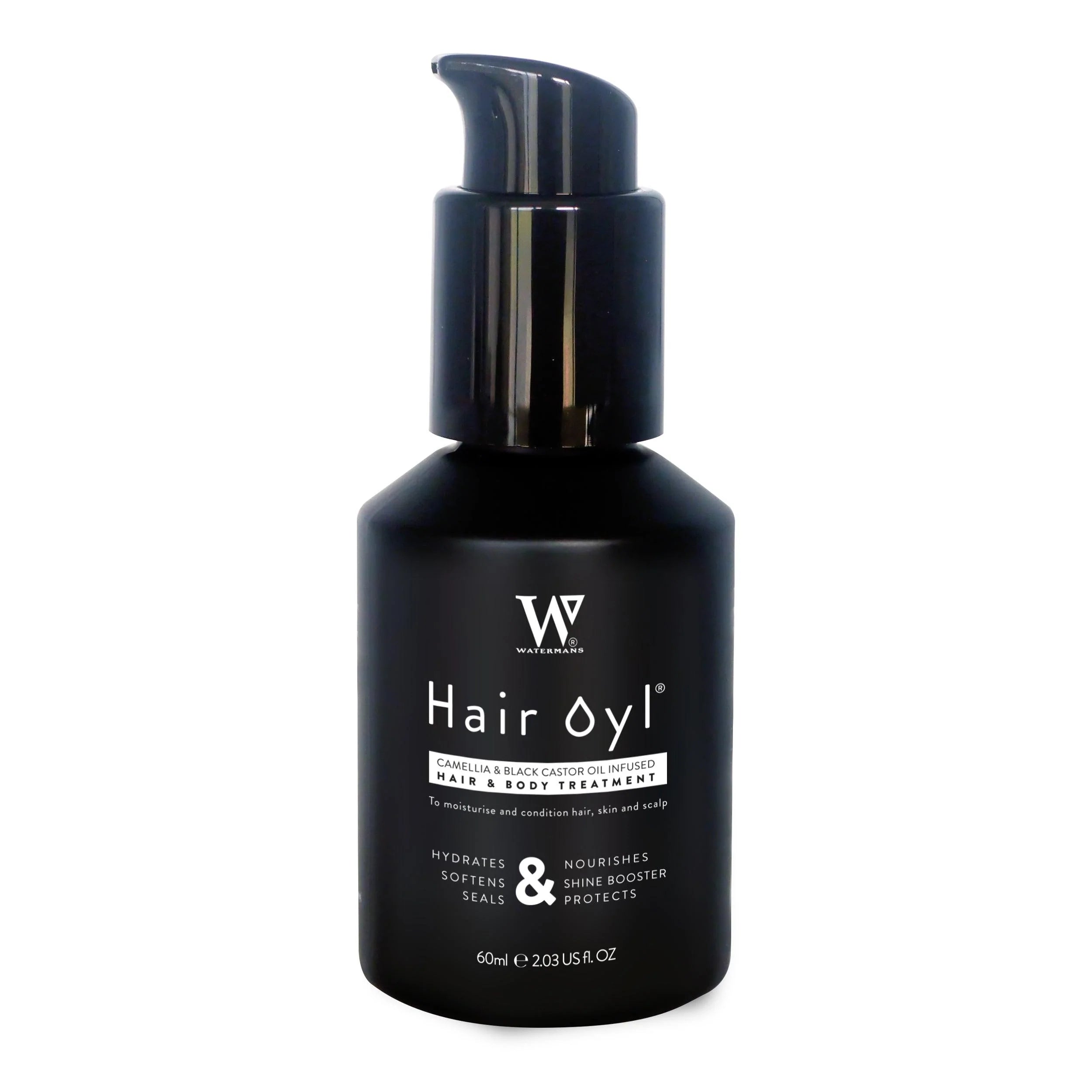
Camellia & Black Castor Hair & Body Oil £24.95
A lightweight oil for smoothing frizz and adding shine to grey hair, which scatters light differently and can look dull without it.

Protect Me® Heat Protection Spray £13.95
Coarse grey strands snap more readily under heat. Heat protection before a dryer or straighteners keeps the length you have.
When should you see a GP about a pigmentation change?
See a GP if hair colour changes suddenly, in patches rather than gradually, or alongside pale patches of skin, since that combination can point to vitiligo. Go too if pigment change comes with fatigue, breathlessness or a sore tongue, which can accompany B12 or folate deficiency, and if a white patch appears after an area of hair loss or an injury to the scalp. Gradual greying spread evenly across the scalp over years is a normal process and needs nothing.
Watermans makes cosmetic hair care. We do not run clinics, do not assess anyone and do not give medical advice, so everything above belongs with a GP. If your question is about products or a routine rather than a medical one, you can talk to Gail Waterman, our co-founder, as an AI avatar on the Watermans homepage.
What are the frequently asked questions about hair pigmentation?
Can grey hair turn dark again on its own?
An individual strand cannot, because colour is fixed when the fibre is built and the emerged hair is dead tissue. New hairs from the same follicle can come through pigmented again if pigment cells recover, and DermNet notes hairs can repigment in some situations such as with alopecia areata, though this is uncommon.
Does plucking a grey hair make more grow back?
Plucking one hair does not affect neighbouring follicles, so the myth does not hold. Repeated plucking can damage a follicle over time, which is a reason to leave them alone, and the hair that grows back from that follicle will be unpigmented anyway.
Why does grey hair feel coarse and wiry?
Losing melanin changes how the fibre sits and how well it holds moisture, so unpigmented strands are frequently drier, more porous and stiffer than pigmented ones from the same head. Richer conditioning and weekly masking address the symptom, which is the practical answer.
Why is my grey hair turning yellow?
Unpigmented hair is more transparent, so it picks up tones from hard water, styling products, smoke, pollution and sun far more readily than coloured hair. Occasional use of a purple-toned shampoo and a clarifying wash for buildup usually resolve it.
Can stress turn hair grey overnight?
Not in the literal sense, since existing strands cannot lose their colour. A shedding episode can release many pigmented hairs at once and leave a higher proportion of white ones visible, which produces a convincing impression of sudden greying without any strand changing.
Does going grey mean my hair is getting thinner?
No, these are separate processes that happen to overlap in the same decades. White hair reflects light differently and can read as sparser than it is, so if you suspect real thinning it is worth measuring rather than judging by appearance.
Is a white patch of hair something to worry about?
A localised patch of white hair is what DermNet calls poliosis, which it describes as a clinical sign rather than a condition in its own right, associated with conditions including vitiligo and alopecia areata. Because it points at an underlying cause rather than being one, it is worth showing to a GP.
Do supplements restore hair colour?
No supplement restores melanin production to follicles that have stopped, though correcting a genuine B12 or folate deficiency identified by a blood test can matter. Taking something unprompted risks masking a deficiency that a GP would otherwise have found.
What is the bottom line on hair pigmentation?
Hair pigmentation is set inside the follicle while a hair grows, which means existing strands cannot change colour and no topical product can restore pigment to them. Greying is genetically timed and gradual, it is separate from thinning, and the practical work is managing the texture and tone that unpigmented hair brings rather than chasing colour back. Sudden, patchy or symptom-accompanied change is the version that belongs with a GP.
If grey hair has left you with coarser, drier lengths, a weekly deep conditioning hair mask does more for how it looks and behaves than anything marketed at the colour itself.
Sources & references
- DermNet, Poliosis, checked 17 September 2026.
- NHS, Vitiligo, checked 17 September 2026.
- NHS, Vitamin B12 or folate deficiency anaemia, checked 17 September 2026.
- DermNet, Alopecia areata, checked 17 September 2026.
- NHS, Hair loss, checked 17 September 2026.
- NHS, Hair dye reactions, checked 17 September 2026.
Watermans products are 100% cosmetic and do not treat medical hair loss. Individual results may vary.