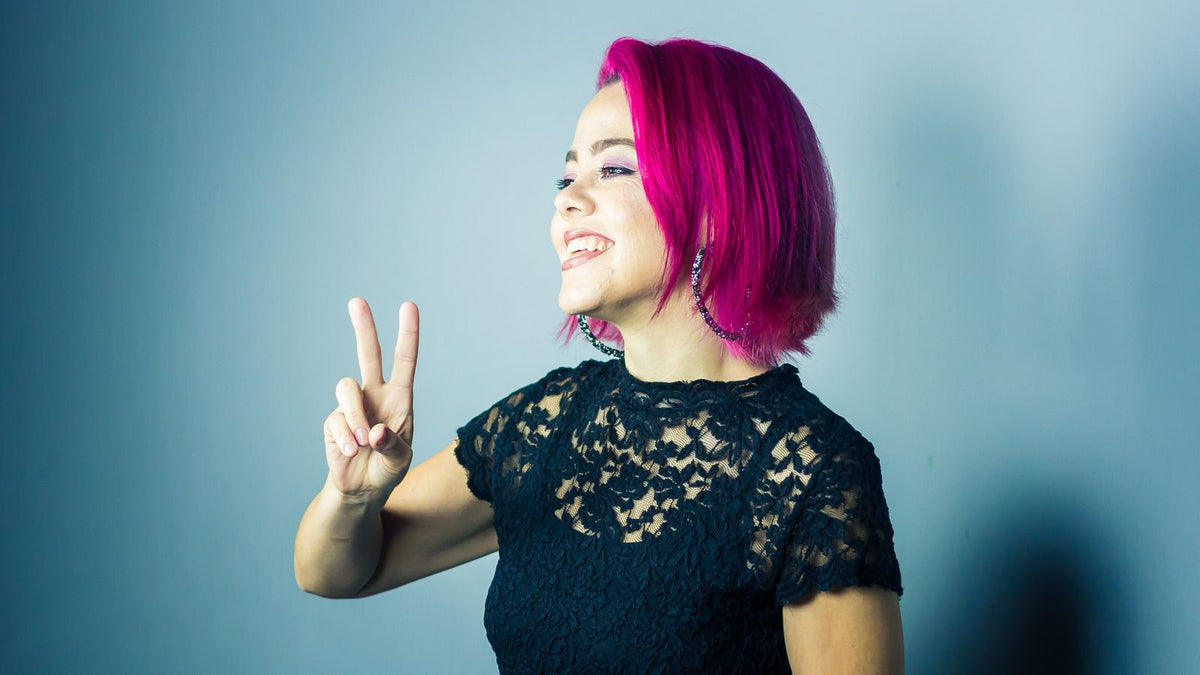
Nonbinary Hair: Cuts, Colour and a Routine That Lasts
If you are looking for a straight answer, nonbinary hair is not a single cut or colour. It is hair that has been chosen rather than assigned, and the practical questions it raises are almost all about the fibre rather than the gender: how to survive repeated bleaching, how to keep a grown-out crop from looking accidental, and how to build a routine that nobody has labelled for you.
Our heat protection spray
Protect Me® Heat Protection Spray, £13.95. A leave in spray that shields hair from heat styling, helps control frizz and keeps colour looking fresher for longer.
Nonbinary hair describes hair styled to sit outside the men's or women's categories, which in practice means short, long and everything between. The care problems are consistent and physical: bleach and vivid colour weaken the fibre, clipper work needs a four to six week rhythm, and androgynous shapes rely on texture rather than length. None of that requires gendered products, only ones matched to what your hair has been through.
Key takeaways
- The look is defined by intent, not by length. There is no standard cut.
- The commonest real problem is bleach damage, not growth: lightened hair loses tensile strength and snaps.
- Hair breakage, hair shedding and hair loss are three separate things, and vivid colour only causes the first.
- Short shapes need a cut every four to six weeks to keep their line. That schedule is the style, not a luxury.
- Shampoo and conditioner are matched to hair condition, never to gender. Ignore the pink and blue bottles.
What does nonbinary hair actually mean?
The phrase means a haircut, colour or styling choice made to sit outside the expected men's or women's presentation, chosen by the person wearing it. The phrase describes an intention rather than a shape, which is why it covers a shaved head, a shoulder-length shag, a mullet, a long undercut and a bleached crop equally well. There is no checklist to satisfy and no one look that qualifies.
That matters for care, because the hair itself does not know any of this. A bleached crop behaves like bleached hair whoever is wearing it, and a grown-out shag tangles the same way on everyone. Once you separate the identity question from the fibre question, the whole subject becomes a lot more practical: what state is this hair in, and what does it need next?
Which cuts work best for nonbinary hair?
The cuts that work hardest are the ones built on structure rather than length, because structure is what reads as deliberate. A short crop with a soft top, a long undercut, a shag with curtain-style framing and a blunt mid-length bob all sit comfortably outside gendered expectations, and all of them keep their shape as they grow because the weight has been removed in layers rather than at the ends.
Length is the least important variable. What decides whether a shape works is your growth pattern, your density and your hair's natural texture, which is why the same instruction produces a different result on different heads. A cowlick at the crown will fight a flat forward fringe forever; a fine, straight head of hair will not hold a heavily textured shag without product. Tell a barber or stylist what you want the hair to say, then let them choose the technique.
| Shape | Cut interval | What it asks of your hair | Main care risk |
|---|---|---|---|
| Buzz or short crop | 3 to 4 weeks | Nothing in particular. Works on any density. | Scalp exposure and dryness, not breakage. |
| Long undercut | 4 to 6 weeks | Enough weight on top to fall cleanly. | The disconnected line blurs fast if the cut slips. |
| Textured shag | 8 to 10 weeks | Some natural movement, or heat styling. | Ends fray where the layers are shortest. |
| Blunt mid-length | 6 to 8 weeks | Decent density to keep the line solid. | Splitting along the blunt edge. |
| Bleached anything | 4 to 6 weeks plus colour upkeep | Fibre strong enough to survive lightening. | Breakage. This is the one that goes wrong. |

Why does bleached nonbinary hair break, and what stops it?
Bleach breaks hair because lightening is a chemical process that opens the cuticle and removes pigment from inside the fibre, leaving the internal protein structure more porous and measurably weaker. Repeat it on the same length and the damage is cumulative, which is why the third round of vivid colour usually goes wrong rather than the first. The hair does not recover its original strength; it only stops getting worse.
What genuinely helps is mechanical restraint, and it is unglamorous. Cut the number of hot-tool passes. Use a wide-tooth comb on wet hair instead of a brush, because wet hair stretches further before it snaps. Put heat protection on before any dryer or iron. Keep colour refreshes to the new growth where a stylist judges that possible, rather than pulling bleach through the lengths again. Our guide to repairing bleach damaged hair sets out what is realistic once the damage is done, and it is worth reading before the next appointment rather than after it.
Patch test every colour, every time
The NHS advice on hair dye reactions is to do a patch test before each application, even with a product you have used before, because sensitisation can develop after years of trouble-free use. A reaction to an oxidative dye can be severe. This is the one step in a colour routine that is genuinely about safety rather than results.

Is it hair breakage, hair shedding or hair loss?
Three different things get called the same thing, and vivid colour only causes one of them. Hair breakage is the fibre snapping along its length, which is mechanical and chemical, and is what bleach and hot tools produce. Hair shedding is whole hairs leaving the scalp early because the growth cycle was disturbed, usually by illness, a big weight change or severe stress. Hair loss is follicles producing progressively finer hairs or stopping, which is genetic or medical and has nothing to do with your colourist.
The test takes ten seconds. A shed hair has a small pale club-shaped bulb at the root end. A broken hair has no bulb and both ends look cut or frayed. If your bathroom floor is full of short broken pieces, that is breakage and it is fixable with handling. If it is full of long hairs with bulbs, that is shedding, and the shedding triggers list is longer than most people expect. If the parting is genuinely widening over months, that is a GP conversation, not a hair-care one.
Get a discount on the coloured and bleached hair range
Join the Watermans mailing list and we will email a discount code straight to your inbox, so you can try the coloured and bleached hair range for less. Made in the UK, over 6.5 million bottles sold since 2012.
How do you build a nonbinary hair routine without gendered products?
You match products to hair condition and scalp behaviour, and ignore the marketing entirely. There is no physical difference between a shampoo sold to men and one sold to women beyond fragrance and bottle design; the meaningful variables are how much the formula cleanses, whether the conditioner is light or heavy, and whether you need protection before heat. Build the routine from those three questions and the aisle labels become irrelevant.
A workable default for coloured or bleached nonbinary hair looks like this: a gentler shampoo used two or three times a week rather than daily, a conditioner every wash concentrated on the mid-lengths and ends, a deeper mask once a week, and heat protection every single time a hot tool comes out. If your scalp is oily and your ends are fried, treat them as two different surfaces with two different products, which is what most people with bleached lengths actually need. Our scalp health guide covers the top half of that problem.


Protect Me® Heat Protection Spray £13.95
Heat protection sprayed on before the dryer or iron is the single highest-value step for bleached or coloured lengths, because it reduces the thermal damage that turns porous hair into broken hair.

Masque Me® Hair Mask £24.95
A weekly mask on the mid-lengths and ends, left the full time rather than rinsed straight off, is what keeps repeatedly lightened hair feeling like hair rather than straw.

Condition Me® Hair Growth Conditioner £13.95
Conditioner every wash, concentrated below the roots, is the unexciting habit that protects length. Fine hair included: use less, not none.
What should you ask a barber or stylist for?
Ask for the shape and the feeling, not the gendered name of a cut. Saying "I want a short crop with enough weight on top to push forward, and I do not want it to read as a men's cut" gives a stylist far more to work with than naming a haircut from a photo. Bring two or three reference pictures on hair of a similar texture and density to yours, because that is the variable that decides whether a shape is achievable.
Be direct about the booking too. Many UK salons still run gendered price lists, and you are entitled to ask which service you are being charged for and why before you sit down. Plenty of salons and barbers now advertise gender-neutral pricing based on the time and technique involved rather than the client, and a quick phone call before you book saves an uncomfortable conversation in the chair. If a stylist reacts badly to the question, you have learned something useful cheaply.
Do tight styles and daily heat cause lasting damage?
Tight styles can cause lasting damage, and it is a different mechanism from heat. Persistent tension on the same follicles, from tight ponytails, braids or repeatedly pinned styles, produces traction alopecia, which DermNet describes as hair loss caused by pulling forces on the hair and which can become permanent if the tension continues for long enough. Early on it is reversible by changing the style; late on the follicles are scarred and it is not.
Daily heat is less dramatic but more constant. Each pass of an iron or a hot dryer on dry hair removes a little more of the fibre's ability to stretch without snapping, and on bleached hair that margin is already thin. The practical rule is one pass, not four, on a cooler setting, with protection on first. Our breakdown of what actually causes hair damage ranks the culprits so you can drop the worst one rather than trying to fix everything at once.
How does nonbinary hair differ from hair care during a gender transition?
Nonbinary hair care is about cuts, colour and fibre condition, while hair care during a medical transition is about hormones changing what the follicle produces. They overlap in the mirror but almost nowhere else. A bleached crop needs protein, moisture and restraint. Hair going through a hormonal change needs time, realistic expectations and, for anything medical, a clinician.
If hormones are part of your picture, the relevant reading is different. Our transgender trichology guide covers how hair behaves through transition, and the transgender hair care routine covers the practical care that goes with it. This page deliberately stays on the styling side so those pages can own the hormonal side properly, rather than both doing half a job. For masculine and feminine cuts as well, our gender-affirming hair guide sets out options in every direction. Our guide to hair care during gender affirming care is the place to go next on that.
What are the frequently asked questions about nonbinary hair?
Is there one specific cut that counts?
No. The category covers shaved heads, crops, mullets, shags and long layered hair. What makes a cut work is that you chose it and it suits your growth pattern and density, not that it matches a named style.
How often should a short nonbinary crop be cut?
Every three to six weeks, depending on how sharp you want the line. A buzz or tight crop loses its shape fastest, at about three to four weeks; a long undercut holds for four to six.
Does bleaching cause hair loss?
Bleaching causes hair breakage, not hair loss. The fibre snaps because lightening weakens it, so hair looks shorter and thinner, but the follicle is unaffected. Genuine hair loss from a widening parting is a separate issue for your GP.
Do I need products made for my gender?
No. Shampoo and conditioner work on hair condition, not gender. Choose by how much your hair needs cleansing, how much weight your conditioner should add, and whether you use heat.
Can I ask for gender-neutral pricing at a salon?
Yes, and it is worth asking before you book. Many UK salons now price by the time and technique a cut takes rather than by the client, and a phone call establishes that in thirty seconds.
Is vivid colour worse for hair than a permanent dye?
Vivid colour itself is usually gentle, because the semi-permanent pigments sit on and just inside the cuticle. The damage comes from the bleach needed first to lighten the hair enough for the colour to show.
Will my hair grow back thicker after a buzz cut?
No. Cutting hair does not change the follicle, so it grows back at the same diameter it had before. Freshly cut ends are blunt rather than tapered, which feels coarser without being thicker.
Can Watermans products help bleached hair?
They can help with condition and breakage, which is the real problem with bleached hair. Heat protection, conditioner and a weekly mask reduce further damage and make the length you have look and feel better. They are cosmetic products and do not change the follicle.
What is the bottom line on nonbinary hair?
The bottom line on nonbinary hair is that the identity part is settled the moment you decide, and everything left over is ordinary hair science. Choose a shape built on structure so it grows out well, respect what bleach does to the fibre, keep the cut interval you actually need, and buy products for the condition your hair is in rather than the gender on the bottle. That is the whole method.
If one thing on this page is worth acting on, make it heat protection before every hot tool. It is the cheapest intervention with the largest effect on bleached or coloured hair, and it is the difference between growing length and constantly cutting breakage off the ends. Hair that stays attached always looks better than hair that has been styled hard.
If you want one product to start with for coloured or bleached lengths, use a heat protection spray before every dryer and iron pass. It is the step that protects the length you already have. If your question is about products or a routine rather than a medical one, you can talk to Gail Waterman, our co-founder, as an AI avatar on the Watermans homepage. If your parting is genuinely widening or your scalp is sore or scaling, see your GP rather than a stylist.
Sources & references
- NHS, Hair dye reactions, checked 17 September 2026.
- DermNet, Traction alopecia, checked 17 September 2026.
- DermNet, Hair loss (the hair cycle and its phases), checked 17 September 2026.
- DermNet, Telogen effluvium, checked 17 September 2026.
- NHS, Hair loss, checked 17 September 2026.
Watermans products are 100% cosmetic and do not treat medical hair loss. Individual results may vary.