Graft Survival: How to Protect Your Hair Transplant Grafts
Graft survival is the question everyone asks after a hair transplant: will the hairs that were moved actually take and keep growing? The answer depends on decisions made before, during and after surgery, many of which are in your hands. This guide explains what affects it, the recovery timeline the NHS describes, the normal shedding that worries so many people, and how to choose a clinic you can trust.
Our hair growth shampoo
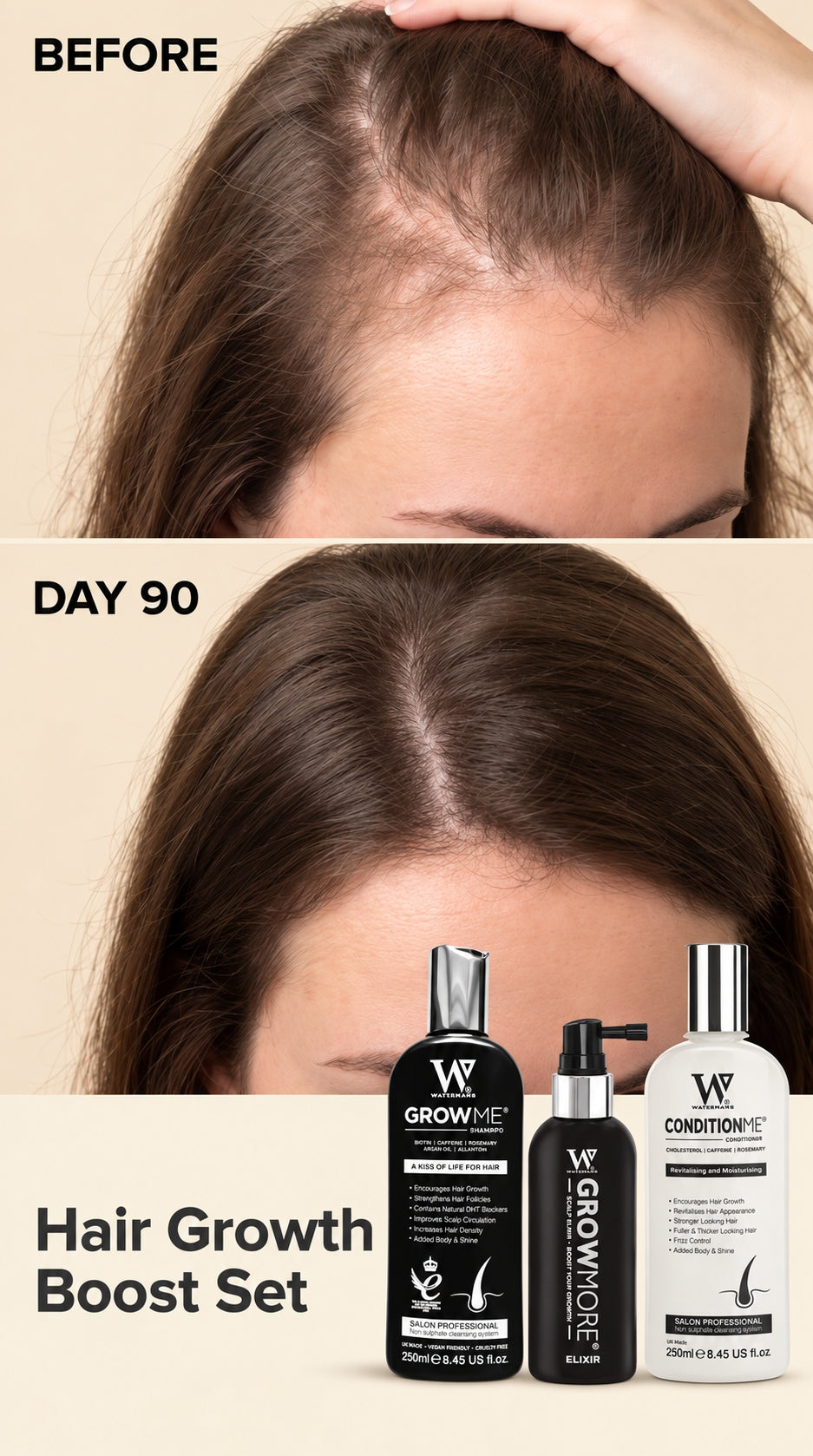
Grow Me® Hair Growth Shampoo, £14.95. A sulphate free daily shampoo that supports a healthy scalp environment and helps reduce breakage, so lengths hold on and look fuller.
Graft survival is the share of transplanted hair grafts that stay alive, root in their new position and go on to grow hair. It depends on surgical skill, how long grafts spend outside the body, how they are stored, and how carefully you protect them in the first two weeks. The NHS says new hair usually appears after about 4 months, with full results after 10 to 18 months.
Key takeaways
- The NHS says transplanted grafts are not secure for the first 2 weeks, so aftercare in that window matters most.
- Losing the transplanted hairs a few weeks after surgery is expected; the NHS says new hair usually appears after about 4 months.
- A 2026 review in Frontiers in Medicine lists smoking, graft handling and the time grafts spend without a blood supply among the factors behind complications.
- In England, clinics doing cosmetic surgery must be registered with the Care Quality Commission, and surgeons with the General Medical Council.
- A UK hair transplant can cost between £1,000 and £30,000, according to the NHS.
What does graft survival mean?
Graft survival means the proportion of hair grafts that live through being removed, stored and placed in the scalp, and then establish a blood supply and grow hair in their new spot. A graft is a small piece of skin holding a follicular unit: the NHS describes each graft as containing 1 to 4 hairs.
A graft is at its most fragile between being taken from the donor area, usually the back of the head, and being connected to a new blood supply in the recipient area. During that time it relies on careful handling and storage. Once it has rooted, it behaves like the donor hair it came from. That is why surgeons talk about technique and timing so much, and why the first days of aftercare matter. If you are still weighing up the procedure itself, our guide to FUE versus FUT transplants explains the two methods.

What affects graft survival during surgery?
The main things that decide whether grafts take during surgery are the skill of the team, how gently grafts are extracted and handled, how long they spend outside the body, how they are kept moist and at what temperature, and how densely they are packed into the recipient area. Most of these are down to the clinic, which is why choosing one carefully matters.
A 2026 review of complications after follicular unit excision, published in Frontiers in Medicine, lists technical factors including punch design, graft handling, follicular unit density and ischemia time, the time grafts spend without a blood supply, alongside personal factors such as smoking, other health conditions and medicines. Grafts that dry out, are crushed or are packed too tightly are more likely to fail.
| Factor | Why it matters | Who controls it |
|---|---|---|
| Extraction and handling | Crushed or split grafts are less likely to take | The surgical team |
| Time out of the body | Grafts have no blood supply until they root | The surgical team |
| Storage solution and temperature | Grafts must stay moist and viable while waiting | The clinic |
| Packing density | Very dense packing can strain the local blood supply | The surgeon, with your input |
| Smoking and general health | Linked with more complications in the 2026 review | You |
| Aftercare in the first 2 weeks | Grafts are not yet secure | You |
Does the way grafts are stored matter?
The way grafts are stored does matter, although the best method is still debated. Clinics commonly keep grafts in a cooled holding solution, but a small 2025 laboratory study in the International Journal of Trichology found that follicles stored at body temperature, 37°C, showed cell outgrowth after 7 days while those kept at 4°C or 26°C did not.
That study used 60 follicles from just 3 volunteers and tested them in a dish, not in a scalp, so it cannot overturn established practice on its own. It does show that storage is an active area of research and that clinics differ. A sensible question to ask any clinic is what solution and temperature it uses, and why. A confident, specific answer is a good sign; a vague one is worth noting.
Where the evidence disagrees
Chilled storage is widely used because cooling slows cell metabolism. The 2025 laboratory study suggests body temperature may keep follicles more viable. Neither view is settled by human trials, so regard any clinic's certainty either way as a talking point rather than proof.
Get a discount on the post-transplant hair care range
Join the Watermans mailing list and we will email a discount code straight to your inbox, so you can try the post-transplant hair care range for less. Made in the UK, over 6.5 million bottles sold since 2012.
How do you protect grafts after surgery?
You protect grafts after surgery by following your surgeon's instructions exactly, not touching or rubbing the recipient area, avoiding anything that knocks or presses on it, and taking the first two weeks slowly. The NHS says grafts are not secure for the first 2 weeks and that you may be told to cut down on exercise in the first month.
The NHS describes a typical timeline, though your surgeon's plan comes first:
| When | What usually happens |
|---|---|
| Days 2 to 5 | Bandages can usually be removed, but you should not touch the grafts |
| Day 6 | You should be able to wash your hair gently by hand |
| Days 10 to 14 | Any non-dissolvable stitches can usually be removed |
| After a few weeks | The transplanted hair will often fall out |
| After about 4 months | New hair usually starts to appear |
| After 10 to 18 months | The full results should be seen |
Practical habits that help include sleeping with your head raised for the first few nights if advised, wearing a loose, clean hat rather than a tight cap outdoors, avoiding swimming pools and saunas until you are cleared, and not picking at scabs. The NHS notes it is common to have a tight, achy, swollen scalp for a few days and temporary scabbing. For warning signs that something is wrong, our guide to how to tell if grafts are damaged goes through what to look for.

Is it hair loss, hair shedding or hair breakage after a transplant?
Hair loss, hair shedding and hair breakage mean different things after a transplant, and mixing them up causes a lot of needless worry. Hair shedding of the transplanted hairs a few weeks after surgery is expected: the NHS says the transplanted hair will often fall out and later start to grow back. The follicle stays in place and rests before producing a new hair.
Some people also shed native hairs around the grafts, often called shock loss. The 2026 review puts it at 0.15% to 15% of cases, usually 2 to 8 weeks after surgery, with hair tending to return around 3 months; case reports in the Annals of Dermatology describe people fully recovering within 10 months. Hair loss in the medical sense, the ongoing pattern thinning that led to surgery, can continue in untreated areas. Hair breakage is simply the fibre snapping and is a styling issue, not a graft issue.
| What you notice | What it usually is | What to do |
|---|---|---|
| Transplanted hairs falling out at 2 to 6 weeks | Expected shedding; the follicle stays | Be patient; new growth from about 4 months |
| Thinning of native hair near the grafts | Shock loss (recipient-site effluvium) | Tell your surgeon; it usually settles |
| Gradual thinning elsewhere on the scalp | Ongoing pattern hair loss | Ask your surgeon or GP about longer-term options |
| Short snapped hairs | Breakage from handling or heat | Gentler styling and conditioning |
What should your hair routine look like once you are healed?
Once your surgeon says the grafts are secure, a good hair routine is gentle cleansing, conditioner on the lengths, careful drying and low heat. Transplanted follicles behave like donor hair, so the aim is simply to look after the scalp and the new growth without friction or harsh products.
Use a mild, sulfate-free shampoo and lukewarm water, pat rather than rub your scalp dry, and introduce heat styling slowly. While you wait for new growth to fill in, which the NHS puts at 10 to 18 months for the full result, hair building fibres can make the recipient area look denser for special occasions. Only use them once your surgeon has confirmed the area has healed.

Grow Me® Hair Growth Shampoo £14.95
A sulfate-free shampoo with caffeine, biotin and rosemary for gentle everyday cleansing once your surgeon has cleared you to wash normally. It helps hair look fuller at the root.

Hair Building Fibres £19.95
Coloured keratin fibres that cling to existing hairs to make thinner areas look denser while new growth fills in. Use only after your surgeon confirms the scalp has healed; they wash out with shampoo.

How do you choose a safe hair transplant clinic?
You choose a safe hair transplant clinic by checking regulation first, then asking detailed questions about the team, technique and aftercare. The NHS says all independent clinics and hospitals providing cosmetic surgery in England must be registered with the Care Quality Commission, and all doctors must be registered with the General Medical Council.
The NHS also suggests checking the British Association of Hair Restoration Surgery website to see whether the surgeon is a member, and warns that some clinics pay to advertise in search listings. Ask how many procedures the surgeon has done, how many had complications, what method they recommend for you and why, and what follow-up you will get if things go wrong. Our guide to hair transplant costs in the UK explains why the cheapest quote is rarely the best value.
When should you contact your surgeon or GP?
You should contact your surgeon or GP if you have spreading redness, heat, pus, a fever, bleeding that will not stop, or pain that gets worse rather than better after surgery. The NHS lists bleeding, infection and allergic reaction to the anaesthetic among the small risks of any operation. The NHS also advises seeing a GP about hair loss before going to a commercial hair clinic, and says a transplant is not usually suitable for patchy hair loss such as alopecia areata.
Watermans does not offer medical advice or consultations, and your surgeon's aftercare instructions always come first. If your question is about products or a routine rather than a medical one, you can talk to Gail Waterman, our co-founder, as an AI avatar on the Watermans homepage. If you are weighing up surgery, our guide to donor hair quality sets out the seven signs that decide how far grafts will go.
What are the frequently asked questions about graft survival?
What is graft survival?
It is the share of transplanted grafts that stay alive, root in the recipient area and go on to grow hair. It depends on the surgery, graft storage and your aftercare.
When are hair grafts secure?
The NHS says grafts are not secure for the first 2 weeks after surgery, so you need to be very careful with them during that time.
Is it normal for transplanted hair to fall out?
Yes. The NHS says transplanted hair often falls out after a few weeks and later grows back, with new hair usually appearing after about 4 months.
Does smoking affect a hair transplant?
A 2026 review lists smoking among the personal factors linked with complications. Ask your surgeon for advice on stopping before and after surgery.
When can I wash my hair after a transplant?
The NHS says you should usually be able to wash your hair gently by hand from day 6, but always follow your own surgeon's instructions.
When will I see the final result?
The NHS says the full results should be seen after 10 to 18 months.
Can I use hair fibres after a transplant?
Only once your surgeon confirms the area has healed. Fibres are a cosmetic cover and wash out with shampoo.
What is the bottom line on graft survival?
The bottom line on graft survival is that it is decided by a skilled, regulated team on the day and protected by you in the weeks after. Choose a CQC-registered clinic and a GMC-registered surgeon, ask how grafts are handled and stored, follow aftercare to the letter for the first two weeks, expect the transplanted hairs to shed, and give the result 10 to 18 months before you judge it.
When you are cleared to wash normally, a mild, sulfate-free hair growth shampoo is a gentle everyday choice.
Sources & references
- NHS, Hair transplant, checked 18 September 2026.
- Complications in follicular unit excision hair transplantation: current evidence and practical approaches, Frontiers in Medicine, 2026, checked 18 September 2026.
- An in vitro study comparing the survival of hair follicles in various storage media at different temperatures, International Journal of Trichology, 2025, checked 18 September 2026.
- Localized telogen effluvium following hair transplantation, Annals of Dermatology, 2018, checked 18 September 2026.
- Care Quality Commission, checked 18 September 2026.
- British Association of Hair Restoration Surgery, checked 18 September 2026.
- NHS, Hair loss, checked 18 September 2026.
Watermans products are 100% cosmetic and do not treat medical hair loss. Individual results may vary.