Hair Falling Out in Shower: How Much Is Normal and How to Lose Less
The shower is where you see your hair fall, not where most of it falls.
Hair falling out in shower drains is normal for almost everyone, because washing releases hairs that had finished growing and were waiting to drop. The NHS puts everyday shedding at around 50 to 100 hairs a day, and if you wash every two or three days the shower collects two or three days' worth at once. The clump looks alarming and is usually fine. What matters is whether the hairs have a pale bulb, which means shedding, or a snapped end, which means breakage, and whether the amount has changed.

The conditioner that stops the comb tearing
Condition Me® Hair Growth Conditioner, £14.95. Detangles and strengthens the fibre with cholesterol, shea butter, hydrolysed lupine protein and niacinamide, so fewer strands snap in the shower and on the brush.
Key takeaways
- Normal shedding is around 50 to 100 hairs a day. A shower every two or three days collects all of it in one place, which is why the drain looks worse than the maths.
- Pale bulb at the root means shedding, the growth cycle doing its job. Snapped, bulb-free pieces mean breakage, which you can reduce this week.
- Washing less often does not reduce shedding. It stores it up, so the next wash looks worse.
- Lukewarm water, scalp-only shampoo, conditioner combed through, and blotting rather than rubbing cut the breakage part.
- A sudden jump in shedding two to four months after illness, childbirth, a crash diet or stress is usually telogen effluvium and usually settles on its own.
- Shedding that lasts beyond six months, patchy loss, a widening parting or a sore scalp needs your GP, not a new shampoo.
How much hair falling out in shower drains is normal?
Around 50 to 100 hairs a day is normal according to the NHS, and because most of those hairs leave during washing and brushing rather than at random, a person who washes every third day can reasonably find 150 to 300 hairs in the plughole and still be completely normal.
The arithmetic comes from the hair cycle. Each of the roughly 100,000 follicles on a scalp spends two to seven years growing (anagen), a few weeks winding down (catagen) and about three months resting (telogen) before the hair is released and a new one starts. At any moment around ten per cent of follicles are resting, which is 10,000 hairs due to fall over the next three months, or roughly 100 a day. Water, warmth and the manipulation of washing loosen the ones that are ready, so the shower is where they finally let go.
Two things change the count without anything being wrong. Long hair makes the same number of strands look like far more, because a 60 cm hair in a drain is three times the mass of a 20 cm one. And a gap between washes stores the shed hairs in the hair itself, held in by neighbouring strands, until water releases them all at once. Our separate guide on how much hair shedding is normal gives the honest numbers for brushes, pillows and ponytails too.
Ten per cent of your follicles are resting at any moment. The shower does not create that shedding; it collects it.
Is the hair in the drain shedding or breakage?
Pick a few hairs off the drain and look at the ends: a hair with a tiny pale or white bulb at one end was shed by the follicle as part of the cycle, while a hair that is short, has no bulb and looks cut or frayed at both ends has broken off mid-length, and only the second kind is something a shower routine can change.
- Hair shedding releases a whole hair, root to tip, with a small club-shaped bulb. The bulb is pale, not dark, and does not mean the root has been pulled out. This is the cycle, and it is the majority of what you see.
- Hair breakage is the fibre failing. Short pieces, often the length of your hair from the ends up to the last tangle, with no bulb. Frizz at the crown where snapped hairs stand up, white dots along a strand and see-through ends are the other clues. Wet hair is at its weakest, so the shower and the comb after it are where most breakage happens.
- Hair loss in the follicular sense is different again: follicles shrinking or closing, so the parting widens and the ponytail thins month on month. Shed hairs from a thinning area are often finer and shorter than the rest.
If the drain is mostly bulbed hairs and the amount has not changed, the answer is reassurance. If it is mostly bulb-free pieces, the rest of this page will cut the number within a couple of weeks. If the amount has roughly doubled and stayed there, the section on sudden increases applies. The three-clue self-check is a quick way to tell which you have.

Why does hair fall out in the shower more than anywhere else?
Hair comes out in the shower more than anywhere else because the three things that release a resting hair all happen there at once: water swells the fibre and loosens the grip of the follicle on a hair that has already stopped growing, warmth and massage move the scalp, and shampooing and conditioning run fingers and a comb through every strand.
Wet hair is also weaker than dry hair. Water breaks the temporary hydrogen bonds that give a dry strand its stiffness, so a wet hair stretches further and snaps at lower force. A 2003 study in the Journal of Cosmetic Science measured protein loss from hair during washing and found that coconut oil applied beforehand reduced it, which is the clearest evidence that the wash itself is where the fibre takes damage. Shedding you cannot change. Breakage in the shower you can.
Washing less often is the instinct and it backfires. The resting hairs are still released on schedule; they are just held in place by their neighbours until the next wash, when they all appear together. People who go from washing daily to washing weekly often panic at the first weekly wash, having seen seven days of normal shedding in one go.
How do you lose less hair in the shower?
You lose less hair in the shower by cutting the breakage half of the problem: detangle before you get in, use lukewarm rather than hot water, shampoo the scalp with fingertips and let the suds rinse through the lengths, condition the mid-lengths and ends for two minutes and comb through while the slip is there, then blot dry rather than rubbing.
- Detangle dry, before the water. Start at the ends and work up with a wide-tooth comb or a flexible-bristle brush. A knot that goes into the shower comes out as a tear.
- Lukewarm water. Hot water swells the fibre further and lifts the cuticle. Warm is enough to lift oil from the scalp.
- Shampoo the scalp only. Fingertips, small circles, about thirty seconds. Do not pile the lengths on top of your head and scrub; that is where the tangles and the snapping start.
- Condition the lengths, then comb while it is in. Mid-lengths and ends, leave for two minutes, pass a wide-tooth comb through from the ends up. This single step saves more hair than any product.
- Rinse cool and squeeze, do not wring. Press water out between your palms.
- Blot with microfibre or a cotton T-shirt. Rubbing a terry towel along the lengths roughs up the cuticle. A microfibre hair towel is the cheapest upgrade in the whole routine.
- Leave it alone until it is damp. Brushing soaking-wet hair is the second most common cause of breakage. Wait until it is damp rather than dripping, then detangle from the ends.
| Habit | What it does to the count | Swap |
|---|---|---|
| Hot water | More swelling, lifted cuticle, more snapping | Lukewarm, cool final rinse |
| Scrubbing lengths on top of the head | Tangles that tear on the comb | Scalp with fingertips, suds rinse the lengths |
| Combing with no conditioner in | The most breakage of any single step | Comb through with conditioner on, ends up |
| Terry towel rub | Frizz and cuticle damage | Blot with microfibre or a cotton T-shirt |
| Washing once a week to "save" hair | Same shedding, released all at once | Wash as often as your scalp needs |
| Tight wet bun or ponytail | Tension on weak wet fibres and on the hairline | Loose plait once damp, fabric scrunchie |
Get a discount on the hair shedding range
Join the Watermans mailing list and we will email a discount code straight to your inbox, so you can try the hair shedding range for less. Made in the UK, over 6.5 million bottles sold since 2012.
What causes a sudden increase in hair falling out in shower water?
A sudden, noticeable jump in hair falling out in shower water, often two to four months after a trigger, is most commonly telogen effluvium: a stress on the body such as a high fever, surgery, childbirth, rapid weight loss, a new medicine or an emotionally hard period pushes an unusually large number of follicles into the resting phase at once, and they all release their hairs on the same schedule.
The delay is the giveaway. Because telogen lasts about three months, the shedding arrives long after the event, which is why people rarely connect the two. Postpartum shedding is the textbook case: oestrogen holds hairs in the growing phase through pregnancy, then after the birth they all move to resting together and fall in a wave at around three to four months. A review of telogen effluvium in the Journal of Clinical and Diagnostic Research describes the same pattern after illness, crash dieting and surgery, and the usual outcome, which is that shedding slows over about six months as the cycle resets. What causes telogen effluvium lists the triggers in full.
Two other common causes are worth a blood test rather than a guess. Low iron stores are a well-recognised contributor to diffuse shedding in women, and the NHS notes that iron deficiency anaemia can cause hair loss; an underactive or overactive thyroid can do the same. Both are a GP conversation, and both are fixable in a way no shampoo is.
Please note: Watermans products are 100% cosmetic and do not treat medical hair loss. Individual results may vary.
When should hair falling out in shower water send you to a GP?
See your GP if the increase in hair falling out in shower water has lasted more than six months, if the loss is patchy or sudden, if the parting is widening or the ponytail is thinning month on month, if the scalp is sore, itchy, scaling or red, or if you have other symptoms such as tiredness, feeling cold, weight change or heavy periods that could point to iron or thyroid.
Take a photograph of your parting under the same light every four weeks. A GP can do far more with "this is what it looked like in June and this is now" than with a description of a drain. If your question is about products or a routine rather than a medical one, you can talk to Gail Waterman, our co-founder, as an AI avatar on the Watermans homepage.

Which products help with the breakage half of the problem?
The products that help are the ones that make wet hair easier to get through without tearing: a sulphate-free shampoo so lengths keep more of their natural lipid, a conditioner with enough slip to comb through, and a pre-wash oil on the lengths once a week to reduce protein loss during washing, with none of them doing anything to the shedding cycle itself.
Price them honestly. A conditioner at around £15 used properly every wash will cut the hair on the comb more than a £60 serum applied to the lengths, because the comb is where the breakage happens. The order of value is handling first, conditioner second, shampoo third, pre-wash oil fourth.

The sulphate-free wash
Grow Me® Hair Growth Shampoo, £14.95. Sulphate-free, with hydrolysed lupine protein, biotin, caffeine, rosemary and niacinamide, made to reduce breakage so hair looks fuller. Vegan and made in the UK.
The pre-wash oil
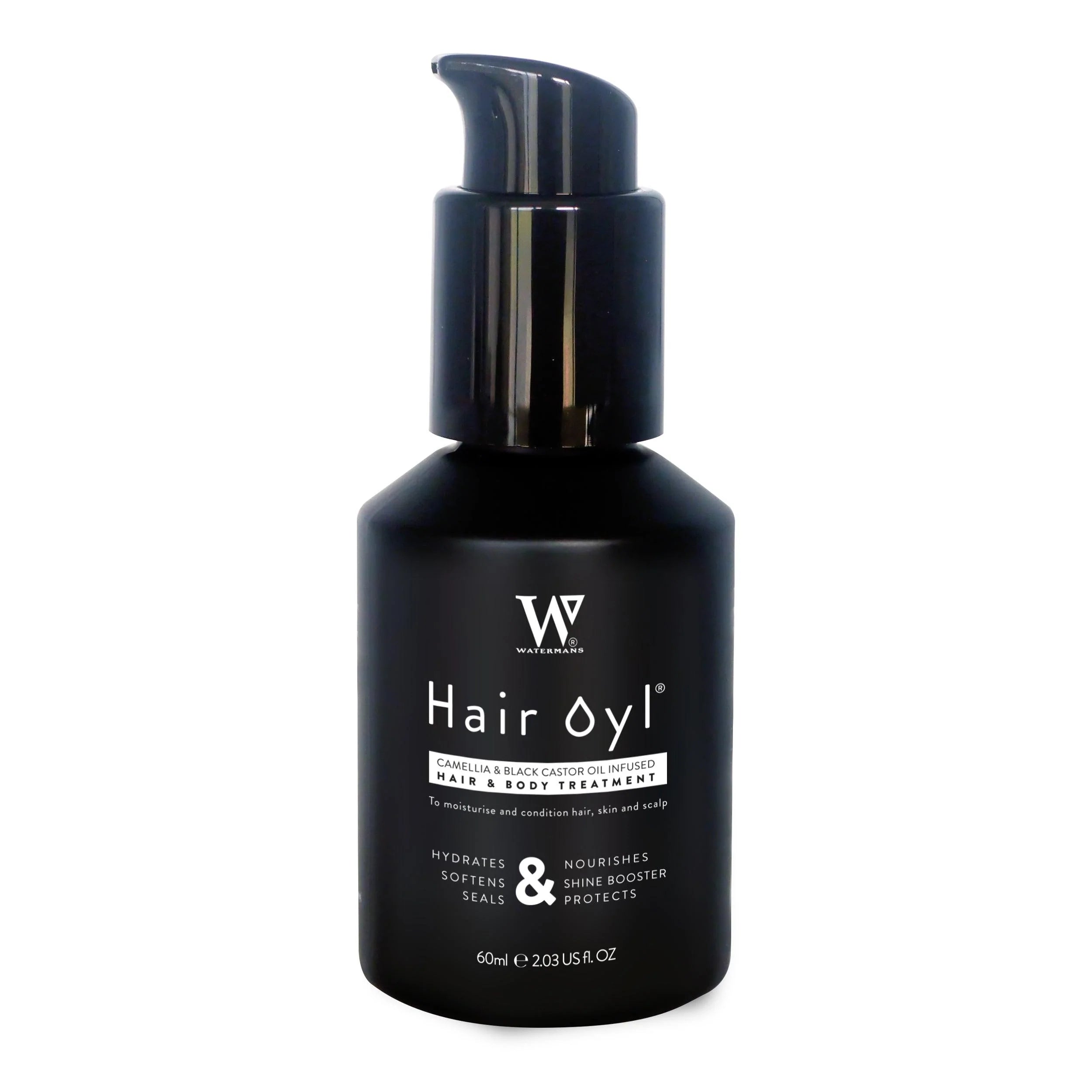
Camellia & Black Castor Hair & Body Oil, £24.95. A multi-use oil for the mid-lengths and ends before washing, and for taming frizz once hair is dry.
Frequently Asked Questions
Is it normal to lose a handful of hair in the shower?
Usually, yes. Normal shedding is around 50 to 100 hairs a day, and if you wash every two or three days the shower collects all of it. Long hair makes the same number look like far more.
Why is more hair falling out in shower water than it used to?
The most common reason is telogen effluvium, a wave of shedding two to four months after illness, childbirth, a crash diet, a new medicine or a stressful period. It usually settles within six months. Washing less often also makes each wash look worse.
Does washing hair every day make it fall out?
No. Washing releases hairs that were already due to fall. Daily washing spreads them out; weekly washing stores them up. Wash as often as your scalp needs, with a gentle shampoo and a conditioner you comb through.
How do I tell shedding from breakage?
Look at the ends. A pale bulb at one end means the hair was shed by the follicle. A short piece with no bulb and a frayed or cut end has broken off. Shedding is the cycle. Breakage is handling, and you can reduce it.
Does cold water stop hair falling out?
Cold water does not change shedding. A cool final rinse does help the cuticle lie flatter, so hair tangles and snaps a little less on the comb afterwards.
Can a shampoo stop hair falling out?
No shampoo changes the shedding cycle. A sulphate-free shampoo and a conditioner with real slip reduce the breakage part, which is often a third or more of what ends up in the drain.
Should I see a GP about hair in the shower?
See your GP if a clear increase has lasted more than six months, if loss is patchy or sudden, if the parting is widening, if the scalp is sore or scaling, or if you feel unusually tired or cold, which can point to iron or thyroid.
Sources & References
- NHS, Hair loss
- NHS, Iron deficiency anaemia
- Hughes EC, Saleh D. Telogen Effluvium. StatPearls, National Library of Medicine
- Malkud S. Telogen effluvium: a review. Journal of Clinical and Diagnostic Research, 2015
- Rele AS, Mohile RB. Effect of mineral oil, sunflower oil, and coconut oil on prevention of hair damage. Journal of Cosmetic Science, 2003
What is the bottom line on hair falling out in shower water?
Hair falling out in shower water is mostly the cycle doing its job, collected in one place. Count the bulbs, not the clump: bulbed hairs at a steady rate are normal, bulb-free pieces are breakage you can cut this week with lukewarm water, scalp-only shampoo, a conditioner combed through and a towel that blots. A sudden rise two to four months after a shock to the body is usually telogen effluvium and usually passes. A rise that lasts past six months, patchy loss, a widening parting or a sore scalp is your GP's question, and a photo every four weeks is the best thing you can take to that conversation.
If the comb is where you lose it, our hair growth conditioner is the one change that makes the biggest difference.