Horsetail Oil Hair Growth: How to Make It and What It Does
Yes, you can make it in one jar. No, it will not change your hair density.
Horsetail oil is dried Equisetum arvense steeped in a carrier oil until the plant compounds transfer across. The horsetail oil hair growth claim rests on silica and antioxidants, which is traditional use plus plausible chemistry rather than proof. Realistically it makes a pleasant weekly strengthening oil that reduces breakage by improving slip and softness, and breakage is often what people are actually seeing.
Our hair and body oil
Camellia & Black Castor Hair & Body Oil, £24.95. Adds hydration and shine to dry lengths and smooths the hair before a blow dry, without weighing fine hair down.
Key takeaways
- Horsetail is the richest common plant source of silica, the mineral linked with hair strength, elasticity and shine.
- Evidence for the horsetail oil hair growth claim is traditional rather than modern. Expect condition and shine, not new density.
- Use dried horsetail only. Fresh plant material carries water, and water in oil grows bacteria.
- Two methods: slow infusion over two to six weeks, or a warm infusion in two to three hours.
- Store in dark glass away from heat and use within six to twelve months.
- Patch test first, and avoid horsetail internally in pregnancy or with a thiamine deficiency without medical advice.
What is horsetail, and why does it turn up in hair care?
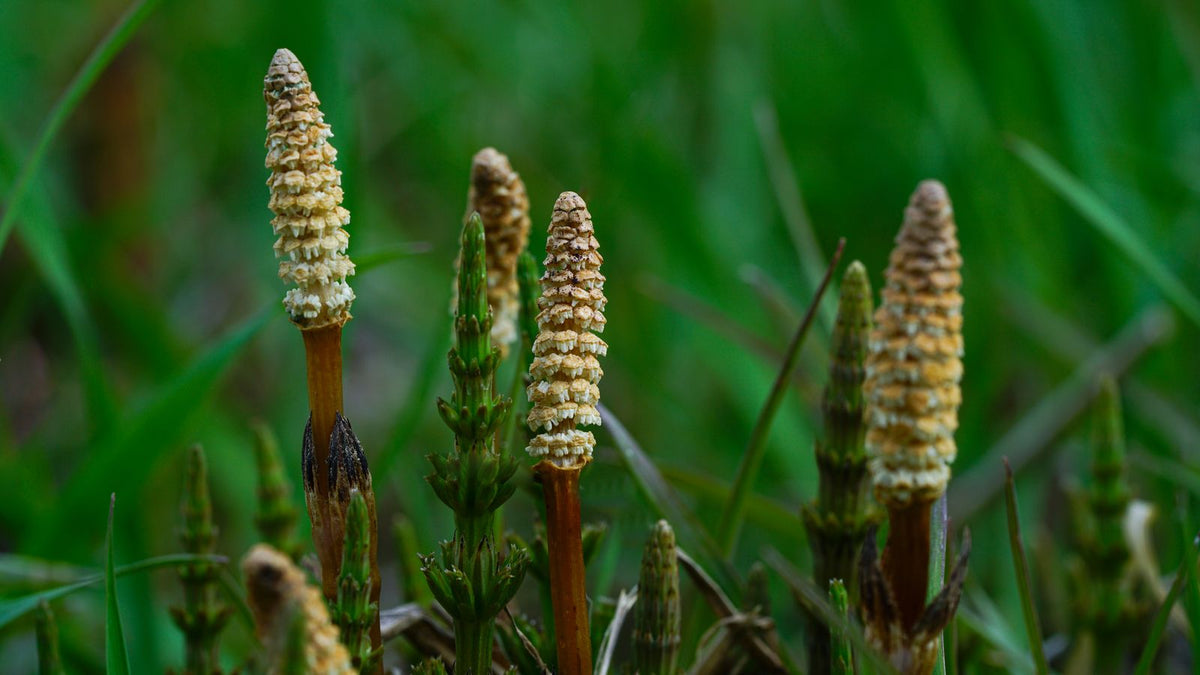
Horsetail (Equisetum arvense) is a primitive, hollow stemmed plant that predates flowering plants entirely. Its stems accumulate silicon from the soil and deposit it as hydrated silica in the cell walls, which is what gives horsetail its faintly gritty texture and its old country name of scouring rush. Cooks and metalworkers once used the dried stems as fine abrasive.
That silica content is the whole basis of its reputation in hair care. Hair fibre is keratin, and silicon appears in connective tissue throughout the body as part of the machinery that builds collagen and elastin. The reasoning goes that a silica rich plant should support stronger, springier hair. It is a reasonable chain of thought, and it is worth being honest that it is a chain of thought rather than a demonstrated result for a topical oil.

What does the evidence say about horsetail oil hair growth?
The honest position is that the horsetail oil hair growth claim sits in the traditional use category. The European Medicines Agency recognises horsetail herb as a traditional herbal medicine, and that classification is explicit about what it means. It reflects long standing use and an acceptable safety record, not demonstrated efficacy from modern trials. For a related angle, see our guide to best herbs for hair growth.
Where good sources disagree is worth stating plainly. Some laboratory and small human work on oral silicon supplementation reports improvements in hair tensile strength and elasticity, which is a fibre quality outcome. Other reviewers argue those studies are small, industry linked and measure surrogate endpoints rather than density or count. Both readings are defensible from the published literature. What nobody has shown is that silica applied to the outside of the hair in an oil crosses into the fibre and changes how it is built.
So set expectations accordingly. A horsetail oil hair growth routine gives you a conditioning oil with antioxidant plant compounds. That is genuinely useful, and it is not the same as growing more hair.
Hair loss, hair shedding or hair breakage: which are you trying to solve?
This is the question that decides whether any home made oil is the right tool at all, and the three are constantly confused.
- Hair loss means the follicle itself is affected, as in androgenetic alopecia or alopecia areata. Density falls in a pattern or in patches. No infused oil changes this, and it belongs with a GP.
- Hair shedding means the growth cycle has been disturbed, as in telogen effluvium after illness, childbirth or a sustained stressful period. A group of hairs leaves the anagen phase early and falls together around three months later. Time and correcting the trigger are what resolve it.
- Hair breakage means the fibre is snapping along its length rather than leaving the scalp. You find short broken pieces of uneven length with white ends rather than bulbs. Heat, bleach, tight styling and friction are the usual causes.
Breakage is the one an oil genuinely helps, because an oil that reduces friction and improves slip means fewer strands snapped by combing and towel drying. If you are losing length rather than density, a horsetail oil hair growth routine may deliver exactly the result you wanted, just through a different mechanism than the one on the label. Our guide to what causes hair damage covers how to tell the difference at the sink.
Watermans products are 100% cosmetic and do not treat medical hair loss. Individual results may vary.
Which carrier oil should you infuse the horsetail into?
| Carrier | Feel on hair | Shelf life | Best for |
|---|---|---|---|
| Fractionated coconut | Light, absorbs fast | Two years plus | Fine hair, scalp application, beginners |
| Sweet almond | Medium, slightly rich | Around one year | Normal to dry hair, mid lengths |
| Jojoba | Light, close to scalp sebum | Very long, it is a wax ester | Oily scalps, anyone prone to congestion |
| Olive | Heavy, strong smell | Around one year | Coarse or very dry hair only |
| Castor | Very thick, needs blending | Around two years | Blend at 10 to 20 percent for slip and shine |
If you have never infused anything before, use fractionated coconut or jojoba. Both are stable, close to odourless and forgiving. Argan is another sensible option, and our guide to argan oil for hair explains what it does and does not do on the fibre.
Get a discount on the hair breakage range
Join the Watermans mailing list and we will email a discount code straight to your inbox, so you can try the hair breakage range for less. Vegan, made in the UK, over 6.5 million bottles sold since 2012.
How do you make horsetail oil at home, step by step?
Two methods produce a usable oil. The slow one extracts more and is harder to spoil. The warm one is ready the same afternoon.
Method one: the slow infusion (two to six weeks)
- Fill a clean, completely dry glass jar one third full with dried horsetail. Roughly 20g of dried herb to 200ml of oil is a good ratio.
- Pour the carrier oil over until the herb is covered by at least two centimetres. Anything poking above the oil line will mould.
- Seal, label with the date, and stand it somewhere warm and out of direct sunlight. A kitchen shelf away from the hob is ideal.
- Swirl the jar once a day. This is the step people skip and it matters, because it keeps everything wetted.
- After two to six weeks, strain through muslin, squeeze the herb out properly, and bottle in dark glass.
Method two: the warm infusion (two to three hours)
- Put the same herb and oil ratio into a heatproof bowl over a pan of barely simmering water, or use a slow cooker on its lowest setting.
- Hold the oil between 50 and 70 degrees Celsius. It should never bubble or smoke. Above about 80 degrees you start degrading the oil rather than extracting the plant.
- Keep it there for two to three hours, stirring occasionally.
- Cool, strain through muslin, and bottle in dark glass.

If you want the plant focused version of this method with more detail on sourcing and ratios, our companion guide to making horsetail infused hair oil at home covers the infusion craft itself. This page stays on the growth question and what to expect from it.
How should you use horsetail oil on hair and scalp?
Two or three times a week is plenty. More than that and fine hair goes limp and the scalp gets congested.
- As a pre wash oil. Warm a teaspoon in your palms, work it through the mid lengths and ends, leave for 30 minutes to an hour, then shampoo out. This is the highest value use, because oil on dry hair before washing limits how much water the fibre swells with, and swelling is part of what weakens it.
- As a scalp massage. A few drops parted through and massaged with fingertips for two or three minutes. Wash out the same day. Massage itself is pleasant and increases local blood flow, which is not the same as a growth effect but is not nothing either.
- As a finishing oil. One or two drops rubbed between the palms and smoothed over dry ends. Use far less than you think.

Patch test on the inner forearm 24 hours before the first scalp application. Plant extracts are not automatically gentle, and horsetail is no exception.
Is horsetail safe, and when should you skip it?
Topically, on intact skin, at the concentrations a home infusion produces, horsetail oil is generally well tolerated. The cautions that matter are mostly about taking it internally, and they are worth knowing because horsetail teas and capsules sit on the same shelf as the dried herb. If your question is about products or a routine rather than a medical one, you can talk to Gail Waterman, our co-founder, as an AI avatar on the Watermans homepage.
- Horsetail contains thiaminase, an enzyme that breaks down thiamine (vitamin B1). Prolonged internal use has been linked with thiamine depletion, which is why regulators cap the duration of traditional internal use.
- Avoid internal use in pregnancy and breastfeeding without advice from a pharmacist or GP.
- Equisetum arvense is easily confused with Equisetum palustre, marsh horsetail, which contains alkaloids that are toxic to livestock. Buy dried herb from a reputable herbal supplier rather than foraging unless you can identify both confidently.
- Stop using it if the scalp becomes itchy, red or flaky, and see a GP if that persists.
Home made oil or a formulated product: which makes more sense?
Both have an honest place. A home infusion is cheap, satisfying and lets you control every ingredient. A formulated oil is stabilised, filtered, consistent from bottle to bottle, and does not go rancid in a warm bathroom in August. If you enjoy making things, make it. If you want the result without the jar on the shelf, buy it.

If you want the pre wash oil result without infusing your own, this is the ready made version. Camellia and black castor oils for slip and shine, so a comb moves through without snapping strands. Works as a pre wash oil, a blow dry oil or a body oil.
Shop the hair and body oil
Worth mentioning here because horsetail and bamboo silica are actually in them, alongside biotin and zinc, which contribute to the maintenance of normal hair. Sugar free and vegan. Food supplements support a normal diet, they do not replace one.
Shop GrowPro gummiesWatermans is a UK family business that has sold over 6.5 million bottles since 2012. GrowPro gummies is vegan, and the range is cruelty free and made in the UK.
Frequently asked questions
Does horsetail oil make hair grow faster?
There is no modern trial evidence that it does. The horsetail oil hair growth reputation rests on silica content and centuries of traditional use, not on demonstrated growth. Expect better condition, more shine and less breakage, which for many people is the visible result they were after anyway.
How long does horsetail oil take to infuse?
Two to six weeks for a cold infusion kept in a warm dark spot and swirled daily, or two to three hours for a warm infusion held between 50 and 70 degrees Celsius.
Can I use fresh horsetail instead of dried?
No. Fresh plant material carries water, and water in oil grows bacteria and mould. Use properly dried horsetail, a completely dry jar, and keep every fragment under the oil line.
How long does home made horsetail oil last?
Six to twelve months in dark glass kept away from heat and light. Discard it if it smells sour, sharp or like old crayons, which is what rancid oil smells like.
How often should I use it?
Two or three times a week as a pre wash oil or a scalp massage. More often than that tends to leave fine hair limp and the scalp congested, which is the opposite of what you wanted.
Is horsetail safe to use?
Topically it is generally well tolerated after a patch test. Internally it contains thiaminase, an enzyme that breaks down vitamin B1, so regulators limit the duration of traditional internal use and it should be avoided in pregnancy without advice from a pharmacist or GP.
Which carrier oil is best?
Fractionated coconut or jojoba for fine hair and oily scalps, sweet almond for normal to dry hair, and up to 20 percent castor blended in if you want extra slip and shine.
Will it help if my hair is thinning at the parting?
Not in the way you are hoping. A widening parting points to follicular change rather than fibre damage, and that belongs with a GP who can run the blood tests. An oil can still be worth using alongside, because keeping the length you have makes the parting look better than losing it to breakage does.
Sources and references
- European Medicines Agency, Equiseti herba herbal monograph, for the traditional use classification, permitted uses and the safety cautions including thiaminase.
- NHS, Hair loss, for when hair changes warrant a GP appointment rather than a home remedy.
- NHS, Vitamins and minerals, for what the UK guidance actually says about supplementing individual nutrients.
- British Association of Dermatologists information leaflets, for condition specific detail where the cause is not simple damage.
What is the bottom line on horsetail oil hair growth?
Making horsetail oil is a genuinely good weekend project, and the result is a nice pre wash oil that leaves hair softer, shinier and less prone to snapping. Read the horsetail oil hair growth claim as tradition rather than proof, use dried herb in a dry jar, store it in dark glass, and take a widening parting or a sudden shed to a GP instead of to the infusion cupboard.
For a pre wash oil that rinses cleanly, our camellia and black castor hair oil is the one we make. Made in the UK.