PCOS Hair Loss Questions, Answered Honestly
The most common PCOS hair loss questions all circle the same paradox: why does the same condition thin the hair on your head while growing more of it on your face? The answer is that scalp follicles and facial follicles respond to androgens in opposite directions. Raised androgen activity shrinks the ones on top of your head and stimulates the ones on your chin. It is one hormonal signal producing two opposite results, and understanding that makes the rest of this considerably less confusing.
Our day and night set
Grow Me® Shampoo & Overnight Elixir Set, £39.45. The shampoo for the morning wash and the overnight scalp elixir for the evening, our most popular pairing with men.
This page answers the PCOS hair loss questions people actually ask, in the order they usually ask them. We are a hair care company, not a medical service, so the honest headline is this: the part of PCOS that affects your hair is best handled with a GP, and most of what follows is about how to have that conversation well.
General information for adults, not medical advice.
Key takeaways
- Nearly all PCOS hair loss questions reduce to one mechanism: androgen activity acting on follicles that inherited a sensitivity to it. PCOS affects roughly one in ten women of reproductive age and is one of the most common hormonal conditions there is.
- Scalp thinning follows the female pattern: a widening parting with the hairline usually preserved, developing over years rather than weeks.
- Scalp thinning and unwanted facial hair come from the same androgen signal acting on follicles that respond to it in opposite ways.
- Iron deficiency, thyroid problems and vitamin D deficiency are all more common alongside PCOS and all affect hair independently. They are worth ruling in or out because they are correctable.
- This is a GP conversation. Nothing sold as a cosmetic changes hormones, and anything that genuinely does is a medicine.
- Watermans products are 100% cosmetic and do not treat medical hair loss. Individual results may vary.
Why does PCOS cause hair loss on the scalp?
Polycystic ovary syndrome raises androgen activity, and scalp follicles in genetically susceptible women are sensitive to it. Testosterone is converted in the skin into dihydrotestosterone, or DHT, and where a follicle carries plenty of androgen receptors, DHT shortens its growing phase. Each cycle then produces a slightly finer, shorter hair than the last, a process called miniaturisation.
Two points are worth being precise about. First, this is the same mechanism as ordinary female pattern loss, which is why the picture looks the same: a parting that widens over time with the frontal hairline mostly intact. Our guide to pattern hair loss covers the underlying biology in more depth. Second, PCOS does not create a new kind of hair loss. It supplies more of the signal that drives an existing susceptibility, which is why some women with PCOS have significant thinning and others have none at all.
It is also why the severity does not track neatly with blood test numbers. Receptor sensitivity in your follicles is inherited and is not measured by any routine test, so two women with identical testosterone results can have very different hair.
Why is my hair falling out on my head but growing on my face?
Scalp follicles at the parting and crown and facial follicles on the chin, upper lip and jaw respond to androgens in opposite directions, which is the single most disorienting thing about this condition. Androgens shrink the scalp follicles that are sensitive to them. The same androgens convert fine, colourless vellus hair on the face into coarse, dark terminal hair.
Both effects are permanent-feeling but neither is fixed. Facial hair growth, called hirsutism, responds to a different set of approaches from scalp thinning, and the two frequently need to be handled separately even though they share a cause. If facial hair is the part that bothers you most, say so at your GP appointment, because it is often the more directly addressable of the two.

Is this hair loss, hair shedding or hair breakage?
Distinguishing these three is the most useful thing you can do before spending any money, because they have almost nothing in common beyond the fact that there is more hair in your brush.
| What it is | What you notice | Where PCOS fits |
|---|---|---|
|
Hair loss Follicles miniaturising |
A parting that widens over months and years, more scalp visible in bright light, ponytail feels thinner | This is the PCOS-linked one, driven by androgen signalling |
|
Hair shedding More follicles resting at once |
Sudden handfuls, all over the head evenly, each hair full length with a white bulb at the root | Not PCOS itself, but low iron, thyroid change or a crash diet can trigger it, and all three travel with PCOS |
|
Hair breakage The fibre snapping |
Short broken pieces with no bulb, split ends, frizz along the parting | Unrelated to hormones. This one is about heat, tension and handling |
Mixed pictures are common. A woman with PCOS-related thinning who then has a stressful year, or goes on a restrictive diet, gets both at once. The distinction still matters, because the shedding half usually recovers on its own within six to nine months and the thinning half does not.
Which PCOS hair loss questions belong at a GP appointment?
A good appointment is one where you arrive with specifics, because ten minutes goes quickly. The things generally worth raising:
Blood tests that identify correctable causes. Ferritin and full blood count for iron, thyroid function, vitamin D, and, where relevant, testosterone and sex hormone binding globulin. Iron and thyroid matter enormously here: both are more common in women with PCOS, both cause hair changes by themselves, and both are correctable. It is genuinely worth knowing whether part of what you are seeing is a deficiency rather than hormones.
Whether the pattern fits. A GP can look at the distribution of thinning and say whether it matches the female pattern or something else. If you have round smooth patches, scalp pain, scaling, or hair coming out in clumps, that is a different conversation and a more urgent one.
The medical options that exist for the hair specifically. There are licensed medicines used in the UK for androgen-related hair changes, and there are broader approaches to PCOS itself. We are a cosmetics company with no medical professional on record, so we do not name medicines or advise on them. Ask your GP what applies to you and what the trade-offs are.
Metabolic health alongside the hair. Insulin resistance is common in PCOS and is linked to androgen levels, which is why the hair question is rarely separate from the wider picture. It is a reasonable thing to ask about even if hair is what brought you in.
What to do if it is affecting your mood. Hair loss in women is consistently under-acknowledged and the psychological impact is real and well documented. It is a legitimate thing to raise with a GP, not a vanity issue.
Get a discount on your next order
Join the Watermans mailing list and we will email a discount code straight to your inbox. Made in the UK, over 6.5 million bottles sold since 2012.
Does losing weight help PCOS hair loss?
Weight change affects the hormonal picture in some women with PCOS and not in others, and the evidence is more nuanced than the confident advice usually given. Where insulin resistance is part of the picture, improving it is associated with lower androgen levels, and modest weight loss has been shown in trials to improve menstrual regularity and some hormonal markers. Whether that translates into visible hair change is much less well established, partly because hair takes six to twelve months to reflect anything and few studies follow it that long.
Two honest caveats. Not everyone with PCOS has insulin resistance or a raised BMI, and telling a lean woman with PCOS to lose weight is unhelpful. And rapid or severe restriction reliably triggers shedding two to three months later, so a crash diet undertaken to help your hair can make it visibly worse before anything else improves. If you are changing how you eat, doing it gradually matters more here than in most contexts.
How long does it take to see any change?
Timescale is where PCOS hair loss questions most often collide with reality. Hair changes on a fixed biological timetable that no intervention shortens. A follicle that shifts back into a growing phase produces about a centimetre of hair a month, so anything aimed at follicle behaviour needs six months before a verdict is fair, and twelve months to see the full picture. Anything aimed at shedding shows sooner, typically three to six months.
This is why photographs matter more than memory. Take four on day one: parting, crown, hairline and one from directly above. Same window, same time of day, dry hair, parted in exactly the same place. Then repeat monthly. Almost everyone who does this is surprised by the comparison at month six, in one direction or the other, and it is the only way to tell a real change from a hopeful one. Our guide to aromatase activity and hair thinning explains the enzyme that converts androgens into oestrogens, and why that conversion matters at the scalp.

Do supplements help?
Supplements come up in PCOS hair loss questions more than almost anything else, and the honest answer disappoints most people. They help only where there is a deficiency to correct, and that is a genuinely important distinction. If your ferritin is low, correcting it can make a real difference to hair, and your GP can establish that with a blood test that costs you nothing. If your ferritin is normal, taking iron will not improve your hair and taking too much of it causes problems of its own.
Inositol is the supplement most often raised in connection with PCOS. There is a reasonable body of work on it for insulin sensitivity and ovulation, with much less specifically on hair, so treating it as a hair product oversells what the evidence supports. Discuss it with your GP rather than a forum.
One practical warning that catches people out: high dose biotin, which is in most hair supplements, can interfere with several common blood tests including thyroid and some hormone assays, producing results that are simply wrong. If you take a hair supplement, stop it a few days before any blood test and tell whoever takes the sample. Given how much of the PCOS picture rests on blood results, this matters more here than elsewhere.
What can cosmetics actually do?
Cosmetics feature in PCOS hair loss questions constantly, usually with more hope attached than is warranted. They can protect the hair you currently have and change how it looks, and that is the whole of it. No shampoo, conditioner or scalp serum alters androgen levels, and any product implying otherwise is making a claim it cannot support. What good cosmetic care genuinely does is reduce breakage, support a healthy scalp environment and make hair look fuller, which matters when every hair counts.
Because PCOS is a medical condition and we sell cosmetics, we keep this section short deliberately.

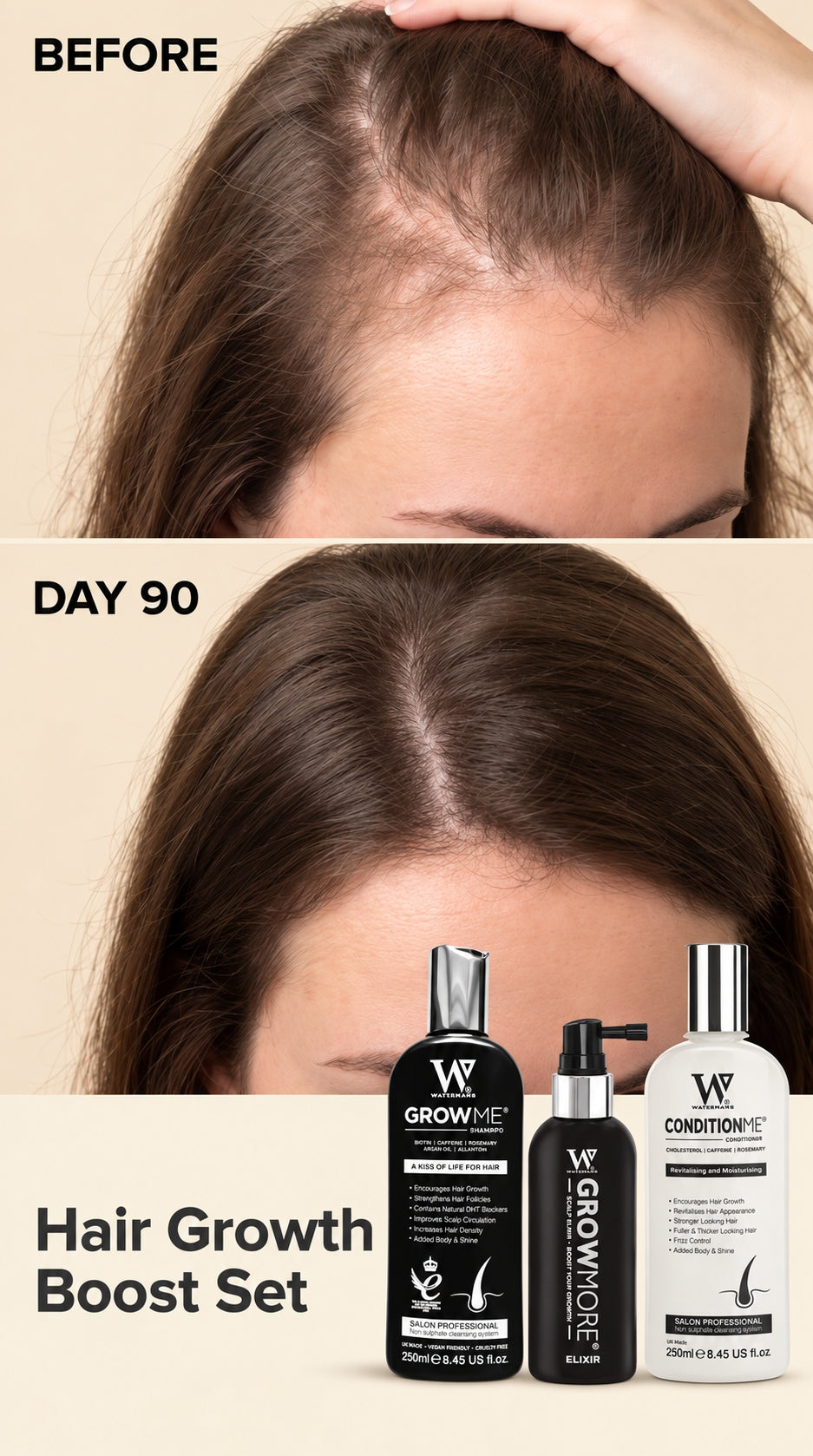
Grow Me and Grow More Set, a cosmetic daily routine
A biotin, caffeine and rosemary shampoo with a leave-on overnight scalp elixir. It sits alongside whatever you and your GP decide rather than instead of it. Note the biotin point above before any blood test.

Hair Building Fibres, for a visible parting today
Keratin fibres that cling to existing hair and hide the scalp showing through at a parting. It washes out and changes nothing underneath. If the six to twelve month timescale above is the part you find hardest, this is the honest answer for the meantime.
Watermans products are 100% cosmetic and do not treat medical hair loss. Individual results may vary. We are UK made, and have sold over 6.5 million bottles since 2012.
What about styling, and does anything make it worse?
Styling sits behind more PCOS hair loss questions than it should, because thinning hair is more fragile than it looks, and a fair amount of what women with PCOS describe as loss is breakage layered on top of it. The fixes are dull and they work.
Take the tension out. Tight ponytails, buns and clip-in extensions pull on follicle openings at the hairline and parting, exactly where you can least afford it. Traction damage is fully recoverable early and permanent late.
Move your parting. A centimetre either way redistributes both the tension and the light, and a parting that has sat in the same place for a decade always looks widest.
Detangle from the ends upwards, on conditioned hair. Most mechanical damage happens here rather than during washing.
Reduce heat, not necessarily to zero. Lower settings and a heat protectant do most of the work.
Be careful with strong chemical processing. Bleaching and relaxing already-fine hair is where breakage accelerates.

How does this compare with menopausal hair change?
PCOS and the menopause produce a similar-looking result through opposite hormonal routes, which is worth understanding if you have PCOS and are approaching midlife. In PCOS, androgen activity is relatively high from a young age. Around the menopause, oestrogen falls while androgen levels decline more slowly, so the ratio between them shifts in a similar direction even though the absolute numbers differ.
Practically, this means PCOS hair loss questions from women in their forties frequently turn into menopause questions, because the hair changes again around the perimenopause. Our guide to menopausal hair change covers that stage, and the Ludwig scale guide explains how the staging works for either.
If you want the fuller picture of PCOS itself rather than the questions format, we also have a companion guide to why PCOS affects hair and how it is managed. For the skin side of the same picture, our guide to whether spots after a new active are purging or a genuine breakout explains when to carry on and when to stop. If your GP has checked your hormones, what a free androgen index result means explains the calculation and the NICE range. For an overview of every hormone cause, see our guide to endocrine alopecia. For how DHEA and cortisol connect to shedding and extra hair, see our guide to adrenal hormones and hair. If extra shedding started a few months after coming off hormonal contraception, our guide to hair shedding after stopping the pill explains the usual timeline. If your question is about products or a routine rather than a medical one, you can talk to Gail Waterman, our co-founder, as an AI avatar on the Watermans homepage.
Frequently asked questions
A final set of PCOS hair loss questions that come up regularly and deserve short, direct answers.
Is PCOS hair loss permanent?
Follicles that have miniaturised recently can still produce thicker hair again if the driving signal changes, which is why acting early matters. Follicles that have been dormant for many years are much less responsive. The realistic aim for most women is slowing progression and holding density rather than returning to how things were at twenty.
Will my hair grow back if my periods become regular?
Sometimes, partially, and slowly. Regular ovulation suggests the hormonal picture has shifted favourably, and some women do see density improve over the following year. It is not guaranteed and it is not fast, so give it twelve months and photographs rather than judging it at three.
Can I have PCOS hair loss with normal testosterone results?
Yes, and it is common. Blood tests measure circulating hormone levels, not how sensitive your follicles are to them, and that sensitivity is inherited and unmeasured. Normal results do not mean your hair is imagining it.
Does birth control help or make it worse?
It depends entirely on which one, because different formulations affect androgen activity in different directions, and some are used specifically for androgen-related symptoms. This is exactly the sort of question a GP or pharmacist can answer properly for your situation and a hair care brand cannot.
Is a low carbohydrate diet the answer?
Improving insulin sensitivity is a reasonable goal where insulin resistance is present, and lower glycaemic eating patterns have some support for that. Whether it visibly changes hair is much less established. Avoid anything rapid or severe, because sharp restriction reliably triggers shedding a couple of months later.
Should I see a dermatologist rather than my GP?
Start with the GP. They can arrange the blood tests, look at the pattern, discuss what applies to you, and refer onward if needed. Going straight to a private clinic often means paying for tests that would have been free.
Why does my hair look worse in some photographs than others?
Lighting is the main reason. Overhead light in a bathroom or a shop passes straight down the parting and makes the scalp maximally visible, while side lighting and daylight are far more forgiving. This is why standardised monthly photographs are worth the small effort: they compare hair, not lighting.
Does scalp massage help?
The evidence is thin, mostly small uncontrolled studies, and the effect if any is modest. It is free, pleasant and harmless as long as you are not dragging at fragile hair, so there is no reason not to. Just do not let it displace the GP appointment. PCOS sits alongside several other hormonal causes that behave differently, which we set side by side in our guide to the different types of hormonal hair thinning.
Sources and references
- NHS guidance on polycystic ovary syndrome, for prevalence, the features used to identify it, and what is available through general practice in the UK.
- NICE Clinical Knowledge Summaries on polycystic ovary syndrome and on hirsutism, for the standard investigation sequence and the associated conditions worth checking for.
- The Rotterdam consensus criteria, under which PCOS is identified when two of three features are present: irregular or absent ovulation, clinical or biochemical signs of raised androgens, and polycystic ovarian morphology on ultrasound.
- British Association of Dermatologists public information on female pattern hair loss, for the distribution of thinning and the expected course.
- Published work on androgen receptor density and 5-alpha-reductase activity in scalp and facial follicles, which is the basis for the opposite responses seen in the two sites.
- Trials and systematic reviews of weight reduction and insulin sensitising approaches in PCOS. Effects on menstrual regularity and hormonal markers are better established than effects on hair, and most studies are too short to measure hair reliably.
- Regulatory notices and laboratory medicine literature on high dose biotin interference in immunoassays, including thyroid function and several hormone assays.
- Studies on the psychological impact of hair loss in women, which consistently report a greater effect on quality of life than the same degree of loss in men.
What is the bottom line on pcos hair loss questions?
Most PCOS hair loss questions come down to one mechanism: raised androgen activity shrinking scalp follicles that are genetically sensitive to it, while stimulating facial follicles that respond the opposite way. The pattern is a widening parting with the hairline preserved, it develops over years, and normal blood test results do not rule it out. The single most valuable step is a GP appointment, because iron, thyroid and vitamin D are all more common problems alongside PCOS, all affect hair independently, and all are correctable for free. Take four photographs today and repeat them monthly, because six to twelve months is the honest timescale and memory is not up to the job. Be gentle with tension and heat, because breakage quietly compounds thinning. And take cosmetics for what they are: they protect what you have and change how it looks, which is worth having, and it is not the same as changing the hormone driving it. For the other half of the same hormonal picture, what actually works for unwanted facial hair compares creams, waxing, shaving, laser and electrolysis honestly.
If you want the wash and the overnight step together, our shampoo and overnight elixir set pairs them. Made in the UK.