



Pattern Hair Loss: The Stages in Men and Women, and What Helps
Pattern hair loss, androgenetic alopecia, to give it its clinical name, is the most common form of hair loss on earth: over 85% of men see it before 50, and around 20% of younger women plus 65% of post-menopausal women experience its female form. It is genetic, hormone-driven and progressive, but the trajectory is far from fixed: caught early, it can be slowed significantly. Here is how it works, how the stages differ between men and women, and the honest state of treatment.
Key takeaways
- Pattern loss = follicles genetically sensitive to DHT shrinking over successive growth cycles.
- Men recede at temples and crown (Norwood stages); women thin diffusely at the parting (Ludwig stages) and rarely go bald.
- There is no cure, but early treatment preserves far more hair than late treatment.
- Licensed options exist for both sexes, via pharmacist or GP, not the internet.
- Sudden or patchy loss is NOT pattern loss and needs a GP for different reasons.
What is pattern hair loss?
Everyone sheds 50 to 100 hairs a day; pattern loss is different. In genetically susceptible people, follicles in specific zones are sensitive to dihydrotestosterone (DHT), a hormone made from testosterone. With each growth cycle, sensitive follicles shrink a little, producing a thinner, shorter hair, until eventually they produce nothing visible. The full biology is in our guide to what triggers androgenic alopecia; the severity comes down to how sensitive your follicles are, which your genes decide.
Male pattern hair loss
Male pattern loss typically starts any time after puberty and follows the Norwood scale, a seven-stage map of the classic progression:
- No significant loss or recession.
- Slight recession at the temples, the "mature hairline".
- First clearly visible balding, deepening temples or a thinning crown.
- More severe recession plus a sparse crown, still separated by a band of hair.
- The two zones enlarge; the separating band thins.
- The band is lost, front and crown baldness merge.
- The most advanced stage: hair remains only in the horseshoe around the sides and back.
Progression speed varies enormously, some men move a stage in two years, others in twenty. Your relatives' timelines are your best forecast, and a thinning crown is usually the earliest actionable signal, covered in detail in our crown thinning guide.
Female pattern hair loss

The same hormone drives the female version, but the pattern differs completely: diffuse thinning across the parting and crown with overall volume loss, while the hairline usually holds, graded on the Ludwig scale rather than Norwood. Reassuringly, women very rarely progress to baldness.
Female pattern loss is also more entangled with hormonal context: PCOS, menopause and some contraceptive pills can all accelerate it, which is why women's pattern loss always deserves a GP conversation, some of the drivers are adjustable.
Is there a cure?
No, and anyone selling one is selling something else. What exists is genuinely useful though: treatments that slow, stabilise and partially reverse early loss. The realistic menu:
- Minoxidil (Regaine): the licensed topical for both sexes, thickens miniaturising follicles while used.
- Anti-androgenic medication: prescription routes that lower DHT's impact, finasteride for men, other options for women, all through a GP.
- Supportive care: a healthy scalp environment, good nutrition and gentle handling protect what the treatments preserve.
Because cases vary and some treatments have trade-offs, talk to a GP or pharmacist before starting anything, and read our guide on stopping minoxidil safely before you commit, it works only while used.

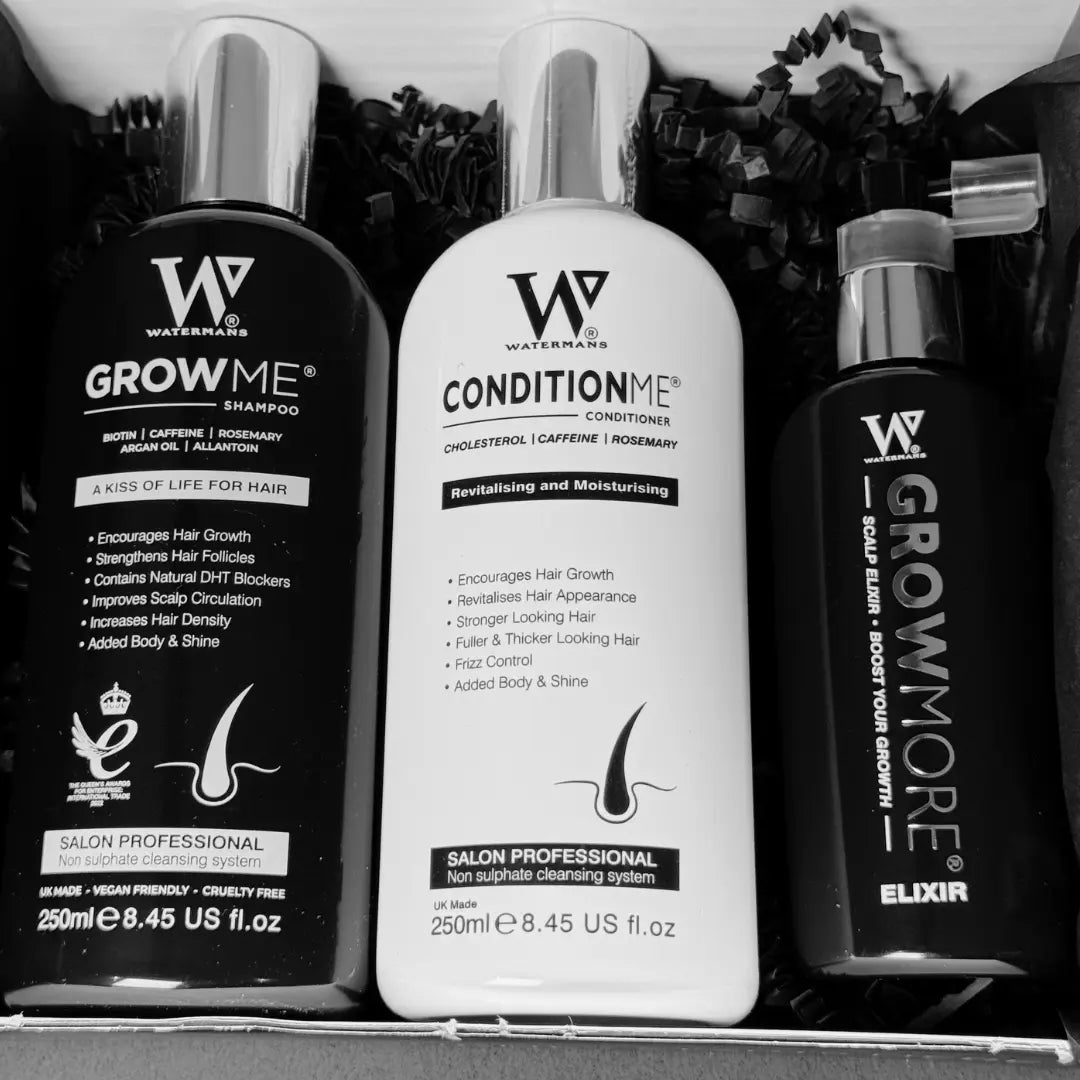
A drug-free daily foundation, biotin, caffeine and rosemary shampoo plus an overnight scalp elixir, that keeps the scalp cared for and hair looking fuller alongside whatever you and your GP decide.
View the setWatermans is a UK family business that has sold over 5 million bottles since 2012. The range is vegan and cruelty-free.
Frequently asked questions
At what age does pattern hair loss start?
Any time after puberty. Earlier onset usually predicts stronger progression, and rewards earlier action proportionally.
Do women go bald from pattern hair loss?
Very rarely. Female pattern loss thins the parting and crown diffusely but almost never removes coverage entirely.
Can pattern hair loss be stopped?
It can usually be slowed substantially and sometimes partially reversed in recently thinned areas, with licensed treatment started early. It cannot yet be cured.
Is pattern loss from my mother's or father's side?
Both, the old single-gene myth is false. Look at hair across your whole family for the fairest forecast.
Does DHT shampoo stop pattern loss?
No rinse-off product meaningfully changes hormone levels. Shampoo supports the scalp and appearance; DHT itself is prescription territory.
Pattern hair loss runs on two clocks: your genes set the speed, and your response time sets the outcome. Learn your stage, involve a GP early if it bothers you, and keep the scalp foundation strong, the difference between acting at stage two and stage five is measured in years of hair.