



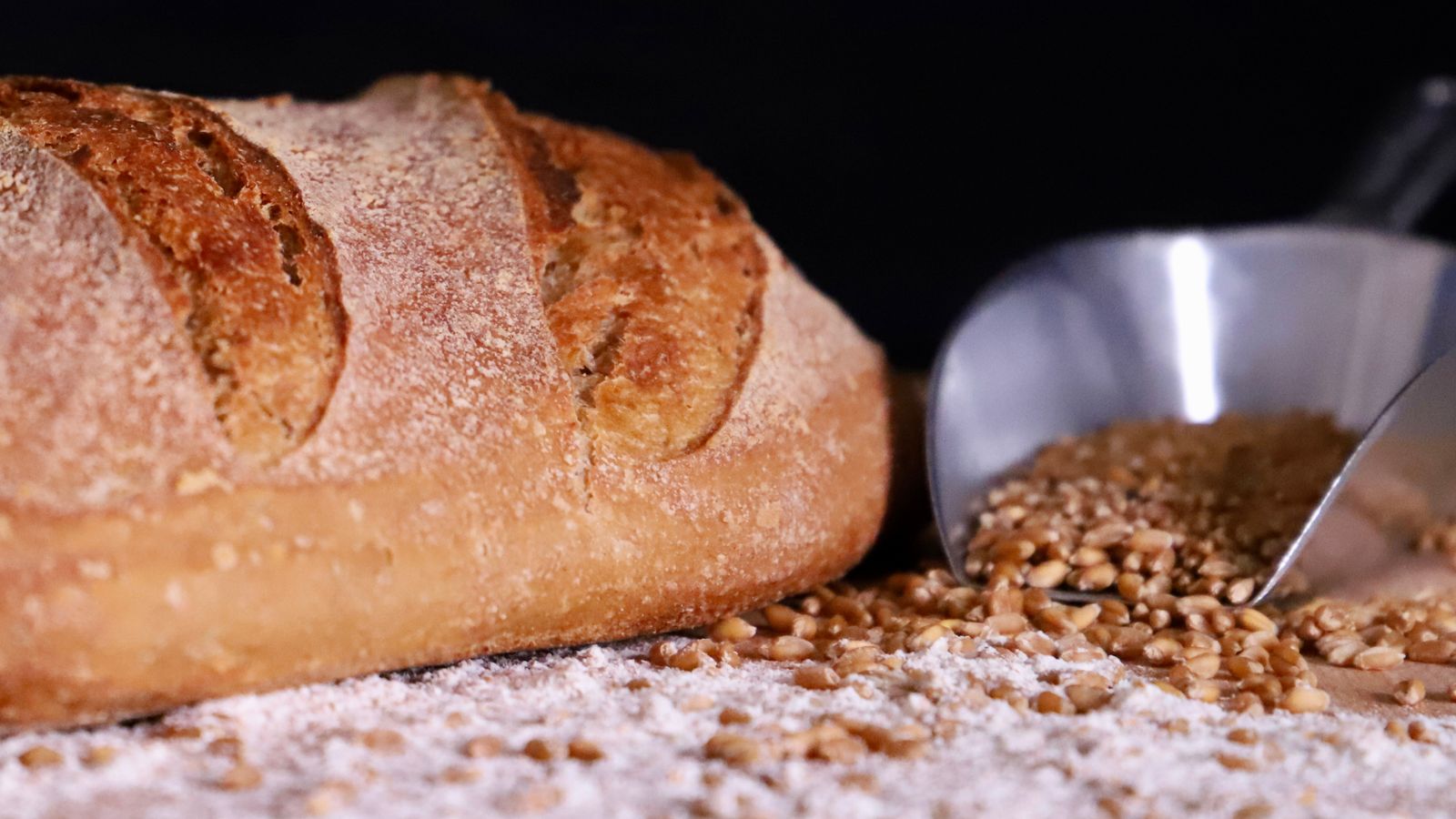
Is Sourdough Easier to Digest? Fructans, Fermentation and Sourfaux
For a lot of people, yes, but almost certainly not for the reason you have been told. Long fermentation does not strip gluten out of bread in any way that matters. What it does do is lower the fructans, a fermentable carbohydrate in wheat that is a far more likely cause of bloating in people who do not have coeliac disease.
That distinction changes what you should buy. It also explains the more awkward problem in British supermarkets: a large share of the loaves sold as sourdough are not made by long fermentation at all, so they cannot deliver the benefit the label implies.
Key takeaways
- Sourdough is not gluten free and is not safe for anyone with coeliac disease, however long it was fermented.
- Fructans are the better explanation for bread related bloating in people without coeliac disease. They are FODMAPs, poorly absorbed and fermented by gut bacteria.
- Long fermentation genuinely lowers fructans, which is the mechanism most likely behind people feeling better on real sourdough.
- Sourdough has no legal definition in the UK. A loaf can be labelled sourdough while containing baker's yeast, vinegar and additives.
- Read the ingredients, not the front of the packet. Flour, water, salt and a starter is what you are looking for.
- Get coeliac disease excluded first. Switching bread before testing can mask a diagnosis.
Why does bread cause bloating?
Three quite different things get blamed on the same slice, and they call for different responses.
- Gluten, in coeliac disease. An autoimmune reaction that damages the small intestine. This needs diagnosis and a strict lifelong gluten free diet, and no bread making method makes wheat safe.
- Fructans, in most other cases. Chains of fructose molecules that humans lack the enzymes to break down. They travel intact to the large intestine, where bacteria ferment them, producing gas, distension and discomfort. Wheat is one of the largest fructan sources in a typical British diet, largely because we eat so much of it.
- Quantity and everything around it. Portion size, how fast you eat, alcohol with the meal, and how much you have moved that day all shift how bread feels.
The evidence that fructans rather than gluten drive most non coeliac symptoms comes from blinded challenge studies. When people who are certain they react to gluten are given gluten or a placebo without knowing which, many react to both or to neither. Give the same people fructans, and symptoms follow much more reliably. That is an inconvenient result for the gluten free aisle, and a genuinely useful one for anyone trying to keep bread in their life.

What long fermentation actually does
A sourdough starter is a live culture of wild yeasts and lactic acid bacteria. Given enough time, that culture works on the dough in several ways at once.
| Claim | What the evidence supports |
|---|---|
| Reduces fructans | Yes. Extended fermentation measurably lowers fructan content, which is the most plausible reason people report less bloating. |
| Breaks down some gluten peptides | Partly. Bacterial enzymes degrade a proportion, but nowhere near enough to make bread safe in coeliac disease. |
| Makes bread gluten free | No. Ordinary sourdough sits far above the 20 parts per million legal threshold for a gluten free claim. |
| Lowers the glycaemic response | Modestly. Organic acids slow starch digestion, so blood glucose tends to rise a little less sharply. |
| Improves mineral availability | Yes. The acidity activates phytase, which degrades phytates and frees up more zinc, iron and magnesium. |
| Adds live probiotics | No. Baking kills the culture. The benefits come from what fermentation did to the dough, not from live bacteria surviving the oven. |
| Keeps longer without preservatives | Yes. Acetic and lactic acid slow mould growth naturally. |
The important row is the third one. A real sourdough loaf may be more comfortable for someone with a fructan sensitivity, and it remains completely unsafe for someone with coeliac disease. Those are not contradictory statements, they are two different conditions, and conflating them is how people get hurt.
The British bread problem: Chorleywood and sourfaux
Most bread eaten in Britain is not made slowly. In 1961, researchers at the Chorleywood Flour Milling and Baking Research Association developed a method using intense high speed mixing, extra yeast, added fats and improvers to produce a finished loaf in around three and a half hours rather than overnight. It was a commercial triumph. The Chorleywood Bread Process now accounts for the great majority of UK plant bakery bread, and it means the dough has almost no time to ferment.
Then there is the labelling issue. Sourdough has no legal definition in the UK. There is no minimum fermentation time, no requirement to use a live starter, and no restriction on adding baker's yeast or additives to a loaf sold as sourdough. Campaigners for an Honest Crust Act have spent years documenting supermarket loaves marketed as sourdough that contain commercial yeast, vinegar or acidity regulators for the sour taste, ascorbic acid, enzymes and emulsifiers. The nickname that stuck is sourfaux.
This matters practically rather than snobbishly. If the benefit you are chasing comes from long fermentation, a loaf that was proved for ninety minutes and flavoured with vinegar cannot deliver it, whatever the sticker says.

How to tell real sourdough from sourfaux
The 30 second label check
Good sign, the whole ingredients list reads: wheat flour, water, salt. Some will also name the starter, levain or sourdough culture. That is it.
Red flags, in rough order of how much they tell you: yeast or baker's yeast; vinegar or acidity regulator; ascorbic acid or E300; emulsifiers such as E471; enzymes; palm oil or vegetable fat; dextrose; anything described as fermented wheat flour used as a flavouring rather than as the leavening.
Two more checks that cost nothing:
- Ask the baker how long the dough is fermented. A genuine answer is usually somewhere between 12 and 48 hours. Hesitation is informative.
- Look at the crumb and the crust. Real long fermented sourdough has an irregular, uneven crumb, a thick blistered crust, and a distinct chew. A perfectly uniform soft crumb in a sourdough wrapper is a plant loaf in fancy dress.
| Real sourdough | Sourfaux | Standard plant loaf | |
|---|---|---|---|
| Leavening | Live starter only | Baker's yeast, plus flavouring | Baker's yeast |
| Fermentation | 12 to 48 hours | A few hours | Under 4 hours |
| Fructan reduction | Meaningful | Minimal | None to speak of |
| Ingredients | Three or four | Often eight or more | Often ten or more |
| Safe in coeliac disease | No | No | No |

Why bread abroad sometimes feels different
A very common experience is eating bread and pizza on holiday in Italy or Spain with no trouble, then reacting to it again at home. Slow fermentation is a plausible part of that. Traditional Neapolitan pizza dough and many European bakery breads are fermented far longer than a British plant loaf, and lower fructans would follow.
It is worth being honest that this is uncontrolled evidence, and several other things change on holiday at the same time: you walk considerably more, you eat at a slower pace, portion sizes and the rest of the meal are different, sleep and stress change, and the bread is usually fresh rather than several days old. All of those affect gut symptoms. Fermentation is a reasonable explanation, not a proven one, and the useful move is to test it at home where only one variable changes.
A sensible plan if bread bothers you
- Rule out coeliac disease first, while still eating gluten. This is the step people skip and regret. Ask your GP for tTG IgA together with total IgA, after at least six weeks of eating gluten in more than one meal a day. Our companion guide covers the full pathway: coeliac disease or gluten sensitivity, and why to test first.
- Then try genuinely long fermented bread for two to three weeks. Same amount, same time of day, so you are comparing like with like.
- Keep a simple diary. Food, time, symptoms, and what else was going on. Memory is a poor witness with digestive symptoms.
- Adjust the portion before you adjust the food group. Two slices and four slices can behave very differently with fructans, which are dose dependent.
- If that fails, ask about a structured low FODMAP trial with a registered dietitian. It is designed as a short elimination followed by systematic reintroduction, not as a permanent diet, and doing it unsupervised tends to end in unnecessary restriction.
- See your GP for weight loss you did not intend, blood in your stool, a persistent change in bowel habit, anaemia, or symptoms that wake you at night. Those need assessment rather than a different loaf.
Bread, restriction and your hair
Here is the part that brings this back to what we do. The most common way food ends up affecting hair is not any single ingredient. It is restriction.
Cutting out a staple usually means cutting out more than you planned. Bread and fortified flour contribute a meaningful share of British intakes of iron, thiamin, niacin, folic acid and fibre, and removing it without replacing it leaves gaps. If overall energy or protein intake drops at the same time, follicles can shift early out of their growing phase, and roughly two to three months later you notice more hair in the shower. That is telogen effluvium, and self imposed elimination diets are one of the quieter triggers for it.
So the practical hair advice is unglamorous: do not remove a food group on a hunch. Test properly, restrict only what you have shown you need to, and replace what you take out. If shedding has already started, our guides to what causes thinning hair and hair loss during fasting and restriction explain the timing to expect, and our guide to blood tests, diet and hair loss lists which results to ask your GP for.

GrowPro Hair Growth Gummies
Sugar free, vegan gummies with biotin, zinc, MSM, bamboo silica and vitamins C, D3 and B12, covering some of the micronutrients an elimination diet tends to squeeze out.
Two honest caveats. It contains no iron, and iron deficiency should be measured by your GP rather than guessed at and self treated. And it is a cosmetic and nutritional supplement, not a treatment for coeliac disease, IBS or any digestive condition. If you have been diagnosed with coeliac disease, check the label for gluten free certification before taking any supplement.
Frequently asked questions
Is sourdough easier to digest than normal bread?
For many people without coeliac disease, yes. Long fermentation measurably lowers the fructan content of the dough, and fructans are the fermentable carbohydrate most likely to cause bloating and wind from wheat. The benefit depends on genuinely long fermentation, so a supermarket loaf proved for a couple of hours is unlikely to help.
Is sourdough gluten free?
No. Fermentation breaks down a proportion of gluten peptides but leaves levels far above the 20 parts per million legal threshold for a gluten free claim. Sourdough is not safe for anyone with coeliac disease, however long it was fermented.
Can people with coeliac disease eat sourdough?
No. Coeliac disease requires a strict gluten free diet for life, and ordinary sourdough made from wheat, rye or barley flour contains gluten. Only bread labelled gluten free, meaning tested below 20 parts per million, is suitable.
How can I tell if a supermarket sourdough is real?
Read the ingredients. Real sourdough needs only flour, water, salt and a starter culture. Baker's yeast, vinegar or acidity regulators, ascorbic acid, emulsifiers and enzymes all indicate a fast made loaf flavoured to taste sour. Sourdough has no legal definition in the UK, so the front of the packet tells you nothing.
What are fructans and why do they cause bloating?
Fructans are chains of fructose molecules found in wheat, onions, garlic and some other foods. Humans lack the enzymes to digest them, so they pass into the large intestine where gut bacteria ferment them, producing gas, distension and discomfort. They are part of the group of fermentable carbohydrates known as FODMAPs, and their effects are dose dependent.
Does sourdough contain probiotics?
No. The bacteria in the starter are killed by the heat of baking. The benefits of sourdough come from what the culture did to the dough during fermentation, not from live organisms surviving in the finished loaf.
Is sourdough better for blood sugar?
Modestly. The organic acids produced during fermentation slow starch digestion, so the rise in blood glucose after eating tends to be a little lower than with a fast made white loaf. It is a small effect, not a reason to treat bread as a diabetes management tool.
Why can I eat bread in Italy but not in the UK?
Longer fermentation and therefore lower fructans is a plausible part of it, since much European bakery bread and traditional pizza dough is fermented far longer than a British plant loaf. It is not the whole story though. Walking more, eating more slowly, different portions and fresher bread all change how a meal feels, so it is worth testing long fermented bread at home before drawing conclusions.
The bottom line
Sourdough deserves much of its reputation, just not the version of it that circulates online. It does not remove gluten, it will never be safe in coeliac disease, and it contains no live probiotics. What it does is reduce fructans, free up minerals and slow the starch, and for a lot of people that is enough to make bread comfortable again.
Get coeliac disease excluded first, then buy on the ingredients list rather than the label, and give a genuinely long fermented loaf a fair two or three weeks before you decide.
Noticed more shedding since you changed your diet? Watermans has made vegan, cruelty free haircare in the UK since 2012, with over five million bottles sold. GrowPro gummies cover part of the micronutrient picture, and Grow Me shampoo works on the condition of the hair fibre for a fuller look. Both are cosmetic and nutritional support rather than medical treatments. For persistent digestive symptoms, unexplained weight loss or sudden hair loss, please see your GP.