Medication Related Hair Shedding: Timeline and What Helps
Medication related hair shedding is one of the more confusing hair problems, because the cause and the effect are separated by months. A medicine changes in March, nothing happens, and then in June hair starts coming out in the shower. The shed is usually diffuse and temporary rather than permanent, and the single rule that overrides everything else is this: never stop or change a medicine you have been given because of your hair.
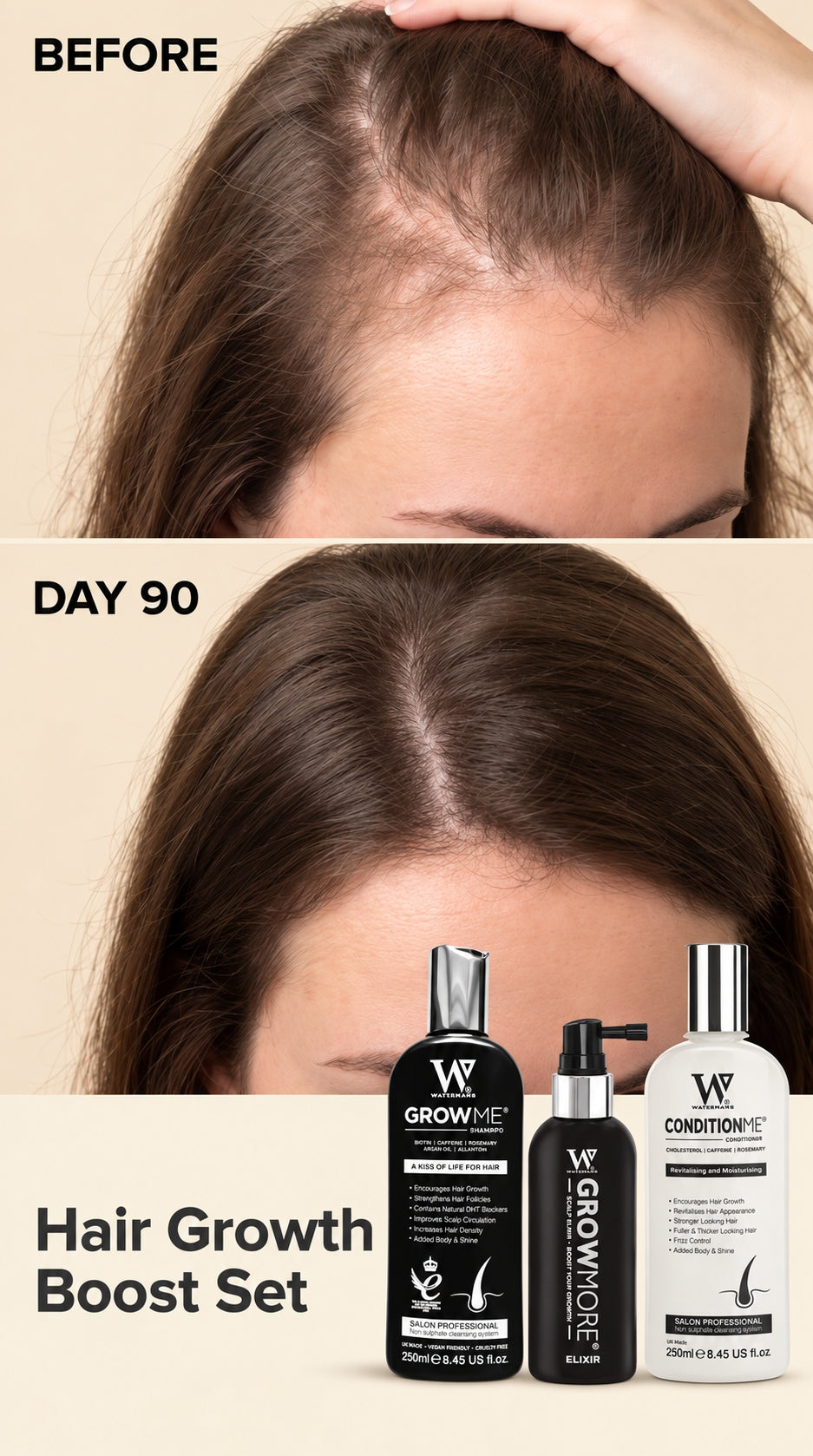
Our hair growth shampoo
Grow Me® Hair Growth Shampoo, £14.95. A sulphate free daily shampoo that supports a healthy scalp environment and helps reduce breakage, so lengths hold on and look fuller.
Key takeaways
- The signature is a delay of two to four months between the medicine changing and the shed starting.
- The usual mechanism is telogen effluvium, a diffuse temporary shed, not permanent loss and not patchy loss.
- Never stop a medicine you have been given over your hair. Take the timeline to the clinician who started it.
- The illness itself is often as plausible a trigger as the medicine, and the two are hard to separate.
- Ask for ferritin, vitamin D, B12, folate and thyroid tests before buying supplements.
- Hair care cannot shorten the shed, but it does stop you losing extra length to breakage.
What does medication related hair shedding actually look like?
The picture is diffuse rather than localised. Hair comes away evenly from the whole scalp, so instead of a bald spot you get a ponytail that has lost its thickness, a wider parting, and a noticeably larger amount of hair in the shower drain and on the pillow. Individual strands are full length and carry a small pale, club-shaped bulb at the root end, which is the marker of a hair that finished its cycle and was released normally.
What does not fit this picture: patches with a clean defined edge, a sore or scaling scalp, hair snapping off mid-length leaving stubble, or a slow retreat at the temples and crown over several years. Those are different problems with different answers and are worth showing to a GP rather than attributing to a medicine.

Why is there such a long delay?
Each follicle runs an independent cycle. Anagen, the growing phase, lasts two to seven years and covers roughly 85 to 90 per cent of scalp hairs at any moment. Catagen is a brief transition. Telogen is a resting phase of about three months, at the end of which the strand is released and a replacement begins underneath. Because the cycles are unsynchronised, losing 50 to 100 hairs a day is simply normal turnover.
A meaningful change to the body can push an unusually large group of follicles out of anagen and into telogen at once. Nothing is visible at that point, because telogen still has to run its three months. When it ends, that whole synchronised cohort sheds within a few weeks of each other, and the result looks alarming and sudden even though the trigger was months earlier. This is why the timeline is the diagnostic tool rather than the sensation of how bad it feels.
The timing test
Shedding that begins within days of a change is very unlikely to be the medicine. Shedding that begins two to four months after a change fits the pattern well. Shedding that has crept on gradually over two or three years is not this pattern at all and is more likely inherited thinning.
Which is it: hair loss, hair shedding or hair breakage?
These three words get used as if they mean the same thing. They do not, and the difference decides what is worth doing.
| Where the problem sits | How it presents | What changes it | |
|---|---|---|---|
| Hair shedding | The follicle cycle, temporarily | Sudden, diffuse, whole hairs with a pale root bulb | Time and removing the trigger. Correcting a real deficiency |
| Hair loss | The follicle itself, over years or through disease | Gradual and localised, or defined patches | A GP or dermatologist assessment. The cause decides the option |
| Hair breakage | The hair fibre, above the scalp | Short snapped pieces, split ends, frizz, no root bulb | Gentler handling, less heat and tension, conditioning |
In practice the first and third arrive together. Someone unwell enough to be starting a new medicine is often also sleeping badly, eating less well and handling their hair roughly because they have less energy for it. The shed is the part you wait out. The breakage is the part you can act on immediately.
Get a discount on the hair shedding range
Join the Watermans mailing list and we will email a discount code straight to your inbox, so you can try the hair shedding range for less. Vegan, made in the UK, over 6.5 million bottles sold since 2012.
What should you do, in order?
- Keep taking your medicine as agreed. This is first for a reason. Some medicines are dangerous to stop suddenly, and the condition being managed matters more than a temporary shed.
- Build the timeline. Write down when each medicine started, stopped or changed dose, and when the shedding began. Add any illness, surgery, fever, weight change or major stress in the same window.
- Take it to the clinician who started the medicine. They can weigh the timing against everything else in your history and decide whether a review is warranted.
- Ask about blood tests. Ferritin, full blood count, vitamin D, B12, folate and thyroid function. Being unwell is an efficient way to become short of several at once.
- Do one honest hair count, then stop. Collect a day of loose hair for a real number rather than an anxious estimate. Repeated daily counting increases distress without changing the outcome.
- Protect what you have. Gentle handling from today limits the breakage that otherwise stacks on top of the shed.

How long does medication related hair shedding run, realistically?
| Stage | Timing | What happens |
|---|---|---|
| Trigger | Month 0 | Follicles switch to resting. Nothing visible. |
| Shed starts | Month 2 to 4 | Daily fall rises sharply. This is when people search for answers. |
| Shed peaks and eases | Month 4 to 8 | Fall returns toward normal. Short new hairs appear at the hairline. |
| Density returns | Month 8 to 18 | New hairs reach a length that reads as fullness. |
The gap between the shed stopping and the mirror agreeing is the hardest part psychologically, and it is where most people conclude nothing is working. Hair grows at roughly one centimetre a month, so a strand that started in the spring is only a few centimetres long by autumn. New growth is under way well before it is visible.
What can hair care actually do during medication related hair shedding?
One job, done properly. Products work on the fibre and the scalp surface, so they cannot shorten a shed driven by the follicle cycle. What they can do is keep you from losing additional length to breakage, and since hair looks thin because of both the shed and the accumulated breakage, that is a genuine contribution rather than a consolation prize.
- Detangle wet hair from the ends upward with a wide-tooth comb, never from the roots down.
- Keep styling heat below about 185°C and use a protective layer when you do use it.
- Loosen ties and vary where you put them, so the same section of hairline is not always under tension.
- Condition mid-lengths to ends every wash, so hair slides through the comb rather than catching.
- Sleep on silk or satin, or plait loosely, to cut overnight friction.

Grow Me® Hair Growth Shampoo · £14.95
A sulfate-free everyday shampoo with biotin, caffeine, rosemary and niacinamide. It cleanses gently, supports a healthy scalp environment and reduces breakage, so the hair you keep looks and feels fuller. It is a cosmetic product and does not act on the follicle cycle behind a shed.


Masque Me® Repairing Hair Mask · £24.95
A deep conditioning mask for hair that has turned dry and brittle and is snapping in the comb. Useful once a week when breakage is adding visible thinness on top of a shed.
Where does this sit alongside other shedding triggers?
Medicines are one entry on a longer list, and it is worth seeing the list, because attributing a shed to the wrong cause wastes months. Childbirth, surgery, a high fever, rapid weight loss, severe stress, a thyroid change and iron deficiency all produce the same diffuse pattern on the same delayed timeline. Several can be running at once.
We cover the neighbouring cases in more detail: shedding linked to mood medication looks at that specific class and the mental health considerations around it, hair thinning and blood sugar covers the metabolic and dietary route, shedding after surgery deals with the post-operative pattern, and what causes telogen effluvium is the general explainer for the mechanism itself.
Where is the evidence genuinely uncertain?
Two honest caveats. First, most of what is known about drug-linked shedding comes from spontaneous reporting systems and individual case reports rather than controlled trials. Those sources establish that something has been observed but cannot tell you how often it happens, and they tend to over-represent dramatic cases. Second, confounding here is severe: the medicine and the illness that prompted it arrive together, and the illness is frequently a sufficient trigger on its own. Reviews of drug-associated hair changes routinely note that attribution in any individual case is uncertain. That is not a reason to dismiss the link, but it is a good reason to resist confident claims in either direction, and a very good reason to leave the decision with the clinician who knows the whole history.
Frequently asked questions
How do I know if my medicine is the cause?
Timing is the strongest clue you have. Medication related hair shedding characteristically begins two to four months after starting, stopping or changing a medicine, not in the first fortnight. If the shed started within days it is very unlikely to be the medicine, and if it started three months after a change the timing fits. Write the dates down and let your GP weigh it up.
Should I stop the medicine to find out?
No. Never stop or adjust a medicine you have been given in order to test a theory about your hair. Some medicines cause serious problems if stopped abruptly, and the condition being managed is almost always more important than a temporary shed. Take the timeline to the clinician who started it and let them decide whether anything should change.
Is this kind of shedding permanent?
Usually not. The common pattern is telogen effluvium, in which follicles switch to resting early and release strands together. The follicles stay alive and keep cycling, so density typically recovers once the trigger is removed or the body adjusts. Recovery is slower when something else is running alongside, such as low iron or inherited pattern thinning.
How long does medication related hair shedding last?
The shed itself usually runs three to six months. Visible density takes longer, because a new strand grows at roughly one centimetre a month and has to reach a length that contributes to volume. Most people are looking at six to twelve months from the end of the shed before the mirror agrees with them.
Could it be the illness rather than the medicine?
Very often, yes, and this is the part most articles skip. Infection, fever, surgery, pain, poor sleep, weight change and the stress of being unwell are all well-documented triggers for exactly the same diffuse shed. Since the illness and the medicine usually arrive together, separating them is genuinely difficult and sometimes impossible.
Will a hair product stop it?
No. Shampoos, conditioners, oils and serums act on the hair fibre and the scalp surface, not on the follicle cycle driving the shed. What they can do is reduce breakage so you stop losing extra length on top of the shed, which is a real and worthwhile job, just not the one people hope for.
What blood tests are worth asking for?
Ferritin and full blood count, vitamin D, B12, folate and thyroid function are the usual starting set. Being unwell, eating poorly or losing weight quickly can leave you short of several of these at once, and correcting a genuine deficiency is one of the few things that measurably helps.
Is it normal to feel upset about this?
Yes, and it is worth saying plainly. Hair change on top of managing a health condition is genuinely distressing, and people routinely feel they should not mind. Distress is a legitimate reason to raise it with your GP, not a reason to keep quiet about it. If your question is about products or a routine rather than a medical one, you can talk to Gail Waterman, our co-founder, as an AI avatar on the Watermans homepage.
What is the bottom line on medication related hair shedding?
Medication related hair shedding announces itself two to four months after a medicine starts, stops or changes, presents as a diffuse temporary shed rather than patchy or permanent loss, and usually settles within three to six months with density recovering over the following year. The timeline is your best evidence, so write it down. Do not stop a medicine you have been given in order to test the theory; take the dates to the clinician who started it, ask for the standard blood tests, and in the meantime handle your hair gently so breakage does not compound what the cycle is already doing.
Most routines fall over because they are complicated, so start with the Grow Me hair growth shampoo and nothing else. Vegan, made in the UK.
Sources & references
- NHS: Hair loss: overview including temporary shedding after illness, stress and some medicines.
- DermNet NZ: Telogen effluvium: mechanism, the delayed onset and typical duration.
- British Association of Dermatologists: Telogen effluvium information leaflet.
- MHRA: Yellow Card scheme: how suspected side effects are reported in the UK, and the limits of spontaneous reporting data.
- NICE: Clinical Knowledge Summaries: Iron deficiency anaemia: on ferritin testing.
- NHS: Underactive thyroid: a common alternative explanation worth excluding.
Important: Watermans products are 100% cosmetic and do not treat medical hair loss. Individual results may vary.