



Vitamin D Deficiency in the UK: Who Needs to Supplement
Last updated: August 2026
If you live in the UK, you cannot make vitamin D from sunlight between roughly October and March, no matter how much time you spend outside. Britain sits between about 50 and 59 degrees north, and at that latitude the winter sun is too low for its ultraviolet B rays to reach the skin in a useful amount. That is why UK guidance advises everyone over the age of four to consider a daily 10 microgram supplement through autumn and winter, and why some groups need one all year round.
Key takeaways
- UK guidance is 10 micrograms (400 IU) of vitamin D a day for everyone aged 4 and over, taken from October to March.
- Some groups need it every month of the year, including people with darker skin, anyone who covers up outdoors, and people who are rarely outside.
- Skin synthesis stops in UK winter because of latitude, not cloud cover. Sitting by a window does not work either, since glass blocks UVB.
- Do not exceed 100 micrograms (4,000 IU) a day for adults. Vitamin D is fat soluble, so it accumulates and can cause harm.
- Food is a weak source in Britain. Unlike the US and Canada, the UK does not routinely fortify milk.
- Vitamin D receptors sit in the hair follicle, but the link to hair loss is an association, not a proven cause, and supplements are not a hair loss treatment.
Why is vitamin D deficiency so common in Britain?
The cause is geography. Your skin makes vitamin D when ultraviolet B radiation hits it, and UVB only reaches the ground at a useful intensity when the sun is high enough in the sky. Above roughly 37 degrees latitude, that stops happening in winter. The UK stretches from about 50 degrees north at the Lizard to about 59 degrees north in Shetland, which puts the entire country well outside the winter window.
This catches people out because it has nothing to do with how bright the day feels. A crisp, cloudless January afternoon in Cornwall produces essentially no vitamin D. Nor does sitting in a sunny conservatory, because ordinary window glass blocks almost all UVB while letting the warmth through.

In summer the position reverses. From late March to the end of September, most people with lighter skin make enough from short, regular exposure of forearms and face, well before the skin starts to redden. Deliberately burning does not produce more vitamin D, it just damages skin, because synthesis plateaus quickly and then stops.
Who needs to take vitamin D all year, not just in winter?
Anyone whose skin gets little usable UVB even in summer needs it every month. That is a larger group than most people realise, and it is where deficiency is most likely to be significant rather than marginal.
| Group | Why |
|---|---|
| People with African, African-Caribbean or South Asian backgrounds | Melanin absorbs UVB, so significantly longer exposure is needed to make the same amount. UK summers rarely provide it. |
| Anyone who covers most of their skin outdoors | Whether for religious, cultural or sun-protection reasons, covered skin makes no vitamin D. |
| People who are housebound, in a care home, or work nights | Very little outdoor daylight in any season. |
| Babies under 1 and children aged 1 to 4 | Growing bones and limited dietary sources. Breastfed babies need drops. Formula-fed babies taking 500ml or more a day usually do not, as formula is already fortified. |
| Pregnant and breastfeeding women | Requirements rise, and maternal status affects the baby's stores. |
| Adults over 65 | Skin becomes less efficient at synthesis with age, and time outdoors often falls. |
How much vitamin D should you take, and how much is too much?
For adults and children over four, the UK reference nutrient intake is 10 micrograms a day, which is the same as 400 international units. That is the number on most supermarket supplements, and for the overwhelming majority of people it is all that is needed.
The ceiling matters just as much, because vitamin D is fat soluble and therefore accumulates in the body rather than being flushed out like vitamin C. Very high doses raise blood calcium, which can cause nausea, vomiting, weakness, excessive thirst and, over time, damage to the kidneys and heart.
| Age group | Recommended daily amount | Do not exceed |
|---|---|---|
| Adults and children over 11 | 10 micrograms (400 IU) | 100 micrograms (4,000 IU) |
| Children 1 to 10 | 10 micrograms (400 IU) | 50 micrograms (2,000 IU) |
| Babies under 12 months | 8.5 to 10 micrograms | 25 micrograms (1,000 IU) |
Take it with food that contains fat
Vitamin D is fat soluble, so absorption improves markedly when the tablet is taken with a meal containing some fat rather than on an empty stomach with water. Breakfast with eggs, or any meal with oil, butter or nuts, does the job. Consistency matters more than timing, so pick the meal you never skip.

Which foods contain vitamin D, and can diet alone be enough?
Diet alone rarely covers it in Britain. Very few foods contain meaningful vitamin D naturally, and unlike the United States and Canada, the UK does not routinely fortify milk. That single policy difference is a large part of why British intakes look poor next to North American ones.
The genuinely useful sources are oily fish and, at a much lower level, egg yolks, liver, red meat and fortified products.
- Oily fish is far ahead of everything else. Salmon, mackerel, sardines, herring, trout and pilchards are the reliable options, and tinned versions count.
- Egg yolks contribute a modest amount, and the level depends on how the hens were raised.
- Liver and red meat provide small amounts.
- Fortified foods in the UK mainly means some breakfast cereals, most fat spreads, and some plant milks. Always check the label, because fortification is voluntary here.
- Mushrooms can contain vitamin D2 if they have been exposed to ultraviolet light, which some producers now do deliberately and state on the packet.

Two portions of fish a week, one of them oily, is the standard UK advice and is worth hitting for reasons beyond vitamin D. But even people who manage it are usually advised to supplement through winter, because the arithmetic simply does not get there on food alone.
Should you take D2 or D3, and what works for vegans?
Vitamin D3, or cholecalciferol, raises and maintains blood levels more effectively than D2, or ergocalciferol, so D3 is the better choice where you have one. The complication is that conventional D3 is usually made from lanolin, the grease in sheep's wool, which makes it unsuitable for vegans.
The solution is vegan D3 derived from lichen, which is now widely available and delivers the same form of the vitamin. If a supplement simply says vegan without specifying, check whether it is lichen-derived D3 or D2, because the difference is real. Look for the Vegan Society trademark or an explicit statement on the label.
The most common mistake is not choosing the wrong form. It is buying a bottle in November and stopping in December.
Do you need a blood test for vitamin D?
Most people do not. The standard 10 microgram dose is low enough to be safe without testing, so routine screening is not offered on the NHS for people with no symptoms. Testing becomes worthwhile when there is a specific reason to suspect a significant deficiency or an absorption problem.
The test measures 25-hydroxyvitamin D in the blood. In the UK, a level below 25 nanomoles per litre is generally treated as deficient, and that is a level that warrants medical treatment rather than a supermarket supplement. Ask a GP for a test if you have persistent bone or muscle pain, muscle weakness, a history of fractures, a condition affecting fat absorption such as coeliac or Crohn's disease, or if you fall into more than one of the higher-risk groups above.
Speak to a GP or pharmacist before supplementing if
You have kidney disease, sarcoidosis, hyperparathyroidism, a history of kidney stones, or you take any medication that affects calcium. Vitamin D raises calcium absorption, and in these situations that needs supervising rather than self-managing.
Also see a GP for bone or muscle pain that is not explained by activity, or for any sudden, patchy or rapid hair loss. Those need assessing properly, not treating with a supplement bought on a hunch.
Does vitamin D deficiency cause hair loss?
The honest answer is that the connection is real but far weaker than supplement marketing suggests. Vitamin D receptors are present in the keratinocytes of hair follicles and play a part in cycling follicles from the resting phase back into growth, so the biology is not invented. What is oversold is the leap from that to a supplement fixing hair.
The clearest evidence comes from a rare genetic condition, hereditary vitamin D resistant rickets, in which a faulty receptor causes total hair loss. Crucially, that hair loss is not corrected by giving vitamin D, which suggests the receptor's role in the hair cycle does not depend on the vitamin binding to it. That single finding explains why topping up levels rarely produces the dramatic results people expect.
Observational studies do repeatedly find lower vitamin D levels in people with telogen effluvium, the diffuse shedding that follows a physical stress, with female pattern thinning, and with alopecia areata, an autoimmune condition. But an association measured after the fact cannot tell you which came first, and intervention trials remain limited and mixed.
The sensible position: correcting a genuine deficiency is worth doing for your bones, muscles and general health regardless, and if it also helps your hair, that is a bonus rather than the plan. If you are unsure whether what you are seeing is normal, our guide to what counts as normal hair loss for a woman after 40 is a good place to calibrate.

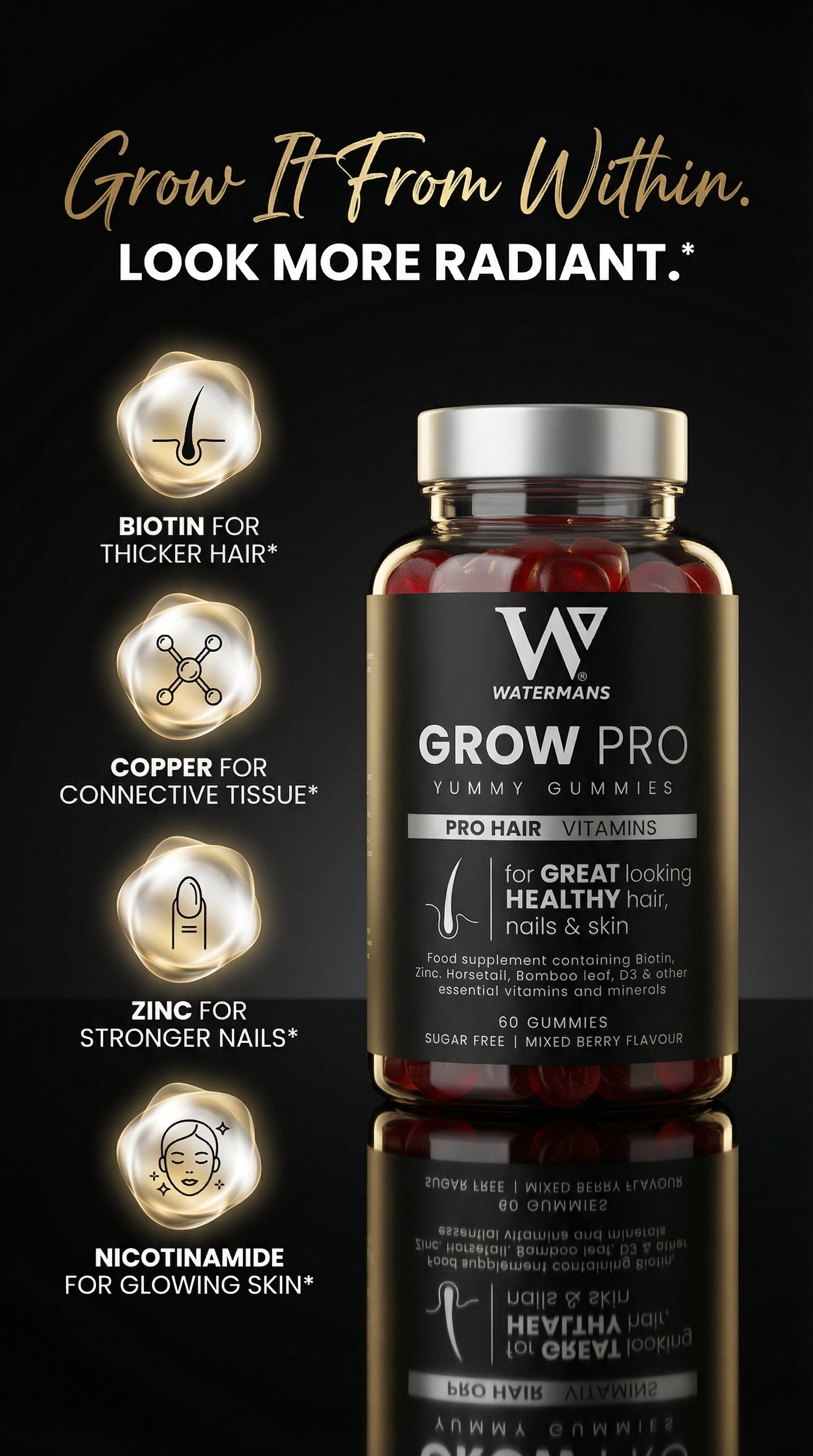
GrowPro Hair, Skin and Nails Gummies, 22.95 pounds
Sugar-free and vegan, with biotin, zinc, vitamin D3, vitamin C and bamboo silica among their nutrients. Biotin and zinc contribute to the maintenance of normal hair. One clarification worth making: this is a hair, skin and nails formula, not a dedicated vitamin D supplement, so if you are following the 10 microgram winter guidance, keep taking your vitamin D alongside rather than swapping it out.
View the gummiesVitamin D is one of three nutrients people reach for when they feel run down in winter. We have looked at the other two in detail: whether vitamin C actually prevents colds, and whether zinc shortens a cold you have already caught. The answers differ more than you might expect.
Frequently asked questions
How long does it take to correct a vitamin D deficiency?
Blood levels typically begin rising within a few weeks of daily supplementation and reach a steady state after roughly two to three months. Correcting a diagnosed deficiency usually involves a higher loading dose prescribed by a GP, followed by a normal maintenance dose.
Can I get enough vitamin D from a sunbed?
No, and it is not worth the trade. Most sunbeds emit mainly UVA, which does not produce vitamin D but does contribute to skin ageing and skin cancer risk. A 10 microgram tablet costs pennies and carries none of that risk.
What are the symptoms of vitamin D deficiency in adults?
Mild deficiency often causes nothing noticeable. More significant deficiency can produce aching bones, muscle weakness or pain, particularly in the thighs and hips, tiredness, and low mood. These symptoms are non-specific, which is exactly why a blood test rather than guesswork is the right route.
Is it safe to take 1,000 or 2,000 IU instead of 400?
Doses in that range sit comfortably below the 4,000 IU adult upper limit and are widely sold and used. They are not necessary for most people, though, and taking more than you need brings no additional benefit. If you are considering higher doses long term, get your level checked first.
Do I still need vitamin D in a British summer?
From late March to the end of September most people with lighter skin can make enough from short, regular daylight exposure without burning. The higher-risk groups listed above should continue year round regardless of season.
Does sunscreen stop you making vitamin D?
In laboratory conditions high-factor sunscreen substantially reduces synthesis, but in real-world use people apply too little and too unevenly for it to prevent vitamin D production in practice. Keep using sunscreen and take the supplement. Skin cancer risk is the more serious of the two problems.
Can too much vitamin D be dangerous?
Yes. Sustained very high doses cause hypercalcaemia, meaning too much calcium in the blood, which can lead to nausea, vomiting, thirst, confusion and kidney damage. This comes from supplements rather than sun or food, since the body self-limits skin synthesis.
Will a vitamin D supplement regrow my hair?
No, and no supplement should be sold on that basis. Correcting a genuine deficiency supports normal function throughout the body, but vitamin D is not a hair loss treatment. Persistent or patchy shedding needs a GP or trichologist assessment to find the actual cause.
The practical summary
Buy a 10 microgram vitamin D supplement, take it with a meal that contains some fat, and start in October rather than waiting until you feel rough in February. If you have darker skin, cover up outdoors, or rarely get outside, take it all year. Eat oily fish twice a week if you can. And if hair thinning is what brought you here, treat vitamin D as basic housekeeping rather than the answer, and get the shedding itself looked at.
Watermans has sold over 5 million bottles since 2012, and everything we make is vegan and produced in the UK.