Menopause Hair Loss: Is It Really the Menopause?
Menopause hair loss is the explanation almost every woman is handed for thinning hair after forty five, and it is right often enough to be believable and wrong often enough to be a problem. Low iron stores, thyroid change, a delayed shedding episode and ordinary breakage all peak in the same decade and produce a very similar looking head of hair. Sorting out which one you actually have is what decides whether the next twelve months are useful or wasted.
Our menopause hair care kit
Menopause Hair Care Kit, £69.99. A complete hair, skin and wellbeing routine put together for the hair changes that arrive around the menopause.
Key takeaways
- Menopause hair loss is real, but four other things peak at the same age and look almost identical: low iron stores, thyroid change, a shedding episode and plain breakage.
- Pattern separates them. Diffuse widening at the parting with an intact hairline is pattern thinning. Sudden loss all over is shedding. Patchy or scarred needs a GP now.
- Four blood tests settle most of it: ferritin, full blood count, thyroid function and vitamin D.
- Follicle level change is judged at nine to twelve months. Breakage responds in about six weeks. Do not measure one with the other's clock.
- Washing less does not reduce shedding. It concentrates the same hairs into fewer, more frightening handfuls.
- Cosmetic hair care cannot alter the follicle, but it can stop you losing length to breakage, which is often a third or more of what you are seeing.
Is menopause hair loss actually what you have?
Menopause hair loss has a specific shape. It is diffuse rather than patchy, worst along the central parting, gradual over a year or more, and the frontal hairline usually holds while the scalp behind it shows through. The hairs themselves get finer with each cycle rather than falling out in dramatic quantities. If that is not what you are seeing, the menopause may not be the main story even if you are the right age for it.
The reason this matters is that the four common alternatives are all far more actionable. Low ferritin can be corrected. A thyroid change can be managed. A shedding episode recovers on its own once you stop feeding it. Breakage responds to a different hairbrush and a bit less heat. Attributing all four to the menopause means none of them gets addressed, and the year you spend waiting for hormones to settle is a year those causes carry on unchecked.
This page is deliberately the sorting page. If you already know what you are dealing with and want the routine, the menopause hair loss options page covers what actually helps, and the symptoms page covers the wider picture of menopausal hair change.
How do you tell the causes apart at home?
You can get surprisingly far with a mirror, good daylight and honesty about timing. Work down this table and find the row that matches what you are actually seeing rather than what you fear.
| What you notice | Most likely explanation | Typical timing | Next step |
|---|---|---|---|
| Parting slowly widening, hairline intact, hairs look finer | Female pattern thinning, which becomes more visible around the menopause | Over a year or more, gradual | Dated photographs, then a GP conversation about options |
| Sudden heavy shedding all over, scalp not visibly thinner at first | A shedding episode triggered two to three months earlier | Starts abruptly, settles over three to six months | Identify the trigger, check ferritin and thyroid |
| Tired, cold, heavier periods, weight change alongside the hair | Low iron stores or a thyroid change, both common at this age | Builds over months, easy to attribute to the menopause | Blood tests. This is the one most often missed |
| Short broken pieces, split ends, hair not getting longer | Breakage. Nothing to do with hormones or the follicle | Any time, worse with heat, colour and tight styling | Change how you handle it. Responds in weeks |
| Coin sized bald patches, smooth skin | Not menopause related. A separate condition | Can appear within weeks | See a GP |
| Itchy, sore, scaly or shiny scarred scalp | A scalp condition, not hormonal thinning | Variable, often with symptoms you can feel | See a GP promptly. Scarring is not recoverable |

What is the difference between hair loss, shedding and breakage?
These three words get used interchangeably and describe completely different events. Getting them straight is the single highest value thing on this page, because two of the three respond on a timescale of weeks or months while only one is genuinely slow.
| Hair loss | Hair shedding | Hair breakage | |
|---|---|---|---|
| Where it happens | At the follicle. It shrinks or is lost. | At the follicle, but only the timing changes. | Along the fibre, well away from the scalp. |
| What the hair looks like | Full length, but progressively finer and shorter each cycle. | Full length with a small white bulb on the root end. | Short, uneven pieces with no bulb at either end. |
| Hormonal? | Yes, strongly. | Sometimes, but illness, iron and stress are just as common. | No. It is mechanical and chemical. |
| How fast it responds | Nine to twelve months to judge anything. | Three to six months, usually on its own. | About six weeks. The fast win. |
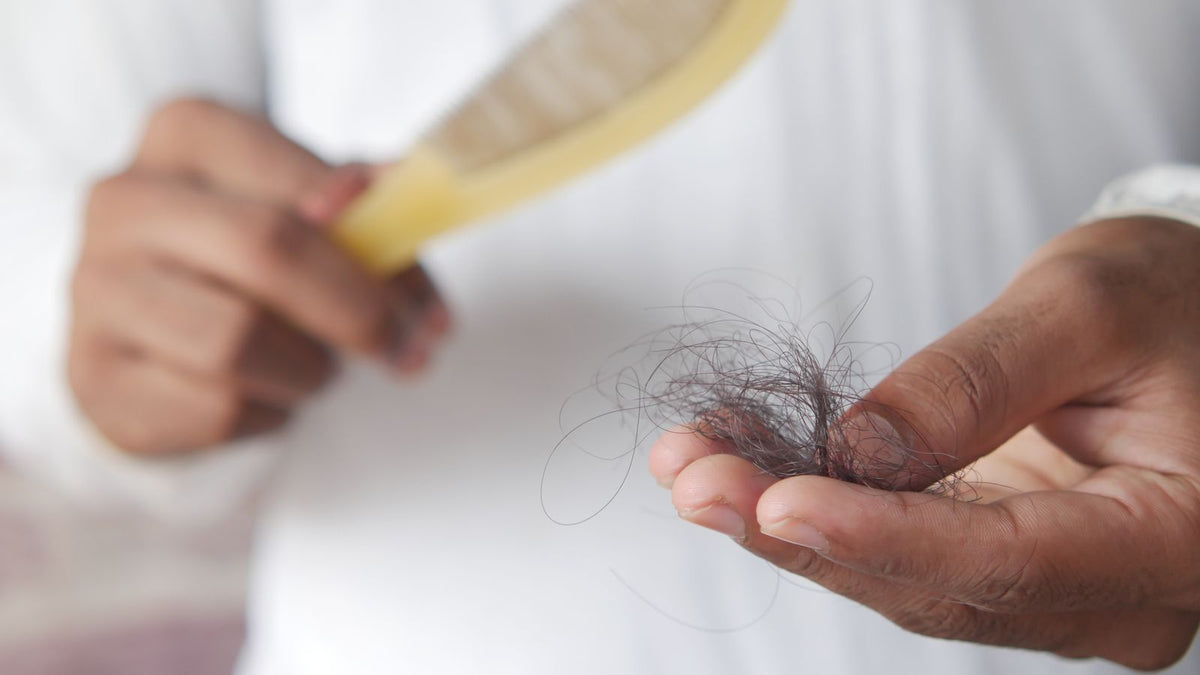
The at home test takes under a minute. Pick a hair off your jumper and look at the root end in daylight. A tiny pale swelling means the follicle completed its cycle and released the hair, which is shedding. No swelling, with a blunt or frayed end, means the fibre snapped, which is breakage. Do that with ten hairs and you will know which problem dominates. The three clue self check walks through it in more detail, and the shedding page explains the two to three month delay that makes people blame the wrong month.
The most common mistake in this age group
Assuming it is one thing. Plenty of women in their late forties and fifties have gradual pattern thinning, a shedding episode from a stressful year, and breakage from colouring, all at once. The pattern thinning is the slow half everyone focuses on. The other two are the fast half, and they are where the visible difference in the next three months comes from.
Which blood tests are worth asking your GP for?
Four tests do most of the work. Your GP decides what is appropriate in your case, but knowing what to ask about turns a rushed ten minutes into a useful one.
- Ferritin. This measures stored iron, not the iron currently in your blood, so it can be low while a standard anaemia check comes back normal. Low iron stores are the most commonly missed cause of hair shedding in women who still menstruate, and heavy or irregular perimenopausal periods make it more likely, not less. See the shedding page for how it connects.
- Full blood count. Picks up anaemia itself and gives context to the ferritin result.
- Thyroid function. Both an underactive and an overactive thyroid affect hair, and the general symptoms overlap heavily with menopausal ones: tiredness, weight change, feeling cold, low mood. The thyroid and hair page covers what to look for.
- Vitamin D. Widely low in the UK, straightforward to correct, and worth knowing either way.
Take dated photographs to the appointment. A description of your hair over twelve months is worth far less than two pictures of your parting taken a year apart in the same light.

Get a discount on the menopause hair range
Join the Watermans mailing list and we will email a discount code straight to your inbox, so you can try the menopause hair range for less. Made in the UK, over 6.5 million bottles sold since 2012.
How do you measure your own hair at home?
Three measurements, none of which need equipment, will tell you more over six months than daily mirror checking ever will.
- The parting photograph. Same room, same daylight, dry hair, parted the same way, every three months. Compare photographs, never memories.
- The ponytail circumference. If your hair is long enough to gather, measure around the ponytail with a soft tape at the same point on your head. It picks up density change earlier than a photograph.
- The wash day count. Once a month, collect what comes out in the shower and while combing, and count it rather than eyeballing it. Somewhere between fifty and a hundred hairs a day is ordinary, and a wash after three days concentrates three days worth into one handful.
Where does HRT fit in?
Hormone therapy is not started for hair, and it is one factor in a much larger decision involving symptoms, bone health, cardiovascular risk and your own priorities. Some women notice their hair stabilises. Others notice nothing. Any effect is slow enough that nine to twelve months is the earliest honest assessment, and it acts on what happens from now on rather than recovering what has already gone.
If you are already on hormone therapy and trying to work out whether your hair is responding, the page on realistic HRT hair outcomes sets out the timeline in detail, including the early shedding phase that catches most people out. Whatever you read, the decision itself belongs with the clinician who looks after your hormone therapy, not with an article.
What can a GP offer that we cannot?
Quite a lot, and it is worth being clear about the line. A GP can test, examine your scalp, review the other medicines you take, consider conditions that need proper medical attention, and discuss the options available to you. We sell cosmetic hair care. We are not a clinic, we do not offer consultations or assessments, and nothing on this page is medical advice about your own situation.
See a GP without waiting if the loss is patchy rather than diffuse, if your scalp is itchy, sore, scaly or looks shiny and scarred, if hair is coming out in clumps, if it is happening quickly, or if it comes alongside unexplained fatigue, weight change or heavy periods. Scarring in particular does not recover, so speed matters there in a way it does not elsewhere.
Where does cosmetic hair care genuinely help?
In exactly one place, and it is a bigger place than most women assume. Nothing applied to hair reaches the follicle the way a hormone does, and no shampoo changes what your ovaries are doing. What good cosmetic care does is stop you losing length to breakage and rough handling, and for a lot of women in this age group that is a third or more of the apparent problem.
The habits matter more than the products. Condition the mid lengths and ends every single wash. Detangle wet hair from the ends upward with a wide tooth comb rather than dragging a brush from the roots. Use heat protection before any hot tool, every time. Stop wearing the same tight style in the same position daily. Wash often enough that your scalp stays comfortable, because washing less does not reduce shedding, it only concentrates it.
Important: Watermans products are 100% cosmetic and do not treat medical hair loss. Individual results may vary.

Menopause Hair Care Kit, 5 step routine, £69.99
Built for exactly this situation: the shampoo, conditioner and scalp elixir together with a supplement and a moisturiser, so it is one routine rather than five separate decisions during a period when nothing else feels simple.

Grow Me® Hair Growth Shampoo, £14.95
A sulfate free shampoo with biotin, caffeine, rosemary and niacinamide, gentle enough to use as often as your scalp needs rather than rationing washes.

Condition Me® Hair Growth Conditioner, £13.95
The breakage half of the job. Used on the mid lengths and ends at every wash, this is what keeps length on your head while the slower questions get answered.
Made in the UK, and over 6.5 million bottles sold since 2012.

What order should you do things in?
Sequence matters, because doing all of it at once leaves you unable to tell what worked.
- This week. Take the baseline parting photograph and do the bulb test on ten hairs. Five minutes, and it decides everything that follows.
- This month. See your GP about ferritin, full blood count, thyroid function and vitamin D. Take the photograph with you.
- This month, in parallel. Fix the breakage half. Conditioner every wash, heat protection every time, gentler detangling, looser styling. This is the part that shows a difference by about week six.
- Months two and three. Change nothing else. Adding four new things at once means you learn nothing from any of them.
- Month six. Second photograph. Compare with the baseline, not with your memory of how your hair used to look at thirty.
- Months nine to twelve. Third photograph, and the first fair judgement on anything acting at the follicle. Take all three photographs back to your GP.
Frequently asked questions about menopause hair loss
How do I know if this is menopause hair loss and not something else?
Pattern is the clue that separates them. Menopause related thinning is usually diffuse and worst along the central parting, developing over a year or more, with the hairline largely holding. Sudden heavy shedding all over, starting a few months after an illness, an operation, a crash diet or a bereavement, points to a shedding episode instead. Patchy, coin sized bald areas or an itchy, sore, scarred scalp are neither, and both need a GP.
Which blood tests should I ask my GP for?
The four worth asking about are ferritin, a full blood count, thyroid function and vitamin D. Ferritin measures iron stores rather than haemoglobin, so it can be low while a standard anaemia check looks normal, and it is the single most commonly missed cause in women of this age. Your GP decides what is appropriate for you, but going in able to name them makes the conversation far more productive.
Does HRT help with menopause hair loss?
It can help some women and does nothing noticeable for others, and it is not started for hair alone. Any effect is slow, judged over nine to twelve months rather than weeks, and it is far better at slowing a process than recovering ground already lost. That is a discussion for the clinician who looks after your hormone therapy, weighing symptoms, risks and your own priorities together.
Why is my parting getting wider but my hairline looks fine?
A widening central parting with an intact frontal hairline is the classic picture of female pattern thinning, which becomes more visible around the menopause as oestrogen falls. The follicles are miniaturising rather than disappearing, so each new hair grows finer and shorter than the one before, and the scalp shows through sooner. It develops slowly, which is why photographs a year apart tell you more than the mirror does.
Is menopause hair loss permanent?
Pattern thinning tends to be progressive if nothing changes, but it is gradual, and how far it goes varies enormously between women. Shedding episodes, by contrast, are usually temporary and recover once whatever triggered them has passed. Because the two often overlap in this age group, some of what feels permanent is actually the temporary half sitting on top.
Can diet or supplements make a difference?
Only where something is genuinely low. Correcting a real iron, vitamin D or B12 shortfall can make a visible difference to hair. Taking supplements on top of already normal levels has no established benefit, and some nutrients cause harm in excess. A blood test first, then a supplement if it is warranted, is the right order and the cheaper one.
How long should I wait before deciding something is not working?
Nine to twelve months for anything acting on the follicle, and about six weeks for anything acting on breakage. Those two timescales get confused constantly. If your hair feels stronger and snaps less within two months, that is the breakage half responding, and it is real even though it is not follicle growth.
Should I see a GP or is this just part of getting older?
See a GP if the loss is patchy rather than diffuse, if your scalp is itchy, sore, scaly or scarred, if hair is coming out in clumps, if you also have unexplained fatigue, weight change, heavy periods or a change in your voice, or if it is happening fast. Diffuse gradual thinning around the menopause is common, but common is not the same as nothing worth checking.
Does washing my hair less often reduce menopause hair loss?
No, and this belief costs women hair. The hairs that come out on wash day were already released by the follicle and were going to fall regardless. Washing every third day instead of daily does not reduce the weekly total, it just concentrates three days of shedding into one alarming handful. Meanwhile an uncomfortable, flaky scalp gets worse.
What is the bottom line on menopause hair loss?
Menopause hair loss is common, real and over blamed by the internet. Before you accept it as your explanation, check the pattern, do the bulb test, and get the four blood tests, because low iron and thyroid change are both far easier to address and both peak in exactly this decade. Then split your effort honestly: the follicle question is a nine to twelve month conversation with your GP, and the breakage question is a six week job you can start this week. Most women who feel their hair improved within a couple of months did the second thing, and that is not a lesser result, it is simply the half that moves fastest. If your question is about products or a routine rather than a medical one, you can talk to Gail Waterman, our co-founder, as an AI avatar on the Watermans homepage.
For the everyday version of all this, our sulphate free hair growth shampoo does the scalp work while you get on with the rest.