


Stress and Hair Shedding: Why It Shows Up Months Later
If you have been through a hard few months and your hair is now coming out in handfuls, the two are almost certainly connected, and the delay is the reason most people miss it. A significant physical or emotional shock pushes a large batch of hair follicles out of their growing phase and into resting all at once. Those hairs then sit in place for around three months before they release together. That is why the shedding starts long after the worst of the period has passed, and it is also why it usually settles on its own within six to nine months.
This page is about the hair side of that experience, because it is the part we can genuinely help with. For the rest of it, please talk to your GP. If you are struggling right now, the Samaritans are available free on 116 123, at any hour, and Mind has practical guidance at mind.org.uk.
Key Takeaways
- The delay is normal. Shedding typically begins two to three months after the trigger, not during it. If you are shedding now, think back to what was happening in the spring, not last week.
- It is diffuse, not patchy. This kind of shedding comes from all over the scalp evenly. Smooth round bald patches are something different and need a doctor.
- It is usually temporary. Most people see shedding slow within three to six months of the trigger resolving, with visible density returning over six to twelve months.
- The follicles are not gone. They have paused, not closed. This is the single most reassuring fact about the whole experience.
- Get your iron and thyroid checked. A difficult period often comes with poor eating and disrupted sleep, and low ferritin makes everything worse and lasts longer.
- Do not start six new products at once. You will not know what did anything, and aggressive routines cause breakage on top of shedding.
Why does hair fall out months after a stressful period?
At any moment about 85 to 90 per cent of your hair is in its growing phase, and 10 to 15 per cent is resting. That balance is what keeps density looking stable, because the small number of hairs releasing each day is invisible against the number still growing.
A serious shock disturbs that balance. The body ranks hair as a low priority tissue, so when it is dealing with something more pressing, a large share of follicles are moved out of growing and parked in the resting phase early. The important detail is that a resting hair does not fall immediately. It stays anchored, looking completely normal, for roughly three months. Then it releases.
So the sequence people actually experience is this: something difficult happens, life gradually improves, and then, just as things are settling, the hair starts coming out. It feels like a cruel joke and it feels like it must have a new cause. It does not. You are seeing a delayed echo of something that already happened. This pattern is called telogen effluvium, and our full guide to what causes telogen effluvium covers the triggers and recovery in more detail.

What counts as a trigger?
People often dismiss their own experience as not dramatic enough to count. The threshold is lower than most assume, and the trigger does not have to be emotional at all.
| Type of trigger | Examples | Typical delay to shedding |
|---|---|---|
| Physical illness | High fever, COVID, flu, any infection that put you in bed | 2 to 3 months |
| Medical events | Surgery, general anaesthetic, childbirth | 2 to 4 months |
| Nutritional | Rapid weight loss, restrictive dieting, months of barely eating | 2 to 4 months |
| Emotional and psychological | Bereavement, relationship breakdown, caring for someone unwell, sustained work pressure, a prolonged low period | 3 to 4 months |
| Hormonal | Post pregnancy, stopping or starting hormonal contraception, perimenopause | 2 to 4 months |
Two things are worth saying plainly here. First, a bad stretch does not need to be the worst thing that has ever happened to you to affect your hair. Sustained moderate pressure over months does it just as reliably as one acute event. Second, triggers stack. A winter of poor sleep, poor eating and high pressure is three triggers, not one, which is why recovery from a compound period takes longer.
The version of this that follows pregnancy is so common it has its own name, and if that is your situation, postpartum hair loss covers the specific timeline.
How to tell this apart from something else
The distinction matters, because the answer is completely different.
- Diffuse, all over, sudden. You are shedding noticeably more from everywhere, it started fairly abruptly, and your parting has widened evenly. That fits the stress related pattern, and it usually recovers.
- Patterned and gradual. Thinning concentrated at the crown and temples, or a parting that has widened slowly over years. That is a different mechanism and it does not resolve on its own.
- Smooth, round, well defined patches. Sudden bald circles with normal skin. This is a medical condition and needs a GP, not a shampoo.
- Redness, scaling, pain, burning or scarring. Any of these mean see a doctor promptly. Scarring conditions are the one situation where waiting genuinely costs you.
It is also perfectly possible to have both a temporary shedding event and an underlying gradual pattern at the same time, which is often why a stressful year seems to reveal thinning that was already quietly in progress. Our overview of whether stress causes hair loss goes through how the two interact.
How long does it last?
The honest timeline, assuming the trigger has passed:
- Months 0 to 3 after the shed starts. Heavy shedding. This is the hardest part psychologically, because it feels like it will never stop. It does.
- Months 3 to 6. Shedding slows to something closer to your normal. Density still looks reduced because the new hairs are only a few centimetres long.
- Months 6 to 9. A halo of short new hairs appears along the parting and hairline. They stand up and will not lie flat. Irritating to style, and the best sign you could ask for.
- Months 9 to 18. Those hairs reach a length where they blend in and density looks normal again in photographs.
If heavy shedding is still going strong beyond six months, or you cannot identify any trigger at all, that is the point to go back to your GP rather than waiting it out. Persistent shedding usually has a maintaining cause, most often low ferritin or thyroid function, and both are simple blood tests.

What actually helps
In order of how much difference it makes.
1. Ask your GP for blood tests. Specifically ferritin, full blood count, thyroid function and vitamin D. A difficult period is very often accompanied by months of poor eating, and a genuine deficiency will hold the shedding open long after the original trigger has gone. This is the single most useful thing on this list and it costs nothing.
2. Eat enough, particularly protein. Not a special diet, just adequate regular intake. Around 0.8g of protein per kilogram of body weight a day is the baseline. Eggs, fish, pulses, dairy, meat if you eat it. When appetite is poor, easier options like a yoghurt, a handful of nuts or a boiled egg count.
3. Protect your sleep where you can. Sleep is not a cure for anything, but the physiological load of chronic poor sleep is itself a trigger, and it is often the most fixable part of a bad stretch.
4. Stop doing damage on top of the shedding. This is where most people accidentally make things look worse. Loosen tight ponytails and buns, turn heat styling down, detangle from the ends upward on damp hair with a wide tooth comb, and be gentler when you wash. You cannot stop the shedding, but you can stop losing additional hair to breakage while it happens.
5. Do not count the hairs in the plughole every day. It is a completely understandable impulse and it makes the experience considerably worse without changing anything. Take one photograph of your parting in the same light on the first of each month instead. That will tell you what is really happening, and your memory will not.
One thing not to do: washing your hair less does not reduce shedding. Those hairs are already released and waiting. Washing twice a week instead of daily simply means three days of normal shedding arrives in one terrifying handful. Wash as often as your scalp needs.
Get the shedding recovery timeline
A one page guide to working out where you are: how to date your trigger backwards, the blood tests worth asking your GP about, the month by month milestones, and the signs that mean you should stop waiting and get seen. Sent once, free.
One email at a time, no spam, unsubscribe whenever you like.
Where gentle everyday care fits
We should be straightforward about this, because you are being sold to constantly and you deserve a clear answer. No shampoo affects the cycle that produced this shedding. What a well made cosmetic routine does is reduce breakage, so you keep the hair that is still growing and the new hairs coming through are not snapped off before they gain any length. During a recovery phase, when your hair is already reduced, that retention matters more than usual.
Keep it simple, and keep it to two steps rather than a shelf of new things:

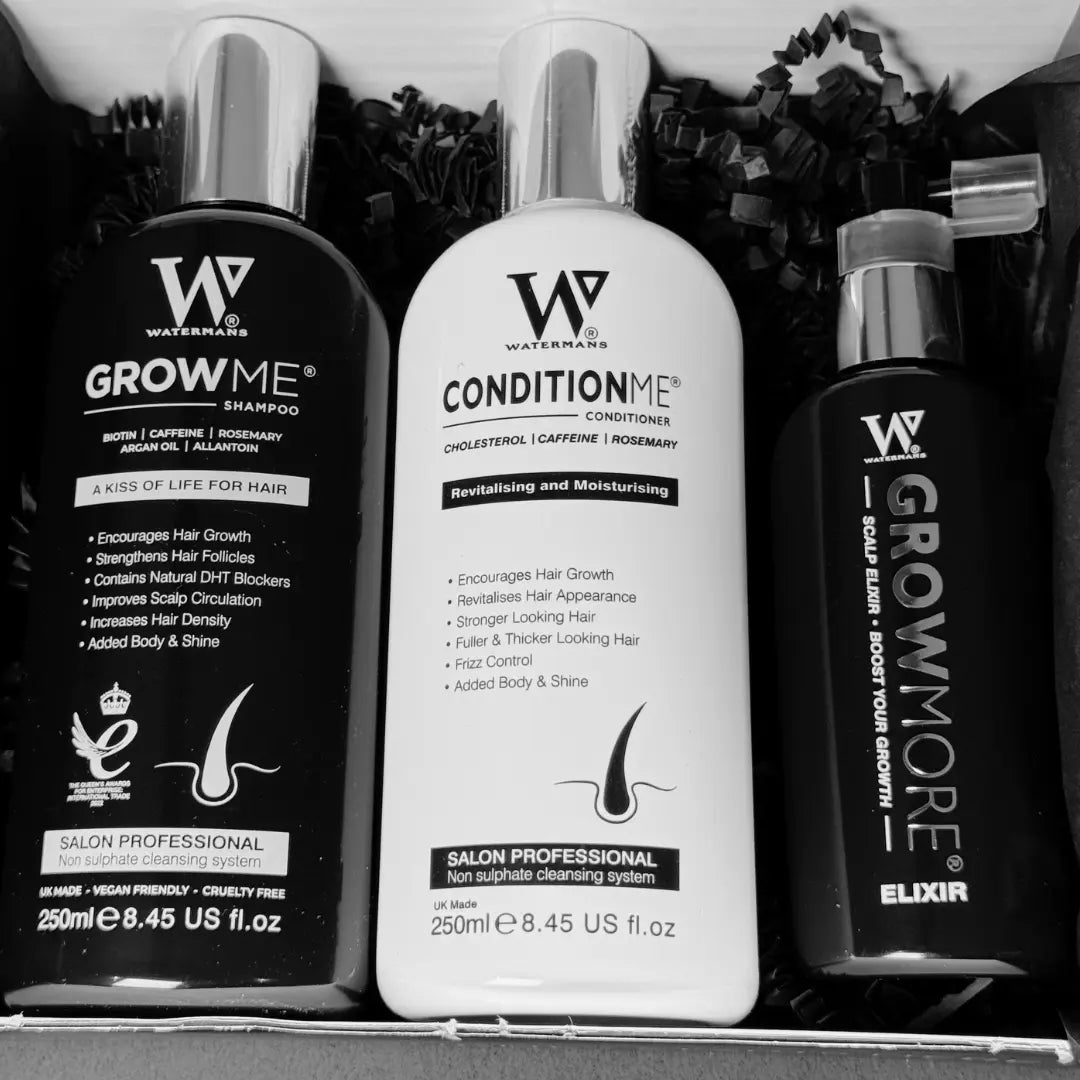
Grow Me® Hair Growth Shampoo
A gentle sulfate free daily shampoo with biotin, caffeine, rosemary and niacinamide. It reduces breakage for fuller looking hair and keeps the scalp comfortable. Massage it in with your fingertips rather than scrubbing.
£14.95 · sulfate free, vegan, made in the UK

Condition Me® Hair Growth Conditioner
Breakage defence with shea butter, glycerin and hydrolysed lupine protein. The detangling is the point here: hair that combs through easily is hair you are not pulling out mechanically on top of what you are already losing.
£13.95 · vegan and made in the UK
That is genuinely all we would suggest during a shedding phase. Anything that promises to stop what is happening is overselling, and adding five products at once means you will never know which of them, if any, was worth the money.
The part that is not about hair
Hair loss during a hard period is not a vanity problem. For a lot of people it is the visible proof of a difficult stretch they were otherwise managing to keep private, and it arrives exactly when resilience is lowest. That is a genuinely hard thing, and it is worth naming rather than pretending it is trivial.
Two things are worth holding on to. The follicles have paused, not closed. And this particular kind of shedding has a well documented tendency to resolve.
If the underlying period is still going on, please do not put off talking to someone about it. Speak to your GP. The Samaritans are on 116 123, free, at any time of day or night. Mind has practical information at mind.org.uk. Those are the right resources for that side of it, and we are not qualified to be, which is why we are pointing you to them rather than writing about it ourselves.
Frequently asked questions
How long after stress does hair fall out?
Usually two to four months. Follicles are moved into their resting phase at the time of the trigger, but a resting hair stays anchored for around three months before it releases. That delay is why so few people connect the shedding to what caused it.
Will my hair grow back after stress related shedding?
In most cases yes, provided the trigger has passed and there is no ongoing deficiency. The follicles have paused rather than closed. Expect shedding to slow within three to six months and density to look normal again over roughly six to twelve months after that.
How much shedding is too much?
Fifty to one hundred hairs a day is normal. What matters is a sustained change from your own baseline lasting more than six to eight weeks, or visible widening of your parting in photographs. One heavy wash day after a few days without washing is not a signal.
Should I stop washing my hair so often?
No. The hairs you see on wash day were already released and simply waiting to be dislodged. Washing less frequently just concentrates several days of normal shedding into one alarming handful, and a scalp left to build up gets itchy, which leads to scratching and more mechanical damage.
What blood tests should I ask for?
Ferritin, a full blood count, thyroid function and vitamin D are the standard starting points. Ferritin is the important one and it can be low while a routine full blood count still reads as normal, so it is worth asking for specifically.
Can supplements fix it?
Only if you were genuinely short of something. Correcting a real deficiency makes a clear difference. Taking extra of a nutrient you already have enough of does very little, which is the argument for testing before spending.
Is it worth seeing a trichologist?
A GP first, because the useful blood tests come from there and some causes are medical. We do not run clinics or offer consultations ourselves. If you do see a private practitioner afterwards, be cautious of anyone who recommends an expensive package of their own products on a first visit.
Watermans products are 100% cosmetic and do not treat medical hair loss. Individual results may vary.
Where to start
Work backwards and find your trigger, because knowing the date tells you roughly when this ends. Ask your GP for ferritin and thyroid tests. Eat enough protein. Be gentle with your hair and stop counting what comes out. Take one photograph a month and judge it at six months, not at six days.
And if the hard period is still ongoing, deal with that first. The hair follows the rest of you, in both directions. Watermans has sold over 5 million bottles since 2012, and every formula is vegan and made in the UK.