



How to Fix a Nutrient Deficiency: Tests, Food and Supplements
Fixing a nutrient deficiency properly is a four step process: test, correct, respect the upper limit, retest. Skipping the first step is the mistake almost everyone makes. Buying a supplement because a symptom seems to fit means you might spend six months correcting something that was never low, while the actual cause carries on unaddressed.
This is the practical companion to our guide on which nutrient deficiencies cause hair loss. That one covers what the evidence says. This one covers what to do about it.
Key takeaways
- Ask your GP for ferritin, full blood count, thyroid function, vitamin D and B12. That panel covers the common correctable causes of fatigue and shedding.
- A result inside the reference range is not automatically fine. Ferritin in particular can be flagged normal while sitting too low to be comfortable.
- The NHS advises everyone in the UK to consider 10 micrograms of vitamin D daily in autumn and winter, because sunlight is not sufficient at this latitude.
- Research since 2015 suggests iron may be absorbed better on alternate days than daily, and vitamin C alongside it helps while tea and coffee hinder.
- Respect upper limits: NHS guidance is no more than 1.5mg of vitamin A and no more than 350 micrograms of selenium a day from all sources combined.
- Retest after about three months. Correcting a deficiency without confirming it worked is only half the job.
Which blood tests should you actually ask for?
A focused panel answers most questions about unexplained fatigue, shedding hair or brittle nails. Ask for these by name, and say clearly what symptom prompted the request, because that is what justifies the tests being run.

| Test | What it tells you | Why it matters |
|---|---|---|
| Ferritin | Iron stores, not just circulating iron | Falls long before anaemia appears, so it catches the problem early |
| Full blood count | Haemoglobin and red cell size | Confirms or rules out anaemia and hints at the type |
| Thyroid function | TSH, and free T4 if indicated | Thyroid disease mimics nutritional symptoms closely |
| 25-hydroxyvitamin D | Vitamin D status | Low levels are extremely common in the UK, especially in winter |
| Vitamin B12 and folate | Both, since they interact | Important for anyone plant-based, older, or on metformin |
| Coeliac screen | Antibody test for coeliac disease | Worth it if iron keeps dropping despite treatment |
| Serum zinc | Zinc status | Only if there is a real reason: malabsorption or restrictive eating |
Two tests to skip: hair mineral analysis, which is not a validated measure of nutritional status and varies wildly between laboratories, and broad direct-to-consumer panels testing dozens of markers with no clinical question behind them. They generate incidental findings that cause worry without changing treatment.
One important preparation step: if you take a hair or beauty supplement containing high-dose biotin, tell whoever takes your blood. Biotin is known to interfere with several laboratory immunoassays, including thyroid tests, so it can distort exactly the results you are relying on. Ask whether to pause it beforehand.
Why can a normal result still be a problem?
A laboratory reference range describes what is typical in a population, not what is optimal for an individual. It is usually built from the middle 95 percent of results in a reference group, which means results near the very bottom of the range are, by definition, still inside it.
Ferritin is the clearest example. Lab ranges commonly start low, while many hair specialists consider a minimum around 30 micrograms per litre necessary and some argue for considerably higher. Someone can be told their iron is normal at a level a trichologist would want corrected. That is a genuine and unresolved difference of opinion, not a conspiracy, and the right move is to ask for your actual number rather than accepting a verdict of normal.
Always request the figures themselves, not just the interpretation. Keep them, because a single result is a snapshot and the trend across two or three tests is far more informative than any one of them.
How do you fix iron deficiency?
Iron deficiency is corrected with a supplement prescribed or recommended by a clinician, supported by dietary changes, over a minimum of three months. Food alone rarely refills depleted stores at a useful speed, which is the one common deficiency where supplements genuinely are the primary tool rather than an add-on.
Several practical details make a large difference to how well it works:
- Alternate-day dosing. Research since 2015 suggests taking iron every other day may be absorbed more efficiently than daily dosing, because a dose temporarily raises hepcidin and blunts absorption for the next day or so.
- Take it with vitamin C. Orange juice or a vitamin C tablet meaningfully improves absorption of non-haem iron.
- Keep tea and coffee away from it. Polyphenols bind iron. Leave an hour either side.
- Separate it from calcium, including dairy and calcium supplements.
- Expect three months minimum, and usually a further three months after levels normalise to rebuild stores rather than just the blood count.
- If it is not working, ask why. Persistent deficiency despite treatment needs investigation for blood loss or malabsorption, not a higher dose.
On the food side, haem iron from red meat, liver and shellfish is absorbed far more efficiently than non-haem iron from lentils, beans, tofu, fortified cereals and dark leafy greens. Plant sources still count, they simply need the vitamin C pairing to perform.
How do you fix vitamin D in the UK?
NHS guidance is that everyone in the UK should consider taking 10 micrograms of vitamin D a day during autumn and winter, because between roughly October and March the sunlight at this latitude is too weak for the skin to make enough. Some groups are advised to take it year round, including people who are rarely outdoors, those who cover most of their skin, and people with darker skin tones.

Food contributes relatively little for most people. Oily fish such as salmon, mackerel and sardines are the best natural source, with egg yolks and fortified spreads and cereals adding smaller amounts. This is one of the few nutrients where diet alone genuinely struggles in a British winter.
If a test shows you are properly deficient rather than merely low, your GP may prescribe a higher loading dose for a period before dropping to maintenance. That is a medical decision, and it is worth having rather than self-prescribing high doses, because vitamin D is fat-soluble and accumulates.
How do you fix vitamin B12, zinc and protein?
Vitamin B12 is not present in plant foods in useful amounts, so anyone eating vegan needs either reliably fortified foods or a supplement. This is not optional and it is not a matter of eating well enough. If you have been plant-based for years without either, get tested, because B12 deficiency can cause neurological damage that is not fully reversible if left too long. People over 60 and long-term metformin users are also at raised risk.
Zinc comes from meat, shellfish (oysters are exceptionally high), pumpkin seeds, chickpeas and cashews. Correcting a genuine deficiency is straightforward, but long-term high-dose zinc supplementation causes copper deficiency by competing for absorption, which brings its own problems. This is one to correct on advice and then stop, not one to take indefinitely.
Protein is the simplest to fix and the most often overlooked. Hair is essentially keratin, a protein, and hair shedding after crash dieting or bariatric surgery is usually a protein and calorie problem rather than a micronutrient one. Spread intake across meals rather than loading it into one, and be particularly careful during any period of rapid weight loss.
When is a supplement actually the right answer?
Food first is the right default, with three genuine exceptions. Use this to decide which situation you are in rather than defaulting to a shelf of bottles.
| Situation | Food or supplement | Why |
|---|---|---|
| Confirmed iron deficiency | Supplement, on advice | Food cannot refill depleted stores fast enough |
| UK autumn and winter | Supplement | NHS advises 10 micrograms of vitamin D daily |
| Vegan diet | Supplement for B12 | Not obtainable from unfortified plant foods |
| Pregnancy or trying to conceive | Supplement folic acid | Standard antenatal advice, and avoid vitamin A supplements |
| Generally varied diet, no symptoms | Food | Supplementing without deficiency shows little benefit |
| Busy diet with known gaps | Either, modestly | A sensible multivitamin as cover, not as a fix |
How do you avoid overdoing it?
The commonest way to reach an unsafe intake is stacking: a multivitamin, plus a hair supplement, plus an individual mineral, plus fortified cereals and drinks, each reasonable alone. Fat-soluble vitamins accumulate rather than being excreted, and a few minerals have a narrow safe window.

Specific limits worth knowing, all from NHS guidance: no more than 1.5mg of vitamin A a day from food and supplements combined, and no more than 350 micrograms of selenium a day. Both excess vitamin A and excess selenium are recognised causes of hair loss, which makes them a particularly unfortunate way to treat hair loss. Anyone pregnant should avoid vitamin A supplements and liver entirely.
Practical habit: write down everything you take, add up the overlapping nutrients, and take the list to a pharmacist. Pharmacists do this for free and are very good at it. Also mention any prescribed medication, because interactions are common, including iron with thyroid medication and several antibiotics.

Everyday cover, not a correction
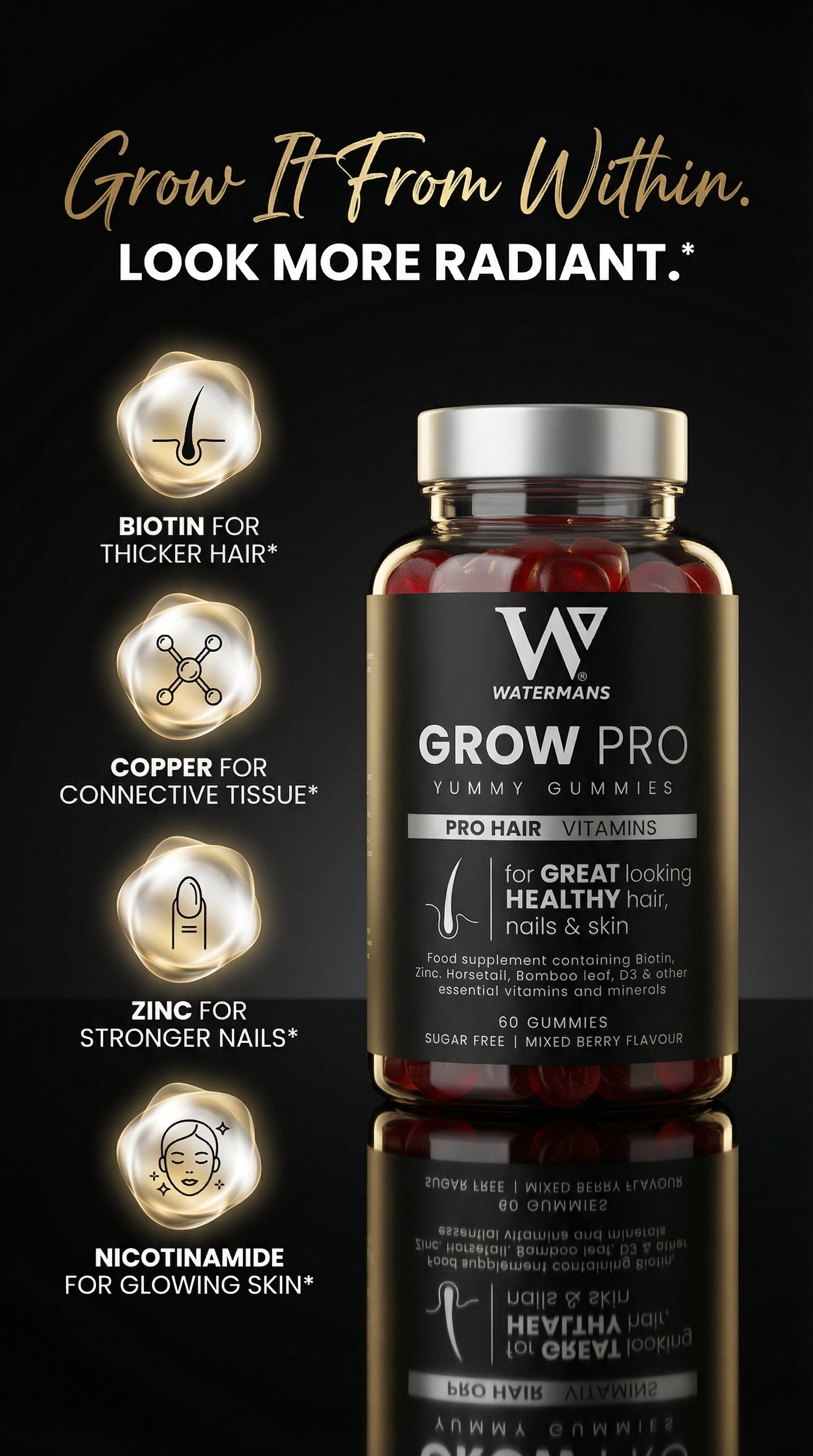
GrowPro Hair Growth Gummies, £22.95
A sugar-free vegan gummy with biotin and zinc, which contribute to the maintenance of normal hair, plus MSM, silica-rich bamboo and horsetail, and vitamins C, A, D3 and E. Two a day alongside a varied, balanced diet.
Scope: a food supplement. It is not a treatment for a diagnosed deficiency and contains no iron, so it is not the answer to low ferritin. Count it in your daily totals if you already take a multivitamin, do not exceed the recommended dose, and tell your clinician you take biotin before any blood test.
How long until you see a difference?
Energy usually improves before appearance does, and hair is always the slowest to respond because it has to grow out. These are realistic timelines rather than optimistic ones.
| What changes | Typical timeframe |
|---|---|
| Energy and concentration with iron or B12 correction | 2 to 6 weeks |
| Blood levels normalising | About 3 months, then retest |
| Shedding slowing down | 2 to 3 months after correction begins |
| Visible regrowth at the hairline and parting | 3 to 6 months |
| Restored overall thickness | 6 to 12 months |
| Nail changes growing out | 4 to 6 months for a full fingernail |
Because hair grows roughly a centimetre a month, patience is not optional. Take a photograph of your parting in consistent lighting each month, since month-to-month change is almost impossible to judge from memory. If shedding has not slowed at all by four months after correcting a confirmed deficiency, the deficiency probably was not the whole story, and it is worth going back to your GP. Our guides to telogen effluvium and stress related hair loss cover the other common triggers, and menopause and thinning hair covers the hormonal picture.
When should you see a GP?
See a GP before starting iron supplementation, because unexplained iron deficiency in adults sometimes signals ongoing blood loss that needs investigating rather than replacing. That is the single most important reason not to self-treat this particular deficiency from a supermarket shelf.
Book an appointment promptly for breathlessness on ordinary exertion, palpitations, unexplained weight loss, tingling or numbness in hands and feet, mouth ulcers with a sore tongue, heavy periods affecting daily life, or fatigue severe enough to interfere with work. And go back if a corrected deficiency returns, since a recurring deficiency is a symptom in itself.
None of the above is medical advice for your individual situation. Take your actual results and your supplement list to a GP or pharmacist and decide with them.
Frequently asked questions about fixing a nutrient deficiency
Can I get a nutrient panel done privately?
Yes, private blood testing is widely available in the UK, and it is a reasonable option if your GP declines or the wait is long. Choose a targeted panel rather than a very broad one, and take the results to a clinician for interpretation rather than acting on the accompanying automated advice.
Should I take a multivitamin just in case?
A modest multivitamin is low risk and may help if your diet has genuine gaps, but there is little evidence of benefit in people already eating varied diets. It is not a substitute for testing when you have a specific symptom, and it counts toward your daily totals if you also take individual supplements.
How long should I take iron for?
Usually at least three months, and commonly a further three months after blood levels normalise, because the aim is to refill stores rather than just correct the blood count. Stopping as soon as the number looks acceptable is the most common reason iron deficiency returns.
Do gummy supplements work as well as tablets?
Gummies deliver nutrients perfectly well and people take them more consistently, which matters more than a small difference in formulation. The trade-offs are that they typically hold fewer nutrients per dose than a tablet and some contain added sugar, so check the label if that matters to you.
Can I fix vitamin D with sunlight alone in the UK?
Not between about October and March. The sun does not get high enough at this latitude for skin to make meaningful amounts of vitamin D during those months, which is why NHS guidance recommends a daily supplement over the autumn and winter regardless of how much time you spend outdoors.
Does cooking destroy nutrients in vegetables?
Some, but far less than people fear. Water-soluble vitamins such as C and some B vitamins leach into cooking water, so steaming or roasting preserves more than boiling. Cooking also makes several nutrients more available, including lycopene in tomatoes, so a mix of raw and cooked is the sensible answer.
Should I stop supplements before surgery or blood tests?
Tell your clinician what you take and follow their instruction. High-dose biotin can distort several laboratory assays, and some supplements affect bleeding or interact with anaesthetic drugs. This is a routine question and any surgical team will expect it.
Is it possible to correct a deficiency with diet alone?
It depends which one. Protein and zinc are usually correctable through food. Iron deficiency and B12 deficiency on a vegan diet generally are not, at least not at a useful speed. Vitamin D is very difficult through UK winter food. Diet maintains levels well and corrects genuine deficits slowly.
Where to start
Book the blood test first, before you buy anything. Ask for ferritin, full blood count, thyroid function, vitamin D and B12, and ask for the actual numbers rather than a verdict. Correct what is genuinely low, respect the upper limits, and retest in three months.
Watermans is a founder-led British brand that has sold over 5 million bottles since 2012, and everything we make is vegan, cruelty-free and made in the UK. For everyday nutritional cover alongside a varied diet, GrowPro Gummies supply biotin and zinc, which contribute to the maintenance of normal hair. They are cover, not a correction, and no substitute for treating a diagnosed deficiency with your GP.