

Does Shaving Make Hair Grow Back Thicker? The Myth, Explained
No. Shaving does not make hair grow back thicker, darker or faster. It cannot, because everything that determines a hair's thickness, colour and growth rate happens inside the follicle, several millimetres below the skin, and a razor never gets anywhere near it. A razor cuts a dead protein filament at the surface. That is the entire interaction.
The myth survives because the regrowth genuinely feels different, and that impression is real even though the explanation is wrong. It comes down to one detail: the shape of the cut end. This article explains that properly, then covers what actually does change hair thickness, and how to shave without the bumps and ingrown hairs that come with it.
Key Takeaways
- Shaving changes nothing about the follicle. Thickness, colour, growth rate and how long a hair grows are all set below the skin.
- The blunt tip is the whole illusion. An untouched hair tapers to a fine point. Shaving removes that taper and leaves a flat end at the shaft's full diameter, so stubble feels coarse.
- Controlled studies settled this a century ago. Research going back to the 1920s compared shaved and unshaved skin and found no difference in growth rate, thickness or colour.
- Shaving your head does not affect balding either way. It neither causes nor prevents it. It is a styling choice, and often a good one.
- Dermaplaning does not turn peach fuzz into stubble. Fine vellus hair only becomes coarse terminal hair under hormonal influence, which a blade cannot supply.
- Breakage is the thickness lever you can actually pull. You cannot change your follicles cosmetically, but you can stop losing length and condition to snapping.
How hair actually grows
To see why a razor cannot influence regrowth, it helps to know where the decisions get made.
Each hair grows from a follicle, a small organ set into the skin. At its base sits the hair matrix, a cluster of rapidly dividing cells fed by a tiny blood supply, and alongside it the melanocytes that supply pigment. Those cells determine the diameter of the shaft, its colour and how fast it is pushed upward.
Follicles cycle through phases. Anagen is the active growing phase, and its length is what caps how long a hair can get, which is why scalp hair reaches waist length while eyebrow hair does not. Catagen is a short transition. Telogen is a resting phase, after which the hair sheds and the follicle begins again.
Here is the key point. By the time a hair emerges from the skin, it is dead keratin. It has no blood supply, no nerves and no cells that can respond to anything. Cutting it is like trimming a fingernail or mowing grass at the tip rather than the root. The follicle is not informed and does not react.

Why does regrowth feel thicker then?
Because four things happen at once, and all of them push in the same direction.
1. The taper is gone
This is the main one. A hair that has never been cut tapers gradually to a fine point at its tip, because it thins as it grows out. That fine point is soft and bends easily. Shaving slices straight across the shaft, removing the taper entirely and leaving a flat, blunt end at the hair's full diameter. A blunt end at full thickness is stiff and does not bend, so it feels bristly against a hand. The hair has not become thicker. You are simply feeling the widest part of it instead of the narrowest.
2. New growth has not been weathered
Hair that has been out in the world for months gets bleached by sunlight and worn by washing, friction and heat. Freshly emerged hair has had none of that, so it looks darker and more uniform than the older hair around it. That is a difference in exposure, not in the hair itself.
3. Short hairs stand up
Long hair lies flat under its own weight. Very short hair stands more upright, catches the light differently and is far more visible against skin. Density has not changed. Presentation has.
4. Timing gets misread
People often start shaving during adolescence, exactly when androgens are converting fine hair to coarse hair across the face, chest and body anyway. The hair does get thicker over those years. Shaving happens to be running alongside it, and gets the credit. This is the coincidence that keeps the myth alive across generations.
Myth against reality
| What people believe | What actually happens |
|---|---|
| Shaving makes hair grow back thicker | No change in diameter. The blunt cut end feels coarser than a tapered tip. |
| Shaving makes hair darker | Pigment is set in the follicle. New growth only looks darker because it has not been sun bleached yet. |
| Shaving makes hair grow faster | Growth rate is set by the matrix. It is unchanged. Regrowth is simply more noticeable from zero. |
| Shaving your head helps hair grow back stronger | It does not. It neither helps nor harms. Pattern hair loss continues underneath regardless. |
| Plucking one grey makes several grow back | One follicle produces one hair. Greying is progressive, so more appear anyway. Repeated plucking can damage a follicle, which is the opposite outcome. |
| Trimming split ends makes hair grow faster | Growth happens at the scalp, so trimming cannot speed it up. It does remove splits before they travel up the shaft, which preserves length you would otherwise lose. |
| Waxing permanently thins hair | Long term repeated waxing can damage some follicles and reduce regrowth in some people, which is genuinely different from shaving. It is not reliable or predictable. |
What about dermaplaning and peach fuzz?
This is the version of the question that worries people most, and the answer rests on a distinction worth knowing.
There are two kinds of body hair. Vellus hair is the fine, short, usually pale fuzz covering most of the body, including the face. Terminal hair is thicker, longer and pigmented: scalp hair, eyebrows, beard hair, underarm and pubic hair.
Vellus hair can convert to terminal hair, which is exactly what happens through puberty. But that conversion is driven by hormones acting on the follicle, principally androgens, and it happens from the inside. A blade at the surface has no hormonal effect whatsoever. Dermaplaning removes vellus hair and some dead surface skin, and the fuzz returns as fuzz.
Two honest caveats. First, freshly cut vellus hair has the same blunt end problem, so it can feel slightly rougher for a few days before it grows out. Second, if facial hair is genuinely becoming coarser and darker over months, that is a hormonal change rather than a shaving effect, and it is worth mentioning to a GP, particularly alongside irregular periods, acne or thinning at the scalp, since conditions such as PCOS can produce that combination.

Does shaving your head affect hair loss?
No, in either direction, and this is one of the clearest demonstrations that the myth is false. If shaving stimulated growth, no one who shaved their head daily would go bald. Millions do both.
Pattern hair loss is driven by genetics and by follicle sensitivity to DHT, a hormone derived from testosterone. In susceptible follicles, DHT progressively shortens the growing phase and miniaturises the follicle, so each cycle produces a finer, shorter, less pigmented hair until it stops producing a visible one. That process runs entirely below the skin, on its own schedule, whether the surface is shaved or not.
What shaving does offer is cosmetic. A closely shaved head removes the contrast between thinning areas and denser ones, which for many people looks considerably better than trying to disguise a receding hairline. That is a legitimate and often excellent choice.
The point worth making is a different one. If you are shaving because thinning is bothering you, the thinning itself is the thing worth looking at, and early is far better than late, since treatments generally hold onto existing hair more effectively than they recover lost ground. Our guide to the top causes of hair loss and how to address each one is a sensible starting point, and for women specifically we compare the realistic options in the best hair loss treatments for women.

What genuinely changes hair thickness?
Since shaving is off the list, here is what is actually on it.
| Factor | Effect | Can you influence it? |
|---|---|---|
| Genetics and androgens | The dominant factor in strand diameter and in pattern thinning | Not directly. Medical treatments exist and need a clinician. |
| Age | Strands tend to fine down and lose pigment over time | No, though care makes what you have perform better. |
| Nutrition and deficiency | Low iron, low ferritin and some other deficiencies can drive shedding | Yes, once identified by a blood test. Guessing is not useful. |
| Illness, stress and major life events | Can trigger telogen effluvium, a temporary heavy shed | Often self resolving, though the trigger deserves attention. |
| Breakage | Mid length snapping makes hair look thinner and shorter than it is | Yes, and this is the most controllable one. |
| Scalp condition | Persistent inflammation and heavy flaking are not a good growing environment | Yes, with consistent care. |
That fifth row is where most people can make a visible difference. You cannot widen a strand, but a great deal of apparent thinness is length and condition lost to snapping, particularly with heat styling, colouring, tight styles and rough detangling. Hair that reaches its full length in good condition simply looks fuller. We go through the practical causes in 13 reasons your hair falls flat and how to fix each one.
Supporting the hair you already have
Nothing in a bottle will change what your follicles are genetically set to produce, and we are not going to suggest otherwise. What good products do is reduce breakage and support the scalp, so hair keeps its length and condition and looks fuller as a result.

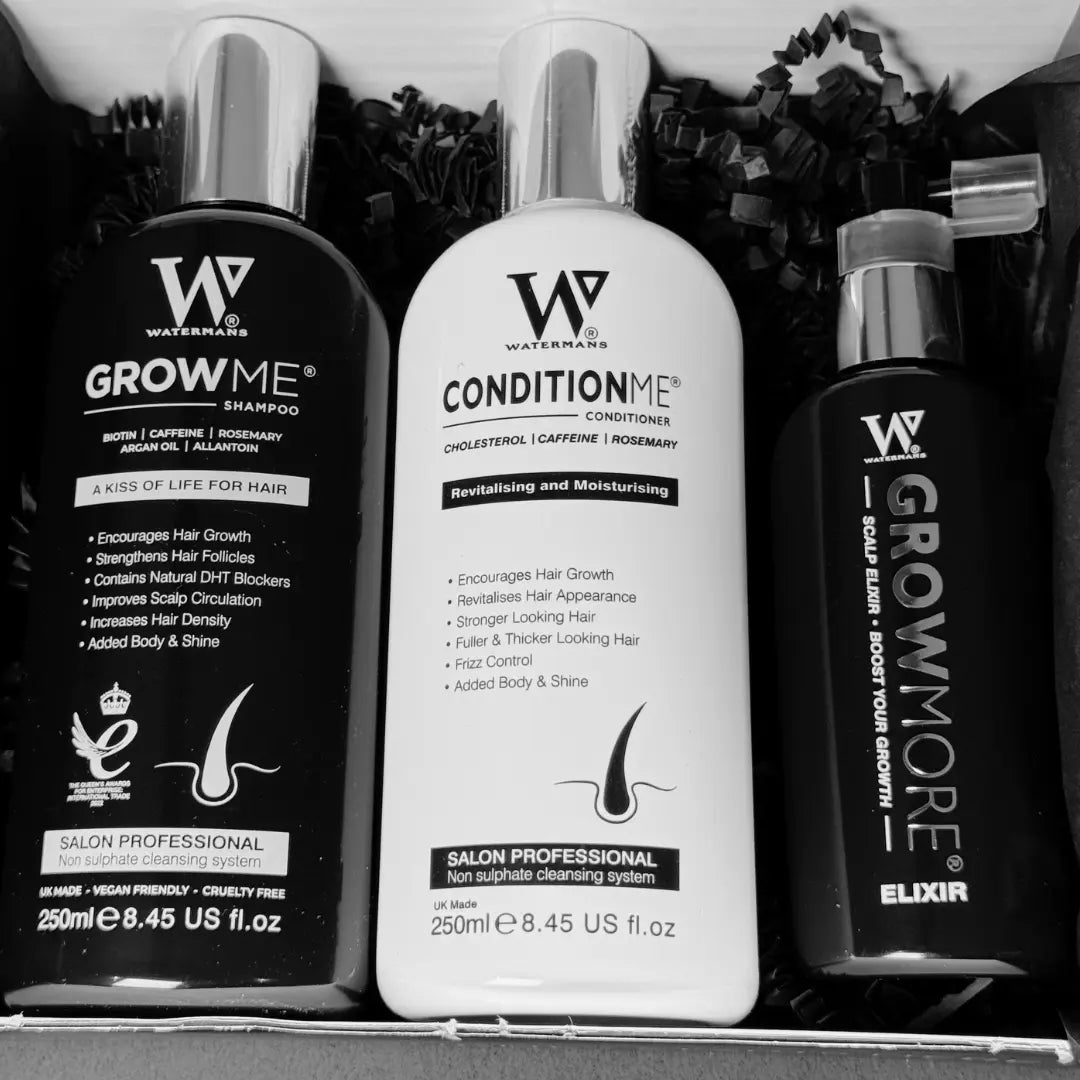
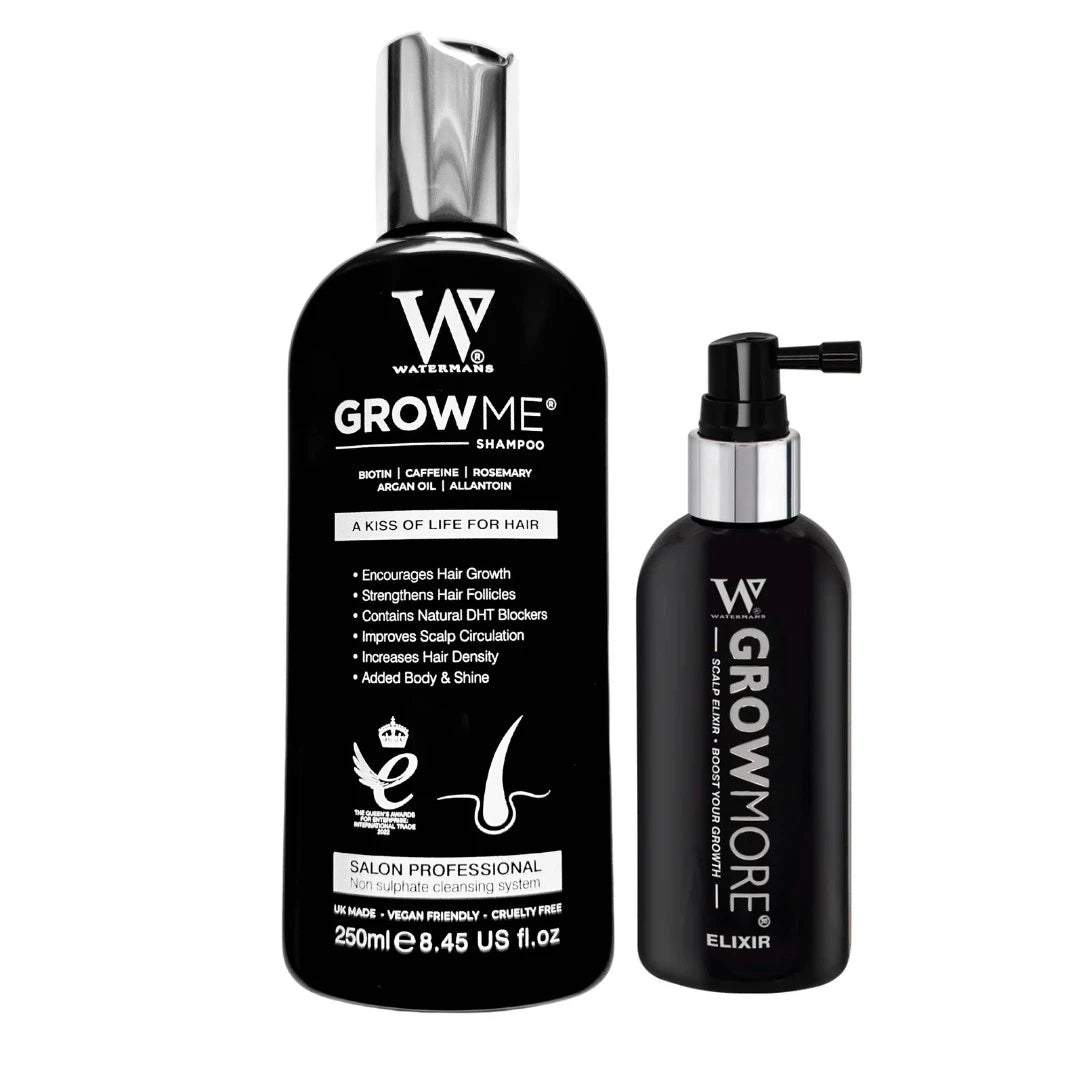
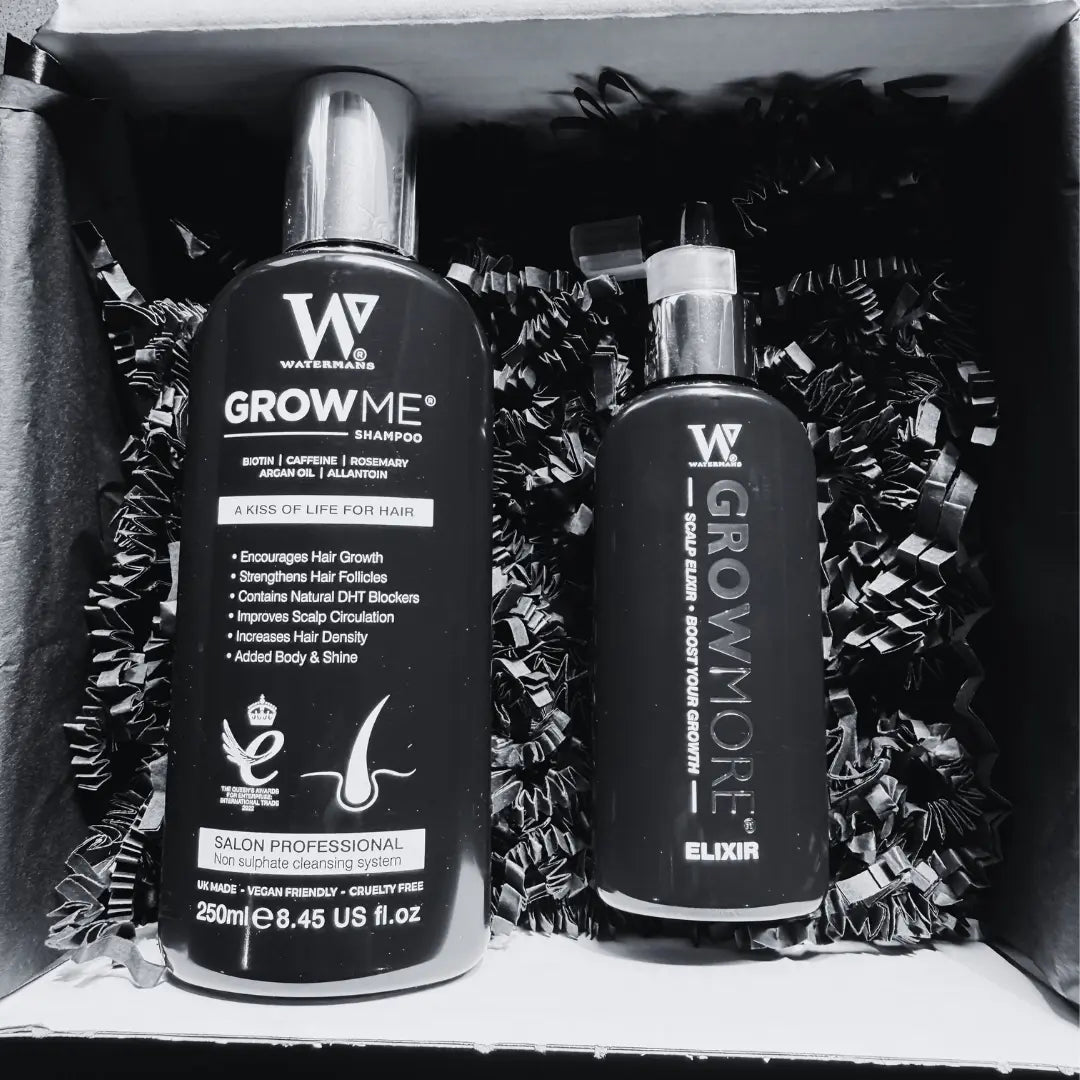
Grow Me® Hair Growth Shampoo, £14.95
Sulphate free daily shampoo with biotin, caffeine, rosemary, niacinamide and hydrolysed lupine protein. Cleanses without stripping and helps reduce breakage for fuller looking hair.

Condition Me® Hair Growth Conditioner, £13.95
The pair for the shampoo, with shea butter, glycerin and rosemary. Detangling is where a lot of avoidable breakage happens, so slip genuinely matters here.

Grow More® Leave In Scalp Elixir, £25.50
An overnight leave on serum for lower density areas such as the crown or parting, if you want to add a targeted step rather than only wash day products.
These are cosmetic products that support the condition and appearance of your hair. They are not medical treatments, and they do not treat hair loss. If you are losing hair rather than breaking it, see a GP or a trichologist, and keep the scalp in good shape meanwhile with the routine in how to keep your scalp healthy. Watermans has sold over 5 million bottles since 2012, and everything we make is vegan and UK made.
How to shave without razor bumps
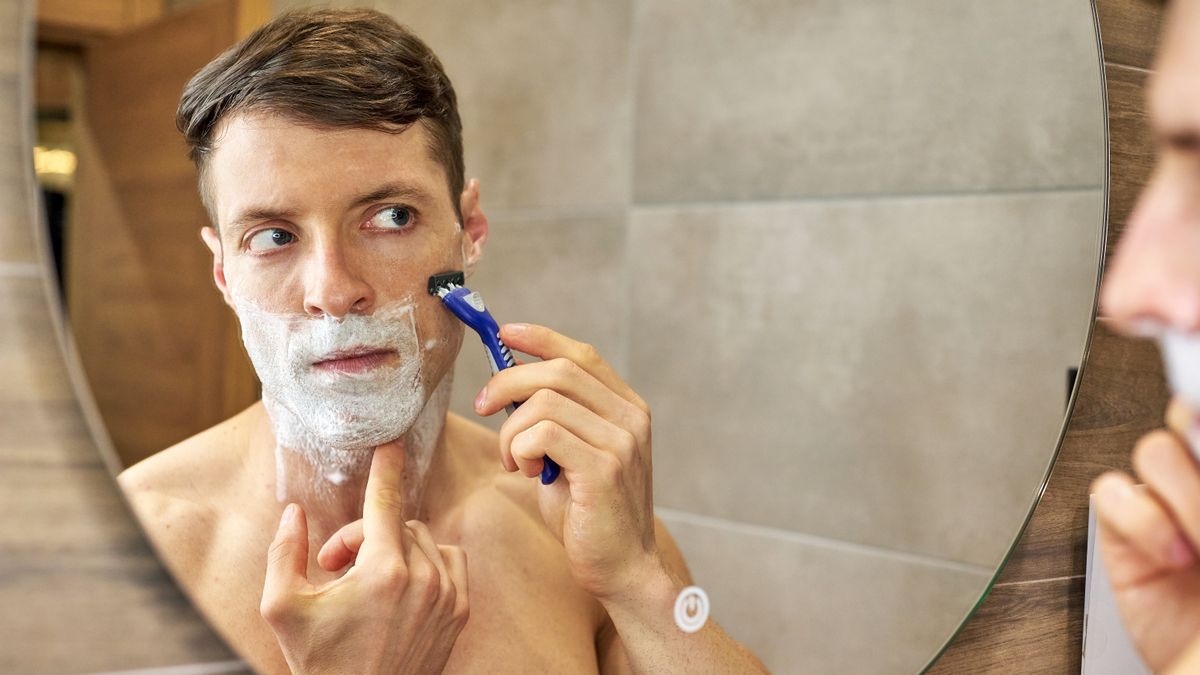
Since shaving is not the problem people fear, the useful question is how to do it well. Almost all shaving complaints come down to irritation and ingrown hairs rather than regrowth.
Pseudofolliculitis barbae, commonly called razor bumps, happens when a cut hair curls back and re enters the skin, producing an inflamed bump. It is far more common with tightly curled hair, because a curved follicle produces a hair already angled to re enter. It is a structural issue, not a hygiene one.
- Shave after warmth and moisture. Hair softens considerably when hydrated, so after a shower is better than before.
- Use a lubricating layer, always. Dry shaving is the fastest route to irritation.
- Go with the grain, not against it. Against the grain gives a closer shave and a much higher chance of the hair being cut below the skin surface, which is how ingrown hairs start.
- Fewer passes, less pressure. Let the blade do the work. Repeatedly going over the same patch removes skin, not just hair.
- Change blades often. A dull blade drags and tugs rather than cutting cleanly. This is the most commonly ignored step.
- Do not stretch the skin taut. It cuts the hair below the surface and increases ingrowth.
- Exfoliate gently between shaves. This helps free hairs starting to curl back, though not on already inflamed skin.
- Consider not shaving as closely. If bumps are persistent, an electric trimmer leaving slight stubble often solves it outright.
If bumps become painful, spread, produce pus or leave dark marks and scarring, see a GP or dermatologist rather than persisting. There are effective treatments, and scarring is worth avoiding.
Frequently asked questions
Does shaving make hair grow back thicker?
No. Thickness is determined in the follicle below the skin, and shaving only cuts the dead shaft at the surface. Regrowth feels coarser because shaving removes the hair's naturally tapered tip and leaves a blunt end at full diameter.
Does shaving make hair grow faster?
No. Growth rate is set by the cells in the hair matrix and is unaffected by cutting. Regrowth is simply more noticeable because you are watching it from zero.
Will shaving my head help my hair grow back thicker?
No. Pattern hair loss is driven by genetics and hormonal sensitivity in the follicle and continues regardless of what happens at the surface. Shaving is a good cosmetic option for thinning hair, but it is not a treatment for it.
Does dermaplaning make facial hair grow back darker?
No. Fine vellus hair only becomes coarse terminal hair under hormonal influence, and a blade has no hormonal effect. It may feel slightly rougher for a few days because of the blunt cut end, then returns to normal.
Why does my leg hair look darker after shaving?
New growth has not been lightened by sun or worn by washing and friction, so it looks darker than the older hair it replaced. Very short hairs also stand upright and show up more clearly against skin.
Is waxing different from shaving?
Yes. Waxing removes the hair from the root, so regrowth emerges with its taper intact and feels softer. Over years, repeated waxing can damage some follicles and reduce regrowth in some people, which shaving does not do. It is not reliable enough to count on for hair removal.
Does shaving cause ingrown hairs?
It can, particularly shaving against the grain, stretching the skin or using a dull blade, all of which encourage the hair to be cut below the surface. Curly hair is more prone because the follicle is curved. Shaving with the grain and slightly less closely usually helps a great deal.
Can anything actually make my hair thicker?
You cannot change the diameter your follicles produce, but you can stop losing hair to breakage, keep the scalp healthy, and get any deficiency or medical cause identified and treated. That combination is what makes a visible difference, and we cover the realistic version in how to grow hair fast and what to actually expect.
Should I be worried if my hair is genuinely getting finer?
Gradual fining with age is normal. Noticeable thinning over months, a widening parting, more scalp showing or a sudden heavy shed is worth a GP appointment, partly to check for treatable causes such as thyroid problems or iron deficiency. Earlier assessment gives better options.
The bottom line
Shave your legs, your face, your head, or nothing at all. It will not change what grows back. The blunt tip left by a blade is stiffer than a tapered one, and that is the entire basis of a myth that has outlived a century of evidence against it.
If your real concern is that your hair is getting thinner, shaving is not the culprit and stopping will not help. Look at breakage, look at your scalp, and get any unexplained shedding checked properly.
This article is general information and not medical advice. If you are experiencing sudden or unexplained hair loss, bald patches, or painful and scarring razor bumps, please see a GP or dermatologist.