Temporary Hair Shedding: Why It Happens and How Long It Lasts
Temporary hair shedding is a burst of hair fall that starts two to four months after something disrupts the hair cycle, then settles by itself over the following six to nine months. If your hair began coming out in handfuls a while after an illness, a course of medicine, a crash diet or a stressful stretch, this delayed pattern is almost certainly what you are seeing. The follicles are not damaged. They have all reset their clocks at once.
Our hair growth shampoo
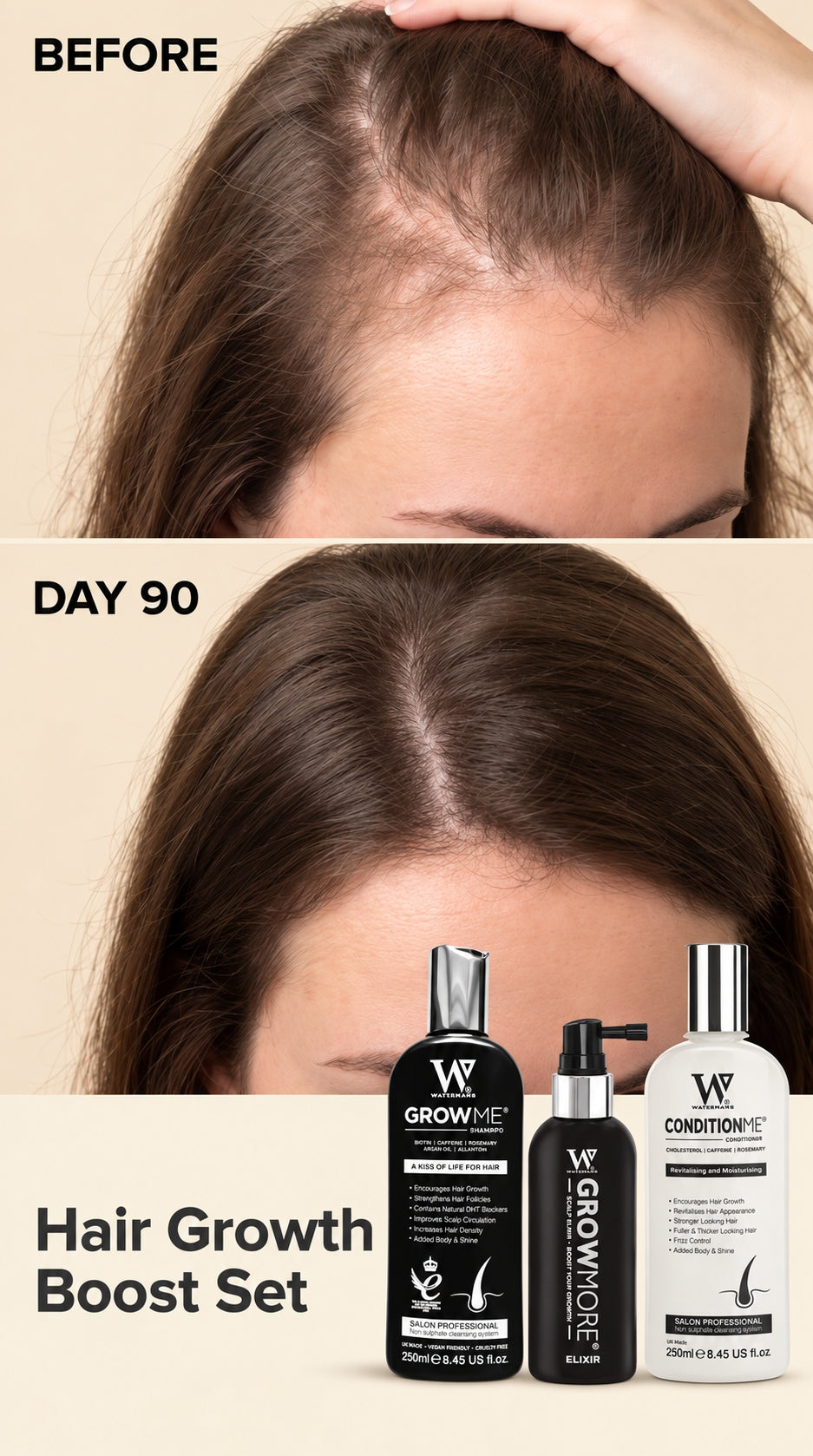
Grow Me® Hair Growth Shampoo, £14.95. A sulphate free daily shampoo that supports a healthy scalp environment and helps reduce breakage, so lengths hold on and look fuller.
Key takeaways
- The delay is the giveaway. A shed that starts two to four months after a trigger, rather than during it, is the classic pattern.
- Hair comes out evenly from all over the scalp, root and all. It does not leave bald patches.
- Most people see it settle within six to nine months once the trigger has passed, and density returns gradually after that.
- Hair loss, hair shedding and hair breakage are three different things, and only one of them is happening here.
- If a medicine you are taking might be involved, speak to the doctor who gave it to you before changing anything.
What is temporary hair shedding?
Temporary hair shedding is the medical picture dermatologists call telogen effluvium, and it is a timing problem rather than a follicle problem. Every hair on your head runs its own independent cycle: a growing phase called anagen lasting several years, a brief transition called catagen, and a resting phase called telogen that ends about three months later when the hair is released. A sharp drop in calories can set off the same pattern, as we explain in hair shedding while fasting.
Normally those cycles are staggered, so roughly 85 to 90 percent of your hairs are growing at any moment and you lose somewhere in the region of 50 to 100 a day without noticing. A significant physical or emotional shock pushes an unusually large batch of follicles out of growing and into resting all at the same time. Nothing visible happens for the length of that resting phase. Then, two to four months later, the whole batch is released together and you find hair on the pillow, in the brush and around the plughole.
That delay is the single most useful fact about temporary hair shedding, because it is what lets you work backwards. Whatever caused this was happening roughly a season ago, not this week.
Why does the shedding start months after the trigger?
The shedding starts months later because a resting hair stays anchored in the follicle for the whole of its resting phase before it lets go. The follicle finishes with the hair almost immediately after the shock, but the strand itself sits in place while the new hair beneath it starts to form. Only when the new hair pushes up does the old one come away.
This is why people so often connect the wrong event to their hair fall. The illness or the surgery or the difficult month has been and gone, life feels normal again, and then the hair starts falling. It also means that by the time you notice, the cause has usually already stopped, which is genuinely good news even though it does not feel like it.
What triggers temporary hair shedding?
The common triggers are all things that make the body reprioritise away from growing hair. Hair is metabolically expensive and non essential, so it is the first thing dropped when resources get tight.
- Illness with a fever. Any significant infection can do it, which is why so many people reported heavy shedding a few months after being unwell.
- Surgery or a general anaesthetic. A well recognised trigger, independent of the reason for the operation.
- Childbirth. Postpartum shedding is the most common version of all, driven by the oestrogen drop after delivery.
- Rapid weight loss or very low calorie dieting. Losing weight quickly, or eating far too little protein, reliably produces a shed a couple of months later.
- Low iron. Low ferritin is one of the most frequently found contributors, especially in women with heavy periods.
- Thyroid changes. Both an underactive and an overactive thyroid can cause it, and both are easy to check.
- Severe or sustained stress. Bereavement, a relationship breakdown, a period of poor sleep. Real, and often the hardest one to fix.
- Starting or stopping certain medicines. A number of medicines list hair changes among their effects. This is a conversation for the doctor who looks after you, not for the internet.
Often it is more than one at once. Someone recovering from an illness who has also been eating badly and sleeping poorly has three triggers stacked up, which is why their shed can be heavier than a friend's.

How long does temporary hair shedding last?
Temporary hair shedding usually runs for about three to six months of active hair fall once it starts, then eases. Density takes longer to return than the shedding takes to stop, because every hair released has to grow back from nothing at roughly one centimetre a month. Here is the shape of it.
| Stage | Roughly when | What you notice |
|---|---|---|
| The trigger | Month 0 | Nothing at all. Hair looks completely normal |
| Shedding begins | Months 2 to 4 | Sudden increase in hair on the brush, pillow and shower floor |
| Peak | Months 3 to 5 | Heaviest fall. The ponytail feels noticeably thinner |
| Settling | Months 6 to 9 | Daily fall drops back toward normal. Short new hairs appear at the hairline |
| New growth visible | Months 9 to 18 | A halo of shorter baby hairs fills in and density gradually comes back |
Those short, wispy, sticking up hairs around the parting and temples are the thing to look for. They are frustrating to style and they are the best sign you will get that the cycle has restarted. If shedding is still heavy beyond about nine months, that is worth a GP visit, since a shed that will not settle usually has an ongoing cause behind it.
Get a discount on the hair shedding range
Join the Watermans mailing list and we will email a discount code straight to your inbox, so you can try the hair shedding range for less. Vegan, made in the UK, over 6.5 million bottles sold since 2012.
How do you tell shedding apart from hair loss and breakage?
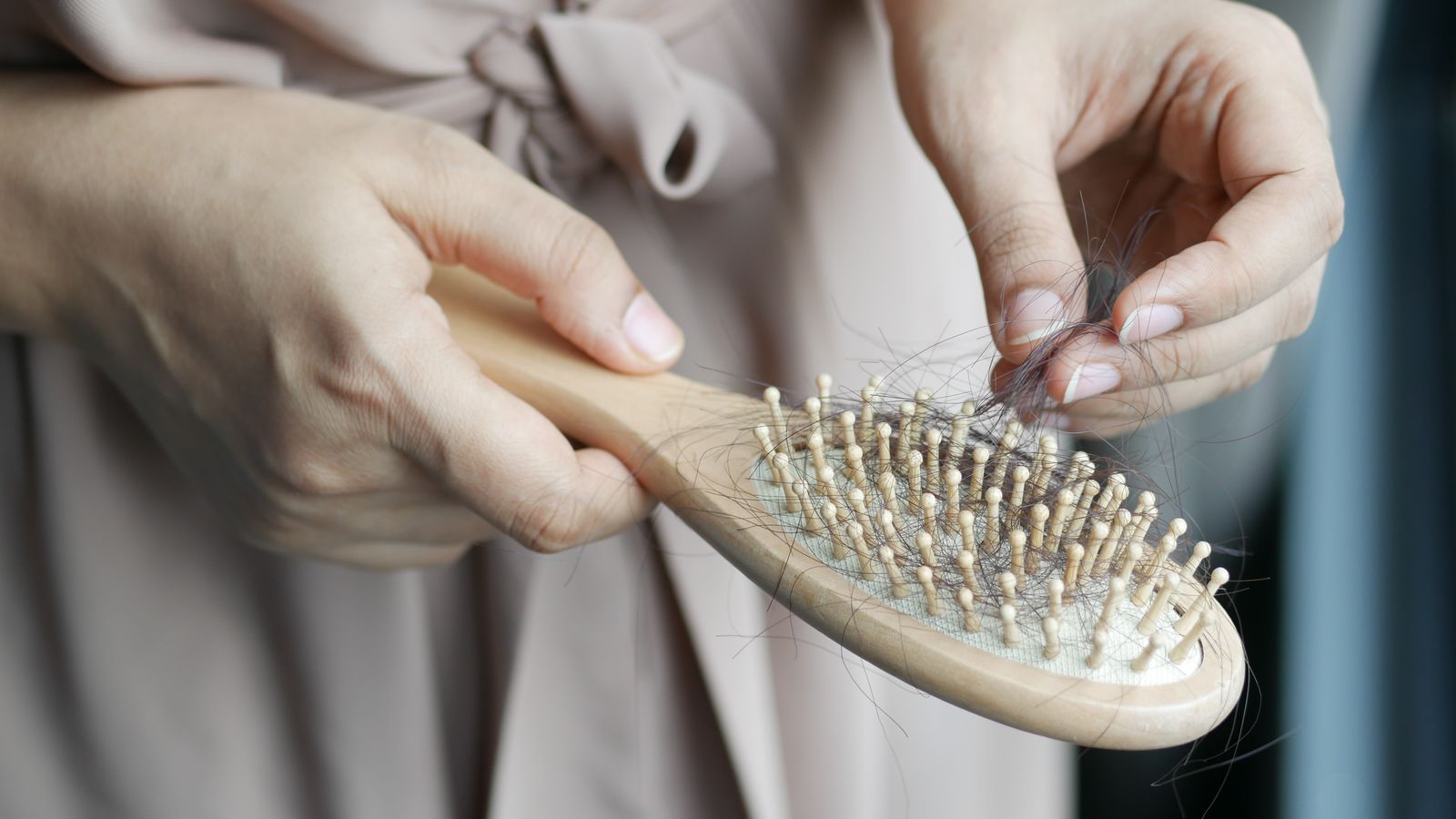
Shedding, loss and breakage look similar in the drain and need completely different responses, so it is worth a minute to work out which one you have. The quickest test is to pick up a fallen hair and look at the end.
| Which one | The fallen hair | The pattern | What to do |
|---|---|---|---|
| Hair shedding (cycle) | Full length, with a small pale bulb at the root end | Sudden, even, all over the scalp, follows a trigger by months | Find and fix the trigger, check bloods, wait it out |
| Hair loss (follicular) | Increasingly fine and short over time | Gradual over years, concentrated at the parting, crown or temples | A GP or dermatology review, plus cosmetic support for density |
| Hair breakage (fibre) | Short pieces, no bulb, often frayed or white tipped | Worst where hair is most processed or pulled, hair will not gain length | Less heat and tension, conditioner every wash |
A hair with a bulb came out of the follicle, which is shedding. A hair with no bulb snapped, which is breakage. Most people in the middle of a heavy shed also pick up some breakage, because anxious over brushing and constant checking are hard habits to avoid. Our guide to what causes telogen effluvium goes deeper into the cycle itself, and our piece on shedding after being unwell covers the post illness version.
What actually helps during temporary hair shedding?
What helps is fixing whatever is still going on underneath, then protecting the hair you keep while the cycle resets. Nothing safely available makes follicles restart faster, and any product promising that is overselling. What you can genuinely influence is the second part.

Get the obvious things checked
Ask your GP for ferritin, a full blood count, thyroid function and vitamin D if shedding has been heavy for more than a couple of months. These are ordinary tests, they are cheap, and between them they explain a large share of stubborn sheds. Do not start iron on a guess, because too much iron is harmful and only a test can tell you.
Eat enough, and eat enough protein
Hair is made of keratin, so persistent under eating is a direct handbrake on new growth. If a diet was the trigger, easing it is the single most effective thing on this list. Aim for protein at every meal rather than one big serving, and stop any very low calorie plan while your hair is recovering.
Keep washing normally
Washing does not cause a shed and skipping washes does not slow one. The hairs you see on wash day were already released and were only waiting to be dislodged. Leaving hair unwashed just gathers several days of them for one alarming handful, which makes the whole thing feel worse than it is. Wash as usual, gently, with lukewarm water.
Take the tension and heat down
Hair that is already sparse cannot afford breakage on top of shedding. Use a wide tooth comb from the ends upward, swap tight bands for soft covered ones, and let hair dry most of the way before any heat. Condition every wash so strands stop catching on each other.
Which products are worth using while hair recovers?
Cosmetic haircare cannot change what the follicle is doing, and it would be dishonest to suggest otherwise on a page about a shed. What a gentle, well built shampoo and conditioner routine does is protect the fibre so the new growth you get keeps its length and the scalp stays comfortable while it happens.

Grow Me® Strength & Retention Shampoo
A daily shampoo with biotin, caffeine, niacinamide and lupin protein. It cleans without stripping and helps reduce breakage, which matters when every strand counts. Vegan and made in the UK.

Grow Me® Shampoo & Conditioner Set
Conditioning every wash is the part that stops new growth snapping before it gets anywhere. If you buy one thing on this page, make it the pair rather than the shampoo alone.
Watermans products are 100% cosmetic and do not treat medical hair loss. Individual results may vary.
What should you eat while hair is growing back?
Food matters here mainly because a shortfall is such a common trigger in the first place. New growth is a building job, and the body will not start it properly while it is short of materials.

- Protein at every meal. Eggs, fish, meat, dairy, beans, lentils, tofu. This is the single most important one.
- Iron rich foods. Red meat, lentils, dark leafy greens and fortified cereals, with a source of vitamin C alongside plant sources to help absorption.
- Vitamin D. The NHS advises everyone in the UK to consider a daily 10 microgram supplement through autumn and winter, when we cannot make enough from sunlight.
- Zinc and B vitamins. Widely available in a varied diet. Worth checking your intake rather than reaching for a high strength supplement.
- Enough calories overall. Under eating is the trigger hiding behind a great many sheds, and it is the one most people are reluctant to look at.
Multi ingredient hair supplements rarely add anything on top of a decent diet unless you have a measured shortfall. Test first, then supplement what is actually low.
When should you see a GP about hair shedding?
See a GP about hair shedding if it does not follow the reassuring pattern set out above. Speak to your own doctor if any of these apply:
- Heavy shedding has continued beyond about nine months, or keeps restarting.
- There are smooth bald patches, or the scalp is sore, scaly, scarred or shiny.
- You are also losing eyebrow, eyelash or body hair.
- Shedding comes with fatigue, weight change, feeling cold, breathlessness or heavy periods.
- You think a medicine you are taking might be involved. Do not stop anything on your own. Ask the doctor who looks after you, or your pharmacist, and let them weigh it up.
- It is affecting your mood or your confidence. That is reason enough on its own.
Watermans does not run clinics and cannot examine a scalp. Our part is the cosmetic half, which is keeping the hair you still have in good condition while the rest gets sorted out by someone qualified to look at it. If your question is about products or a routine rather than a medical one, you can talk to Gail Waterman, our co-founder, as an AI avatar on the Watermans homepage.
Frequently Asked Questions About Temporary Hair Shedding
How do I know if my hair shedding is temporary?
Temporary hair shedding is even across the whole scalp, the fallen hairs are full length with a small pale bulb at the root, and it began two to four months after an identifiable trigger such as illness, surgery, childbirth, dieting or a stressful period. Patchy loss, a sore scalp or a very gradual thinning at the parting point somewhere else.
How long until my hair grows back after a shed?
Active shedding usually runs three to six months and then eases. Visible density takes longer, commonly nine to eighteen months, because hair grows back at roughly one centimetre a month. Short wispy hairs around the hairline and parting are the earliest sign that new growth has started.
Should I wash my hair less to reduce shedding?
No. Washing does not cause shedding and skipping washes does not reduce it. The hairs that come away on wash day were already released and simply collect until they are dislodged, so washing less just concentrates several days into one frightening handful.
Can stress alone cause hair shedding?
Yes. Severe or sustained stress is a well recognised trigger, and it works through the same mechanism as illness or surgery by pushing a large batch of follicles into their resting phase at once. As with the other triggers, the hair fall shows up two to four months later rather than during the stressful period itself.
Which blood tests should I ask for?
Ferritin, a full blood count, thyroid function and vitamin D cover the most common contributors. Ask your GP rather than buying supplements on a hunch, since taking iron when you do not need it is harmful.
Do hair supplements speed up recovery?
Only where there is a genuine measured shortfall, most often iron or vitamin D. In someone eating a reasonable diet with normal bloods, a multi ingredient hair supplement generally makes no difference to how quickly hair comes back.
Could a medicine I am taking be causing this?
Some medicines list hair changes among their possible effects, and the timing of a shed can line up with starting or finishing a course. This is a question for the doctor who looks after you or for your pharmacist. Never stop or change a medicine on your own because of hair fall.
Will my hair grow back the same as before?
In most cases of temporary hair shedding the follicles are unharmed and density returns close to where it started, though it can take well over a year. Where an underlying pattern thinning already existed, the shed can reveal it, which is why density sometimes settles slightly below the previous baseline.
What is the bottom line on temporary hair shedding?
Temporary hair shedding is frightening and almost always self limiting. Count back two to four months from the day the hair fall started and you will usually find the cause, and it has usually already passed. Get ferritin, thyroid, full blood count and vitamin D checked, eat properly and enough, wash normally, and take the heat and tension out so breakage does not compound it. Then give it time, because new growth runs at about a centimetre a month and there is no way to hurry it. If a medicine might be involved, that is a conversation with your own doctor and never a decision to make alone. And if the shedding is patchy, painful or still going after nine months, see a GP. For more on the underlying cycle, read our guide to what causes telogen effluvium, and our explainer on how much hair loss is normal.
Sources & References
- NHS, Hair loss, for normal daily shedding and when hair loss warrants a GP visit.
- DermNet, Telogen effluvium, for the delayed two to four month onset, the common triggers and the recovery timeline.
- NHS, Iron deficiency anaemia, for why iron should be tested rather than assumed.
- NHS, Vitamin D, for the UK autumn and winter supplement advice quoted above.
- British Association of Dermatologists, for UK dermatology information leaflets on hair and scalp conditions.
If your current shampoo is stripping the scalp, Grow Me hair growth shampoo is the gentler swap. Vegan and made in the UK.