Mature Hairline at 20: Normal or Early Hair Loss?
Short answer first: yes, this is common, and no, it is not automatically the start of balding.
A mature hairline at 20 is the normal, one-off settling of the juvenile hairline into its adult shape, and the early twenties are the single most common window for it. The line moves back roughly one to one and a half centimetres, the corners deepen slightly, and it then holds. What separates a mature hairline at 20 from early pattern hair loss is not the height of the line today, it is whether the line keeps moving over the next twelve months.
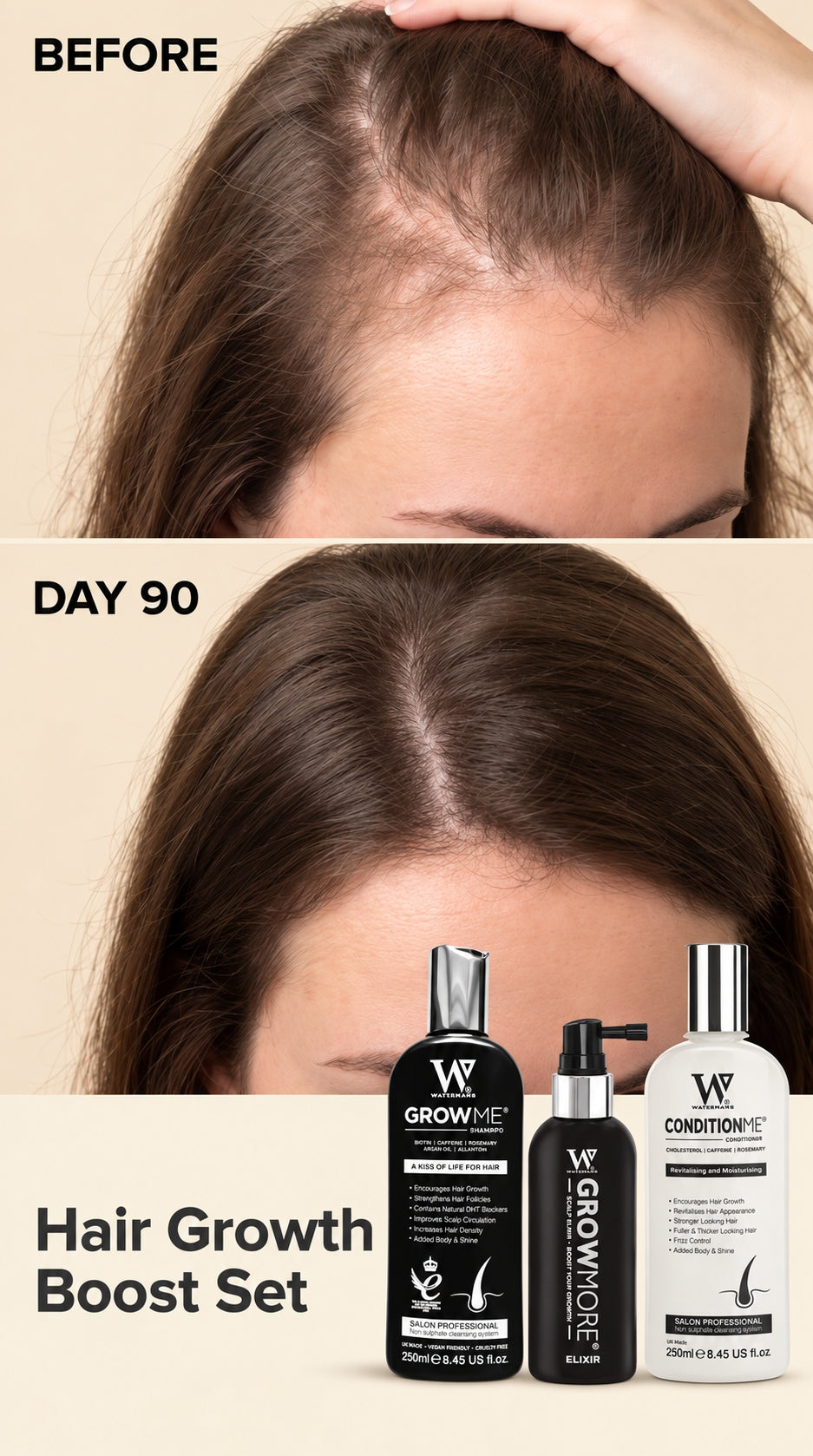
Our hair growth shampoo
Grow Me® Hair Growth Shampoo, £14.95. A sulphate free daily shampoo that supports a healthy scalp environment and helps reduce breakage, so lengths hold on and look fuller.
Key takeaways
- The early twenties are the most common time for the juvenile hairline to settle. Being 20 is not itself a warning sign.
- Speed is the signal, not height. A change you can measure over six months matters, a line that has sat still for a year does not.
- Check the crown as well as the corners. Maturation is a front-of-head event only.
- Family history helps, but it is not destiny, and it does not follow only your mother's father.
- Stress, illness, crash dieting and a rough exam term cause shedding that looks alarming and usually settles on its own.
Is a mature hairline at 20 normal?
A mature hairline at 20 is one of the most ordinary things that happens to young men, and dermatology sources describe the frontal hairline moving back in early adulthood as a developmental change rather than a disease. The low, straight, softly curved line you had at 15 belongs to a child's face. As the skull and face finish developing, the hairline follows, moves back a short distance, and takes on the slightly squarer adult shape you will keep.
The reason it lands so heavily at 20 is timing. Most of this happens between about 17 and 30, and the front of that range overlaps exactly with the age when young men start photographing themselves constantly, comparing old pictures, and noticing. The change is not new. The scrutiny is.
None of this means early pattern hair loss never starts at 20, because it does. Androgenetic alopecia can begin in the late teens. The point is that the two look similar at the start and behave completely differently over time, so the useful question is never "how high is my hairline today" but "where was it nine months ago".

How much should the hairline move by 20?
The usual figure is one to one and a half centimetres behind the juvenile line, which in practice sits about a finger's width above the topmost crease you make when you raise your eyebrows. That is a rough guide rather than a rule, and foreheads vary enormously, so treat it as a starting point for your own tracking rather than a pass or fail mark.
Two other measurements matter more than the distance:
- Evenness. A settling hairline is broadly symmetrical. One corner clearly deeper than the other, or a wedge cutting back at a sharper angle, is worth watching closely.
- Hair calibre at the edge. Run a finger along the first centimetre. Thick, fully pigmented hairs are the reassuring finding. A fringe of short, fine, pale hairs is miniaturisation, and miniaturisation is the signature of pattern loss rather than maturation.
How do you track a mature hairline at 20 properly?
Tracking beats worrying, and it costs nothing. Anxiety at this age tends to run on mirror checks in bad bathroom lighting, which is the least reliable data you can collect. A simple photo protocol removes almost all of that.
- Same light, same spot. Daylight from a window, no overhead spotlights. Overhead light makes every scalp look thinner.
- Dry hair, pushed back. Wet hair clumps and exaggerates gaps.
- Three angles. Straight on, both temples in profile, and one down at the crown taken by a friend.
- Every three months, dated. Put them in one album. Compare month nine against month zero, never against last week.
- Note anything unusual. Illness, a big weight change, a stressful term, a new medicine from your GP. Shedding often lags a trigger by two to three months.
If after a year the photographs look the same, you have your answer, and it is a good one. If the line has moved, you have caught it early with evidence, which is exactly what a GP wants to see.
Get a discount on the thinning hair range
Join the Watermans mailing list and we will email a discount code straight to your inbox, so you can try the thinning hair range for less. Made in the UK, over 6.5 million bottles sold since 2012.
What is the difference between hair loss, hair shedding and hair breakage?
Most 20-year-olds who search this have mixed up three separate problems. They need different answers.
- Hair loss is a follicle problem. In androgenetic alopecia the follicle miniaturises over years, producing finer and shorter hairs until it stops. Our explainer on what pattern hair loss actually is covers the mechanism.
- Hair shedding is a cycle problem. A shock such as flu, a hospital stay, heavy exam stress or a sudden diet pushes growing hairs into the resting phase, and they fall out together a couple of months later. It looks dramatic and it usually recovers. See how stress affects hair for the detail.
- Hair breakage is a fibre problem. The follicle is healthy but the strand snaps, usually from bleach, heat, tight styling or aggressive towel drying. Breakage at the temples is common in your twenties, when experimentation with colour and styling peaks, and it makes a normal hairline look frayed.
Getting the label right saves money. Nothing you can buy fixes a follicle problem, shedding usually resolves without buying anything, and breakage is the one that genuinely responds to gentler care.
Does family history predict a mature hairline at 20?
Partly. Pattern hair loss is strongly heritable, but the old idea that you inherit it purely from your mother's father is wrong. Susceptibility involves many genes on both sides of the family, which is why brothers with the same parents can end up with different hairlines.
A more useful family question is about pattern and pace, not simply presence. Ask when the men and women in your family first noticed a change, how quickly it progressed in the following five years, and where it went first. A father who kept a stable adult hairline until 45 tells you something different from one who was clearly thinning at 22.
What haircut works best at this age?
The worst thing you can do at 20 is style defensively. Long hair combed forward over the temples is heavier, flatter and more transparent than short hair, and it broadcasts exactly what it is trying to hide.

- Short textured crop. The default for a settled hairline in your twenties. Choppy, forward-styled, no hard edges.
- Fade with length on top. Contrast at the sides pulls the eye up and away from the temples.
- Grown-out stubble. Definition along the jaw rebalances a higher forehead more effectively than anything you do on top.
- Avoid long fringes, low side parts, and heavy wet-look product, all of which separate the hair and show scalp.
How should you look after your hair at 20?
Care will not move your hairline. What it can do is stop you losing thickness and length you already have, which matters more at this age than most people realise, because twenties hair takes a beating from bleach, heat, gym showers and cheap hotel shampoo.

Four habits carry almost all of the benefit: wash the scalp rather than scrubbing the lengths, condition every single wash, be gentle while the hair is wet, and keep tension and heat down. On top of that, eat properly. Iron, protein and overall calories are the parts of student life most likely to be short, and hair is one of the first things the body deprioritises when they are.

Sulfate-free, so it cleans a gym-heavy, wash-most-days scalp without stripping it. Biotin, caffeine, rosemary and niacinamide, for hair that looks fuller and feels stronger.

The step most men in their twenties skip. Slip for detangling and cuticle support, so the fine hair at the temples stops snapping in the towel.

Sugar-free vegan gummies with biotin and zinc, nutrients that contribute to the maintenance of normal hair. Useful cover for a student diet, not a substitute for eating properly.
Watermans products are 100% cosmetic and do not treat medical hair loss. Individual results may vary. Made in the UK, over 6.5 million bottles sold since 2012.
When should a 20-year-old see a GP about their hair?
Speak to your GP, rather than a forum, if any of the following apply. Blood tests and a proper look at the scalp are the things a GP can do that no photograph and no shampoo can.
- The hairline has visibly moved within six months, or has kept moving past the finger-width mark.
- The crown or the parting is thinning at the same time as the front.
- You are shedding heavily, in handfuls, especially two to three months after illness, surgery, a crash diet or a very stressful period.
- There are smooth, round bald patches, or the loss is patchy rather than patterned.
- The scalp is itchy, sore, flaky, red or scarred.
- There are other symptoms alongside it, such as tiredness, weight change or low mood, which can point to thyroid or iron problems.
We sell cosmetic hair care. We do not run clinics and we do not give medical opinions, so please take anything on this list to a GP. If your question is about products or a routine rather than a medical one, you can talk to Gail Waterman, our co-founder, as an AI avatar on the Watermans homepage.
Frequently asked questions
Is a mature hairline at 20 a sign of balding?
Not on its own. It is the most common age for the juvenile hairline to settle, and a settled hairline holds its position for years. The signs that point to pattern loss instead are continued movement over twelve months, fine miniaturised hairs along the edge, and thinning at the crown at the same time.
How far back is too far at 20?
Beyond roughly one and a half centimetres behind the old juvenile line, and especially beyond a finger's width above your highest eyebrow crease, is worth tracking with photographs and raising with a GP. Distance alone is still less informative than movement over time.
Can I push my hairline back forward?
No cosmetic product moves a hairline. Shampoos, conditioners and serums work on the hair you have: they reduce breakage, support a comfortable scalp and make hair look thicker. Anything promising to restore a juvenile hairline is overselling, and at 20 you are the exact person that kind of marketing targets.
Does wearing a cap or a beanie make it worse?
Ordinary hats do not cause pattern hair loss. Persistent tight tension does cause traction damage over time, so a cap jammed on all day, or a very tight man bun, is worth easing off. A hat that fits is fine.
Does stress cause a receding hairline at 20?
Stress is strongly linked to shedding rather than to hairline recession. A heavy stress period tends to show up as diffuse thinning all over about two to three months later, and it usually settles once the trigger passes. Recession at the temples follows a genetic pattern instead.
Should I get a hair transplant at 20?
Surgeons generally advise against operating on a hairline that has not stabilised, because a young person's pattern is still unfolding and a line placed too low can look wrong a decade later. This is a conversation for a qualified surgeon, several years of photographs, and no rush.
My friends have lower hairlines than me. Does that mean something?
Almost nothing. Hairline height varies enormously between individuals and between ethnic backgrounds, and plenty of men simply have a naturally high adult hairline that never goes anywhere. Compare yourself with your own photographs, not with your friends.
Sources and references
- NHS, Hair loss, on common causes, normal shedding and when to see a GP.
- British Association of Dermatologists, Male pattern hair loss, on frontal recession in adult men and on inheritance.
- Endotext, NCBI Bookshelf, Male Androgenetic Alopecia, on the age of onset and on follicular miniaturisation.
- StatPearls, NCBI Bookshelf, Androgenetic Alopecia, on polygenic inheritance and staging.
Sources disagree on where to draw the line between late maturation and very early pattern loss in men under 25. Some texts set an age threshold, others frame it purely as a question of progression. We have followed the second view here, because it is the one a reader can actually act on with a camera and twelve months.
What is the bottom line on mature hairline at 20?
A mature hairline at 20 is normal, extremely common, and on its own tells you very little. The early twenties are simply when the juvenile hairline finishes becoming an adult one. Photograph it in consistent light every three months, look at the crown as well as the corners, check whether the hair at the edge is thick or fine, and compare a year apart rather than a week apart. If it has held still, you have your answer. If it has moved, take the photographs to a GP. In between, get a cut that works with the shape, eat properly, and go easy on bleach and heat.
If your current shampoo is stripping the scalp, the Grow Me hair growth shampoo is the gentler swap. Vegan, made in the UK.