Mature Hairline vs Balding: How to Tell the Difference
Short answer first: one settles and stops, the other keeps going. Time is the test.
The difference in mature hairline vs balding is progression, not height. A mature hairline moves back roughly one to one and a half centimetres in early adulthood, keeps a broadly even line with thick pigmented hair at its edge, and then holds that position for years. Pattern hair loss carries on, cuts deeper wedges at the temples, leaves fine miniaturised hairs behind, and usually thins the crown at the same time.
Our complete hair growth routine
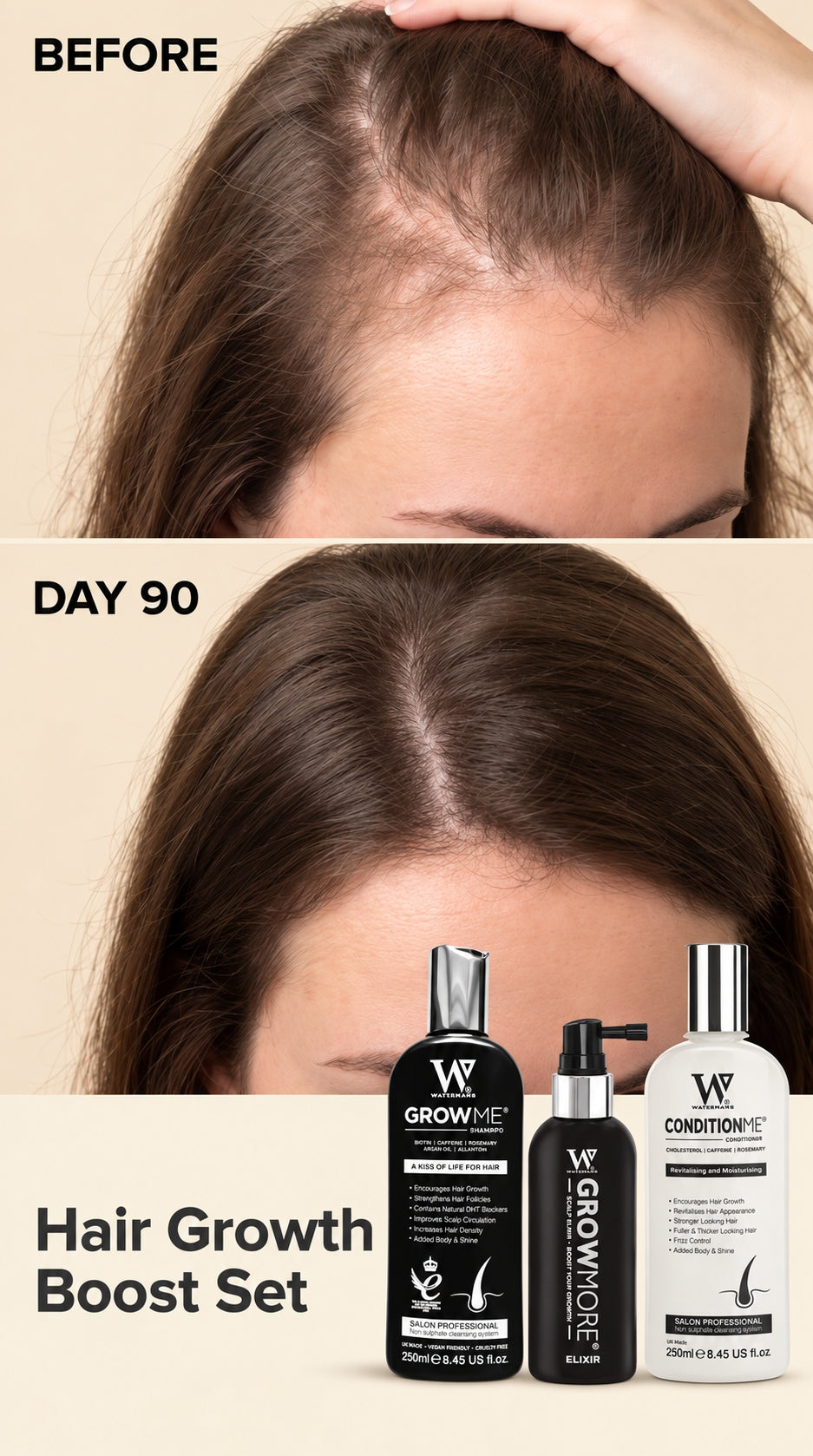
Hair Growth Shampoo, Conditioner & Scalp Elixir Set, £53.40. The full three step routine, cleanse, condition and an overnight scalp elixir, bought together for less than buying each alone.
Key takeaways
- Six signals separate the two: movement over time, distance, shape, hair calibre at the edge, the crown, and density behind the line.
- No single mirror check can tell them apart. Dated photographs twelve months apart can.
- Miniaturisation, meaning short fine pale hairs at the hairline, is the most specific sign of pattern loss.
- Maturation never involves the crown. Front and crown changing together points firmly one way.
- Either way, nothing cosmetic moves a hairline. Care protects the hair you still have from breakage.
Mature hairline vs balding: what actually separates them?
Both start in the same place, at the corners of the forehead, which is why the question is so common and so hard to settle in one glance. The distinction is behavioural rather than visual. Maturation is an event: the juvenile hairline finishes becoming an adult one, then the process is over. Androgenetic alopecia is a process: susceptible follicles at the temples and crown gradually miniaturise across years, producing hairs that are thinner, shorter and paler with each cycle until they stop being visible.
That is why a photograph beats an opinion. Dermatology references describe frontal recession as near universal in adult men, and reserve the label of pattern hair loss for a continuing, patterned progression. So the useful data is a comparison across months, not a measurement taken today. If you want the background on maturation on its own, our guide to what a mature hairline is covers it, and if you are in your early twenties, the age-specific version answers the timing question.
What are the six signals to check?
Run all six together when you are weighing mature hairline vs balding. Any one of them on its own can mislead you, which is exactly why forum photographs generate so much bad advice.
| Signal | Settled adult hairline | Progressive pattern loss |
|---|---|---|
| 1. Movement over 12 months | None you can measure on a photograph | Visible and continuing |
| 2. Distance moved | About 1 to 1.5 cm, then stops | Keeps going well past that |
| 3. Shape | Even line, shallow corners, gentle curve | Deep V-shaped wedges, an island peak in the middle |
| 4. Hair at the edge | Thick, pigmented, full length | Short, fine, pale, miniaturised |
| 5. Crown | Untouched | Often thinning at the same time |
| 6. Density behind the line | Normal, scalp hidden in daylight | Scalp increasingly visible under light |

Why does the crown matter so much?
The crown is the single most decisive check in the mature hairline vs balding question, and it is the one nearly everybody skips because you cannot see it in a bathroom mirror. Maturation is a front-of-head event. It does not thin the vertex. Androgenetic alopecia typically works on the temples and the crown in parallel, which is why the classic pattern ends up as a horseshoe.
So get a photograph of the top of your head, taken from above and slightly behind, in daylight, by somebody else. If the crown is dense and the parting there is a thin line rather than a widening gap, a receding front is much more likely to be maturation. If the crown is thinning while the corners are moving, that combination points firmly at pattern loss, and it is worth taking to a GP.

What is miniaturisation and how do you spot it?
Miniaturisation is the gradual shrinking of a hair follicle under hormonal influence, and it is the most specific physical sign of pattern hair loss. Each growth cycle produces a slightly finer, shorter, less pigmented hair, until what is left is barely visible vellus fluff.
You can look for it without any equipment. Stand in daylight, pull the hair back from the hairline, and study the first centimetre. A settled hairline has a fairly clean border: full-thickness pigmented hairs on one side, bare skin on the other. A miniaturising hairline has a fuzzy transition zone, a band of short, fine, pale hairs of visibly different calibres sitting between the two. Mixed calibres in one small area is the finding that matters.
Get a discount on the thinning hair range
Join the Watermans mailing list and we will email a discount code straight to your inbox, so you can try the thinning hair range for less. Made in the UK, over 6.5 million bottles sold since 2012.
Where does the Norwood scale fit in?
The Norwood scale is the standard way of staging male pattern hair loss, running from stage 1, an unchanged juvenile hairline, up to stage 7, a narrow horseshoe of remaining hair. Stage 2 is where the confusion lives, because Norwood 2 describes exactly the modest, symmetrical temple recession that a settled adult hairline produces. Many men who are told they are "a Norwood 2" have simply finished maturing.
Two things make the scale more useful. First, it is a description of a snapshot, so a single stage tells you nothing about speed. Two men at stage 2 can be five years apart in where they will be at 40. Second, women follow a different distribution, usually widening at the parting with the frontal hairline preserved, which is why the Ludwig scale exists instead. Our overview of what pattern hair loss is and what drives it goes into both.
What is the difference between hair loss, hair shedding and hair breakage?
Before deciding you are balding, rule out the two things that imitate it.
- Hair loss is the follicle changing. Pattern loss miniaturises follicles slowly and in a specific distribution. Alopecia areata takes hair out in smooth round patches instead.
- Hair shedding is the cycle changing. Illness, surgery, a crash diet, childbirth or severe stress push many follicles into the resting phase at once, and the hair comes out two to three months later, diffusely rather than in a pattern. It usually recovers. For a benchmark on normal daily fall, see our piece on how much hair fall is normal.
- Hair breakage is the fibre failing. Bleach, heat, tight styling and rough drying snap strands partway along. Breakage at the temples produces a halo of short broken hairs that can look exactly like miniaturisation at a glance, but the broken ends are blunt and the hairs are full thickness rather than tapered.
That last distinction is worth a proper look under daylight, because breakage and miniaturisation lead to completely different decisions.
What should you actually do next?
The plan for mature hairline vs balding is the same whichever answer you get, because in both cases the first step is evidence.
- Start a dated photo set. Daylight, dry hair, three angles including the crown, every three months.
- Write down triggers. Illness, weight change, stressful periods, any new medicine from your GP. Shedding lags a trigger by roughly two to three months.
- Compare at twelve months. Not at three weeks, and never against a memory.
- Take the photographs to a GP if the line has moved, the crown is joining in, the shedding is heavy, the patches are round and smooth, or the scalp is sore, flaky or scarred.
- Protect what you have in the meantime, with gentler washing, less heat and less tension.
Which haircut helps either way?

Short beats long in almost every case. Shorter hair reduces the contrast between denser and lighter areas, and it removes the weight that makes longer hair lie flat and show scalp. A textured crop, a fade with a little length on top, or a clean buzz all work with a higher hairline rather than drawing attention to it. Stubble or a tidy beard rebalances the face more effectively than anything done on top. What consistently fails is the long comb-forward, the low side part, and any style that needs constant adjusting. A naturally pointed hairline is a different thing again, and our guide to the widow's peak covers how to cut and style around one.
How should you care for the hair around a receding hairline?
Be honest with yourself about what care can do. It does not move a hairline and it does not act on follicles. What it does do is protect the hair you still have, and around a thinning front that matters, because breakage takes an already lighter area and makes it look considerably worse.

The full three-step routine: Grow Me shampoo, Condition Me conditioner and the Grow More scalp elixir. A cosmetic routine for a comfortable scalp, reduced breakage and fuller-looking hair, used consistently rather than occasionally.

A leave-on serum for the temples, parting and crown, applied overnight. Biotin, caffeine, rosemary and niacinamide, for stronger-looking strands and a scalp that feels comfortable.
Watermans products are 100% cosmetic and do not treat medical hair loss. Individual results may vary. Made in the UK, over 6.5 million bottles sold since 2012.
When should you see a GP?
A GP can run blood tests and examine the scalp properly, which is more than any photograph or product can do. Speak to yours if the hairline keeps moving past the finger-width mark, the crown thins alongside the front, you are shedding heavily, there are smooth round patches, the scalp is itchy, sore, flaky or scarred, or hair changes come with tiredness, weight change, low mood or heavy periods. We sell cosmetic hair care and we do not run clinics, so nothing here is a substitute for that conversation. If your question is about products or a routine rather than a medical one, you can talk to Gail Waterman, our co-founder, as an AI avatar on the Watermans homepage.
Frequently asked questions
How do I tell mature hairline vs balding in one check?
You cannot, and that is the honest answer. One check gives you height, and height is the least informative signal. The reliable method is two dated photographs twelve months apart, taken in the same daylight, plus a look at the crown and at the calibre of the hair along the edge.
Does a widow's peak mean I am balding?
No. A widow's peak is an inherited hairline shape that many people have from childhood. It becomes more noticeable as the corners settle, which is why it gets blamed, but the peak itself is not a sign of loss.
Can a hairline recede and then stop?
Yes, and that is precisely what maturation is. The line moves back once, over a few years, then holds. Pattern loss is defined by the fact that it does not stop on its own.
How quickly does pattern hair loss progress?
Slowly and unevenly. Most men see gradual change across years rather than months, often with quieter periods in between. Rapid change over weeks points somewhere else, usually to shedding, and is worth a GP visit.
Is thinning at the temples always genetic?
No. Traction from tight styles, breakage from bleach and heat, iron or thyroid problems, and heavy shedding after illness can all lighten the temples. Genetics is the most common cause in men, not the only one.
Does the Norwood scale apply to women?
Not usefully. Female pattern loss generally widens the parting while preserving the frontal hairline, so the Ludwig scale is used instead. Applying Norwood to a woman's hair tends to produce the wrong conclusion.
If it is balding, is there any point in shampoo?
There is a point, but be clear about what it is. Cosmetic products do not act on follicles. They reduce breakage, support a comfortable scalp and make the hair you have look fuller. Anything advertised as stopping the process is making a claim it cannot support.
Sources and references
- NHS, Hair loss, on causes, normal shedding and when to see a GP.
- British Association of Dermatologists, Male pattern hair loss, on frontal recession and the male pattern.
- British Association of Dermatologists, Female pattern hair loss, on the different distribution seen in women.
- StatPearls, NCBI Bookshelf, Androgenetic Alopecia, on the Norwood and Ludwig staging systems.
- Endotext, NCBI Bookshelf, Male Androgenetic Alopecia, on follicular miniaturisation.
Sources do not fully agree on where Norwood 2 ends and early pattern loss begins, and some authors argue the scale should not be applied to men under 25 at all. We have given more weight to progression over time than to any single stage, because that is the judgement a reader can make for themselves with a camera.
What is the bottom line on mature hairline vs balding?
In mature hairline vs balding, the deciding factor is whether the line is still moving. A settled adult hairline goes back a centimetre or so, keeps thick pigmented hair at its border, leaves the crown alone, and then stops. Pattern loss keeps cutting deeper wedges, leaves fine miniaturised hairs behind, and usually thins the crown at the same time. Take dated photographs in daylight, including one of the crown, compare them a year apart, and take them to a GP if the picture is changing. Meanwhile keep a short cut, go easy on heat and tension, and protect the hair you have.
If you want to work on the scalp directly rather than through a wash, the Grow More overnight scalp serum goes on at night and stays put. Vegan, made in the UK.