

Best Moisturiser for Oily Skin: How to Choose (UK Guide)
Short answer: the best moisturiser for oily skin is a lightweight, water-based gel or gel-cream built around humectants such as glycerin, hyaluronic acid, panthenol and amino acids, with only a small amount of light emollient, no heavy butters or waxes, and ideally niacinamide in the formula. Texture tells you more than the claims on the front of the bottle. If it sinks in within a minute and leaves no film behind, it is probably right for you.
Key takeaways
- Texture beats claims. Gel and gel-cream formats suit oily skin because they are mostly water and humectant, with very little of the heavy oils and waxes that sit on the surface.
- Three ingredient jobs. Humectants pull in water, emollients smooth, occlusives seal. Oily skin usually needs plenty of the first, a little of the second and almost none of the third.
- Non-comedogenic is a marketing word, not a regulated standard. No official body tests or certifies it, so treat it as a hint rather than a guarantee.
- Niacinamide is the most useful optional extra, with reasonable evidence for reducing the look of shine and visible pore size at around 2 to 5 percent.
- Oil-free does not mean lightweight. A product can be free of listed oils and still feel greasy because of silicones, esters or waxes.
- The 30-second label test at the bottom of this page will sort most products on a shelf faster than reading any review.
What actually makes a moisturiser suitable for oily skin?
Almost every moisturiser on the market is built from the same three categories of ingredient. Once you can spot which category dominates a formula, choosing gets much easier, and you stop relying on the marketing copy.
| Ingredient job | What it does | Typical examples | How much oily skin wants |
|---|---|---|---|
| Humectant | Attracts and holds water in the upper layers of skin | Glycerin, hyaluronic acid, panthenol, amino acids, urea, betaine, sodium PCA | Plenty. This should be the backbone of the formula |
| Emollient | Fills gaps between skin cells so the surface feels smooth and soft | Squalane, caprylic/capric triglyceride, dimethicone, light plant oils | A little. Enough for comfort, not enough for shine |
| Occlusive | Forms a physical film that slows water loss from the surface | Petrolatum, mineral oil, shea butter, cocoa butter, beeswax, lanolin | Very little or none on the face, though useful elsewhere |
Rich night creams and body butters are heavy in the third column. That is exactly what dry, cracked or wind-exposed skin wants, and it is why the same product that rescues your hands in January feels unbearable on your forehead in July. Oily skin is not short of surface lipids. It is often short of water, which is a different problem with a different solution.

Gel, gel-cream, lotion or cream: which texture should you pick?
Texture is the single most reliable signal on the shelf, because it is a direct consequence of the formula. A product cannot feel light and watery if it is loaded with butters.
| Format | Feel | Best suited to |
|---|---|---|
| Water gel | Cool, watery, disappears in seconds | Very oily skin, humid weather, under makeup, oily T-zone in summer |
| Gel-cream | Light but slightly cushioned | The best all-rounder for most oily and combination skin, year round |
| Fluid lotion | Pourable, mildly milky | Combination skin, or oily skin in a cold, dry British winter |
| Cream | Thick, leaves a soft film | Usually too much for an oily face. Excellent for hands, elbows and body |
| Balm or ointment | Heavy, greasy, sits on top | Not for an oily face. Reserve for chapped lips and very dry patches |
Try before you commit. Ask for a sample, or buy the smallest size first. Push a little onto the side of your nose rather than the back of your hand. The hand tells you almost nothing, because the skin there has far fewer oil glands than your face.
Which ingredients should be on the label?
You do not need to memorise an ingredients dictionary. A handful of names cover most of what matters.
Humectants worth having
- Glycerin. The workhorse. Cheap, extremely well studied, and effective at drawing water into the upper skin layers. If it appears in the first five ingredients, that is a good sign.
- Hyaluronic acid and sodium hyaluronate. Holds a large amount of water relative to its weight. Pleasant and lightweight, though not inherently better than glycerin.
- Panthenol, also written as provitamin B5. Hydrates and has a reasonable reputation for calming irritated skin, which matters if you also use acids or retinoids.
- Amino acids and natural moisturising factor blends. These mirror the water-binding substances your skin makes for itself, including sodium PCA, urea and lactates.
Light emollients worth having
- Squalane. Light, stable and cosmetically elegant. Related to squalene, which your own sebum contains, so it tends to feel natural on oily skin.
- Caprylic/capric triglyceride. A light, fast-spreading ester that gives slip without weight.
- Dimethicone. Often unfairly criticised online. It is a silicone that smooths the surface, does not feed skin bacteria, and rinses off with a normal cleanser.
Optional actives that earn their place
- Niacinamide, around 2 to 5 percent. The most useful extra for oily skin. It supports the barrier and has decent evidence behind reducing the appearance of shine and enlarged pores. If you want the detail on how the same vitamin behaves on the scalp, we covered it in our guide to niacinamide for hair and scalp.
- Zinc PCA. Frequently paired with niacinamide in oil-control formulas. The evidence is thinner, but it is well tolerated.
- Salicylic acid at low levels. Oil-soluble, so it can work inside the pore. Useful if you are prone to congestion, but do not stack it with several other exfoliants.

What does non-comedogenic actually mean?
This is the claim most likely to mislead you, so it is worth understanding properly.
Non-comedogenic is not a regulated term. There is no official standard, no certifying body and no required test. A brand can print it on the carton based on its own judgement. It is a reasonable signal that a formulator thought about congestion, and nothing more than that.
The comedogenicity ratings you see circulating online, where each oil is scored from zero to five, come largely from old studies applying single ingredients in high concentrations, often to rabbit ear skin. Those numbers do not translate reliably to a finished formula used on a human face, where the ingredient may be present at a fraction of a percent alongside dozens of others. Coconut oil is the classic example: high on those charts, and genuinely a problem for some people, but the score is not a law of nature.
The practical version is simpler. Your own skin is the test. Introduce one new product at a time, give it two to four weeks, and watch the areas where you normally congest.
Ingredients genuinely worth being cautious about
- Heavy butters and waxes high in the list. Shea butter, cocoa butter, beeswax and lanolin are all excellent ingredients in the right place. On an oily face they are usually the wrong place.
- Denatured alcohol high in the list. It gives that satisfying instantly matte finish, which is precisely the trap. It can leave skin tight and irritated, and tight irritated skin is harder to look after, not easier.
- Fragrance, if you are reactive. Fragrance does not cause oiliness, but it is a common cause of irritation, and irritated skin tolerates everything else less well.
- Very rich occlusive formulas marketed for the face at night. If it looks like a body butter, it will behave like one.
How do you know your skin is actually oily?
A surprising number of people buy for the wrong skin type. Genuinely oily skin is shiny across the T-zone within a couple of hours of cleansing, has visible pores across the nose and inner cheeks, and tends to break makeup down through the day. Combination skin is oily through the centre and normal or dry at the outer cheeks and jaw, which is by far the most common pattern in the UK.
Dehydrated skin is the one that catches people out. It can be oily and dehydrated at the same time, because oiliness is about lipids and dehydration is about water. If your skin looks shiny yet feels tight, or shows fine crepey lines when you smile, you are probably in that category. We unpack the difference, and the popular myth that skipping moisturiser makes you oilier, in our companion guide to why oily skin still needs moisturiser.
The 30-second label test
Use this in a shop or on a product page. It sorts the shelf faster than any review.
- Read the first five ingredients only. They make up the bulk of the product. You want water first, then humectants such as glycerin. If you see a butter, a wax or an oil in the first five, put it back.
- Look for the format word. Gel, gel-cream, fluid or lotion is a good start. Rich, nourishing, intense, balm or night repair usually is not.
- Check for a useful extra. Niacinamide is the best single bonus. Panthenol is a good sign for tolerance.
- Scan for the things that catch you out. Alcohol denat high up, heavy fragrance, or a long list of botanical oils.
- Check the packaging. A pump or tube is better than an open jar for anything containing vitamin C or a retinoid, both of which degrade with light and air.
- Sanity check the size and price. A moisturiser is a product you use twice a day. Buying a tiny luxury pot you then ration defeats the purpose.
The most common mistake: switching products every fortnight. Skin turnover means most changes need three to four weeks before you can judge them fairly. Constant switching also makes it impossible to identify what caused a reaction.
How much should you use, and when?
Roughly a pea-sized to almond-sized amount for the whole face, twice a day, morning and night. Apply to slightly damp skin after cleansing, because a humectant-heavy product has more water available to grab.
In the morning, moisturiser goes on before sunscreen. Sunscreen is the last skincare step and the one with the strongest evidence behind it for long-term skin appearance, so it is worth protecting that slot. Many oily-skin sunscreens now double as a light moisturiser, which is a reasonable way to simplify a summer routine.
At night, if you use a retinoid or an acid, the moisturiser can go either before or after it. Applying moisturiser first is the gentler option, and it is a genuinely useful trick during the first weeks on a retinoid. If you are weighing up prescription retinoid options, our guide to tretinoin versus adapalene explains what is and is not available over the counter in the UK.
Should your routine change through the year?
Yes, and this is one of the easiest wins available. British weather swings hard, and so does skin. A water gel that is perfect in August can leave you tight and flaky in February, when cold outdoor air meets dry indoor central heating. Many people with oily skin do best running a gel in summer and a gel-cream or fluid lotion in winter.
That is not a failure of the product. It is simply that the amount of water your skin loses to the environment changes with humidity and temperature. If you want the full cold-weather version of this, see our guide on caring for dry skin in winter.

Where hair products meet oily skin
This is the part most skincare guides miss, and it is the one we see most often. Breakouts that sit along the hairline, the temples, the upper back and the shoulders are frequently caused by hair products rather than by anything you put on your face. Heavy oils, waxes, pomades, silicone-rich leave-ins and rich conditioners all migrate onto the skin, especially overnight and in the shower.
Three fixes cover most of it. Rinse conditioner out with your head tipped back so it runs away from your face rather than down it. Keep styling product on the mid-lengths and ends, not the roots and hairline. Wash pillowcases more often than feels necessary, because they collect both sebum and product.
If your problem is flaking rather than spots, particularly greasy yellowish flakes with redness at the sides of the nose, brows or scalp, that pattern points towards seborrheic dermatitis rather than plain dryness, and it responds to quite different care. Our guide to keeping your scalp healthy covers the routine side.
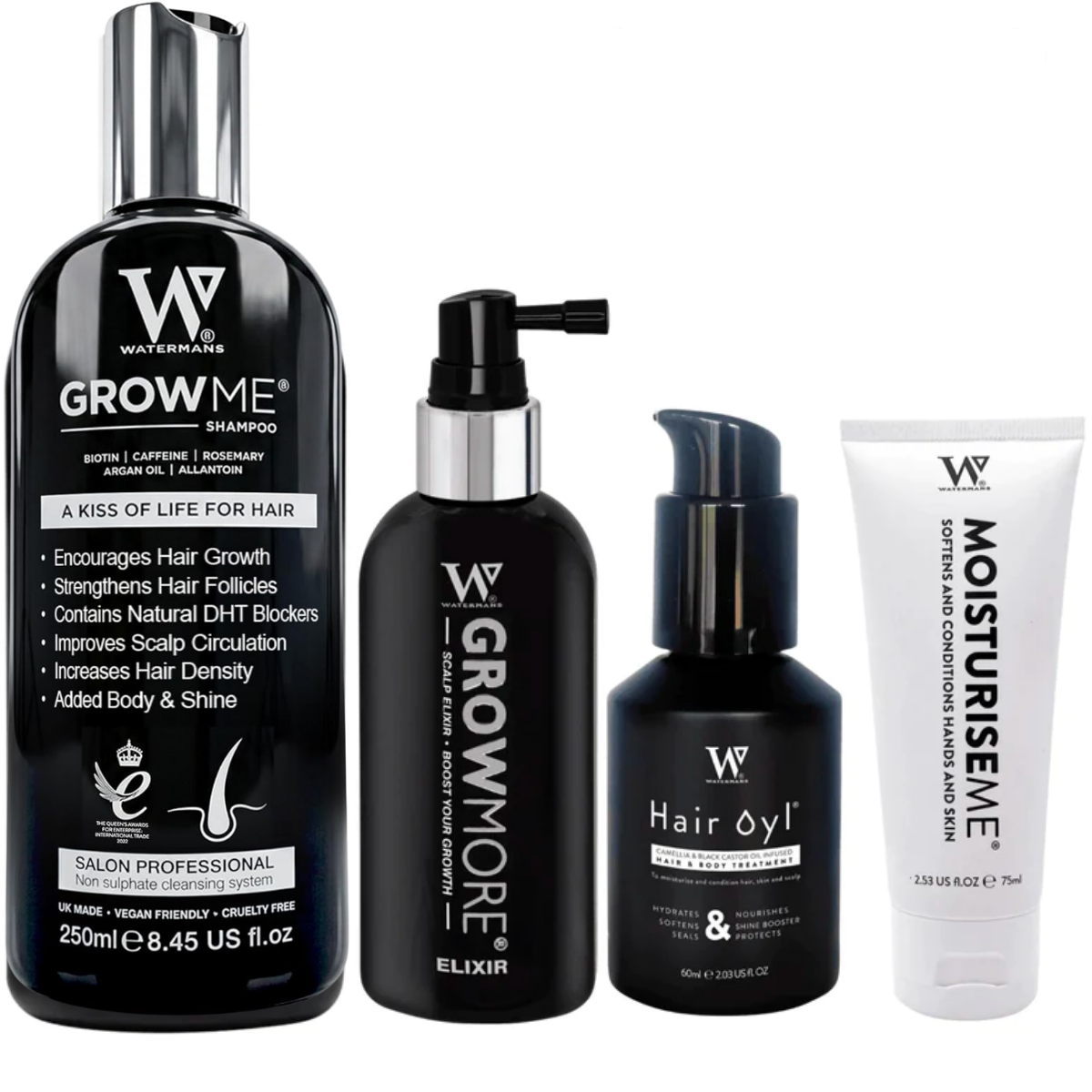
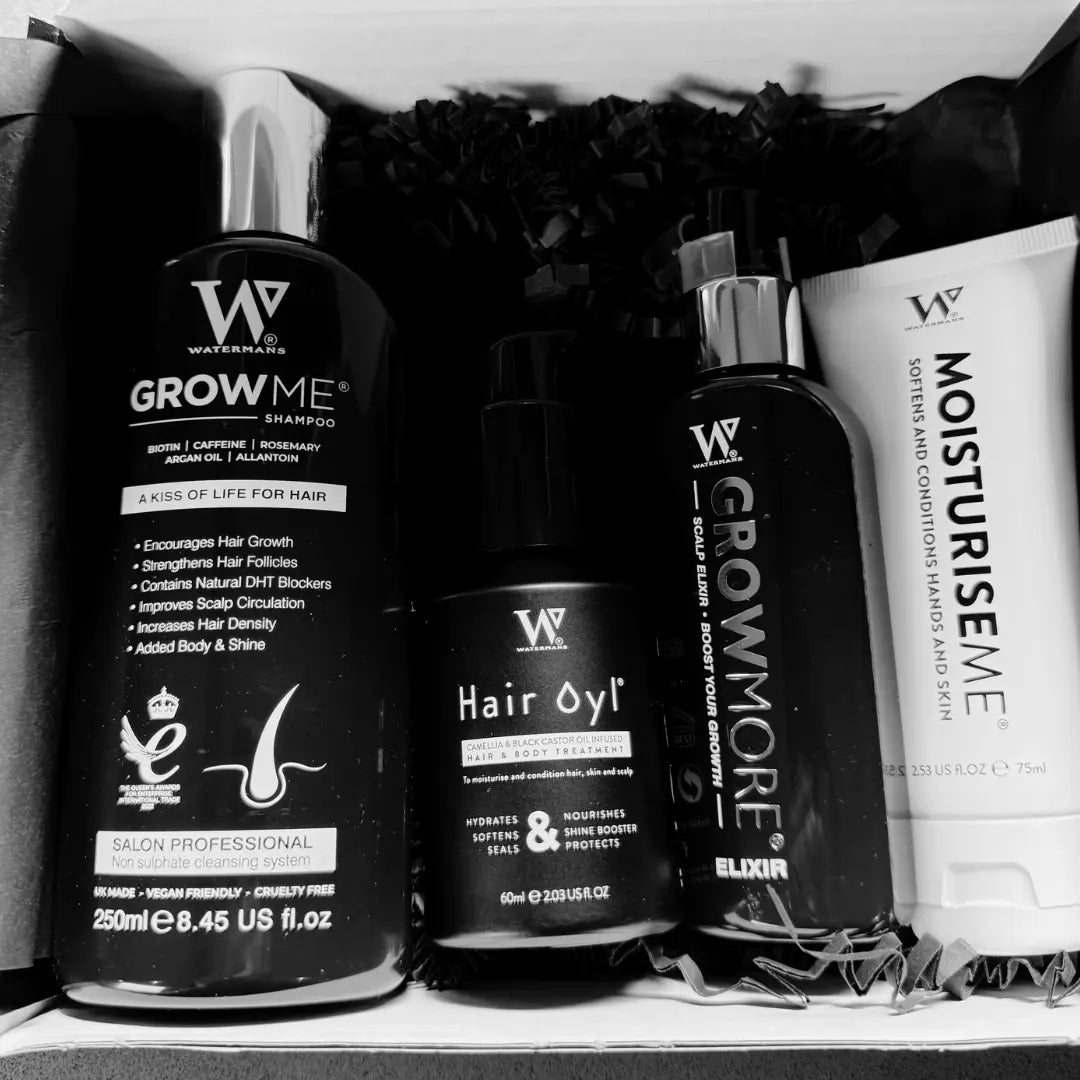
An honest note about what we sell. Watermans is a hair care company. We do not make a gel moisturiser for oily facial skin, so there is nothing for us to sell you on this page, and we would rather say so than push something that is not right for the job. Our skin cream is a rich butter-based formula built for hands and dry body skin, which is the opposite of what an oily T-zone needs. We have sold over five million bottles since 2012, all vegan and made in the UK, by being straight about what each product is for.
When to speak to a pharmacist or GP
Skincare shopping has limits. It is worth getting proper advice if you have painful, deep or cystic spots, acne that is scarring or leaving marks, a persistent rash rather than ordinary oiliness, sudden oiliness alongside new hair growth on the face or irregular periods, or if a few months of sensible over-the-counter care has not moved things at all. A pharmacist can help with the first tier of options, and a GP can prescribe or refer where needed. Nothing on this page is medical advice.
Frequently asked questions
Can I skip moisturiser if my skin is already oily?
You can, and some people are comfortable without it. But going without does not reduce how much oil your skin makes, and it tends to leave the surface less comfortable and less tolerant of actives like acids and retinoids. A light gel takes ten seconds and removes the question.
Is gel or cream better for oily skin?
Gel or gel-cream, in most cases. They are mostly water and humectant with minimal heavy oils, so they hydrate without adding surface shine. A cream is not harmful, it just tends to feel and look greasy on skin that already produces plenty of sebum.
Does oil-free mean it will not clog my pores?
No. Oil-free only means the formula does not contain ingredients classed as oils. It can still contain silicones, esters or waxes that feel heavy, and it can still cause congestion in some people. Judge by texture and by your own experience, not by the phrase.
Should I use a different moisturiser in winter?
Quite possibly. Cold outdoor air and dry indoor heating both increase water loss from skin. Many people with oily skin move from a water gel in summer to a gel-cream or fluid lotion in winter, then back again. Adjusting seasonally is normal, not a sign you got it wrong.
Is niacinamide worth looking for?
For oily skin, it is the single most useful optional ingredient. At roughly 2 to 5 percent it has reasonable evidence for supporting the skin barrier and reducing the appearance of shine and pore size. Very high percentages are not better and are more likely to sting.
How long before I know if a moisturiser suits me?
Give it three to four weeks unless it stings, burns or causes an obvious rash, in which case stop straight away. Introduce one new product at a time, otherwise you will never know which one to blame or thank.
Can hair products cause spots on my face?
Yes, and it is common. Pomades, waxes, heavy oils and rich conditioners transfer onto the hairline, temples, back and shoulders. If your breakouts follow the line where your hair sits, look at what you are putting on your hair before you change your face routine.
Do I need a separate night moisturiser?
Not necessarily. A good gel-cream works morning and night. A dedicated night product is only worth it if you want something slightly richer overnight, or if it carries an active you would rather not wear in daylight.
The bottom line
Choosing well is mostly about ignoring the front of the packaging and reading the first five ingredients on the back. Water and glycerin at the top, a light emollient in the middle, no butters or waxes, ideally niacinamide, in a gel or gel-cream texture that disappears in under a minute. Buy a small size, use it consistently for a month, and change one thing at a time. That approach will beat almost any product recommendation, including this one.