



Foods High in Fructose: Where It Hides and How Much Is Too Much
The foods highest in fructose are sugar-sweetened drinks, agave syrup, honey, fruit juice, dried fruit and anything sweetened with glucose-fructose syrup. Whole fruit contains fructose too, but it is not where the problem sits. What matters is your total intake of free sugars, and UK guidance caps that at about 30g a day for adults. A single 500ml can of full-sugar cola can use up that entire allowance on its own.
Last updated: August 2026
Key takeaways
- Liquid sugar is the main route by which most people take in a lot of fructose fast, because drinks do not make you feel full.
- UK adults are advised to cap free sugars at around 30g a day. Fruit juice counts, and is capped at 150ml a day.
- Whole fruit is not implicated. Large studies link whole fruit to lower type 2 diabetes risk, while juice trends the other way.
- Agave syrup is roughly 70 to 90 per cent fructose, higher than table sugar, but it is not uniquely toxic. The amount you use is what counts.
- High fructose corn syrup and table sugar are close to identical after digestion, at 55/45 versus 50/50.
- On UK labels the words to look for are glucose-fructose syrup, fruit juice concentrate, invert sugar and agave syrup.
Which foods and drinks are highest in fructose?
Sweetened drinks, syrups and dried fruit top the list, because they concentrate sugar into a small volume that is easy to consume quickly. The table below gives approximate fructose content for typical portions, using standard food composition values. Treat them as ballpark figures rather than precise measurements, because varieties and recipes differ.

| Food or drink | Typical portion | Approx. fructose | Why it matters |
|---|---|---|---|
| Full-sugar cola | 500ml can | About 26g | Nearly a whole day of free sugars, with no fibre and no satiety |
| Agave syrup | 1 tbsp (21g) | About 11 to 14g | The highest fructose share of any common sweetener |
| Apple juice | 250ml glass | About 15g | Fructose-dominant and drunk in seconds, unlike the fruit itself |
| Honey | 1 tbsp (21g) | About 8g | Counts as a free sugar in UK guidance despite the health halo |
| Dried dates | 40g (about 5) | About 8 to 10g | Drying removes the water that would otherwise fill you up |
| Table sugar | 1 tsp (4g) | About 2g | Half fructose, half glucose, by chemical definition |
| Medium apple | 180g whole | About 7g | Arrives with fibre, water and chewing time, which changes everything |
| Tomato ketchup | 1 tbsp (17g) | About 2g | Small alone, but savoury sauces add up unnoticed across a week |
The pattern is more useful than any individual number. Fructose becomes a problem when it arrives fast, in liquid form, without fibre, and on top of the calories you were already eating.
How much fructose is actually too much?
There is no separate UK limit for fructose. Public health guidance targets free sugars instead, and recommends adults keep them under about 30g a day, which is roughly seven teaspoons. Free sugars means anything added by a manufacturer, cook or consumer, plus the sugars naturally present in honey, syrups and unsweetened fruit juice.
That definition is the whole trick. The sugar inside an intact apple is not a free sugar. The identical molecules in a glass of apple juice are, because juicing has stripped the structure that slowed them down. Whole fruit sits outside the cap entirely, which is why nutrition guidance encourages more of it while capping juice at 150ml a day.
The one change with the biggest effect. If you do nothing else, deal with what you drink. Sweetened drinks, juices and syrup-laden coffees deliver more free sugar per minute than anything else in a normal diet, and they do it without triggering the fullness that would make you eat less later.
Why is whole fruit not the problem?
Whole fruit comes packaged with fibre, water, and a physical structure your body has to break down, so the sugar is released slowly and the portion is self-limiting. Eating four apples in one sitting is difficult. Drinking the juice of four apples takes under a minute and leaves you no fuller.

The observational evidence points the same way. Large cohort studies have repeatedly associated higher whole fruit intake with lower type 2 diabetes risk, while fruit juice intake trends in the opposite direction. Cohort data cannot prove cause on its own, but the direction is consistent and it matches the mechanism. There is also a gut-level buffer worth knowing about: the small intestine clears a good share of a moderate fructose dose before it ever reaches the liver, and that capacity is overwhelmed by large single doses rather than by a piece of fruit.
So the honest advice is narrower than the internet version. Cut liquid sugar. Keep eating fruit.
Is agave nectar really worse than sugar?
Agave syrup contains roughly 70 to 90 per cent fructose against table sugar's 50 per cent, so gram for gram it does deliver more fructose. That is the whole of the true part. Describing it as more harmful than sugar goes beyond what the evidence supports, and this page previously made that mistake.
In practice, people use agave in teaspoons, not in glasses. A teaspoon of agave and a teaspoon of sugar are both trivial next to a 500ml soft drink. The problem with agave is not toxicity, it is the health halo: the word natural on a bottle of concentrated syrup encourages people to use more of it, and to count it as a free pass rather than as the free sugar that UK guidance classifies it as.
Is high fructose corn syrup worse than table sugar?
Not meaningfully, once digested. The most common form, HFCS-55, is about 55 per cent fructose and 45 per cent glucose. Table sugar is sucrose, which your gut splits into 50 per cent fructose and 50 per cent glucose. That five-point difference does not explain the health effects attributed to it.
There is also a geography point that gets lost when American articles are read in Britain. High fructose corn syrup is far less common in UK food manufacturing than in the US, and where a similar ingredient is used here it is labelled glucose-fructose syrup. If you are hunting for it on a UK ingredients list, that is the phrase to look for.
What HFCS did do, in the US at least, is make sweetened drinks cheap at scale. The volume, not the molecule, is the part that matters. We covered the underlying biochemistry, including why fructose bypasses the insulin-sensitive control point in glycolysis, in our companion piece on fructose and insulin resistance.
What do the label words actually mean?
Manufacturers rarely write the word fructose on a front of pack. Instead the fructose arrives inside a syrup, a concentrate or an invert sugar. Learning six phrases is enough to spot almost all of it.

| Label wording | What it actually is |
|---|---|
| Glucose-fructose syrup | The UK term for the ingredient Americans call high fructose corn syrup |
| Fruit juice concentrate | Sugar syrup made from fruit, counts as a free sugar despite sounding wholesome |
| Invert sugar syrup | Sucrose already split into free glucose and free fructose |
| Agave syrup or nectar | The highest-fructose common sweetener, at roughly 70 to 90 per cent |
| Honey | Roughly 40 per cent fructose, and classified as a free sugar in UK guidance |
| Crystalline fructose | Almost pure fructose, used in some sports and diet products |
Then use the traffic light panel. On UK front of pack labelling, more than 22.5g of total sugars per 100g is high and gets a red light, while 5g or less per 100g is low and gets a green one. For drinks the thresholds are lower, at more than 11.25g per 100ml for red. That single glance settles most supermarket decisions faster than reading the full ingredients list.
Who genuinely needs to watch fructose specifically?
Most people should think about free sugars rather than fructose. Three groups are different, and for two of them this is a medical matter rather than a dietary preference.
- Fructose malabsorption. A digestive issue, not a metabolic one. Poorly absorbed fructose ferments in the colon and causes bloating, wind and pain, often overlapping with IBS. Managing it properly means working with a dietitian, usually through a structured low FODMAP process, not cutting fruit out indefinitely on your own.
- Hereditary fructose intolerance. A rare inherited enzyme disorder that is diagnosed and managed by specialists, and is genuinely serious. It is not something to self-diagnose from a symptom list.
- People told they have fatty liver or raised liver enzymes. Reducing free sugars, particularly from drinks, is a standard part of the advice, alongside weight and alcohol. See what actually reduces liver fat for what the evidence supports and why detox shakes do not qualify.
See a GP before making major dietary changes if you are pregnant, diabetic, taking medication that affects blood sugar, or have been told you have liver disease. If you have persistent bloating, pain, unexplained weight loss or a change in bowel habit, get that assessed rather than treating it as a fructose problem.
What actually reduces your fructose load?
Six changes cover almost all of it, ordered by how much difference they make. None of them involve avoiding fruit.
- Fix the drinks first. Swap full-sugar soft drinks for water, sparkling water or a diet version. This one change usually beats everything else combined.
- Cap juice at 150ml a day and treat it as one of your five a day at most, never as a free extra.
- Eat the fruit, do not drink it. Whole fruit has no cap and no downside for most people.
- Read the syrups. Glucose-fructose syrup, fruit juice concentrate and invert sugar all count, whatever the front of pack says.
- Check the savoury shelf. Ketchup, barbecue sauce, sweet chilli, jarred pasta sauce, bought salad dressing and shop-bought granola are where sugar hides in plain sight.
- Do not swap sugar for a natural syrup. Honey, agave, maple and date syrup are all free sugars. Choosing them for flavour is fine, choosing them believing they are exempt is not.
Two related reads if you are working through your food labels generally: is maltodextrin bad for you, and which foods are genuinely bad for your liver.
Does any of this reach your hair?
Indirectly, and honestly the link is weaker than wellness marketing suggests. Sugar does not damage hair follicles. The realistic route runs through insulin resistance and polycystic ovary syndrome, where higher circulating insulin raises ovarian androgen output, which in genetically susceptible women can show up as thinning through the crown and parting.
The second route is more common and more mundane. Very rapid weight loss, crash dieting or a period of poor overall intake can push a large share of follicles into the resting phase at once, producing the diffuse shedding known as telogen effluvium about two to three months later. That is a nutrition and stress issue, not a sugar issue specifically. If you are shedding heavily, our guides to PCOS-related hair loss and telogen effluvium are the more useful places to start, and sudden or patchy loss warrants a GP appointment.

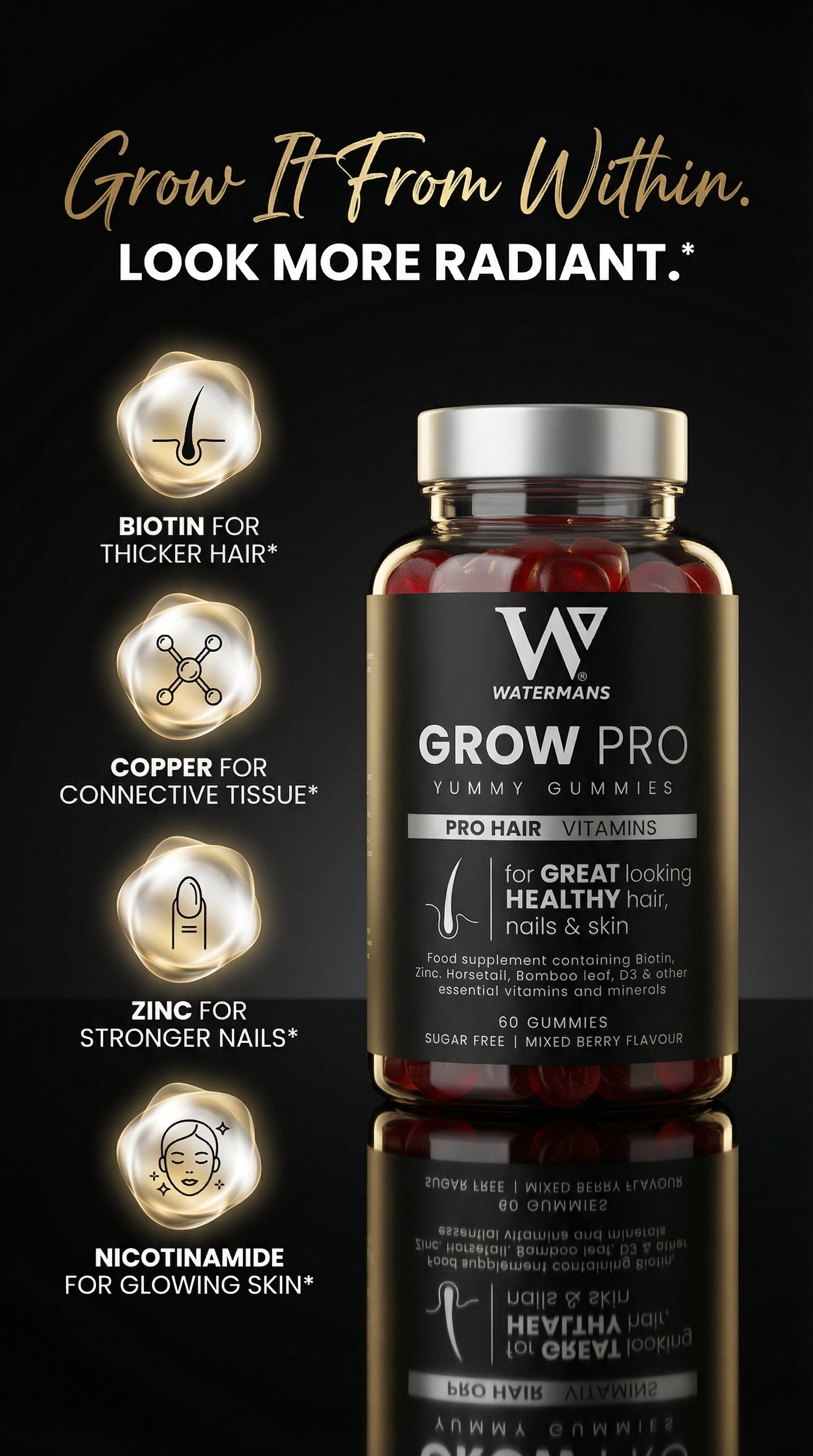
GrowPro® Hair, Skin & Nails Gummies, £22.95
Sugar-free and vegan, with biotin, zinc, selenium and B vitamins that contribute to the maintenance of normal hair. Worth knowing given the subject of this article: most gummy supplements are sweetened with glucose syrup, and these are not. A supplement does not treat insulin resistance, PCOS or any medical cause of hair loss, and it is no substitute for eating enough overall. If you suspect a deficiency, ask your GP for a blood test rather than guessing.
Shop GrowPro GummiesFrequently asked questions
Which food has the most fructose?
By concentration, agave syrup, at roughly 70 to 90 per cent fructose. By the amount people actually consume in one go, sugar-sweetened soft drinks and fruit juice deliver the most, because a 500ml drink can carry around 26g of fructose and takes a couple of minutes to finish.
Is the fructose in fruit bad for you?
No. Whole fruit arrives with fibre, water and structure that slow sugar release and limit how much you eat. Large cohort studies associate higher whole fruit intake with lower type 2 diabetes risk. UK guidance excludes whole fruit from the free sugars cap entirely.
How much fructose per day is safe?
There is no separate fructose limit in UK guidance. The relevant target is free sugars, capped at about 30g a day for adults and less for children. Staying under that automatically keeps fructose from added sugars and juice at a sensible level.
Is agave syrup healthier than sugar?
No, and it contains more fructose per gram than table sugar does. It is not uniquely harmful either. The main risk is behavioural: a natural label encourages people to use more of it and to stop counting it, when UK guidance classifies it as a free sugar like any other syrup.
Is high fructose corn syrup banned in the UK?
It is not banned, but it is far less common than in the United States, and the equivalent ingredient is labelled glucose-fructose syrup here. After digestion it is close to identical to table sugar, at about 55 per cent fructose against sucrose's 50 per cent.
Does fructose cause fatty liver?
Excess energy does, and fructose is an easy way to consume excess energy because it usually arrives as a drink. Overfeeding trials show clear rises in liver fat, while calorie-matched swap studies show only small differences, so total intake matters more than the specific sugar.
What are the symptoms of fructose malabsorption?
Bloating, wind, abdominal pain and loose stools after fructose-rich foods, overlapping heavily with IBS. Diagnosis and management belong with a GP and a dietitian, usually through a structured elimination and reintroduction process rather than permanently cutting out fruit.
Do sugar-free sweeteners solve the problem?
They remove the sugar, which for drinks is a genuine improvement and is the swap most likely to reduce your free sugar intake quickly. They do not make an otherwise poor diet healthy, and they do nothing about total calories from other sources.
The short version
Fructose is not a poison and fruit is not the enemy. The realistic problem is free sugars arriving fast and in liquid form, which is why the highest-value change most people can make is dealing with what they drink. Keep free sugars near 30g a day, cap juice at 150ml, learn the six syrup names on an ingredients list, and keep eating whole fruit without guilt.
If you would rather your supplements did not add to the sugar total, our sugar-free GrowPro gummies are formulated without glucose syrup. Watermans is a founder-led British brand that has sold more than 5 million bottles since 2012, vegan and made in the UK.