


Dull Hair: Why It Happens and How to Get Shine Back
Dull hair is an optical problem before it is a health problem. Shine is light bouncing off a smooth, flat outer surface in one direction, so hair looks dull the moment that surface is rough, lifted or coated and the light scatters instead. That means the fix is smoothing the cuticle and removing what is sitting on it, rather than buying a product with the word shine on the front. Most cases of dull hair come down to four things: mineral deposits, product residue, damage and dryness.
Key takeaways
- Shine is specular reflection. A smooth cuticle reflects light in one direction, a rough one scatters it.
- Hard water is the most underrated cause in the UK. Mineral deposits leave a matte film that no conditioner shifts.
- Product and silicone residue causes dullness that people mistake for dryness, then make worse with more product.
- Coily and very curly hair reflects less light because of its geometry, not because anything is wrong with it.
- The cold rinse advice is weaker than its popularity suggests. An acidic rinse does more than a cold one.
- Dark hair shows shine most and fine pale hair shows it least, so judge your hair against itself rather than an advert.
What actually makes hair shine?
Each strand is wrapped in overlapping cuticle scales, arranged like roof tiles pointing from root to tip. When those scales lie flat, the surface behaves like a curved mirror and reflects light in a single direction. On a head of hair that produces the band of light you see across the crown, sometimes called the shine halo.
Lift or roughen those scales and the same light bounces off in many directions at once. Physically the hair is not much different. Optically it is completely different, and that is all dullness is. Anything sitting on top of the cuticle, whether mineral scale, silicone or dry shampoo powder, does the same thing by breaking up the surface.
Two honest caveats. Straight dark hair shows shine far more readily than fine blonde or grey hair, because there is more contrast and a flatter surface. And coily hair has bends every few millimetres, so light cannot travel along it the way it does on a straight strand. Textured hair showing less shine is geometry, not damage, and it should never be described as a fault.

What causes dull hair?
Seven causes cover almost everything, and the first two are the ones people almost never suspect.
| Cause | How you recognise it | What actually helps |
|---|---|---|
| Hard water minerals | Hair feels rough and matte, worse over months, worst after a house move | A chelating or clarifying wash, and a filtered final rinse |
| Product and silicone residue | Hair looks flat and heavy, feels coated, limp within a day | One clarifying wash, then use fewer leave-on products |
| Alkaline products lifting the cuticle | Hair goes rough and tangly right after washing | A slightly acidic conditioner or a diluted vinegar rinse |
| Heat and bleach damage | Ends much duller than roots, rough, splitting | Lower heat, protectant every time, and a trim |
| Dryness | Hair is dull and feels straw-like, drinks up oil | Richer conditioner, oil on the lengths, less washing of the ends |
| Too much protein | Dull plus stiff and snapping rather than dull plus soft | Pause protein products for two to four weeks |
| Naturally low shine hair | Fine, pale, grey or highly textured hair, dull since always | Nothing is wrong. Optical smoothing rather than repair |
The myth worth dropping
Cold water does not seal the cuticle. Cuticle scales are dead keratin, not muscle, and they do not open and close with temperature the way the advice implies. What genuinely flattens them is pH: hair sits happiest around pH four and a half to five and a half, which is why acidic conditioners and rinses smooth the surface and alkaline soaps roughen it. A cool final rinse is pleasant and does no harm, but if you are choosing one thing to change, choose the pH of what you put on rather than the temperature of what you rinse with.
How do you fix dull hair?
Work in this order. The first two steps fix most cases and cost almost nothing, and doing them before buying a shine product will save you money.
One, clarify once and see what happens. A single clarifying or chelating wash strips mineral deposits, silicone and styling residue. If your hair looks noticeably better immediately, residue was the problem and the answer is fewer products, not more. Once or twice a month is enough afterwards.
Two, deal with your water. Much of the UK is a hard water area. A shower filter or a final rinse from a bottle of filtered water on wash days is a cheap experiment, and for a lot of people it is the whole answer. Give it three weeks before you judge it.
Three, get the pH right. Use an acidic conditioner, and if you want to test the principle cheaply, a rinse of one tablespoon of cider vinegar in a jug of water, poured through and rinsed out, flattens the cuticle noticeably on most hair.
Four, add a light oil to the lengths, not the roots. A few drops on damp mid-lengths and ends fills the microscopic gaps in a rough surface and makes it optically smoother. This is the step that does the most visible work, and it is also the easiest to overdo.
Five, dry it downwards. A nozzle on the dryer pointed from root to tip lays the cuticle in the direction it already lies. Drying upwards or with the head flipped roughens every scale on every strand, which is why that method gives volume and costs shine.
Six, book a trim. Ends are the oldest, roughest and most split part of the hair, and no product makes a split end reflect light. Removing a centimetre changes how the whole length reads.
The shine diagnostic card
One email with the whole thing on a single page: how to work out which of the seven causes is yours in one wash cycle, the clarify and chelate schedule, the vinegar rinse ratio, and the drying technique that costs nothing and changes the most.
Which products help dull hair?
Shine products work optically rather than by repairing anything, and that is fine as long as you know it. A light oil or a smoothing leave-in fills surface irregularities so light reflects more evenly. Nothing in a bottle rebuilds a damaged cuticle, so the honest order is remove the residue, correct the pH, then smooth what is left.
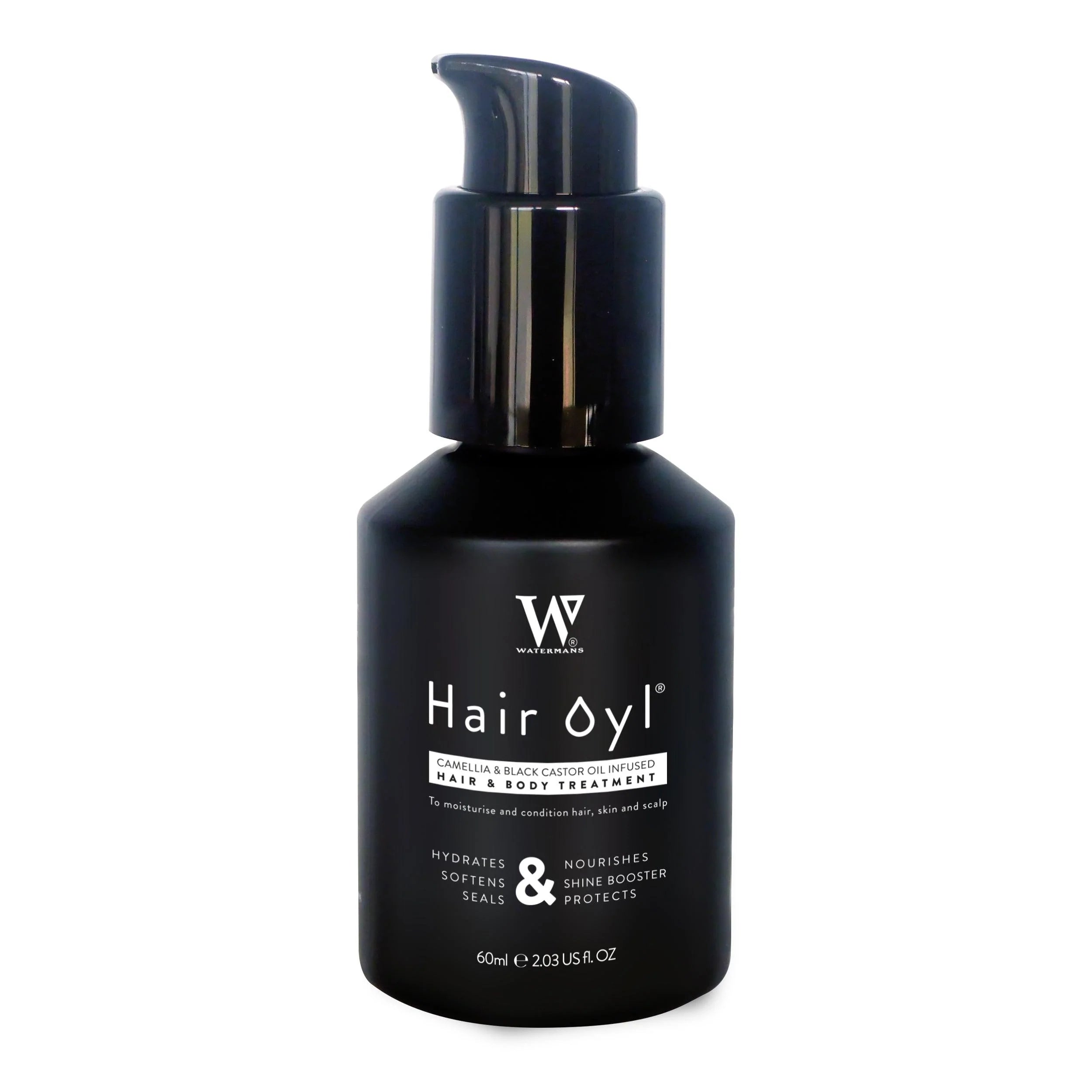
Camellia & Black Castor Oil, a few drops on damp mid-lengths and ends
Camellia and black castor oil is light enough not to weigh fine hair down, which is the usual failure with oils on dull hair. Apply to damp hair so it seals water in rather than sitting on a dry surface, and start with less than you think, since too much reads as greasy rather than glossy.

Masque Me® Mask, weekly, on the last three inches
Ten minutes on the oldest part of the hair, which is where dullness is always worst. If your hair goes limp and mushy rather than smooth, that is over-conditioning and you should drop to fortnightly.

Protect Me® Heat Protection Spray, before every heat styling session
Heat damage is one of the four main routes to a permanently rough cuticle, and unlike hard water or residue it cannot be washed away afterwards. Protection to 230C, used every time, protects the shine you still have.

Which habits keep hair reflective?
- Brush with a boar bristle or mixed bristle brush from mid-length down, which distributes scalp oil along the shaft. This is the oldest shine trick there is and it still works.
- Rinse conditioner with cooler water and get the ends properly clear, since residue left in dulls as it dries.
- Blot with a cotton t-shirt rather than rubbing with a towel.
- Keep the dryer moving, on medium heat, with a nozzle, pointing downwards.
- Cut dry shampoo back. Its powder is a matting agent by design.
- Wear a hat in strong sun. UV degrades the cuticle and lightens colour unevenly.
- Trim every ten to twelve weeks.
If your ends are dull but your roots are greasy, that is a different and very common pattern, and our guide to an oily scalp with dry ends deals with it directly. If your hair is dull and also stiff and snapping, read our piece on protein overload first, because adding oil to that hair will not help.
Is dull hair a sign of a health problem?
Usually not on its own. Hair is dead keratin, so it records what has happened to it rather than what is happening now, and the commonest causes are all external. That said, a genuine change in the hair growing out of your head, as opposed to the condition of the length you already have, is worth paying attention to.
Thyroid problems, iron deficiency, a period of illness, significant weight loss and some medicines can all change hair texture and quality at the root. The clue is that the change starts at the scalp and grows down, affects new hair as well as old, and usually arrives alongside other symptoms such as tiredness, feeling cold or breathlessness. That is a GP conversation and a blood test, not a shopping decision.
It is also worth separating three things people routinely merge. Hair breakage is the fibre snapping along its length, giving short blunt fragments with no bulb. Hair shedding is full length hairs with a small pale bulb leaving the follicle, fifty to a hundred a day being normal. Hair loss is a widening parting, a receding line or visible scalp, which is a medical matter and worth raising with your GP.
Watermans products are 100% cosmetic and do not treat medical hair loss. Individual results may vary.
Frequently asked questions
Why is my hair suddenly dull?
A sudden change usually points to something external and recent: a house move to a hard water area, a new shampoo or styling product, a colour service, or a summer of sun and swimming. Work backwards from what changed, and start with one clarifying wash to rule residue in or out.
Does cold water make hair shinier?
Barely, and not for the reason usually given. Cuticle scales are dead keratin and do not open and close with temperature. Acidity flattens them, so an acidic conditioner or a diluted vinegar rinse does far more than a cold rinse. A cool rinse is pleasant and harmless, just not the lever people think it is.
Can hard water really cause dull hair?
Yes, and it is the most commonly missed cause in the UK. Calcium and magnesium deposit on the fibre over weeks, leaving a rough matte film that ordinary conditioner does not remove. A chelating shampoo or a filtered final rinse is the test, and three weeks is a fair trial.
Do silicones cause dullness?
Not inherently. Silicones make hair look smooth and shiny, which is exactly why they are used. The problem is that the water insoluble ones build up if you never wash properly, and that layer eventually reads as flat and heavy. Clarify monthly and they are fine.
Will a gloss or glaze at the salon fix it?
It will improve the look for a few weeks by depositing a smooth film and often a little tone, and that is a genuine cosmetic result. It does not change the underlying condition, so if the cause is hard water or residue it will come back once the gloss wears off.
Is my grey hair dull because it is grey?
Partly. Grey hair often has a slightly different surface texture and no pigment to give contrast, so it reflects less and reads duller even in good condition. It also tends to be coarser and drier, so conditioning and oil help more than they did before.
Does brushing really make hair shinier?
Yes, modestly and for free. Brushing moves sebum from the scalp along the shaft, which is the original smoothing product. Use a bristle brush, start below the mid-length, and be gentle, because aggressive brushing costs more in breakage than it gains in shine.
Why are my ends duller than my roots?
Because they are older. On shoulder length hair the ends are roughly two years old and have been washed hundreds of times, heated, tied up and exposed to sun. Roots are new. This gradient is normal and it is why trims matter.
Can diet make hair shinier?
Only indirectly and only for hair that has not grown yet. A diet short of protein, iron or essential fats can affect the quality of new hair at the root, but nothing you eat changes the length already on your head. Be wary of any supplement promising shine.
Sources and references
- Robbins, C. R., Chemical and Physical Behavior of Human Hair, Springer, on cuticle structure, surface optics and the measurement of hair lustre.
- Journal of Cosmetic Science, the peer-reviewed literature on hair shine measurement, specular reflection and the effect of pH on the cuticle.
- The water industry hardness data for the UK, for regional variation in calcium and magnesium levels.
- NHS guidance on iron deficiency anaemia and thyroid conditions, for the symptoms that accompany genuine changes in hair quality at the root.
The short version
Dull hair is light scattering off a rough or coated surface, so the answer is to smooth and uncover the cuticle rather than to buy shine in a bottle. Clarify once to rule out residue, find out whether you live in a hard water area, get the pH of your conditioner right, put a few drops of light oil on damp lengths, and dry downwards with a nozzle. Then trim the ends, because no product makes an old split end reflect light. If the change started at the scalp and came with other symptoms, see your GP rather than a shelf.
Watermans is vegan, UK made, and has sold over 5 million bottles since 2012.