Is Alopecia Permanent? What Depends on the Type
Is alopecia permanent? It depends entirely on which type you have. Alopecia areata is autoimmune and hair often comes back, though the pattern is unpredictable. Androgenetic alopecia, the common inherited kind, is progressive and long lasting but can be slowed. Scarring alopecias destroy the follicle, so loss there can be lasting. That difference is why getting your scalp looked at early matters more than any product decision.
Our hair growth shampoo
Grow Me® Hair Growth Shampoo, £14.95. A sulphate free daily shampoo that supports a healthy scalp environment and helps reduce breakage, so lengths hold on and look fuller.
Key takeaways
- Is alopecia permanent? The answer depends on the type, and on how early it is looked at.
- Alopecia areata often recovers, but it can come and go without warning.
- Androgenetic (pattern) alopecia is progressive and long lasting, though it can be slowed.
- Scarring alopecias can cause lasting loss because the follicle itself is destroyed, so speed matters most here.
- Telogen effluvium is not alopecia in the follicle-damage sense at all. It is a temporary shed that usually settles.
- A GP or dermatologist is the only person who can tell these apart, sometimes with a scalp biopsy.
- Cosmetic shampoos and serums care for the hair you have. They are not a medical option for any of these conditions.
What does the word alopecia actually mean?
Alopecia is simply the medical word for hair loss. It is an umbrella term covering several unrelated conditions rather than one disease, which is exactly why the question of permanence has more than one answer. Some forms are driven by the immune system, some by inherited hormone sensitivity, some by a temporary disturbance to the hair cycle, and some by inflammation that scars the follicle shut. Alopecia can affect the scalp alone, or also involve eyebrows, eyelashes and body hair.
Because the word covers so much ground, a blanket headline is wrong in both directions. The honest answer to is alopecia permanent always begins with a second question: which alopecia do you have?
Is alopecia permanent for every type?
No. Permanence tracks one thing above all: whether the follicle is still alive. Where the follicle survives, hair can return. Where inflammation has replaced it with scar tissue, it cannot. The table below sets out the main types on that basis.
| Type | What is happening | Is it usually lasting? |
|---|---|---|
| Alopecia areata | The immune system attacks healthy follicles, causing smooth round patches. The follicle survives. | Usually not. Hair often returns, but relapses are common and the timing is unpredictable. |
| Alopecia totalis and universalis | The same autoimmune process, extended to all scalp hair (totalis) or all body hair (universalis). | Less predictable. Return is possible but tends to be slower and less complete. |
| Androgenetic alopecia | Inherited sensitivity to DHT makes follicles produce progressively finer, shorter hairs. | Progressive and long lasting. Follicles miniaturise over years before they are finally lost. |
| Telogen effluvium | A shock pushes many follicles into the resting phase at once, so they shed together months later. | No. Density usually recovers within six to nine months once the trigger has passed. |
| Traction alopecia | Repeated pulling from tight styles damages the follicle at the hairline over months and years. | Recoverable early, lasting late. Once the follicle scars, the loss stays. |
| Scarring (cicatricial) alopecia | Ongoing inflammation destroys the follicle and leaves scar tissue in its place. | Usually lasting where scarring has already happened. Acting fast protects what remains. |
This is why guessing at home is risky. A patch that looks like straightforward areata can be an early scarring alopecia, and the window in which the follicle can still be saved is measured in months. Only a professional scalp examination, sometimes with a biopsy, separates them reliably. If you are still working out what is happening, the three mechanisms behind thinning hair is a useful place to start.

Is it hair loss, hair shedding or hair breakage?
These three things look similar in a hairbrush and mean completely different things, and mixing them up is the most common reason people worry about the wrong problem.
- Hair loss is follicular. The follicle stops producing a usable hair, either because the immune system is attacking it, because it is miniaturising, or because it has scarred. This is what alopecia describes. Density falls and does not come back on its own.
- Hair shedding is the hair cycle running fast. The follicles are healthy and still there, but too many entered the resting phase at once. Telogen effluvium after illness, surgery, a crash diet or childbirth is the classic example, and it typically settles within six to nine months. What causes telogen effluvium covers the triggers in detail.
- Hair breakage is the fibre snapping partway along its length, usually from bleach, heat, tight styling or over-brushing. The follicle is untouched. You see short broken ends and frizz rather than a wider parting, and hair feels thin without density having changed at all.
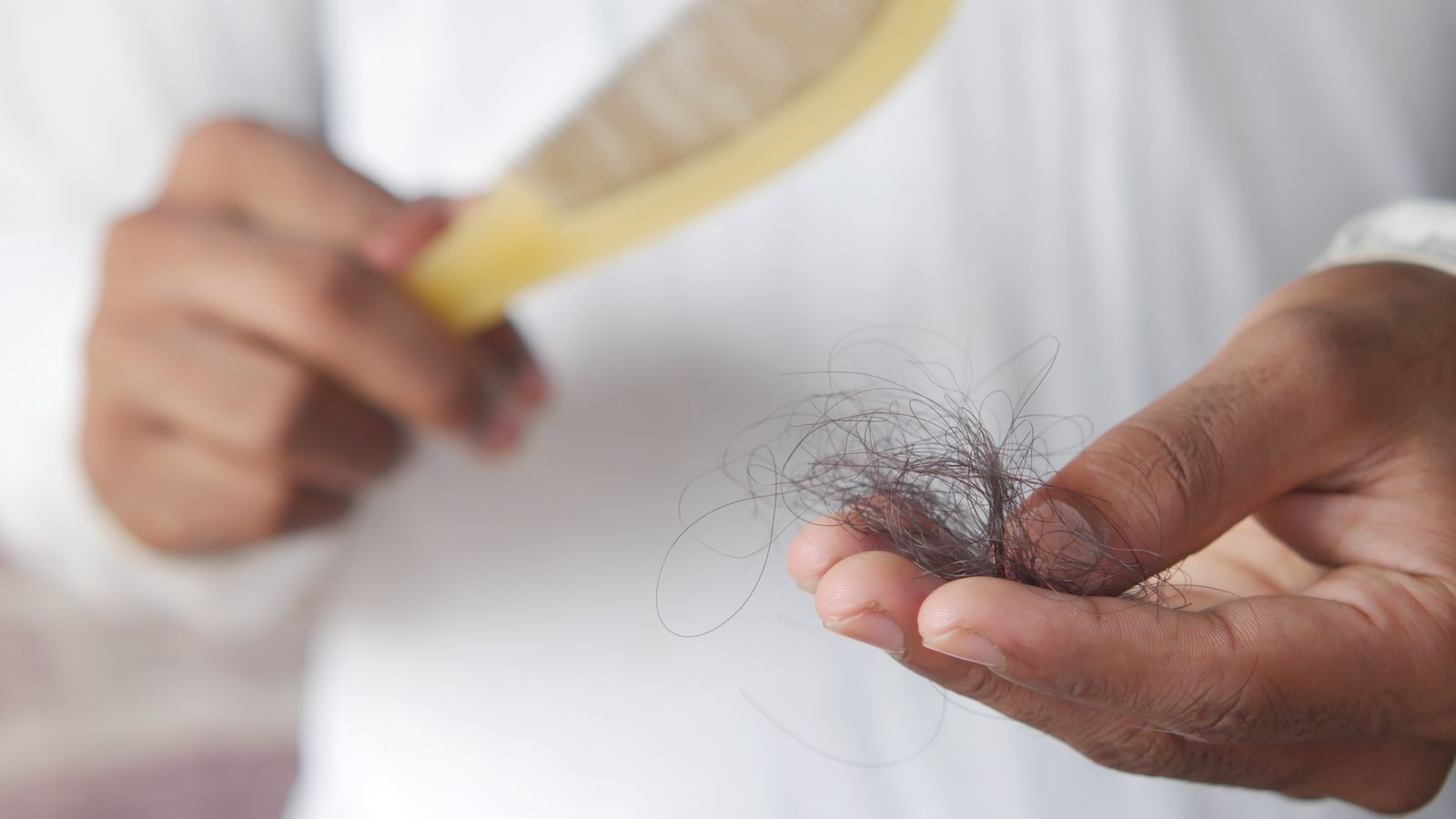
A quick test at home: look at what is in the brush. Shed hairs have a small pale bulb at the root. Broken hairs do not, and they are shorter than the rest of your hair. Neither of those answers is alopecia permanent on its own, but it does tell you whether alopecia is the right question in the first place.
How common is alopecia?
Alopecia is far more common than most people assume. Alopecia areata affects roughly two in every hundred people at some point in life, across every age, gender and background, and it frequently begins in childhood or early adulthood. Pattern hair loss is more widespread still, affecting a substantial share of men and a significant share of women as they get older, with the female pattern typically showing as a widening parting rather than a receding hairline. Whatever you are dealing with, you are in very large company.
What causes each type of alopecia?
Causes differ sharply by type, and more than one can be running at once, which is another reason self-assessment goes wrong.
- Autoimmune activity. In alopecia areata the immune system mistakenly targets healthy follicles. It is associated with other autoimmune conditions such as thyroid disease and vitiligo.
- Inherited hormone sensitivity. Androgenetic alopecia runs in families and reflects how sensitive your follicles are to DHT, a hormone derived from testosterone.
- A physical or emotional shock. Major illness, surgery, bereavement or severe stress can tip the hair cycle into telogen effluvium. Stress and hair loss explains the delay between the event and the shed.
- Hormonal and thyroid shifts. Childbirth, menopause and an underactive or overactive thyroid all disturb the cycle. Thyroid related hair loss is worth reading if you have other thyroid symptoms.
- Mechanical tension. Tight braids, weaves, extensions and habitual high ponytails cause traction alopecia at the hairline and temples.
- Inflammation. In scarring alopecias, conditions such as lichen planopilaris or frontal fibrosing alopecia inflame and then destroy the follicle.
- Nutritional shortfalls. Low iron and low ferritin in particular are common in menstruating women and are worth a blood test, because correcting a genuine shortfall is one of the few things that reliably helps.
Get a discount on the alopecia range
Join the Watermans mailing list and we will email a discount code straight to your inbox, so you can try the alopecia range for less. Vegan, made in the UK, over 6.5 million bottles sold since 2012.
What can a GP or dermatologist actually offer?
A GP starts by identifying which condition you have, because everything else follows from that. Expect questions about timing, family history, medication and recent illness, a close look at the scalp, and often blood tests for iron, ferritin, thyroid function and sometimes vitamin D. A dermatologist may use a dermatoscope or take a small scalp biopsy where scarring is a possibility.
What follows depends on the answer. For alopecia areata, options range from watchful waiting through topical and injected corticosteroids to newer oral medicines reserved for severe cases. For pattern hair loss there are licensed pharmacy and prescription options a clinician can talk you through. For scarring alopecias the priority is calming the inflammation to protect the follicles that remain. Specialists may also discuss platelet rich plasma or low level light therapy, where the evidence is thinner and the cost is real.
This page is education, not medical advice, and we deliberately do not name specific medicines. That conversation belongs with a clinician who has looked at your scalp.

When should you be seen quickly rather than waiting?
Some presentations are time sensitive, because the follicle can only be protected while it is still there. Ask for an urgent appointment if you notice any of the following.
- Bald patches that are spreading week by week rather than staying still.
- Scalp pain, burning, itching, redness or scaling alongside the loss.
- Skin in the bald area that looks smooth, shiny and slightly sunken, with no visible follicle openings.
- Loss of eyebrows or eyelashes as well as scalp hair.
- Hair loss in a child, which needs a different assessment. Hair loss in children covers what to expect.
- Sudden loss alongside other symptoms such as weight change, fatigue or a rash.
The smooth, shiny, follicle free patch is the one to act on fastest. It is the visible sign of scarring, and it is the situation where the answer to is alopecia permanent is most likely to be yes if nothing is done.
Where do cosmetic hair products honestly fit?
They fit around the edges, and it is worth being blunt about that. A shampoo cannot influence an autoimmune attack, an inherited hormone sensitivity or scar tissue. What gentle cosmetic care can do is look after the hair you still have, keep the scalp comfortable, and reduce the breakage that makes thinning look worse than it is. Whatever the answer to is alopecia permanent turns out to be in your case, the hair on your head today still benefits from being handled kindly. On a sensitive or medically managed scalp, less is usually more: a mild cleanse, low heat, loose styling and no tension. We look at joshua dobbs hair separately, with the practical steps.

Grow Me® Shampoo
A gentle sulfate free daily cleanse for a comfortable scalp and stronger looking strands. It is everyday cosmetic care for the hair you have, not a medical option for alopecia. Vegan, made in the UK.
View Grow Me ShampooHow do people cope with alopecia day to day?
The emotional weight of hair loss is real and is not vanity. Hair is bound up with identity, and losing it without warning is a genuine loss. Practical things that people find help include talking to others with the same condition, deciding in advance what you want to say when someone asks, and experimenting with scarves, wigs and hairpieces on your own terms rather than because you feel you must. For the practical next step, our alopecia areata dermatologist guide explains when to ask for a referral and how to prepare.
- Alopecia UK runs support groups, an online community and clear information written for people living with the condition.
- Your GP can refer you for psychological support, and in England some wigs are available on the NHS depending on your circumstances.
- Take your time. Nobody is obliged to explain their scalp to anyone, and there is no correct way to feel about it.

Frequently asked questions
Is alopecia permanent if it is alopecia areata?
Usually not. In alopecia areata the follicle survives the immune attack, so hair commonly returns, often within a year for a single small patch. The frustrating part is that it is unpredictable: it can return, then fall again years later, and the course varies enormously between people. Extensive forms such as totalis and universalis are less likely to return fully.
Can alopecia be cured?
There is no cure for alopecia in the sense of a permanent fix that removes the condition. Alopecia areata can go into long remission, pattern hair loss can be slowed and managed for years, and scarring alopecia can be halted before it spreads further. None of that amounts to a permanent fix, and anyone promising one is selling something.
Is pattern hair loss permanent?
Androgenetic alopecia is progressive rather than sudden. Follicles miniaturise gradually over years, producing finer and shorter hairs before they stop altogether. Started early, medical options can hold the position for a long time, which is why the value of acting early is higher here than almost anywhere else.
Which kinds of alopecia cause lasting loss?
Scarring alopecias, including lichen planopilaris and frontal fibrosing alopecia, cause lasting loss because the follicle is replaced by scar tissue. Long standing traction alopecia does the same thing by mechanical damage. In both cases the loss in already scarred skin stays, which is precisely why speed matters.
Can shampoo or supplements do anything for alopecia?
Not for the condition itself. A cosmetic shampoo works on the hair fibre and the scalp surface, and it has no way of influencing an autoimmune process, an inherited hormone sensitivity or scar tissue. Supplements only help where you have a genuine shortfall, most often iron, which is worth a blood test rather than a guess.
Does stress cause alopecia?
Severe stress reliably triggers telogen effluvium, a temporary shed that appears two to three months after the event and settles once things calm down. Stress is also reported as a trigger for flares of alopecia areata in some people, though it is not the underlying cause. Stress does not cause pattern or scarring alopecia.
Will my hair come back the same colour and texture?
Not always at first. Hair returning after alopecia areata often arrives fine, soft and white or grey before pigment and thickness return over the following months. That early white fluff is a good sign rather than a bad one.
When should I see a doctor about hair loss?
Sooner than most people do. Ask your GP to see you for any patchy loss, any loss with scalp symptoms, any sudden change, and any loss in a child. If you have simply noticed gradual thinning over years it is still worth a conversation, because blood tests are quick and the earlier options are discussed the more of them are open to you. If your question is about products or a routine rather than a medical one, you can talk to Gail Waterman, our co-founder, as an AI avatar on the Watermans homepage.
Is alopecia permanent, and what is the bottom line?
Is alopecia permanent? Only some of it, and which part depends on whether your follicles are still alive. Alopecia areata usually spares the follicle and hair often returns. Pattern hair loss is a slow miniaturisation that can be slowed in turn. Scarring alopecias destroy the follicle and that loss stays. Telogen effluvium is not follicle damage at all and usually resolves by itself. The single most useful thing you can do today is book a GP appointment and ask which one you have, because every sensible decision after that depends on the answer. Cosmetic care looks after the hair you have while the medical side is handled properly. One form worth understanding separately is the sudden, widespread shedding of hairs that were still growing, and what anagen effluvium is covers what causes it and what to expect.
Watermans products are 100% cosmetic and do not treat medical hair loss. Individual results may vary. This article is general information and is not medical advice. Always speak to your GP or a dermatologist about hair loss.
Sources & References
- NHS, Hair loss, overview of causes, what is normal and when to see a GP.
- British Association of Dermatologists, Alopecia areata information leaflet, on the autoimmune mechanism and typical course.
- NICE Clinical Knowledge Summaries, Alopecia areata, on assessment, prognosis and referral.
- Alopecia UK, peer support, community and practical living-with information.