Is Baby Shampoo Sulfate Free? How to Check the Label
Is baby shampoo sulfate free? Not automatically, and that surprises most parents. Plenty of well known baby washes still use a sulfate surfactant, usually sodium laureth sulfate, and a "no more tears" claim on the front says nothing about whether sulfates are in the bottle. The only reliable answer is on the ingredients list. This guide shows you exactly what to look for and what genuinely matters for a baby's scalp.
Key takeaways
- Is baby shampoo sulfate free? Some are, many are not. There is no rule requiring it.
- "No more tears" refers to eye sting, not to sulfates. The two are separate things.
- Sodium lauryl sulfate (SLS) and sodium laureth sulfate (SLES) are the two names to look for. SLES is the milder of the pair and is the one that usually appears in baby products.
- Common sulfate free alternatives include decyl glucoside, coco-glucoside, cocamidopropyl betaine and sodium cocoyl isethionate.
- For eczema-prone or very sensitive skin, fragrance is often the bigger irritant, so check for that too.
- Cradle cap is not caused by shampoo choice and does not need a medicated product in most cases.
- Adults reaching for baby shampoo as a gentle option should know it cleans a greasy adult scalp poorly and can leave build-up.
What are sulfates, and what do they actually do?
Sulfates are detergents. In shampoo they are the surfactants that lift oil, sweat and product residue off the hair and scalp so water can rinse them away, and they are also what produces a thick, satisfying lather. The two you will see on a label are sodium lauryl sulfate, abbreviated to SLS, and sodium laureth sulfate, abbreviated to SLES.
The difference between them matters. SLS is the stronger of the two and is the one most associated with stinging, dryness and irritation on sensitive skin. SLES is a modified version that is noticeably milder, and it is the one manufacturers generally choose when a product is aimed at babies and children. So a baby shampoo containing SLES is not the same proposition as a clarifying adult shampoo built on SLS, even though both are technically sulfate shampoos.
It is also worth saying plainly that sulfates are not dangerous. They are among the most studied cosmetic ingredients in use and are permitted in the UK and EU at the levels found in shampoo. So when parents ask is baby shampoo sulfate free, the honest case for wanting the answer to be yes is about comfort on delicate, still developing skin rather than about safety.
Is baby shampoo sulfate free by default?
No. There is no legal definition of "baby shampoo" that requires a sulfate free formula, and no requirement to declare sulfate free status on the front of the bottle. Manufacturers choose their surfactant system, and many mainstream baby washes still use SLES because it cleans reliably, foams well and costs less than the alternatives.
The result is a market split roughly three ways. Some baby shampoos are genuinely sulfate free and say so. Some contain SLES and say nothing about it. Some are marketed heavily on being natural or gentle while still containing a sulfate, because "natural" and "Sulfate free" are not the same claim and neither is regulated in the way shoppers assume.

What does the "no more tears" claim actually mean?
"No more tears" and "tear free" describe how a formula behaves in the eye, not what surfactant it contains. These products are pH balanced close to the eye's own pH and often include a mild numbing effect on the eye surface, which is why they sting less when suds run down a face. A tear free shampoo can contain SLES. A sulfate free shampoo can still sting if its pH is wrong. Read the two claims as answering two different questions.
Which ingredients replace sulfates?
Once you have settled whether a given baby shampoo is sulfate free, the next question is what it uses instead. Sulfate free does not mean detergent free, because something still has to do the cleaning, and the replacements are gentler surfactants drawn mostly from coconut and sugar chemistry. The table below covers the ones you will meet most often on a baby shampoo label.
| On the label | What it is | How it behaves |
|---|---|---|
| Sodium lauryl sulfate (SLS) | Strong sulfate detergent | Big lather, strong cleanse, most likely of these to feel drying on sensitive skin |
| Sodium laureth sulfate (SLES) | Milder sulfate detergent | Good lather, noticeably gentler than SLS, common in baby products |
| Cocamidopropyl betaine | Coconut derived mild surfactant | Very mild, usually paired with another cleanser, occasional contact allergy reported |
| Decyl glucoside, coco-glucoside | Sugar derived surfactants | Among the mildest available, low lather, a favourite in sensitive skin formulas |
| Sodium cocoyl isethionate | Coconut derived mild surfactant | Creamy lather, gentle, often in cleansing bars as well as liquids |
A practical note on lather: Sulfate free formulas generally foam less. Parents often read the smaller lather as "it is not cleaning", and then use more product than they need. It is cleaning. Babies produce very little of the oil and grime that a big lather is designed to shift.
How do you read a baby shampoo label properly?
Ingredients are listed in descending order of quantity down to one per cent, so anything in the first five or six entries is doing most of the work. Here is the sequence that answers is baby shampoo sulfate free in about ten seconds.
- Scan for "sulfate" or "sulphate". UK and EU labels use the INCI naming system, so it appears as sodium lauryl sulfate or sodium laureth sulfate. If neither is there, the product is sulfate free whether or not it says so on the front.
- Check what is doing the cleaning instead. One of the glucosides, cocamidopropyl betaine or sodium cocoyl isethionate near the top of the list is a good sign.
- Look for parfum or fragrance. On eczema-prone skin, fragrance and its individual allergens are frequently a bigger problem than the surfactant. Fragrance free is a more useful filter than sulfate free for a reactive baby.
- Ignore the front of the bottle. Natural, organic, dermatologically tested and gentle are marketing phrases. Only the ingredients list is regulated in a way you can rely on.
If you want the same logic applied to grown-up hair, our guide to sulphate free shampoo covers what changes and what does not.

Get a discount on the gentle sulfate free range
Join the Watermans mailing list and we will email a discount code straight to your inbox, so you can try the gentle sulfate free range for less. Made in the UK, over 6.5 million bottles sold since 2012.
Does sulfate free matter for cradle cap or eczema?
Cradle cap and eczema are two different situations and the shampoo answer differs for each.
Cradle cap is the greasy yellow crust that appears on many babies' scalps in the first few months. It is thought to relate to maternal hormones and normal skin yeasts rather than to washing habits, it is harmless, it is not itchy or painful, and it clears on its own. The NHS advice is gentle washing with a baby shampoo, softening the scale with an emollient or a plain oil, and brushing loosely with a soft brush. It is not caused by choosing the wrong shampoo, and a sulfate free formula will not clear it any faster.
Eczema is different, because the skin barrier itself is impaired. Here the aim is to reduce anything that strips or irritates. Sulfate free is a sensible choice, but fragrance free matters at least as much and often more, and an emollient wash recommended by your GP or health visitor may be more appropriate than any shampoo. If a baby has active eczema on the scalp or face, ask your health visitor or GP what to use rather than working it out from bottle claims.
How should you wash a baby's hair safely?
- Less often than you think. Two or three times a week is plenty for most babies. Daily plain water is fine if bathing is part of the bedtime routine.
- A pea sized amount. Baby hair is fine and there is very little of it. Most of a squeezed handful ends up down the drain.
- Warm, not hot. Hot water strips the skin barrier faster than any surfactant in the bottle.
- Tip the head back. Supporting the head so water runs backwards keeps suds out of the eyes, which solves the sting problem regardless of the formula.
- Rinse thoroughly. Residue left on the scalp is a common cause of mild irritation, and low lather formulas can feel rinsed before they are.
- Pat dry and moisturise. Rubbing with a towel is rough on both hair and skin.
If you are ever worried about hair coming out in patches on a child rather than the normal thinning and filling in of the first year, hair loss in children explains when to see a GP. If your question is about products or a routine rather than a medical one, you can talk to Gail Waterman, our co-founder, as an AI avatar on the Watermans homepage.
Can adults use baby shampoo instead?
Adults often ask is baby shampoo sulfate free because they are considering switching to it themselves, believing it is the gentlest option available. It is worth being honest about what happens next. Baby shampoo is formulated for a scalp that produces very little sebum and hair that is fine, short and rarely styled. On an adult scalp it frequently under-cleans, leaving oil and styling residue behind, and the hair reads as limp or coated within a few days. Many baby shampoos are also formulated at a slightly higher pH than adult shampoos, which does the hair cuticle no favours over time.
If the reason for switching is sensitivity, a gentle sulfate free adult shampoo is a better answer than a baby product, because it is designed for adult oil levels while still avoiding the harsh surfactant. If the reason is cost, the saving is usually cancelled out by needing more product and washing more often. Sulfate free shampoo on oily hair covers that trade-off in detail.
Is it hair loss, hair shedding or hair breakage?
Adults who switch to a baby shampoo because they think their hair is thinning are often solving the wrong problem, so it is worth separating three different things.
- Hair loss is follicular. The follicle produces finer hairs or stops producing altogether, as in pattern hair loss. Shampoo choice does not influence this either way.
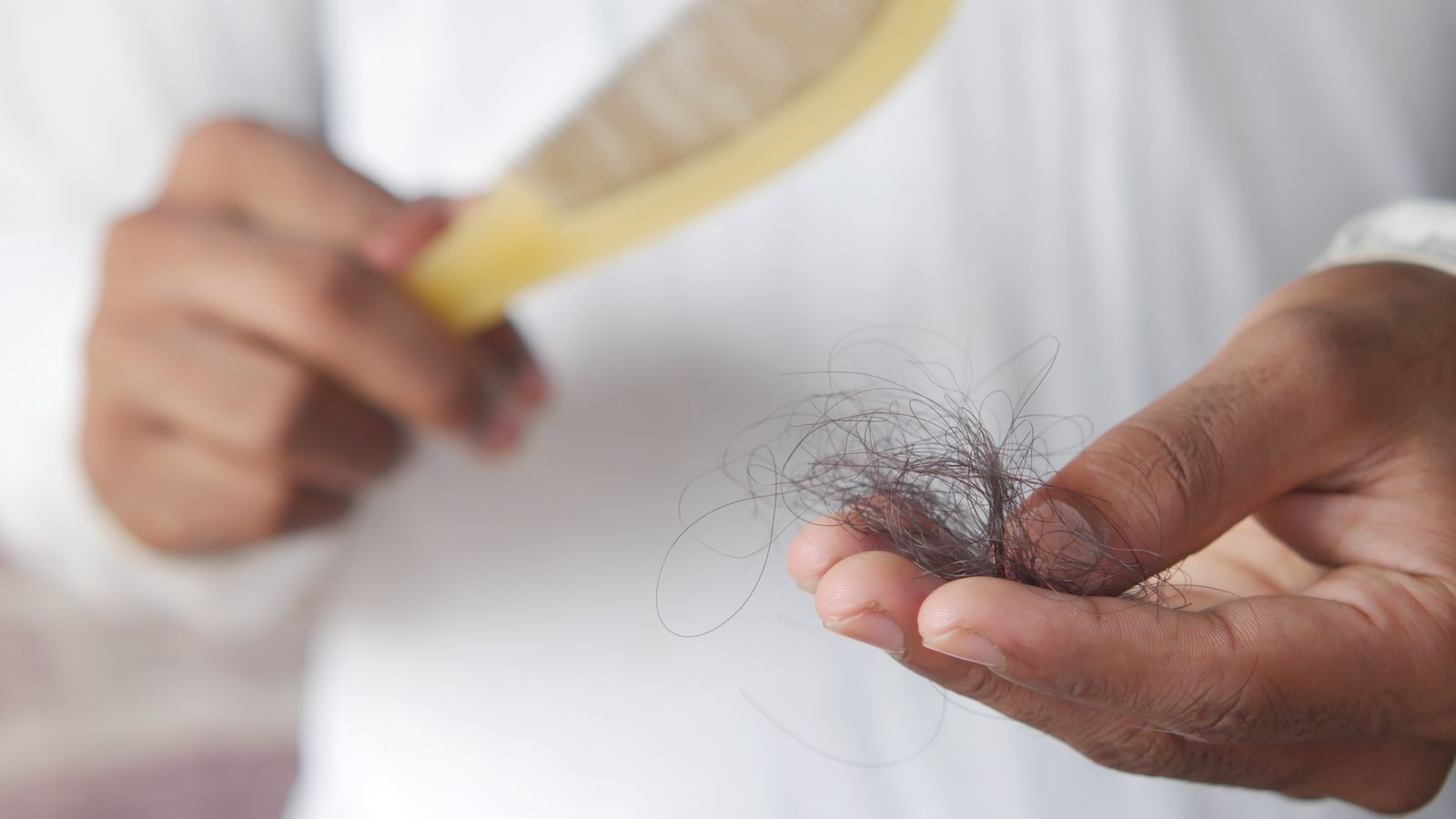
- Hair shedding is a cycle event. Too many follicles enter the resting phase at once, typically after illness, childbirth, a crash diet or severe stress, and shed together two to three months later. It usually settles within six to nine months. New parents often meet this personally, a few months after the birth, at the same time they are choosing a baby shampoo.
- Hair breakage is the fibre snapping along its length from bleach, heat, tension or over-washing. This is the one where product choice genuinely matters, and where a milder cleanse and a conditioner can visibly help.
Broken hairs are short and have no pale bulb at the root. Shed hairs are full length and do. That single check tells you which of the three you are dealing with before you change anything.

Where does a gentle adult shampoo fit?
For the grown-ups in the house who want the mildness without the drawbacks of a baby formula, a sulfate free adult shampoo is the sensible middle ground. These are cosmetic products for the look, feel and condition of the hair you have, and they are not for use on babies, who should have a product formulated for them.

Grow Me® Shampoo, £14.95
A sulfate free daily cleanse for adults, formulated for a comfortable scalp and stronger looking strands. Vegan, made in the UK, over 6.5 million bottles sold since 2012. For adult use, not a baby product.
View Grow Me Shampoo
Condition Me® Conditioner, £13.95
Detangles and smooths the cuticle, which is the practical way to reduce breakage when hair feels rough after washing. Pairs with Grow Me for adults. Vegan and made in the UK.
View Condition Me ConditionerFrequently asked questions
Is baby shampoo sulfate free in every brand?
No. Baby shampoo is sulfate free in some brands and not in others, and there is no rule requiring it. Several of the best known baby washes contain sodium laureth sulfate. The ingredients list is the only reliable place to check, because front-of-bottle claims about being gentle or natural do not cover sulfates.
Is SLES safe for a baby?
Sodium laureth sulfate is permitted in UK and EU cosmetics at the concentrations used in shampoo and is considerably milder than SLS. The reason to avoid it on a baby is comfort on delicate skin rather than safety. If a baby's skin is healthy and not reacting, a well formulated SLES baby shampoo is not a problem.
Do sulfate free baby shampoos clean properly?
Yes. They lather less, which reads as weaker cleaning, but a baby's scalp produces very little oil and needs very little detergent. The mistake to avoid is using several times more product to chase the foam.
Are natural or organic baby shampoos automatically sulfate free?
No. Natural and organic are marketing terms with no fixed cosmetic definition in this context, and several products carrying them contain a sulfate. Read the ingredients rather than the claim.
Does a tear free label mean there are no sulfates?
No. Tear free describes eye comfort, achieved through pH balancing and formulation choices, not the absence of sulfates. A tear free baby shampoo can contain sodium laureth sulfate.
How do I know if my baby is reacting to a shampoo?
Look for redness, dryness, flaking that appears after washing rather than before, or a baby who is unusually unsettled after a bath. Stop the product, go back to plain water for a few days, and speak to your health visitor or GP if the skin does not settle or if it looks sore, weepy or infected.
How often should a baby's hair be washed?
Two or three times a week with shampoo is plenty for most babies. Plain water more often is fine. Over-washing is a more common cause of dryness than the choice between sulfate and sulfate free.
Can I use baby shampoo on my own hair long term?
You can, but most adults find it under-cleans within a week or two, leaving hair limp and coated because adult scalps produce far more oil than a baby's. A gentle sulfate free adult shampoo achieves the mildness without that trade-off.
Is baby shampoo sulfate free, and what is the bottom line?
Is baby shampoo sulfate free? Some of it, not all of it, and nothing on the front of the bottle will tell you which. Turn it over and look for sodium lauryl sulfate or sodium laureth sulfate. If neither appears, it is sulfate free. If SLES appears and your baby's skin is healthy and settled, that is not something to worry about. For eczema-prone skin, fragrance free matters as much as sulfate free, and your health visitor or GP is a better guide than any label. And if you are an adult borrowing the baby shampoo, a sulfate free adult formula will do the job far better.
Watermans products are 100% cosmetic and do not treat medical hair loss. Individual results may vary. Watermans products are formulated for adults and are not baby products. This article is general information and is not medical advice. Speak to your health visitor or GP about a baby's skin.
Sources & References
- NHS, Cradle cap, on what causes it, how to wash and when to seek help.
- NHS, Atopic eczema, on the impaired skin barrier and the role of emollients.
- British Association of Dermatologists, Atopic eczema information leaflet, on irritants and washing products.
- National Eczema Society, Atopic eczema, on fragrance and detergent avoidance.