Does Masturbation Cause Hair Loss? Myth vs Fact

Does masturbation cause hair loss? No. There is no research finding a link between the two, and no biological mechanism that would produce one. The myth survives because male pattern hair loss usually begins in the same years that men are most sexually active, and a coincidence of timing is easy to mistake for cause and effect. If your hairline is changing, the cause is almost certainly inherited and worth discussing with a GP.
Our hair growth shampoo
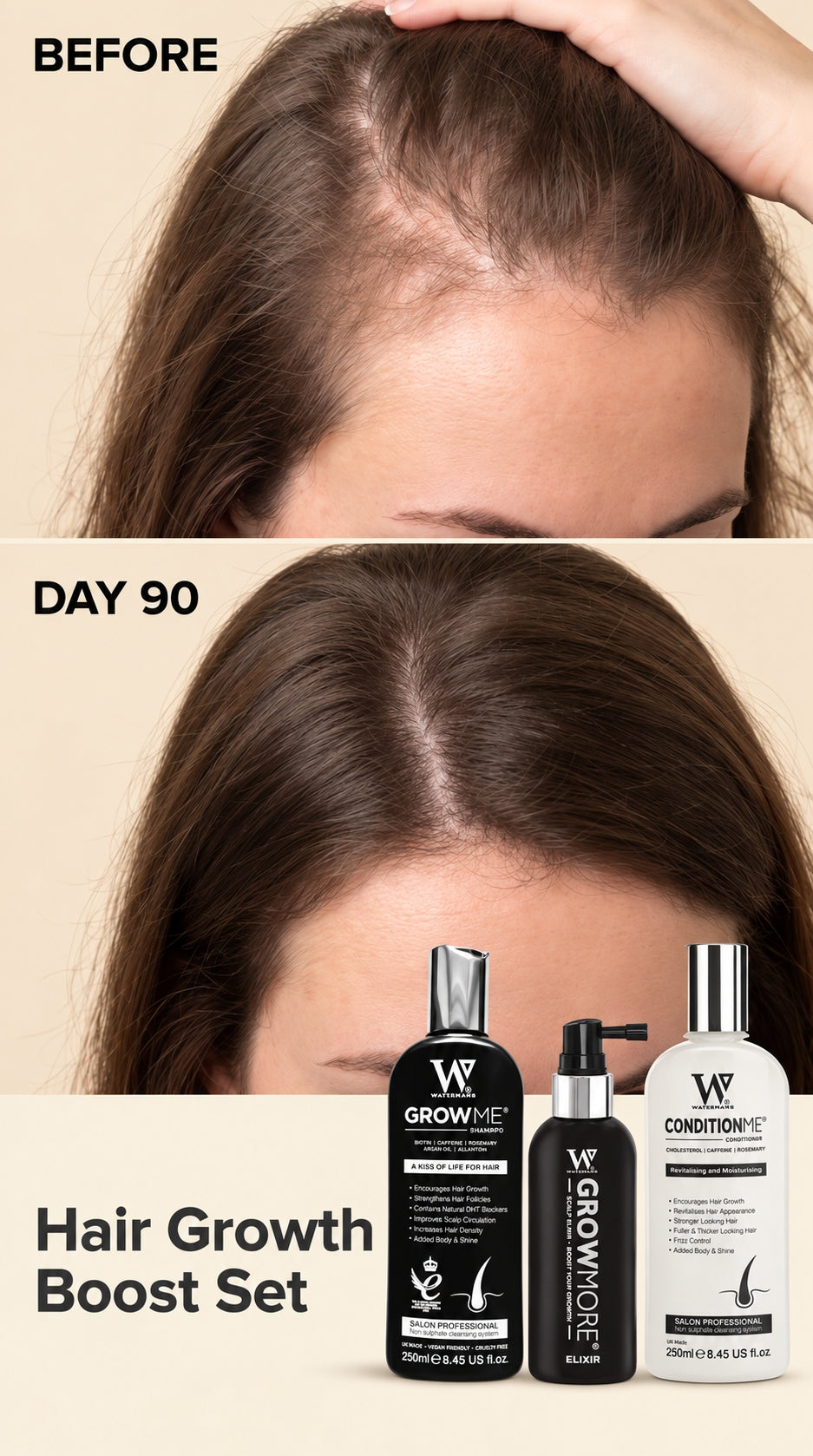
Grow Me® Hair Growth Shampoo, £14.95. A sulphate free daily shampoo that supports a healthy scalp environment and helps reduce breakage, so lengths hold on and look fuller.
Key takeaways
- The straight answer to does masturbation cause hair loss is no. No study has found a link, and no plausible mechanism exists.
- Testosterone shifts briefly around sexual activity and returns to baseline. Long term levels are unchanged.
- Pattern hair loss is about inherited follicle sensitivity to androgens, not about how much androgen is circulating, so hormone based versions of the myth fail on their own logic.
- The protein and zinc lost in semen are trivially small next to a normal daily diet.
- Anxiety itself can trigger noticeable shedding a couple of months later, so the worry can matter even when its subject does not.
Where did the myth come from?
The belief is old and predates any of the biology used to justify it. Several traditional systems of thought treated semen as a concentrated vital essence whose loss depleted the body, and Victorian medical writing in Britain and North America attached a long list of ailments to masturbation, hair loss among them. None of it was based on evidence.
The modern version borrows scientific vocabulary without the science. It usually runs: ejaculation raises DHT, DHT causes hair loss, therefore ejaculating more causes more hair loss. The middle step is broadly right. The first and last are not.
What keeps the myth alive is timing. Male pattern hair loss most often becomes visible between the late teens and the early thirties. That is also when sexual activity is typically highest and when a young man noticing his hairline for the first time goes looking for a reason. Two changes in the same decade feel connected. They are not.

Does masturbation cause hair loss through testosterone or DHT?
This is the version worth taking apart properly, because it sounds the most technical.
Dihydrotestosterone, or DHT, is an androgen converted from testosterone. In people who inherit the relevant sensitivity, DHT gradually shortens the growing phase of scalp follicles at the temples and crown, so each cycle produces a finer, shorter hair until the follicle produces nothing visible. That part is genuinely well established, and it is the core of androgenetic alopecia.
The failure is in the leap from there. Testosterone does fluctuate around sexual activity, but the changes are short lived and levels return to baseline. Nothing in the research shows normal sexual activity altering a man's long term androgen levels.
More importantly, the argument misunderstands the condition. Men with pattern hair loss do not generally have unusually high androgen levels. What they have is follicles that respond strongly to ordinary levels. It is a sensitivity of the receptor, inherited, not a question of supply. That is why two men with identical hormone results can have completely different hairlines at forty. So even if sexual activity did raise DHT, which it does not meaningfully, it would not be the lever the myth imagines.
What about the protein and zinc in semen?
The nutritional version of the myth is easier to settle, because it comes down to arithmetic.
A typical ejaculate is a few millilitres and is mostly water. Its protein content is a fraction of a gram. An adult man needs somewhere around 55 grams of protein a day, and a single egg supplies about six. The protein in question is replaced several times over by one modest meal, and it never approaches the point where the body would deprioritise keratin production.
Zinc works the same way. Semen contains zinc, and the amount lost is a small fraction of the recommended daily intake, easily covered by an ordinary diet. No research connects sexual frequency to zinc deficiency, let alone to hair.
What does the myth claim, and what is actually the case?
| The myth says | What is actually the case |
|---|---|
| It raises DHT, which attacks the follicles | Sexual activity does not meaningfully change circulating DHT. Pattern hair loss depends on inherited follicle sensitivity, not on how much androgen is present |
| You lose protein the hair needs | Semen is mostly water. The protein content of one ejaculation is a fraction of a gram, replaced many times over by any normal meal |
| It drains zinc reserves | The zinc lost is a small fraction of a normal daily intake, and no study links sexual frequency to zinc deficiency |
| It permanently lowers testosterone | Levels fluctuate briefly and return to baseline. Long term testosterone is unchanged by normal sexual activity |
| Stopping will bring the hair back | There is nothing to stop. Inherited pattern hair loss continues on its own timetable regardless of sexual activity |
If you have seen a version of this claim not on that list, it will almost certainly reduce to one of these five, which is a reasonable sign that the answer to does masturbation cause hair loss has been settled for some time. Our companion piece exploring the connection between masturbation and hair loss looks at how the belief spread and why it persists culturally. This page focuses on the biology and on what to do next.
Get a discount on the thinning hair range
Join the Watermans mailing list and we will email a discount code straight to your inbox, so you can try the thinning hair range for less. Made in the UK, over 6.5 million bottles sold since 2012.

Is it hair loss, hair shedding or hair breakage?
If you are here because something has changed, this distinction will tell you more than anything else on the page.
Hair loss is follicular. The follicle miniaturises over years, producing progressively finer hairs. It shows up as a receding temple, a thinning crown or a widening parting, and you will not necessarily see more hair on the pillow, because the hairs are getting smaller rather than falling out faster. In young men this is almost always androgenetic alopecia. Our guide to what triggers androgenic alopecia and what speeds it up covers the inherited factors, and pattern hair loss, its stages and causes explains how it progresses.
Hair shedding is whole hairs leaving the scalp with a small white bulb at the root. Fifty to a hundred a day is normal. A clear increase two to three months after illness, high fever, surgery, a crash diet or serious stress is usually telogen effluvium, which typically resolves once the trigger passes. This is the one that anxiety can genuinely contribute to. What causes telogen effluvium sets out the timeline.
Hair breakage is the fibre snapping along its length, leaving short pieces of uneven length. It comes from mechanical and chemical stress: aggressive brushing, heat, bleach, tight styles. It has nothing to do with the follicle and nothing to do with hormones.
None of the three has any connection to sexual activity.
What should you actually do if your hair is changing?
See a GP, and do it early rather than after a year of worrying. A GP can distinguish inherited pattern hair loss from the causes that are not inherited, including thyroid problems, iron shortfall and alopecia areata, usually with a short conversation and a blood test. What is available works better when there is more hair to work with. If your question is about products or a routine rather than a medical one, you can talk to Gail Waterman, our co-founder, as an AI avatar on the Watermans homepage.
Do not change your sex life for your hair. There is nothing to gain, and the abstinence advice circulating on parts of the internet has no evidence behind it whatsoever.
Look after the hair you have. Pattern hair loss is not the only thing making hair look thinner. Breakage from rough handling, harsh cleansing and heat is common and entirely fixable, and it is worth removing that variable so you can see what is actually happening underneath.

Where does everyday hair care fit?
Honestly, at the margins, and we would rather say that than oversell it. A shampoo cannot change an inherited follicle sensitivity. What a good one can do is clean without stripping and keep the scalp comfortable, and a conditioner can reduce the friction that snaps hair off and makes thinning look worse than it is.

Grow Me® Shampoo, £14.95
A sulphate free daily shampoo with biotin, caffeine, rosemary and niacinamide, formulated for a comfortable scalp and stronger looking strands. Vegan, made in the UK, over 6.5 million bottles sold since 2012.
View Grow Me® Shampoo
Condition Me® Conditioner, £13.95
A breakage defence conditioner that reduces snapping along the length, so the hair you have looks fuller and holds its condition.
View Condition Me® ConditionerFrequently asked questions
Does masturbation cause hair loss at any frequency?
No. There is no frequency at which masturbation has been shown to cause hair loss. No study has found a link, and no plausible biological mechanism connects the two. Pattern hair loss is driven by an inherited sensitivity of the hair follicles to androgens, and that sensitivity is set by your genes rather than by anything you do.
Does masturbation lower testosterone?
Not in any lasting way. Testosterone fluctuates modestly around sexual activity and returns to its baseline shortly afterwards. Normal sexual activity does not move your long term testosterone level. And even if it did, lower testosterone would not cause pattern hair loss, because pattern hair loss is about how sensitive the follicle is to androgens, not about how much androgen is circulating.
Does losing protein in semen affect hair?
No. Semen is mostly water, and the protein in a single ejaculation is a fraction of a gram, far less than the protein in a single mouthful of food. A normal diet replaces it many times over without you noticing. The idea that this could starve the hair of keratin does not survive contact with the numbers.
Why do so many people believe the myth then?
Timing and coincidence. Male pattern hair loss commonly starts in the late teens and twenties, which is exactly the period when men are most sexually active and most likely to be looking for an explanation. Two things happening in the same years feels like cause and effect, and older cultural ideas about the depleting effects of ejaculation gave that feeling a ready made story.
Does masturbation cause hair loss in women?
No, for the same reasons. Female pattern hair loss and increased shedding have their own well described causes, including inherited pattern thinning, thyroid problems, low iron stores, childbirth and significant stress. Sexual activity is not among them in any research literature.
Can stress or anxiety about this affect my hair?
Significant physical or emotional stress genuinely can push a lot of hairs into the resting phase at once, producing noticeable shedding two to three months later. So the worry can matter even when the thing being worried about does not. If anxiety about this is persistent, that is worth raising with a GP in its own right.
What actually causes hair loss in young men?
Overwhelmingly androgenetic alopecia, or male pattern hair loss, which is inherited and progressive. Less commonly, telogen effluvium after illness, surgery, a crash diet or major stress, thyroid disorders, iron shortfall, or alopecia areata, which is an autoimmune condition. A GP can usually tell these apart quickly.
Should I see a GP about my hairline?
If your hairline or crown is genuinely changing, yes, and sooner rather than later. The available options work better before a lot of density has been lost, and a GP can rule out the causes that are not inherited. There is no need to change anything about your sex life first.
Does masturbation cause hair loss, and what is the bottom line?
Does masturbation cause hair loss? No. The research does not support it, the hormonal explanation misunderstands how pattern hair loss works, and the nutritional explanation collapses as soon as you look at the actual quantities involved. It is a very old idea wearing modern vocabulary. If your hairline or crown is changing, the likely cause is inherited, it has nothing to do with your sex life, and the useful next step is a GP appointment rather than a change of habits. In the meantime, look after the hair you have and stop paying rent to a myth.
For the cosmetic side of a fuller look, our sulphate free hair growth shampoo is the step that does the heavy lifting. Vegan and made in the UK.
Watermans products are 100% cosmetic and do not treat medical hair loss. Individual results may vary. This article is general information and is not medical advice. Speak to your GP or a pharmacist about any concern with your health or your scalp.
Sources & References
- Ho CH et al., Androgenetic Alopecia, StatPearls, NCBI Bookshelf, on inherited follicle sensitivity to androgens as the mechanism of pattern hair loss.
- NHS, Hair loss, on the common causes of hair loss and when to see a GP.
- Owen DH, Katz DF, A review of the physical and chemical properties of human semen, Journal of Andrology, 2005, on the composition of semen, including its water, protein and zinc content.
- NHS, Zinc, on recommended daily zinc intake for adults.
- NHS, Anxiety, fear and panic, on when persistent health worry is worth raising with a GP.