Hormone Therapy Hair Thickness: What Changes the Fibre Itself

Hormone therapy hair thickness is about the diameter of each individual fibre, not how many fibres you have. Scalp hair runs roughly 50 to 100 micrometres across, and hormones change that number by moving follicles between fine vellus output and thick terminal output. The same androgens that thin scalp hair thicken beard hair, which is why one body can do both at once.
Our hair growth conditioner
Condition Me® Hair Growth Conditioner, £13.95. Detangles and strengthens the hair fibre so lengths snap less on the brush and look thicker through the ends.
Key takeaways
- Thickness is fibre diameter. Density is hairs per square centimetre. A head can lose one and keep the other.
- Human scalp hair is roughly 50 to 100 micrometres across, so a tenth of a millimetre is a thick hair.
- Terminal hair is thick and pigmented. Vellus hair is short, fine and pale. Follicles switch between the two.
- Androgens thicken beard and body follicles while thinning genetically sensitive scalp follicles. Site, not dose, decides.
- A diameter change only becomes visible as the hair grows out, at roughly one centimetre a month.
- Conditioners and masks change how thick hair feels and behaves. They do not change what the follicle produces.
What does hormone therapy hair thickness actually measure?
Hormone therapy hair thickness measures the cross sectional diameter of a single hair fibre, which for human scalp hair sits roughly between 50 and 100 micrometres. That is a tenth of a millimetre at the thick end, which is why nobody can judge it by eye and why two people with identical hair counts can have completely different looking hair.
Diameter is set by the follicle, specifically by the size of the bulb and the number of cells it pushes into the growing fibre. A larger follicle makes a wider hair. When a follicle shrinks, the fibre it produces narrows in proportion, and the hair also tends to grow for a shorter time before it rests. Our companion guide to hormone therapy hair density deals with the separate question of how many hairs there are.
The test you can do in ten seconds
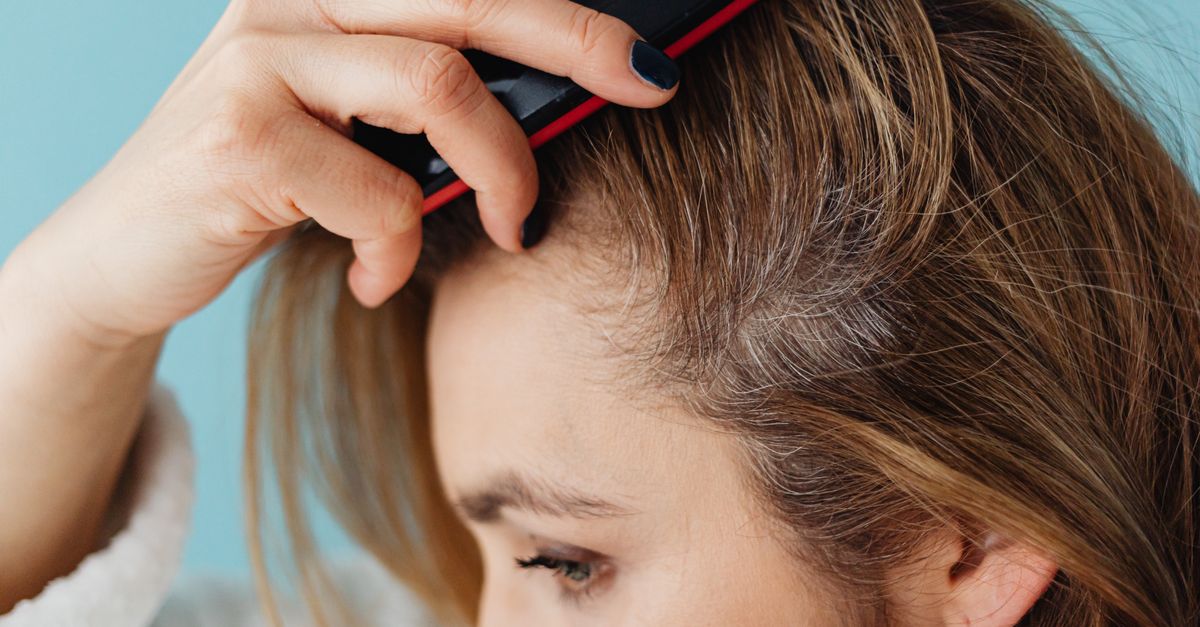
Pull one shed hair taut between finger and thumb against a plain background and compare it with one from the back of your head, which pattern loss usually spares. A visible difference in calibre between crown and nape is the classic sign that diameter, not count, is what has changed.
What is the difference between terminal and vellus hair?
Terminal hair is the thick, pigmented, long growing hair of the adult scalp, beard and body. Vellus hair is the short, fine, pale hair that covers most of the rest of the skin and is barely visible at arm's length. Every follicle can produce either, and the transition between them is what most hormonal hair change actually consists of.
Pattern hair loss is essentially terminal hair being converted back towards vellus, one cycle at a time. That is why an affected scalp looks thin long before it looks bald: the follicles are still there and still cycling, but the fibre they push out is narrower, shorter and lighter with each round. Our guide to follicle miniaturisation covers how to spot that shift early.
| Feature | Terminal hair | Vellus hair |
|---|---|---|
| Diameter | Roughly 50 to 100 micrometres | Very fine, well under that range |
| Pigment | Pigmented | Usually unpigmented or barely pigmented |
| Length reached | Can grow for years | Stays short, rests sooner |
| Where you see it | Scalp, beard, brows, body hair after puberty | Cheeks, forehead, most of the body surface |
| Why it matters here | What coverage is made of | What coverage turns into when follicles miniaturise |

Diameter is the variable nobody can see and everybody can feel. A ponytail circumference change is usually this, not a count change.
Why do androgens thin scalp hair but thicken beard hair?
Androgens thin scalp hair and thicken beard hair because the response is written into the follicle, not into the hormone. Beard, chest and body follicles respond to androgen exposure by converting from vellus output to terminal output. Genetically susceptible follicles on the crown and temples do the opposite, shrinking a little with each cycle.
This is why the same hormone regimen can coarsen a jawline and thin a parting at the same time, and why people often assume something has gone wrong when in fact both effects are the expected behaviour of two different follicle populations. Dermatology sources describe the same androgen sensitivity behind pattern loss in both typically male and typically female distributions.
The hormone is the same everywhere in the bloodstream. The instruction manual sits inside each follicle, and no two regions read it the same way.
Get a discount on the thinning hair range
Join the Watermans mailing list and we will email a discount code straight to your inbox, so you can try the thinning hair range for less. Made in the UK, over 6.5 million bottles sold since 2012.
Can a thinner fibre become thicker again?
Partly, and it depends on how far the follicle has shrunk. A follicle that has narrowed recently can widen its output again if the pressure on it changes, and that is a decision for the GP or specialist managing the hormone side. A follicle that has miniaturised over many years, or one lost to scarring, does not recover its original calibre.
Timing matters more than product choice here. Because scalp hair grows at roughly a centimetre a month, a fibre that starts growing wider today is only a few centimetres of thicker hair by the time most people have given up looking. The old, narrower length is still attached above it, so the hair reads thin from the mid lengths down for most of the first year.
What makes hair feel thicker without changing the fibre?
Several things change how thick hair feels while leaving diameter untouched, and they are the fastest wins available. A raised, damaged cuticle makes a hair feel rough and look dull, so smoothing it changes the hand feel immediately. Conditioning ingredients deposit on the surface and add measurable bulk to a ponytail without adding a single micrometre at the root.
Cut is the other underrated lever. Long fine hair hangs flat and reveals scalp, while a blunt line at shoulder length or shorter concentrates the same amount of hair into a denser looking shape. Our guide to getting thicker looking hair covers the styling and cutting side properly.
How do thickness, density and breakage differ?
Thickness is the diameter of each fibre, density is how many fibres grow per square centimetre, and breakage is fibre snapping partway along its length. All three make hair look thinner and only one of them, thickness, is directly driven by what hormones tell the follicle to produce.
| What you notice | Which mechanism | Hormonal? |
|---|---|---|
| Hairs at the crown are visibly finer than hairs at the nape | Reduced fibre thickness from follicle miniaturisation | Yes, in genetically sensitive follicles |
| Whole hairs with a pale club root, all over, for a few months | Shedding, a temporary drop in density | Often, as a delayed response to a hormone change |
| Short broken pieces with no root, worse after heat or colour | Breakage in grown fibre | No. This is mechanical and chemical damage |
Mixing these up is expensive. Someone whose real issue is breakage can spend a year waiting for a follicle change that was never the problem. Our breakdown of what actually damages hair sets out the four culprits and what each one looks like.
Does hair texture change alongside thickness?
Texture and thickness often move together but they are not the same property. Texture covers curl pattern, porosity and how the fibre behaves in humidity, while thickness is purely the diameter. A finer fibre bends more easily, so hair that narrows can start behaving wavier, flatter or frizzier without any change in its curl programme.
The practical consequence is that a change in how hair behaves is not proof of a change in how much hair there is. Fine hair holds a style badly, tangles more readily and shows humidity faster, all of which get reported as thinning when the count has not moved at all. Our guide to HRT hair texture deals with the behaviour side, and the two articles are worth reading together.
How can you track hormone therapy hair thickness at home?
Three home measures are worth keeping, and none of them needs equipment. Ponytail circumference, measured with a tape at a fixed point on dry hair, is the single most sensitive everyday indicator because it responds to both diameter and count. Record it monthly and the trend becomes obvious long before the mirror agrees.
The second is the crown against nape shed hair comparison, which isolates diameter specifically. The third is a monthly photograph of the same parting in the same light. Together they separate the two variables: if circumference falls while the photograph looks stable, the fibre is narrowing rather than the count dropping.
Write the number down, not the impression
Ponytail circumference in centimetres, one shed hair from the crown and one from the nape, and a photograph of the same parting. Three fixed measurements each month will tell you more about hormone therapy hair thickness in a year than any amount of daily mirror checking.
Where do cosmetic products genuinely help?
Cosmetic products work on the fibre you already have: its surface, its strength under tension, and how much of it survives washing, combing and heat. That is not a small territory, because a hair that snaps at the mid lengths takes its diameter with it. Watermans products are made in the UK and over 6.5 million bottles have been sold since 2012.

A breakage defence conditioner with cholesterol, shea butter and hydrolysed lupine protein. Improves slip so wet combing snaps fewer strands, which is where most everyday length is lost.

An eight in one deep conditioning mask for hair that has been coloured, heat styled or has simply grown long enough to be weathered at the ends. Use it weekly rather than daily.

A sulphate free daily cleanse with caffeine, biotin, rosemary and hydrolysed lupine protein, formulated to leave finer hair looking fuller.

A blunt line at shoulder length changes apparent thickness more in one appointment than most products do in a year.
What is the bottom line on hormone therapy hair thickness?
The bottom line on hormone therapy hair thickness is that diameter and count are separate problems with separate answers. Compare a crown hair against a nape hair to work out which one you have, accept that a genuine diameter change needs most of a year to grow out at a centimetre a month, and use cut and conditioning for the part that can change this week.
For the fibre itself, a breakage defence conditioner is the most useful single product on this list, because every strand it stops snapping keeps the diameter it already had.
Frequently asked questions
What is hormone therapy hair thickness measured in?
Micrometres. Human scalp hair sits roughly between 50 and 100 micrometres across, which is at most a tenth of a millimetre, so the difference between thick and fine hair is far smaller than it feels.
Can hormone therapy make my hair thicker?
It can change what follicles produce, and the direction depends entirely on the site. Beard and body follicles tend to move towards thicker terminal hair under androgen exposure, while genetically sensitive scalp follicles tend to move the other way. That balance is a conversation for the clinician managing your hormone therapy.
Why is my beard coarser while my scalp hair is finer?
Because the two follicle populations read the same hormone differently. Beard follicles convert from fine vellus output to thick terminal output under androgen exposure, while susceptible scalp follicles shrink a little with each cycle. Both happening together is expected, not contradictory.
Is thin hair the same as having less hair?
No. Thin hair means each fibre is narrow. Having less hair means fewer fibres per square centimetre. They often travel together but they are separate measurements, and they respond to completely different things.
How long before a thickness change is visible?
Most of a year. Hair grows at roughly a centimetre a month, so a fibre that starts growing wider today carries its old narrower length above it for months. The change appears at the roots long before it changes how the lengths look.
Do thickening shampoos actually thicken hair?
They change how thick hair feels and behaves rather than what the follicle produces. Conditioning and film forming ingredients add surface bulk and smooth the cuticle, which genuinely changes ponytail feel and appearance. Nothing applied to the outside widens the fibre at the root.
Does cutting hair make it grow back thicker?
No. Cutting removes weathered ends, and the blunt cut end feels coarser than a tapered one, which is where the myth comes from. The diameter at the root is unchanged, though a shorter cut does make the same hair look denser. If your question is about products or a routine rather than a medical one, you can talk to Gail Waterman, our co-founder, as an AI avatar on the Watermans homepage.
Should I see a GP about finer hair?
If the change is rapid, patchy, or comes with scalp pain, scaling or a shiny smooth area, yes. The NHS hair loss page sets out which changes warrant being looked at rather than watched.
Sources and references
- NHS: Hair loss
- NHS: Hormone replacement therapy (HRT)
- DermNet: Male pattern hair loss
- DermNet: Female pattern hair loss
- DermNet: Hair loss overview
- The Institute of Trichologists
Watermans products are 100% cosmetic and do not treat medical hair loss. Individual results may vary.