Hormone Therapy Hair Density: What Can Realistically Change

Hormone therapy hair density means the number of hairs growing per square centimetre of scalp, which is a different thing from how thick each hair is. Density falls for three separate reasons: follicles producing finer fibre, hairs shedding faster than they are replaced, and hairs snapping before they reach any length. Only the first is genuinely hormonal, and it is the slowest to shift.
Our overnight scalp elixir
Grow More® Overnight Scalp Elixir, £25.50. A leave in scalp serum worked into the roots at night, supporting a healthy scalp environment while you sleep.
Key takeaways
- Density is a count of hairs per square centimetre. Thickness is the diameter of each fibre. They fall independently.
- Three mechanisms reduce density: follicle miniaturisation, excess shedding and breakage. Each needs a different response.
- A parting looks wider when density drops by a fraction that no mirror can quantify, which is why photographs beat impressions.
- Losing 50 to 100 hairs a day is normal on the NHS figure. A shed wave is a temporary density dip, not a permanent one.
- Follicles that have shortened their growing stage can lengthen it again. Follicles that have scarred over cannot.
- Hormone therapy is generally started for symptoms rather than for hair, so judge it on what it was for.
What is hormone therapy hair density, and how is it counted?
Hormone therapy hair density is the number of hair fibres growing per square centimetre of scalp at a given moment, counted rather than estimated. A dermatologist or trichologist assesses it with a dermatoscope on a marked patch of scalp, counting follicular units and noting how many hairs each one carries. The mirror cannot do this, which is the root of most of the confusion.
Two other numbers get mixed up with density constantly. Fibre diameter is how thick each individual hair is, and a head can lose diameter while keeping every follicle. Hair length is how long each fibre has grown, which is limited by how long the growing stage lasts. Our guide to measuring HRT hair density walks through the measurement side in detail, and our companion piece on what hormone therapy can and cannot change takes the expectations angle.
Why the parting is the first place you notice
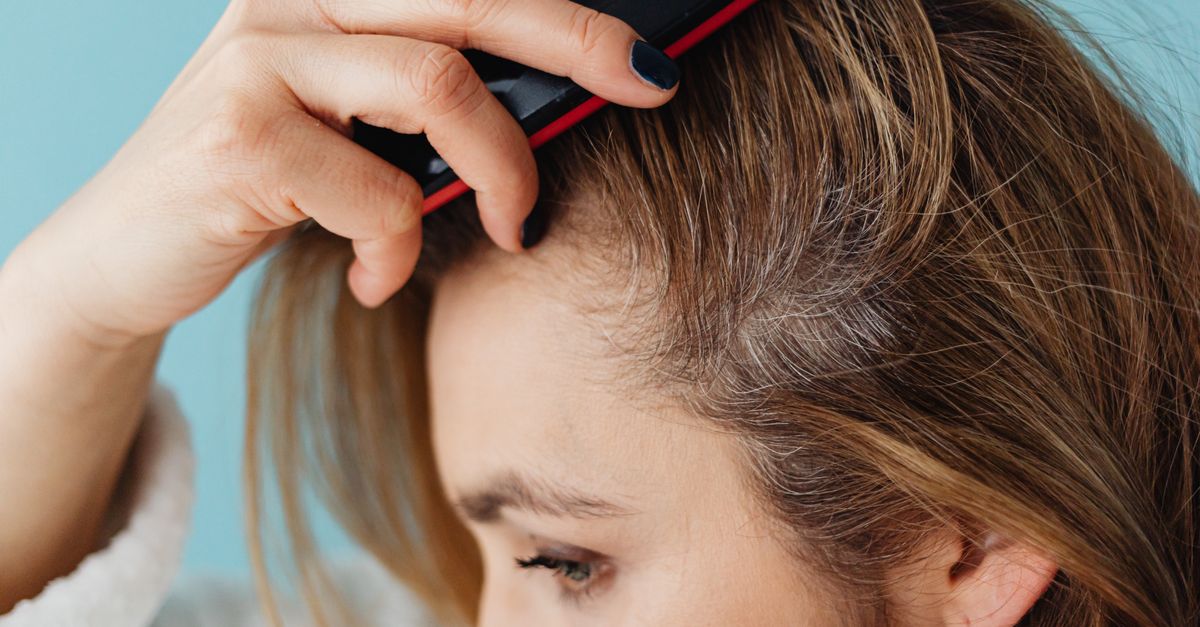
Density is not uniform across the scalp. The vertex and the parting carry the visual load because that is where scalp shows through first, which is why a modest overall drop reads as a dramatic change there and nowhere else. Photograph that exact spot, in the same light, once a month.
Why does hormone therapy hair density fall in the first place?
Density falls for three mechanically different reasons, and hormone therapy touches them unequally. Follicles can miniaturise, producing progressively finer and shorter fibre until it no longer covers anything. Hairs can shed faster than they are replaced. Or fully grown hairs can snap partway along, removing length and bulk without touching the follicle count at all.
| Mechanism | What is happening | What actually shifts it |
|---|---|---|
| Follicle miniaturisation | Sensitive follicles shorten their growing stage and produce finer, shorter fibre each cycle | A GP or dermatology review. Cosmetics cannot change follicle sensitivity |
| Excess shedding | More hairs than usual enter the resting stage together and release two to three months later | Time, once the trigger has passed. Most settle within about six months |
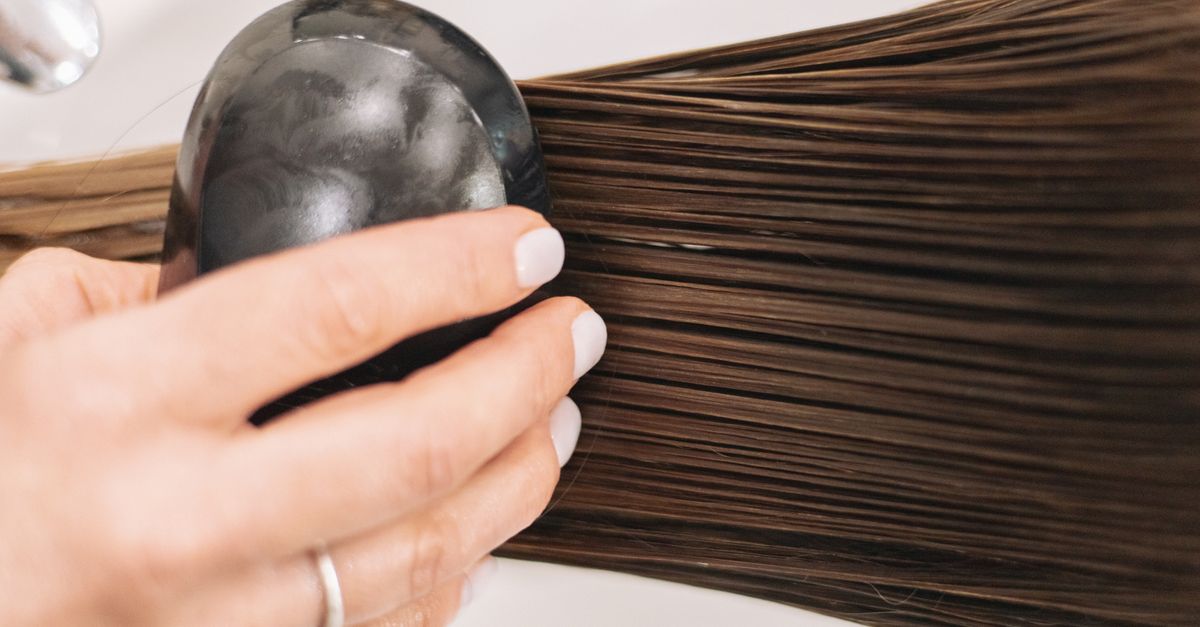
| Breakage | Grown fibre snaps from heat, tension, colour or rough wet combing | Conditioner, heat protection, gentler handling. Fully within cosmetic reach |
Pattern hair loss is the miniaturisation route, and dermatology sources describe it in women as diffuse thinning over the crown with the frontal hairline usually preserved. Our pattern hair loss guide covers the staging. The shedding route is telogen effluvium, which typically begins two to three months after its trigger and settles within about six months once that trigger has gone.

The parting is where a small density change becomes a visible one. It is also the only place worth photographing.
What can realistically be recovered, and what cannot?
Recovery depends entirely on whether the follicle is still there. A follicle that has shortened its growing stage can lengthen it again given the right conditions, so density lost to miniaturisation is partly recoverable. A follicle lost to scarring is gone permanently, and no hormone, supplement or cosmetic changes that.
Density lost to a shedding wave is the most recoverable of all, because the follicles never stopped working. They simply emptied and restarted together. That is why a shed that looks catastrophic in month four often leaves no measurable trace by month twelve, and why panic buying during the wave is usually wasted money.
The honest version: shedding usually comes back, miniaturisation partly comes back, and scarring does not come back at all. Knowing which one you have is worth more than any product decision.
Get a discount on the thinning hair range
Join the Watermans mailing list and we will email a discount code straight to your inbox, so you can try the thinning hair range for less. Made in the UK, over 6.5 million bottles sold since 2012.
How long does a real change take to show?
A genuine density change needs about twelve months to become visible, because scalp hair grows roughly a centimetre a month and a follicle restarting in month five is only a few centimetres long by month eight. Counts recover before appearance does, which is the single most common reason people abandon something that was working.
NHS guidance on hormone replacement therapy sets a similar expectation from the other side: it can take a few weeks to feel the benefit at all, and early side effects often settle within about three months. Hair sits well beyond that horizon. Our piece on shedding during hormone therapy covers the wave itself.
How do hair loss, hair shedding and hair breakage each affect density?
Hair loss reduces the follicle count or the fibre each follicle produces, so it lowers true density. Hair shedding empties follicles temporarily, so it lowers measured density for months without lowering the follicle count. Hair breakage lowers none of the counts at all and still makes hair look thinner, because it removes length and bulk from hairs that are perfectly healthy at the root.
That last distinction saves people a great deal of anxiety. If the pieces coming out are short, have no pale club at the root and appear alongside heat styling or colouring, density is not the problem and hormone therapy is not the cause. Our three clue self check sets out how to tell them apart in a few minutes at the bathroom sink.
Does density fall evenly across the scalp?
Density never falls evenly, and the pattern is one of the most useful clues available without any equipment. Dermatology sources describe female pattern hair loss as diffuse thinning centred on the crown with the frontal hairline usually preserved, while male pattern loss typically starts at the temples and vertex and works backwards from there.
A diffuse shed behaves differently again: it thins the whole scalp at once, including areas that pattern loss leaves alone, which is why a sudden change at the back and sides points away from pattern loss rather than towards it. Scarring conditions are the exception to watch for, because they can produce a smooth, shiny patch where the follicle openings are no longer visible. That last picture is the one worth taking to a GP promptly rather than photographing for another three months.
| Where you notice it | Typical picture | What it points to |
|---|---|---|
| Crown and parting, gradual over a year or more | Parting widens, hairline intact | Pattern loss, the miniaturisation route |
| Temples and vertex, gradual | Hairline moves back, crown thins | Pattern loss in the more typically male distribution |
| Everywhere at once, over weeks | Whole head feels thinner, sides included | A shedding wave rather than pattern loss |
| A smooth patch with no visible follicle openings | Skin looks shiny, hair does not return | Possible scarring. Worth a GP appointment without delay |
What everyday factors change how dense hair looks?
Several things change apparent density without changing a single follicle, and they are worth eliminating before concluding anything. Parting position is the biggest: parting the same head of hair two centimetres to one side moves the scalp that shows and can make a stable head look noticeably better or worse.
Cut and length matter almost as much. Long hair hangs flat and shows scalp; a blunt cut at shoulder length reads denser with no biological change at all. Wet hair always looks thinner than dry hair because the fibres clump. Lighting is the last trap, since overhead bathroom spotlights throw the parting into shadow in a way that daylight never does, which is precisely why the monthly photograph has to be taken in the same place each time.
Eliminate the variables before you panic
Same parting, same dryness, same light, same time of day, once a month. Four fixed variables turn a photograph from a mood into a measurement, and most people who think their hair is falling out fast discover the change is slower and smaller than the mirror suggested.
Where does cosmetic care fit alongside hormone therapy?
Cosmetic care owns retention and appearance, not follicle behaviour. Every hair that survives to full length is a hair that shows up in the density you can actually see, so reducing breakage is the one lever available without a prescription pad. Watermans products are made in the UK and over 6.5 million bottles have been sold since 2012.

A leave on scalp serum for lower density areas at the parting and crown, used overnight. Cosmetic support for the look of fuller hair, not a medicine.

A sulphate free daily cleanse with caffeine, biotin, rosemary and hydrolysed lupine protein, formulated to leave finer hair looking fuller.

Improves slip so wet combing snaps fewer strands. Breakage is the density problem you can fix this week rather than this year.

Twelve months is the first fair comparison. Anything sooner is weather, lighting and hope.
What is the bottom line on hormone therapy hair density?
The bottom line on hormone therapy hair density is that density is a count, and the count falls by three different routes that look identical in the mirror. Work out whether you are dealing with miniaturisation, a shedding wave or breakage, because the first needs a GP review, the second needs patience and the third needs a conditioner. Judge the count at twelve months, from photographs of the same parting.
For the part cosmetics genuinely own, the Grow More scalp serum is a leave on option for lower density areas at the parting and crown, and it works on appearance and retention rather than on anything the hormone side is doing.
Frequently asked questions
What exactly is hormone therapy hair density?
The number of hair fibres growing per square centimetre of scalp. It is counted with a dermatoscope on a marked patch, not estimated in a mirror, and it is a separate measure from how thick each individual hair is.
Can hormone therapy lower my hair density?
It can shift the balance of hairs between growing and resting, which lowers measured density for a period. Whether that settles depends on which mechanism is involved, and it is a question for the GP or specialist who started the hormone therapy rather than one to answer from a shedding count.
How much density loss is noticeable?
Less than most people expect, because the parting and crown show scalp first. A change too small to count by eye can widen a parting visibly, which is why a monthly photograph in fixed lighting is more useful than daily checks.
Is a wider parting the same as hair loss?
Not necessarily. A wider parting reflects lower density at that spot, and that can be caused by a temporary shedding wave, by breakage removing bulk, or by follicles genuinely miniaturising. Only the third is hair loss in the follicular sense.
Will density come back after a shedding wave?
Usually, because the follicles never stopped working. Telogen shedding empties them temporarily and they restart together, which is why a wave that peaks at month four often leaves little measurable trace by month twelve.
Do shampoos increase hair density?
No cosmetic product increases the number of follicles you have. What a good routine does is reduce breakage so more of the hair you already grow survives to full length, which changes the density you can see rather than the density that would be counted at the root.
How often should I photograph my parting?
Once a month, same spot, same light, same parting position, ideally on dry unstyled hair. Monthly is frequent enough to catch a trend and infrequent enough to avoid reading noise as change. If your question is about products or a routine rather than a medical one, you can talk to Gail Waterman, our co-founder, as an AI avatar on the Watermans homepage.
When should I see a GP about density?
Sudden loss, patchy areas, scalp pain or scaling, or a shed still worsening after six months are all worth a GP appointment. The NHS hair loss page sets out which changes warrant being looked at properly.
Sources and references
- NHS: Hair loss
- NHS: Hormone replacement therapy (HRT)
- NICE NG23: Menopause guideline
- DermNet: Female pattern hair loss
- DermNet: Male pattern hair loss
- DermNet: Telogen effluvium
- The Institute of Trichologists
Watermans products are 100% cosmetic and do not treat medical hair loss. Individual results may vary.