Hormone Therapy Scalp Changes: What Actually Happens
Any hormone therapy scalp question usually starts the same way: the parting looks wider, the shower drain looks worse, and it began somewhere around the time a dose changed. Hormones genuinely do influence the hair cycle and the skin of the scalp. What they almost never do is act on the timescale people assume, which is why the link is so easy to get wrong in both directions.
Our menopause hair care kit
Menopause Hair Care Kit, £69.99. A complete hair, skin and wellbeing routine put together for the hair changes that arrive around the menopause.
A hormone therapy scalp change is a shift in the hair cycle and in scalp skin that follows a hormonal change by roughly 2 to 4 months, not within days. Oestrogen, thyroid and androgen levels all affect how long hairs stay in their growing phase. No shampoo alters hormone levels, so the useful sequence is blood tests with a GP first, then cosmetic care to limit breakage.
Key takeaways
- Hair fall from any systemic change is normally noticed 2 to 4 months after it, not during it.
- Scalp hair grows about 1 cm a month for roughly three years, then rests for about three months.
- The evidence on oestrogen and hair is genuinely mixed, and honest sources say so.
- An underactive thyroid lists dry hair or hair loss among its common symptoms, and is checked with a simple blood test.
- Around 40 per cent of women show signs of hair loss by age 50, which often overlaps with menopause timing.
What does a hormone therapy scalp change actually mean?
Hormones set the length of the growing phase, so a hormonal shift changes how long each hair stays on your head rather than the number of follicles you own. DermNet describes scalp hair growing at about one centimetre a month for around three years, then resting for about three months. Shorten the growing phase and hair sheds sooner, arrives shorter and looks thinner.
Scalp skin changes too. Oestrogen and androgen levels influence sebum production and skin barrier behaviour, which is why some people find their scalp turns greasier and others find it turns dry and tight after a change. Both are real, both are common, and neither on its own tells you the follicles are in trouble.

Why does a hormone change take months to show up in your hair?
The delay exists because the follicle reacts first and releases the hair later. When growing hairs switch early into their resting phase, they stay anchored in the scalp until new hairs push them out underneath. DermNet puts that gap at 2 to 4 months, which is why a dose change in January shows up in a March or April shower drain.
That lag cuts both ways. It means the product you started last week almost certainly did not cause this, and it also means a genuinely helpful change will not show for a season. Any hormone therapy scalp plan that promises visible results in two weeks is selling you the wrong timescale.
| Time since the hormonal change | What is happening | What you see |
|---|---|---|
| Week 0 to 4 | Levels shift. Follicles begin responding | Usually nothing in the hair |
| Month 1 to 2 | Some growing hairs switch early into the resting phase | Scalp may feel oilier or drier |
| Month 2 to 4 | New hairs push resting hairs out | Shedding becomes obvious |
| Month 4 to 9 | Cycle re-settles at the new hormonal baseline | Shedding tapers, short new hairs appear |
| Month 9 plus | Any remaining change is usually the underlying pattern, not the shed | Density either recovers or the parting stays wider |
Does oestrogen help or harm hair?
Good sources disagree, and it is more honest to say so than to pick the convenient side. DermNet notes that female pattern hair loss is more common after the menopause, which suggests oestrogen may stimulate hair growth, while also noting that laboratory experiments have suggested oestrogens may suppress hair growth. The role, in its words, is uncertain.
What is not uncertain is the scale of the background picture. DermNet reports that around 40 per cent of women show signs of hair loss by age 50, and fewer than 45 per cent reach 80 with a full head of hair. A great deal of what gets blamed on a hormone change is age-related pattern thinning that was already underway. If the extra fall began after a change in your therapy, our guide to the hormone therapy hair shedding timeline sets out when it usually peaks and when it settles.
What to ask, rather than what to assume
If hair change started within a season of a dose change, it is worth raising with the clinician who manages your therapy. NICE guideline NG23 covers menopause care and is the document your GP works from. Ask what is expected, over what timescale, and what would prompt a review.
What does thyroid medication change on the scalp?
Thyroid levels influence the whole hair cycle, which is why the NHS lists dry skin, dry hair or hair loss among the common symptoms of an underactive thyroid. Both an under-active and an over-active thyroid appear on DermNet list of telogen effluvium triggers, so hair can shed when levels are too low, too high, or moving quickly between the two.
The practical point is that this is measurable. The NHS checks thyroid function with a blood test for thyroid-stimulating hormone and thyroxine. If your hair changed and you also feel unusually tired, cold or foggy, that blood test is worth far more to you than any bottle on a shelf.

What does masculinising hormone therapy do to the hairline?
Raising androgen levels moves body and facial hair in one direction and scalp hair in another. In people genetically predisposed to pattern hair loss, higher androgen exposure can bring temple recession and crown thinning forward in time. DermNet notes that androgens have a clear role in male pattern balding, while their role in female pattern hair loss is less settled.
This is a conversation for the clinician managing your care, ideally before changes are visible, because timing and monitoring are the levers that exist. Our guide to what hormone therapy changes for transgender hair goes through this in more detail.
Get a discount on the thinning hair range
Join the Watermans mailing list and we will email a discount code straight to your inbox, so you can try the thinning hair range for less. Made in the UK, over 6.5 million bottles sold since 2012.
Which blood tests come before any hormone therapy scalp product?
Three ordinary NHS tests sit behind most diffuse shedding: thyroid function, ferritin and a full blood count. The NHS lists hair loss among the less common symptoms of iron deficiency anaemia and uses a full blood count to check for it. No hormone therapy scalp product can tell you any of those numbers, and no trichologist can order them either.
The NHS is direct about the order of operations: see a GP to get an idea of what is causing hair loss before thinking about a commercial hair clinic. That advice costs nothing and routinely changes what people do next.
How do you tell hormonal shedding, follicular loss and breakage apart?
Three separate problems get reported as the same complaint. Shedding releases whole hairs with a small pale bulb and follows a trigger by 2 to 4 months. Follicular hair loss is a slow reduction in the calibre of hair a follicle can make, concentrated at the parting or crown. Breakage snaps the fibre mid-length and leaves the root in place.
| Clue | Hormonal shedding | Follicular loss (pattern thinning) | Breakage |
|---|---|---|---|
| Onset | 2 to 4 months after a hormonal change | Years, often accelerating after menopause | Follows heat, colour or tension |
| Distribution | Diffuse, all over | Parting, crown and temples | Mid-lengths and ends |
| What comes out | Full-length hairs with a bulb | Progressively finer, shorter hairs | Short fragments, no bulb |
| First move | Blood tests with a GP | GP conversation, then cosmetic support | Less heat, more conditioning |
What can cosmetic hair care genuinely do here?
Cosmetic care works on the fibre and the scalp surface, never on hormone levels. That is a smaller job than the marketing usually implies and a genuinely useful one, because breakage-related loss stacks on top of any hormonal shed and is the layer you control. Gentler cleansing, conditioning every wash and less heat are the whole of it. Once you know which scalp pattern you have, the hair care routine that suits a changed scalp turns that into a practical weekly routine.

Menopause Relief Hair Care Kit £69.99
Where hormone changes are not enough on their own, the surgical route is set out in full in our guide to the transgender hair transplant.
A complete routine built around the menopause transition, when pattern thinning and shedding often overlap. Cosmetic care for hair, scalp and everyday wellbeing.

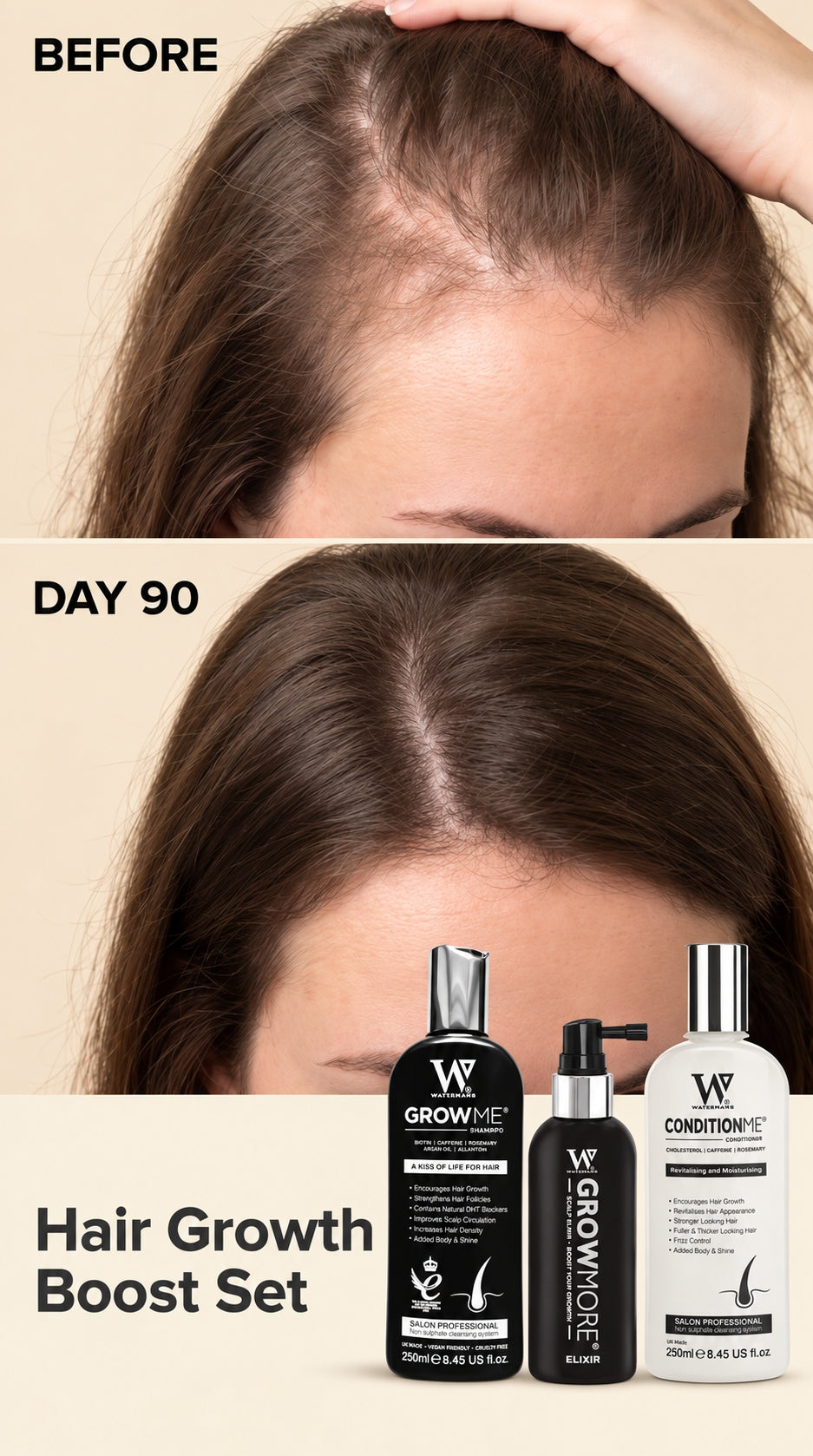
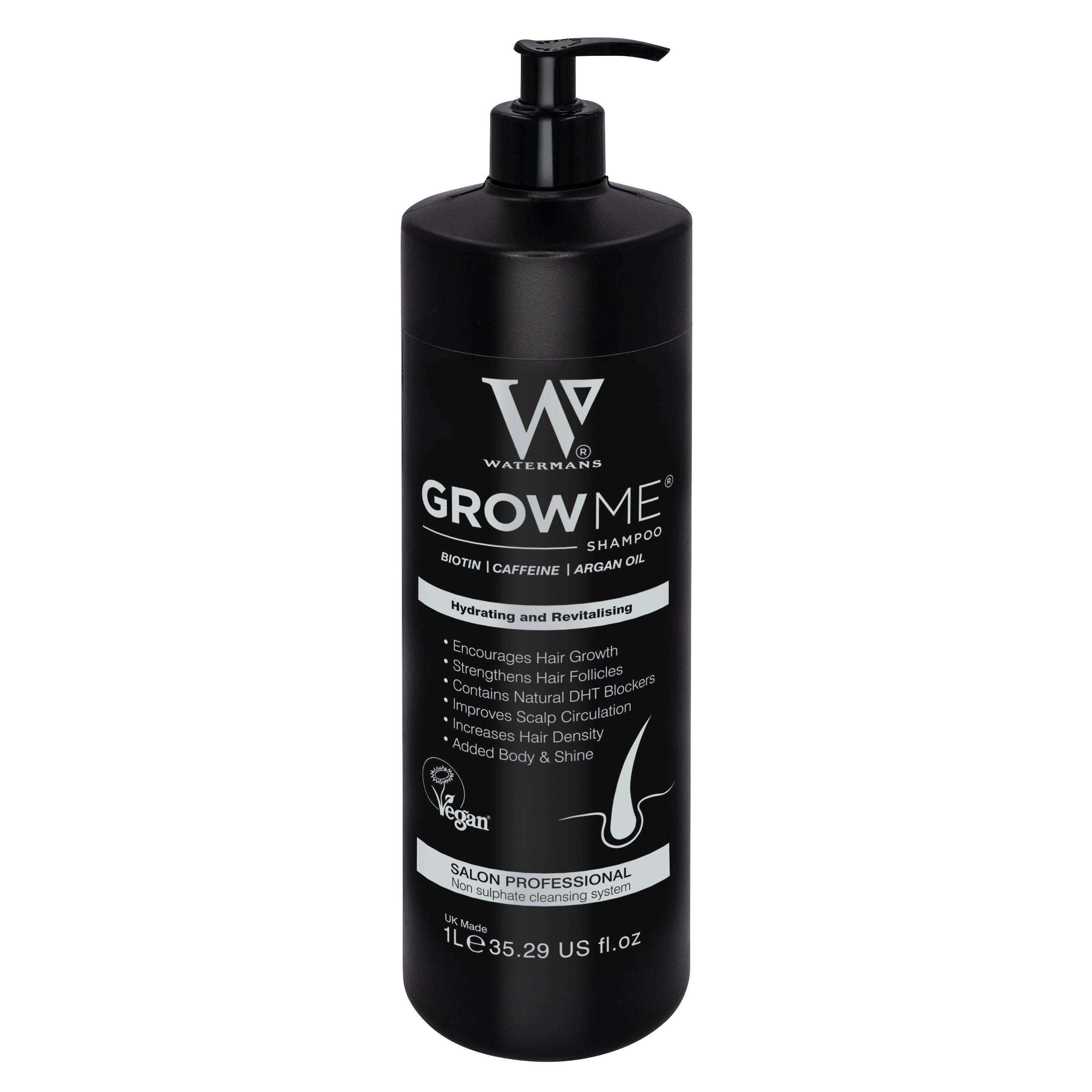
Grow Me® Hair Growth Shampoo £14.95
A sulphate-free daily shampoo with caffeine, biotin and allantoin that cleanses without stripping and supports a healthy scalp environment.

Grow More® Leave-In Scalp Elixir £25.50
A leave-in scalp elixir for people who want a nightly step for the scalp itself, alongside whatever their clinician is managing.
For the wider picture, read menopause and thinning hair, thyroid related hair loss and the three mechanisms behind thinning hair.

Over 6.5 million bottles of Watermans hair care sold since 2012, made in the UK.
Frequently asked questions
How long after starting hormone therapy will my hair change?
Expect roughly 2 to 4 months before any change in shedding becomes visible, because resting hairs stay anchored until new hairs push them out. Changes in scalp oiliness or dryness can appear sooner, since those come from the skin rather than the hair cycle.
Does hormone therapy cause hair loss or stop it?
Both outcomes are reported, which is why honest sources describe the role of oestrogen as uncertain. What matters more is your own pattern, your thyroid and iron levels, and the timing of the change relative to the shed.
Can a shampoo balance my hormones?
No. Nothing applied to the scalp surface changes systemic hormone levels. A shampoo can only affect the scalp surface and the hair fibre, which is worth doing but is a different job entirely.
Which blood tests should I ask my GP about?
Thyroid function, ferritin and a full blood count are the three that most often explain diffuse shedding. The NHS uses a full blood count to check for iron deficiency anaemia and a thyroid-stimulating hormone test to check thyroid function.
Is a wider parting the same as shedding?
No. A widening parting usually reflects follicular thinning, where each follicle produces a finer hair over time. Shedding releases full-length hairs across the whole scalp and is more likely to be temporary.
Will my hair grow back after a hormonal shed?
In most acute sheds the scalp thickens back up as shedding tapers over 6 to 9 months, and short new hairs along the hairline are an early sign. Where pattern thinning is also present, density may settle lower than before.
Do I need a trichologist for a hormone therapy scalp problem?
A trichologist can assess hair and scalp condition, but cannot order blood tests or manage your hormone therapy. For a hormone therapy scalp concern, the clinician who manages your therapy and your GP are the two people who can actually change the plan. If your question is about products or a routine rather than a medical one, you can talk to Gail Waterman, our co-founder, as an AI avatar on the Watermans homepage.
What is the bottom line on hormone therapy scalp changes?
The bottom line on hormone therapy scalp changes is that hormones set the length of the growing phase, so effects arrive a season late and leave slowly. Date the change, expect a 2 to 4 month lag, get thyroid and iron checked, take the uncertainty in the oestrogen evidence seriously, and use cosmetic care for the job it can actually do.
Want a gentler everyday routine while things settle? Grow Me hair growth shampoo is sulphate free, vegan and made in the UK, designed to cleanse fragile hair without stripping it.
Sources & references
- DermNet: Female pattern hair loss, the 40 per cent by age 50 figure, the 1 cm a month growth rate, and the uncertain role of oestrogen
- DermNet: Telogen effluvium, the 2 to 4 month lag, thyroid disorders as triggers, and the 6 to 9 month taper
- NHS: Underactive thyroid (hypothyroidism), dry hair or hair loss as a common symptom and the TSH and T4 blood tests
- NHS: Hormone replacement therapy (HRT), the routes hormone therapy is given by, including tablets, patches, gel and spray
- NICE guideline NG23: Menopause, the UK guideline your GP works from for menopause care
- NHS: Iron deficiency anaemia, hair loss among the less common symptoms and the full blood count
- NHS: Hair loss, normal daily shedding and the advice to see a GP before a commercial hair clinic
Watermans products are 100% cosmetic and do not treat medical hair loss. Individual results may vary.