How to Tell if Your Hair is Thinning: 6 Home Checks
If you arrived here looking for trichoscopy, that is the magnified scalp examination a specialist uses to look at your follicles closely. This page covers the part you can do yourself first. How to tell if your hair is thinning comes down to six checks at home: the parting width, the ponytail circumference, the scalp visibility test in bright light, the hair calibre check, the shed count, and above all a series of photographs taken in the same spot a month apart.
Our hair growth shampoo
Grow Me® Hair Growth Shampoo, £14.95. A sulphate free daily shampoo that supports a healthy scalp environment and helps reduce breakage, so lengths hold on and look fuller.
Key takeaways
- The short answer on how to tell if your hair is thinning: photographs beat memory every time. Nobody can judge their own hair reliably from the mirror, and everybody thinks they are the exception.
- Thinning shows as reduced density and finer individual hairs, not just as more hair in the plughole.
- A widening parting is the earliest reliable sign in women. A receding temple line is usually the earliest in men.
- Losing fifty to a hundred hairs a day is normal. Counting them is a waste of an evening.
- Hair calibre matters more than hair count. Follicles that shrink produce finer, shorter, paler hairs before they stop.
- This page is about detecting a change. Working out the cause is a separate job and needs different evidence.
- Patchy loss, a sore or broken scalp, or shedding that began suddenly after illness needs a GP, not a home test.
How to tell if your hair is thinning: which six checks work at home?
Do these in daylight, on dry, clean hair, with no styling product. Write the answers down, because you will want to repeat them in three months and compare.
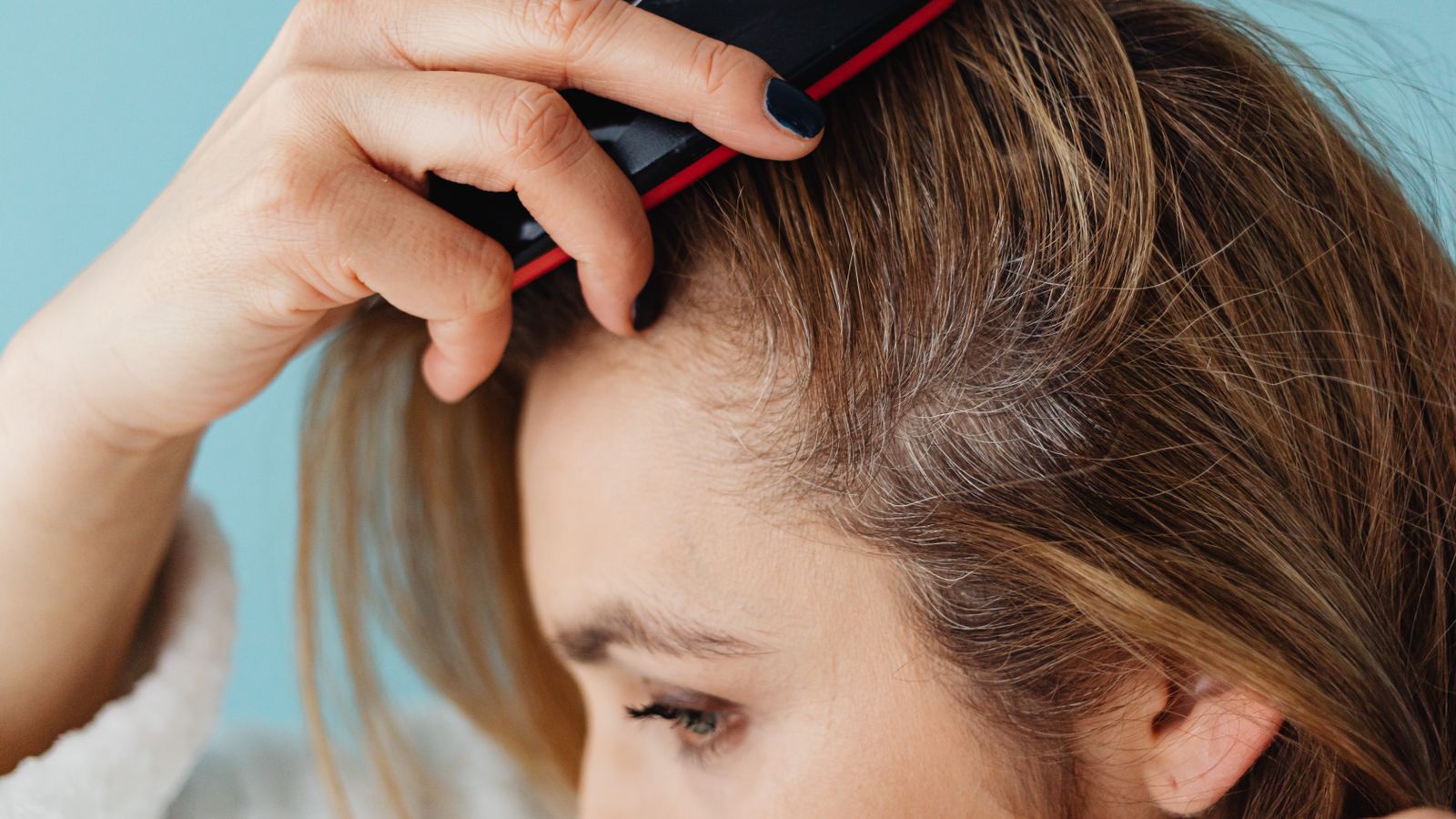
One, the parting width test. Part your hair where you always part it and look straight down at it in a mirror, in daylight. A parting that has widened towards the crown over a year is the earliest reliable sign of reducing density in women. Photograph it rather than trusting your impression.
Two, the ponytail circumference test. If your hair is long enough, gather it and measure around the base with a tape measure, or simply note where a hair tie sits and how many times it wraps. This is the most sensitive test most people have available, because it aggregates the whole head into one number.
Three, the scalp visibility test. Stand under a bright overhead light and look at the crown and parting in a hand mirror. Some scalp visibility is normal, particularly in fine hair. What matters is a change from your own baseline, and the crown is where women notice it last because they cannot see it.
Four, the hair calibre check. Pull a few shed hairs from the brush and compare them side by side on a white surface. A mix of thick and noticeably fine, short, wispy hairs suggests follicles are shrinking, and that is a more meaningful finding than volume alone.
Five, the pull test, done gently. Take about sixty hairs between finger and thumb near the scalp and slide along the length with light tension. More than five or six releasing, repeated in several places, suggests an active shedding phase. Do it on unwashed hair, not straight after a wash, and read it as a rough signal rather than a measurement.
Six, the photograph series. Parting, crown and hairline. Same window, same time of day, same angle, hair dry and parted identically. Once a month. This is the only one of the six that gives you a genuine answer, and it is the one everybody skips.
What does the bathroom mirror get wrong?
Four things mislead people constantly when they are working out how to tell if your hair is thinning, and all four cause unnecessary alarm.
Wet hair always looks thinner. Wet strands clump together and lie flat, so the scalp shows through far more. Judging density in the shower is the single most common cause of a bad evening.
Bathroom downlighting exaggerates the crown. A light directly overhead casts the scalp in a way daylight does not. Use a window.
Shedding is not the same as thinning. A dramatic amount of hair in the drain after a wash usually means you did not wash yesterday. Hair that has already released sits in place until something moves it.
A new haircut, colour or product changes apparent volume enormously. Layers, blow drying and even the direction you dry from will alter perceived density more than three months of real change would.
This is why the photograph series matters so much. It controls for all four at once, which no amount of careful looking can do.
What does a magnified scalp examination add?
Trichoscopy is the term for examining the scalp with a dermatoscope, a magnifier with its own light source, sometimes linked to a camera. A dermatologist or trichologist may use one, and it shows things the naked eye cannot.
Under magnification a specialist can see the variation in hair shaft thickness across a small area, whether follicle openings are still present or the skin has gone smooth, the pattern of redness or scale around the openings, and how many hairs are emerging from each opening. That level of detail genuinely changes what someone can tell you about your scalp, and it is the main reason a specialist appointment beats a home check.
Two honest caveats. First, it is an examination, not a laboratory test, and the interpretation depends heavily on the experience of the person holding it. Second, it does not replace blood tests, so an internal cause such as low iron or a thyroid problem will not show up on a scalp image at all. That is why a GP appointment and a specialist appointment answer different questions.
Get a discount on your next order
Join the Watermans mailing list and we will email a discount code straight to your inbox. Vegan, made in the UK, over 6.5 million bottles sold since 2012.

Which measurements are worth tracking?
Not all the ways of working out how to tell if your hair is thinning carry equal weight. This table ranks them.
| What you can measure | How reliable it is | How often to check |
|---|---|---|
| Photograph series, same conditions | The most reliable thing available to you | Monthly |
| Ponytail circumference | Very good, and sensitive to small changes | Monthly |
| Parting width | Good, and the earliest sign in women | Monthly, photographed |
| Hair calibre, thick versus wispy | Good, and often more meaningful than volume | Every few months |
| Gentle pull test | Rough. Useful for spotting an active shed, nothing more | Occasionally |
| Counting daily hair loss | Poor. Varies enormously with wash frequency | Do not bother |
| How the mirror feels today | Worthless, and usually worse on a bad day | Ignore |
Three months is the shortest interval that means anything, because hair grows around a centimetre a month and any real change is slower than your patience.
How do thinning, shedding and breakage differ as findings?
Once you have established that something has changed, the next question is which of these three it is, because the home evidence differs.
Thinning means the follicle producing finer hair or stopping. The evidence is a widening parting, a smaller ponytail and a mix of thick and wispy hairs. It is gradual, measured over years rather than weeks.
Shedding means more hairs than usual leaving the head because the growth cycle was disturbed, typically two to three months after illness, childbirth, surgery, crash dieting or serious stress. The evidence is volume: handfuls, suddenly, from a head that still has normal calibre hairs. The full picture on that pattern is here, and how hair actually grows explains why the delay is so long.
Breakage means the fibre snapping partway along. The evidence is short broken pieces of varying length, frizz at the mid lengths, and hairs with no bulb at either end.
The bulb check settles the last one in two minutes. Collect what comes out over a single wash, spread it on a white surface in good light, and look at the root ends. A shed hair carries a small pale bulb. A broken one has a blunt or frayed end and nothing at the root.
Watermans products are 100% cosmetic and do not treat medical hair loss. Individual results may vary.
What should you do once you know something has changed?
Detecting a change is this page's job. Finding the cause is a separate exercise with different evidence, and our guide on working out why your hair is thinning takes it from here. In the meantime, three things are worth doing straight away.
See a GP if any of these apply. Round, smooth bald patches rather than even thinning, which may be alopecia areata. A painful, weeping or crusting scalp. Shedding that began suddenly after illness, surgery, childbirth, a new medicine or rapid weight loss, where blood tests for iron, ferritin, thyroid and vitamin D are the useful next step. Any hair loss in a child. If your question is about products or a routine rather than a medical one, you can talk to Gail Waterman, our co-founder, as an AI avatar on the Watermans homepage.
Take the tension off. Loosen tight styles, sleep with hair down, move where the elastic sits, and stop wearing the same parting every day. Sustained pulling at the hairline causes damage that eventually stops recovering, and it is entirely preventable.
Do not change six things at once. If you start a supplement, a shampoo, a scalp serum and a new diet in the same fortnight, you will have no idea in three months which one did anything. One change, ninety days, photographs at both ends.

Where do cosmetic products genuinely help?
Honest framing first. Nothing in a bottle changes what a follicle is doing under the skin. What good products do is protect the hair you have, which matters more than it sounds when a proportion of apparent thinning is really breakage.

Grow Me Shampoo, the baseline wash while you track
Sulfate free, with biotin, caffeine, rosemary and hydrolysed lupine protein. It cleans without stripping and leaves the scalp comfortable, which is the sensible constant to hold while you measure everything else. Fingertips, warm water, two or three times a week.

Grow More Scalp Elixir, the one change worth testing properly
A leave on scalp product stays where you put it rather than going down the drain, which is a better delivery route than a shampoo on paper. If you are going to test one cosmetic change against your photograph series, make it this one, and give it the full ninety days before you judge it. Once you know which of the three you are looking at, where copper peptides for thinning hair fit covers what to do about it.
Frequently asked questions
How to tell if your hair is thinning or if it is just shedding?
Look at the calibre and the timeline. Shedding is sudden, high volume, and the hairs are normal thickness with a pale bulb at the root. Thinning is slow, shows as a widening parting or a smaller ponytail, and produces a mix of thick and noticeably fine, wispy hairs.
How much hair loss a day is normal?
Roughly fifty to a hundred hairs, and it varies hugely with how often you wash. If you wash twice a week, two days of shed hair arrives at once and looks alarming. Counting is not a useful exercise.
Is a widening parting always hair loss?
Not always, but it is the most reliable early sign in women and worth photographing monthly. Weight loss, a new haircut and a change in how you dry your hair can all alter apparent parting width temporarily.
Can I check my own scalp with a phone camera?
Yes, and it is genuinely useful. Ask someone to photograph your crown and parting under a window in daylight, same spot each time. Clip on macro lenses exist and can show hair calibre variation, though interpreting what you see is where a specialist earns their fee.
Does my hair look thinner when it is wet?
Always. Wet strands clump and lie flat so far more scalp shows through. Never judge density in the shower, and never compare a wet photograph with a dry one.
How long before I can tell whether something changed?
Three months at minimum, and six is better. Hair grows around a centimetre a month, so any real change is slow enough that only comparable photographs will reveal it.
Should I get a professional scalp examination?
It is worth it when the home checks show a genuine change and you want more detail than you can gather yourself. Go to a GP first if there are patches, broken skin, or a sudden onset, because a scalp image does not show an internal cause.
Sources and references
- NHS guidance on hair loss, for the normal daily shedding range and the presentations that warrant a GP appointment.
- NICE Clinical Knowledge Summaries on hair loss and on alopecia areata, for the patterns that separate diffuse change from patchy change.
- British Association of Dermatologists public information on hair loss and on scarring alopecias, for the significance of visible follicle openings.
- Peer reviewed dermatology literature on dermoscopy of the scalp, for the features visible under magnification, including hair shaft diameter variation, and for the recognised limitation that interpretation depends on operator experience.
- Published work on standardised scalp photography and on ponytail circumference as an outcome measure, for the reliability of each method, where researchers continue to disagree on how sensitive each one is in ordinary use.
What is the bottom line on spotting thinning early?
How to tell if your hair is thinning is a measurement problem, not an impression problem. Photograph your parting, crown and hairline under the same window at the same time of day, once a month, and measure your ponytail while you are at it. Look at hair calibre as well as volume, because follicles produce finer, shorter hairs before they stop. Ignore the plughole, ignore wet hair, ignore bathroom downlighting, and ignore how it felt this morning. Give any comparison three months, because nothing about hair moves faster than that. Once you know something has genuinely changed, the next question is why, and that one is answered by your GP and by a different page rather than by a mirror.
If you would rather start small, swap the wash first and see how the scalp feels on the Grow Me hair growth shampoo.
Grow Me shampoo is vegan, Watermans is UK made, and we have sold over 6.5 million bottles since 2012.