Ludwig Scale: Stages of Female Pattern Hair Thinning
The Ludwig scale is the three stage grading system used to describe female pattern hair thinning. It looks at one thing only, the width of the central parting and how much scalp shows through it, and it sorts what it sees into stage I, stage II and stage III. It exists because women rarely go bald in the way the male scale describes. The hairline usually holds, the crown stays covered, and the change happens quietly down the middle.
Our hair growth shampoo
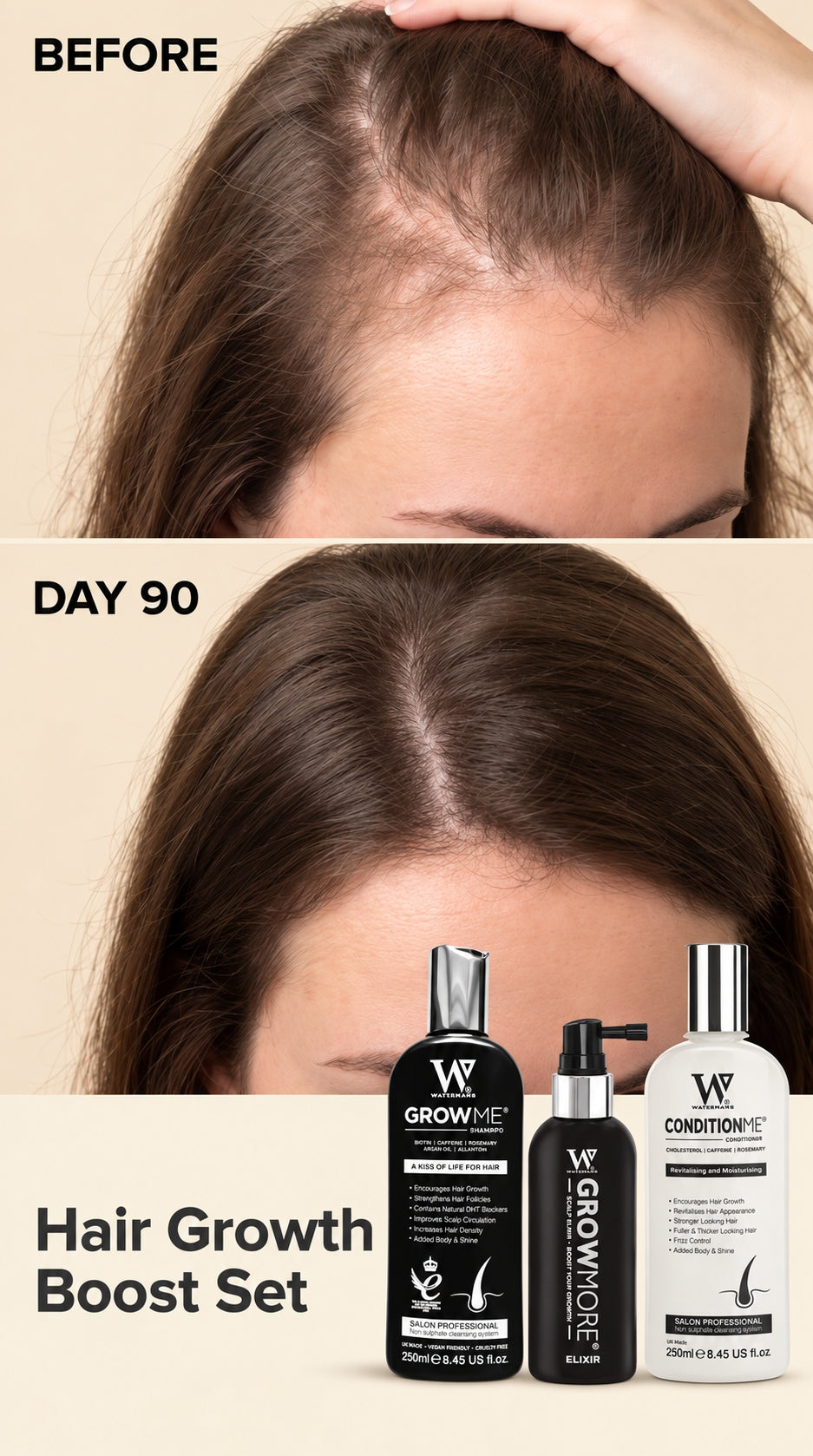
Grow Me® Hair Growth Shampoo, £14.95. A sulphate free daily shampoo that supports a healthy scalp environment and helps reduce breakage, so lengths hold on and look fuller.
Key takeaways
- Three stages, graded on the central parting, not on the hairline and not on the crown.
- Stage I is a parting that has widened but still has hair either side of it along its whole length.
- Stage II is a parting where scalp is visible through the hair rather than only at the line itself.
- Stage III is diffuse thinning across the top of the scalp with the frontal hairline still largely intact.
- The scale describes a pattern. It does not tell you the cause, and two different causes can look identical on it.
- Sudden even shedding all over the head is usually not this pattern at all, and that difference matters.
- Photographs of the same parting in the same light every eight weeks beat any daily count.
What is the Ludwig scale and who is it for?
The Ludwig scale was published by the German dermatologist Erich Ludwig in 1977 and it has been the standard way of describing female pattern thinning ever since. Ludwig noticed that the male grading system in use at the time, which tracked a receding hairline and a thinning crown as separate advancing fronts, simply did not describe what he was seeing in women. Women kept their frontal hairline. What changed was the density of the hair growing from the top of the scalp, and the first place anyone noticed it was the parting.
So the scale grades one thing. You part the hair down the middle, you look at the line from the front of the head backwards, and you ask how much scalp you can see. That is the whole method, and its simplicity is exactly why it has survived for nearly fifty years.

What do the three Ludwig scale stages actually look like?
The three stages describe an increasing amount of visible scalp along the middle of the head. Here is what separates them in practice.
| Stage | What you see | What usually prompts someone to notice |
|---|---|---|
| I (mild) | The parting is wider than it used to be, but hair still lies on both sides of it along its whole length. | An old photograph. The ponytail feeling thinner in the hand. |
| II (moderate) | Scalp shows through the hair on either side of the parting, not just along the line. The parting takes on a wedge shape, widest at the front. | Overhead lighting. A photograph taken from above at a party. |
| III (extensive) | Diffuse thinning across the whole top of the scalp. The frontal hairline is still there, often as a preserved fringe of hair a couple of centimetres deep. | Styling stops covering it. Scalp is visible in ordinary daylight. |
That preserved fringe at the front in stage III is the detail people miss, and it is the single most useful sign that a pattern is female pattern thinning rather than something else. The hairline holds while the density behind it falls.
How does the Ludwig scale differ from the Norwood scale?
The Norwood scale grades male pattern hair loss in seven stages and it tracks two separate things: a hairline moving backwards at the temples, and a thinning circle at the crown, which eventually meet. The female scale tracks neither of those. It ignores the temples entirely and it ignores the crown as a distinct area, because in the female pattern those are usually not where the change begins.
This matters practically. A woman who compares herself against a male scale will look at her temples, see nothing, and conclude nothing is happening, while the parting she never photographs quietly widens. It also matters the other way. Some women do thin at the temples, and when that happens it is worth asking what else is going on rather than assuming it is the same pattern.
There is a third scale, the Sinclair scale, which grades the same female pattern in five stages using standardised photographs of the parting. It is finer grained and it is what most research now uses, but this three stage version remains the one people meet first because three stages are easy to hold in your head.
Why does female pattern thinning follow this shape?
Follicles on the top of the scalp are more sensitive to circulating androgens than follicles at the back and sides. In people with a genetic susceptibility, those sensitive follicles gradually miniaturise, which means each growth cycle produces a slightly shorter and finer hair than the one before, until the hair being produced is a fine, pale, barely visible strand instead of a full one.
Nothing falls out dramatically when this happens. That is why the change is so easy to miss for years. The follicle is not lost, it is producing less, and the visible result is a scalp that shows through a curtain that has quietly become thinner rather than shorter. The back and sides are unaffected because those follicles are not androgen sensitive in the same way, which is also why the pattern is a pattern and not a general thinning.
Age and hormonal change shift the balance. Many women first notice the parting widening in the years around the menopause, when the ratio of circulating hormones changes, and our guide to menopause hair thinning and what actually helps covers that overlap in more detail. There is more on hormonal hair thinning in a separate guide.

What is the difference between hair loss, hair shedding and hair breakage?
This is the distinction that decides whether this scale is even the right tool, and confusing the three is the most common reason people spend money on the wrong thing.
- Hair loss in this context means follicular miniaturisation: the follicle survives but produces progressively finer hair. It is gradual, it is patterned, and it is what this scale grades.
- Hair shedding is a cycle event. A larger than usual number of follicles enter their resting phase at once and release their hairs together a few months later. It is diffuse rather than patterned, it is often dramatic, and it usually follows something identifiable: illness, surgery, a sharp weight change, childbirth. Our explainer on telogen effluvium and why sudden shedding happens covers this properly.
- Hair breakage is not a follicle problem at all. The hair snaps somewhere along its length because it has been weakened by heat, bleach, colour, tension or plain mechanical force. The hair in your brush has a blunt end rather than a small pale bulb, and the ends look ragged and uneven.
You can have all three at once, and many people do. But only the first is graded by the scale on this page, only the second resolves on its own, and only the third responds meaningfully to how you wash, dry and handle your hair.
How do you work out your own stage at home?
Reasonably well, with three photographs and some patience. This is not a substitute for a proper opinion, but it will tell you whether you are watching something change or worrying about something stable.
- Part your hair down the exact centre. Use the same starting point every time, ideally the middle of the hairline, and comb the parting straight back.
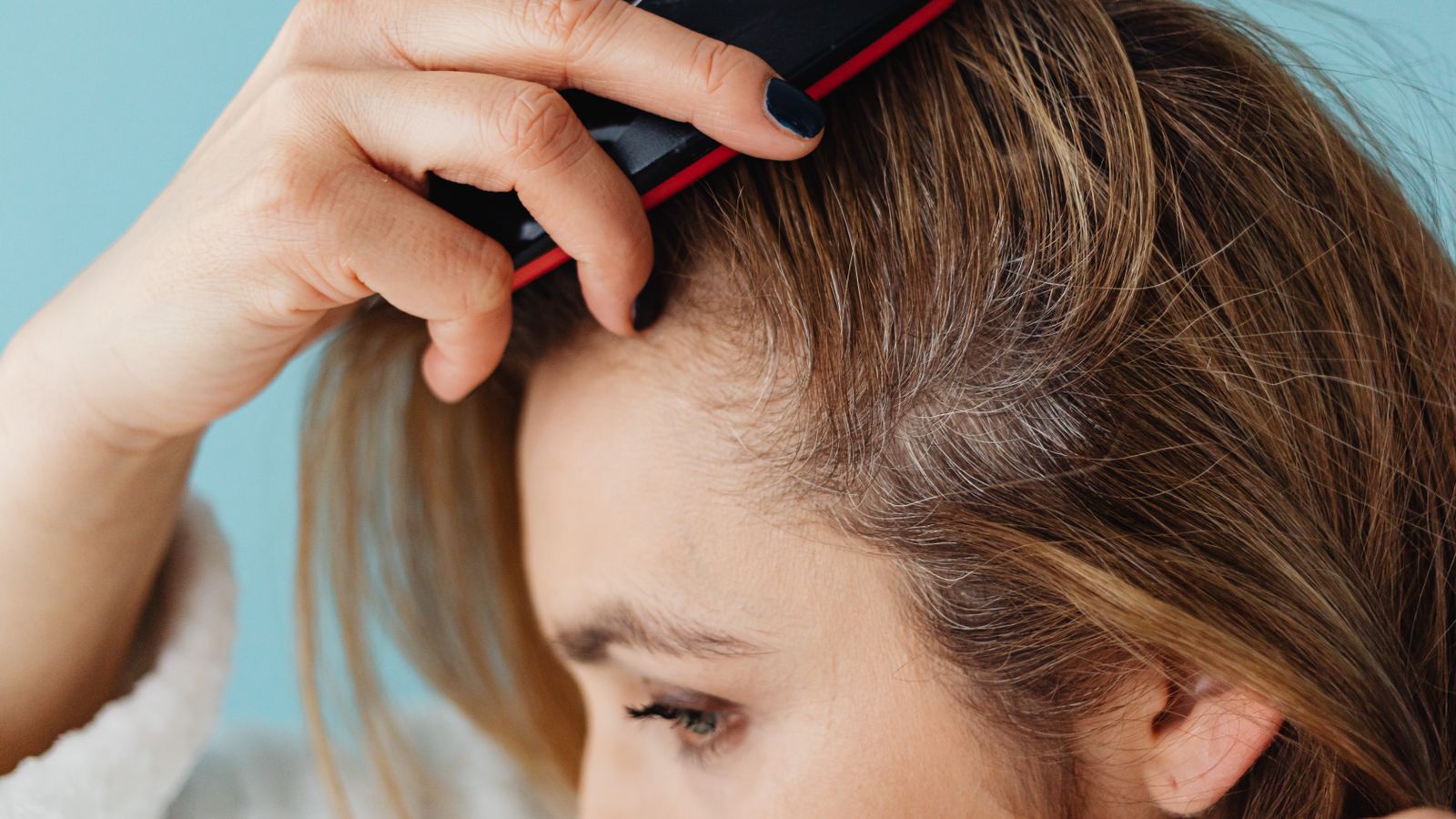
- Photograph it from directly above, in the same light. Daylight from a window is more consistent than a bathroom bulb. Overhead spotlights exaggerate everything and are useless for comparison.
- Take a second photograph of the frontal hairline. If the hairline is holding while the parting widens, that is the female pattern shape. If the hairline is moving too, the picture is more complicated.
- Repeat every eight weeks, not every day. Hair grows roughly a centimetre a month. Nothing meaningful changes in a week, and daily checking reliably makes people more anxious and no better informed.
If what you find is sudden, even shedding across the whole head rather than a widening parting, work through the three clue thinning self check first, because that is a different problem with a different answer.
Get a discount on your next order
Join the Watermans mailing list and we will email a discount code straight to your inbox. Made in the UK, over 6.5 million bottles sold since 2012.
What is worth raising with your GP?
A widening parting on its own is common and rarely urgent. Some things alongside it are worth flagging, because they point at causes that are worth checking rather than watching.
- Speed. A pattern that has changed noticeably in under six months is behaving unusually for this pattern and deserves a look.
- Anything beyond the scalp. New facial hair, acne that has returned in adulthood, or periods that have become irregular. Together those can point at a hormonal cause worth investigating, and our page on PCOS related hair thinning explains why.
- Tiredness, cold intolerance, weight change. Thyroid function is a simple blood test and a common, correctable cause of diffuse thinning.
- Heavy periods or a restricted diet. Low iron stores are worth measuring, and ferritin is the number to ask about rather than haemoglobin alone.
- Any patch of smooth, completely bare scalp. That is not this pattern and should be looked at.
Take the photographs with you. A clear before and after taken eight weeks apart is more useful in a ten minute consultation than any description you can give from memory.

What can cosmetic hair care honestly do here?
It is worth being straight about this, because the gap between what shampoo can do and what people hope it will do is where most of the disappointment in this category lives.
Cosmetic hair care does not change follicle sensitivity to androgens and it does not alter the pattern the Ludwig scale grades. What it can do is protect the hair you are currently growing, and on a scalp where each strand is finer than it used to be, that is not a small thing. Fine hair snaps more easily than coarse hair, and every snapped strand removes length and volume from an area that already has less of both. Reducing breakage does not change the underlying pattern, but it does change how much of your existing hair survives to be seen. If that sounds familiar, our piece on which hormone change is actually driving hair loss on HRT. If you are weighing up products alongside this, our honest guide to peptides in womens hair products explains which ones genuinely do what. At the stages where the parting is genuinely wide, scalp micropigmentation as a shading option is worth understanding before spending anything. If you would rather cover a widening parting while you decide what to do about it, our guide to wigs and toppers for thinning hair compares the two and explains how to clip a piece in without breaking the hair underneath.
Watermans products are 100% cosmetic and do not treat medical hair loss. Individual results may vary.

A sulfate free cleanse with biotin, caffeine and rosemary, formulated to support a comfortable scalp environment and leave fine hair looking fuller. Use it as your everyday shampoo rather than as an occasional gesture.

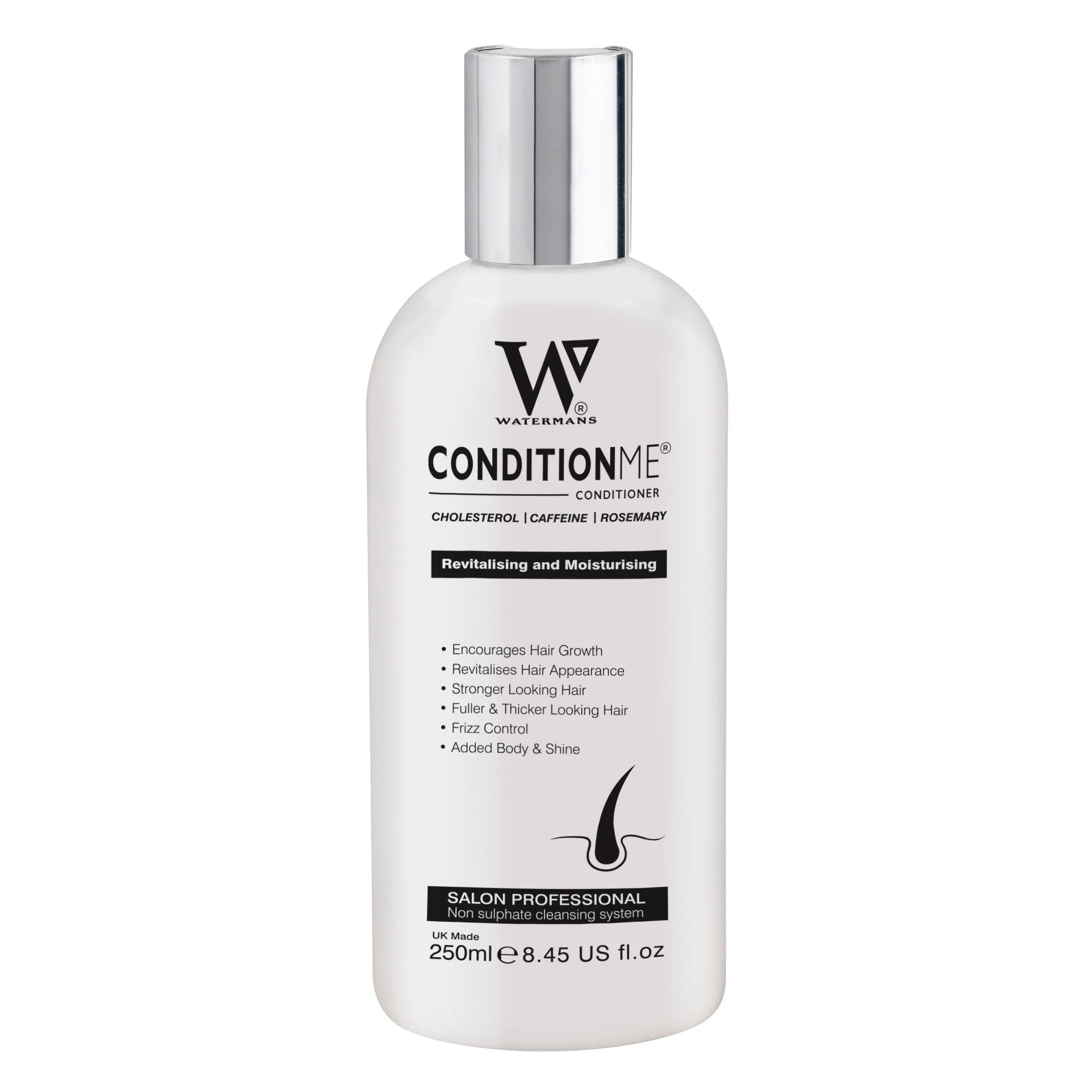
Condition Me Hair Growth Conditioner
The one that earns its place fastest. Slip is what lets a comb pass without force, and fine hair snaps under force that coarser hair would shrug off. Be generous through the mid lengths and comb it through in the shower.

Grow More Leave In Scalp Elixir
A leave on serum for the areas you are actually watching. Part the hair, apply along the line rather than over the whole head, and give it the same eight week window you are giving your photographs.
Frequently asked questions
Is the Ludwig scale used for men as well?
No. Men are graded on the Norwood scale, which tracks a receding hairline and a thinning crown as separate advancing areas. The Ludwig scale grades the central parting only, because the female pattern usually spares the hairline.
Can you move backwards down the Ludwig scale?
Not in the way most people mean. Where the underlying cause is a correctable one, such as low iron or a thyroid imbalance, density can improve substantially once that is addressed. Where the pattern is genuinely androgen driven and inherited, the realistic aim discussed with a clinician is holding the position rather than returning to a previous stage.
Does a stage I parting always progress to stage II?
No. Plenty of people sit at a slightly wider parting for years without any further change. Progression is common but it is not inevitable, and speed varies enormously between individuals.
Why does my hairline look fine when my parting does not?
Because that is the defining feature of this pattern. Follicles at the frontal hairline are less androgen sensitive than those on the top of the scalp, so the hairline holds while density behind it falls. A preserved frontal fringe alongside a widening parting is the classic picture.
Is a widening parting always female pattern thinning?
No. Chronic telogen effluvium can produce a similar look over time, as can traction from tightly pulled styles worn for years, and the two respond to completely different things. If your parting is widening while your ends are also snapping, breakage may be doing more of the work than you think.
How much hair in the shower is normal?
Around fifty to a hundred hairs a day across all activities is the usual figure quoted, and it clumps: wash days look alarming because they collect three or four days of already released hairs at once. Counting is a poor measure. Photographs of the parting are a much better one.
Does the Ludwig scale tell me what caused this?
No, and that is its main limitation. It describes a shape, not a mechanism. Two people at the same stage can have arrived there by different routes, which is why the useful next step is working out the cause rather than refining the grade.
Should I stop parting my hair in the middle?
Moving a parting will not change what is happening underneath, but it does change what is visible, because hair at a new parting has not been trained to fall away from the line. Many people find a slightly off centre or zigzag parting covers more. It is cosmetic, and there is nothing wrong with that.
What is the bottom line on ludwig scale?
The Ludwig scale is a description, not a verdict. Three stages, graded on the central parting, with the frontal hairline holding throughout. Its value is that it gives you a consistent way to describe what you are seeing and to check whether it is actually changing, which is exactly what turns a vague worry into something you can act on. Work out which of loss, shedding and breakage you are dealing with, take the photographs eight weeks apart, and raise anything fast moving or accompanied by other symptoms with your GP. For the wider picture on causes, our guide to what causes thinning hair is the natural next read. If your question is about products or a routine rather than a medical one, you can talk to Gail Waterman, our co-founder, as an AI avatar on the Watermans homepage.
The shampoo is the step you actually repeat, which is why the Grow Me hair growth shampoo is the one worth getting right. Vegan, made in the UK.
Sources & References
- Ludwig E, Classification of the types of androgenetic alopecia (common baldness) occurring in the female sex, British Journal of Dermatology, 1977, the original description of the three stage scale.
- NHS, public information on hair loss, on when to see a GP and on the common causes of hair thinning in women.
- British Association of Dermatologists, public information leaflet on female pattern hair loss, on the pattern of the parting and the preserved frontal hairline.
- Sinclair R, Female pattern hair loss: a pilot study investigating combination therapy and related work introducing the five point parting scale used in current research.
- NICE Clinical Knowledge Summaries, alopecia scenario guidance, on the investigations commonly considered for diffuse hair thinning in women including thyroid function and ferritin.