Vitamin B12 Deficiency Hair Loss: Signs, Tests and What Helps
Vitamin B12 deficiency hair loss shows up as diffuse shedding across the whole scalp, not as a bald patch or a receding hairline. B12 is needed for DNA synthesis, and follicle matrix cells divide faster than almost any others, so a shortfall can push follicles out of their growing phase early. It rarely travels alone: fatigue, breathlessness, a sore red tongue and pins and needles usually appear too. Get a blood test rather than guessing.
Our hair, skin and nails gummies
GrowPro® Hair, Skin & Nails Gummies, £22.95. Sugar free daily gummies for people who would rather chew than swallow a tablet, supporting hair care from the inside out.
Key Takeaways
- Vitamin B12 deficiency hair loss is diffuse shedding across the whole scalp, never a receding hairline or a bald patch.
- Hair is almost never the only symptom. Fatigue, a sore tongue, pins and needles and pallor usually appear too.
- The UK adult reference intake is 1.5 micrograms a day, and reliable food sources are animal foods plus fortified foods.
- Vegans, adults over 60, and people on long term acid reducers or certain long term diabetes medicines are the highest risk groups.
- Get tested before you supplement. Taking B12 first can normalise the blood result and hide a real deficiency.
- High dose biotin supplements can interfere with some laboratory assays, so tell your GP what you are taking.
Is vitamin B12 deficiency hair loss real, and what does it look like?
Vitamin B12 deficiency hair loss is real but narrow: low B12 is associated with telogen effluvium, the diffuse shedding pattern where hair comes out evenly from all over the scalp rather than in patches. It is a recognised nutritional contributor rather than a proven single cause, and correcting a genuine deficiency will not fix hair loss that was actually driven by something else.
The distinction that matters clinically is the pattern. Nutritional shedding is diffuse: more hair in the brush, in the shower drain and on the pillow, a thinner ponytail, but no bald patches and no receding temples. If you are seeing a widening parting at the crown or recession at the temples, that is pattern hair loss with a different mechanism entirely, and no amount of B12 will change it. Our guide to what causes telogen effluvium covers how to tell the two apart.
Why would low B12 affect hair at all?
B12, or cobalamin, is a required cofactor for DNA synthesis and for the formation of red blood cells and the myelin sheath around nerves. Hair follicle matrix cells divide faster than almost any other cell type in the body, so they are unusually sensitive to anything that constrains cell division or oxygen delivery.
Two mechanisms are usually offered, and both are plausible rather than proven:
- Impaired cell division. Without enough B12, DNA synthesis slows. In bone marrow this produces megaloblastic anaemia, with abnormally large red blood cells. The same constraint applied to a rapidly dividing follicle can shorten the growing phase.
- Reduced oxygen delivery. Anaemia means fewer functional red cells carrying oxygen. Follicles are metabolically demanding and are not a survival priority, so they are among the first tissues the body economises on.
This is the same logic that explains why iron deficiency, crash dieting, illness, surgery and severe stress all trigger shedding roughly 2 to 3 months after the event. The follicle responds to a systemic problem by stepping out of anagen, and the hair falls about three months later.
What are the symptoms of vitamin B12 deficiency?

The most common symptoms are persistent fatigue, breathlessness on mild exertion, pale or slightly yellow skin, a sore smooth red tongue, mouth ulcers, and pins and needles in the hands or feet. Symptoms develop slowly over months, which is precisely why people attribute them to age, stress or a busy period and leave them.
| Where | What you might notice | Why it happens |
|---|---|---|
| Blood and energy | Tiredness, breathlessness, palpitations, pale skin | Megaloblastic anaemia reduces oxygen carrying capacity |
| Mouth | Sore, smooth, red tongue, ulcers, altered taste | Fast-turnover mucosal cells are affected early |
| Nerves | Pins and needles, numbness, unsteadiness, weakness | B12 maintains the myelin sheath around nerves |
| Brain and mood | Poor concentration, memory lapses, irritability, low mood | Neurological involvement, covered in our B12 and memory guide |
| Hair and skin | Diffuse shedding, dull hair, pale or slightly yellow skin | Rapidly dividing follicle cells and reduced oxygen delivery |
The neurological symptoms are the ones to take seriously. Left alone for long enough, nerve damage from B12 deficiency can become permanent, and it does not always resolve fully even after levels are corrected.
Who is most at risk of low vitamin B12?
The highest risk groups are vegans and strict vegetarians who do not use fortified foods, adults over 60, people with pernicious anaemia, and anyone on long term acid-reducing medication or certain long term diabetes medicines. B12 is unusual among vitamins because it is only found reliably in animal foods, and because absorbing it depends on a working stomach and terminal ileum.
| Risk group | Why |
|---|---|
| Vegans and strict vegetarians | Plant foods contain no reliable B12. Fortified foods or a supplement are required, not optional |
| Adults over 60 | Stomach acid production falls with age, and acid is needed to release B12 from food protein |
| Pernicious anaemia | An autoimmune condition that destroys intrinsic factor, the protein required to absorb B12 |
| Some long term diabetes medicines | A few reduce B12 absorption in the ileum over years of use. Your GP or pharmacist can say whether yours is one |
| Long term PPI or H2 blocker users | Less stomach acid means less B12 released from food. See our guide to long term acid reducers |
| Gastric or bowel surgery | Gastric bypass or removal of the terminal ileum removes the machinery for absorption |
| Crohn's and coeliac disease | Inflammation of the small bowel impairs absorption even with a good diet |
| Heavy alcohol use | Affects both intake and absorption, and often accompanies other deficiencies |
If you take a proton pump inhibitor such as omeprazole or lansoprazole long term, the nutrient side of that is worth understanding properly. We cover it in our piece on long term PPI use and nutrient risks, including the questions worth asking at a medication review.
Get a discount on the hair shedding range
Join the Watermans mailing list and we will email a discount code straight to your inbox, so you can try the hair shedding range for less. Vegan, made in the UK, over 6.5 million bottles sold since 2012.
How much vitamin B12 do you need, and where do you get it?

The NHS reference nutrient intake for adults in the UK is 1.5 micrograms of vitamin B12 a day, which most people who eat meat, fish, eggs or dairy meet easily. The body also stores B12 in the liver, often enough for two to five years, which is why deficiency from diet alone takes a very long time to appear and why it is so easily missed.
| Source | Notes |
|---|---|
| Liver, beef, lamb | Among the richest sources by far |
| Salmon, mackerel, sardines, tuna | Oily fish also supplies omega 3, useful for other reasons |
| Eggs and dairy | Moderate amounts, easily enough across a normal week |
| Fortified plant milks and cereals | The main practical route for vegans. Check the label, fortification is not universal |
| Nutritional yeast (fortified) | Only if the specific product states added B12 |
| Seaweed, spirulina, wheatgrass | Not reliable. These contain inactive analogues that do not work as B12 in humans |
How is vitamin B12 deficiency tested?

The first line test in the UK is serum total vitamin B12, usually ordered alongside a full blood count and serum folate. If the result is borderline or the picture is confusing, second line tests include active B12 (holotranscobalamin), methylmalonic acid and homocysteine, both of which rise when B12 is functionally low.
If you are being investigated for shedding rather than for anaemia, it is worth asking for the fuller nutritional panel in one go, because the causes overlap and a single low result rarely tells the whole story:
- Full blood count. A raised mean cell volume (MCV) suggests megaloblastic anaemia from B12 or folate deficiency.
- Serum folate. Folate and B12 deficiency look similar and often occur together, and correcting folate alone while B12 is low can worsen neurological damage.
- Ferritin. Iron deficiency is a far more common cause of diffuse shedding in women than B12 is.
- Thyroid function. Both under and overactive thyroid cause shedding, and autoimmune thyroid disease often travels with pernicious anaemia.
- Intrinsic factor antibodies. Ordered when pernicious anaemia is suspected, because it changes the route from tablets to injections.
Why should you get tested before you start supplementing?
Taking a B12 supplement before your blood test can lift the serum result into the normal range while the underlying absorption problem continues. That is a genuine risk, not a technicality, because it can delay the point at which pernicious anaemia is identified, which needs injections rather than tablets, and a delay allows nerve damage to progress.
Worth flagging to your GP: biotin can distort lab results. High dose biotin supplements, common in hair, skin and nail products, are known to interfere with some laboratory immunoassays, including certain thyroid, troponin and vitamin B12 tests. This can produce falsely high or falsely low results depending on the assay.
The standard advice is to tell the person taking your blood what supplements you are on, and to stop biotin supplements a few days before testing if your clinician asks you to. This applies to our own gummies as much as to anyone else's.
What happens once a B12 deficiency is confirmed?
What happens next depends on the cause. A shortfall from diet alone is usually managed with oral B12 tablets and dietary changes, while a shortfall caused by an absorption problem such as pernicious anaemia is usually managed with hydroxocobalamin injections, given as loading doses and then maintenance doses at intervals. NICE guideline NG239 sets out that pathway, and your GP chooses the route based on the cause rather than on the number.
What to expect in practice: energy and mouth symptoms tend to improve within weeks, blood counts normalise over a couple of months, and neurological symptoms improve slowest and least predictably. If the cause is ongoing, such as pernicious anaemia or bowel surgery, the support continues for life rather than ending with one course.
How long does vitamin B12 deficiency hair loss take to recover?
Recovery from vitamin B12 deficiency hair loss takes 3 to 6 months before new growth is visible, and up to 12 months for full density to return. Hair does not restart the moment blood levels normalise. Follicles that shifted into the resting phase have to complete it, shed, and then re-enter the growing phase, and new hair grows at roughly 1 centimetre a month.
The first sign of recovery is usually a fringe of short new hairs along the hairline and parting, not a reduction in shedding. Shedding often continues for a few weeks after the cause is fixed, which people misread as failure. Take a photograph in the same light once a month rather than judging it daily.
Where do hair supplements genuinely fit?
Hair supplements are everyday nutritional support for people eating a reasonable diet, and nothing more than that. If a blood test shows your B12 is low, the answer is whatever your GP arranges, at the dose and route they choose. A gummy is not a substitute for that, and no supplement should be sold to you as one.
Where they are reasonable is the ordinary case: you eat variably, you are not deficient on paper, and you want a consistent baseline of the nutrients that contribute to normal hair. That is a modest claim, and it is the honest one. For the biotin side of the same question, our guide to biotin for hair growth is clear about who actually benefits and who does not.

GrowPro® Hair, Skin & Nails Gummies, £22.95
Sugar free vegan gummies containing vitamin B12, biotin, zinc, MSM, bamboo silica and vitamins C, D3 and E. Zinc and biotin contribute to the maintenance of normal hair, and B12 contributes to normal red blood cell formation and reduction of tiredness.
Please note: this is a food supplement for everyday nutrition. It is not a remedy for a confirmed vitamin B12 shortfall, which needs medical management. If you suspect deficiency, get tested first, because supplementing beforehand can distort the result.

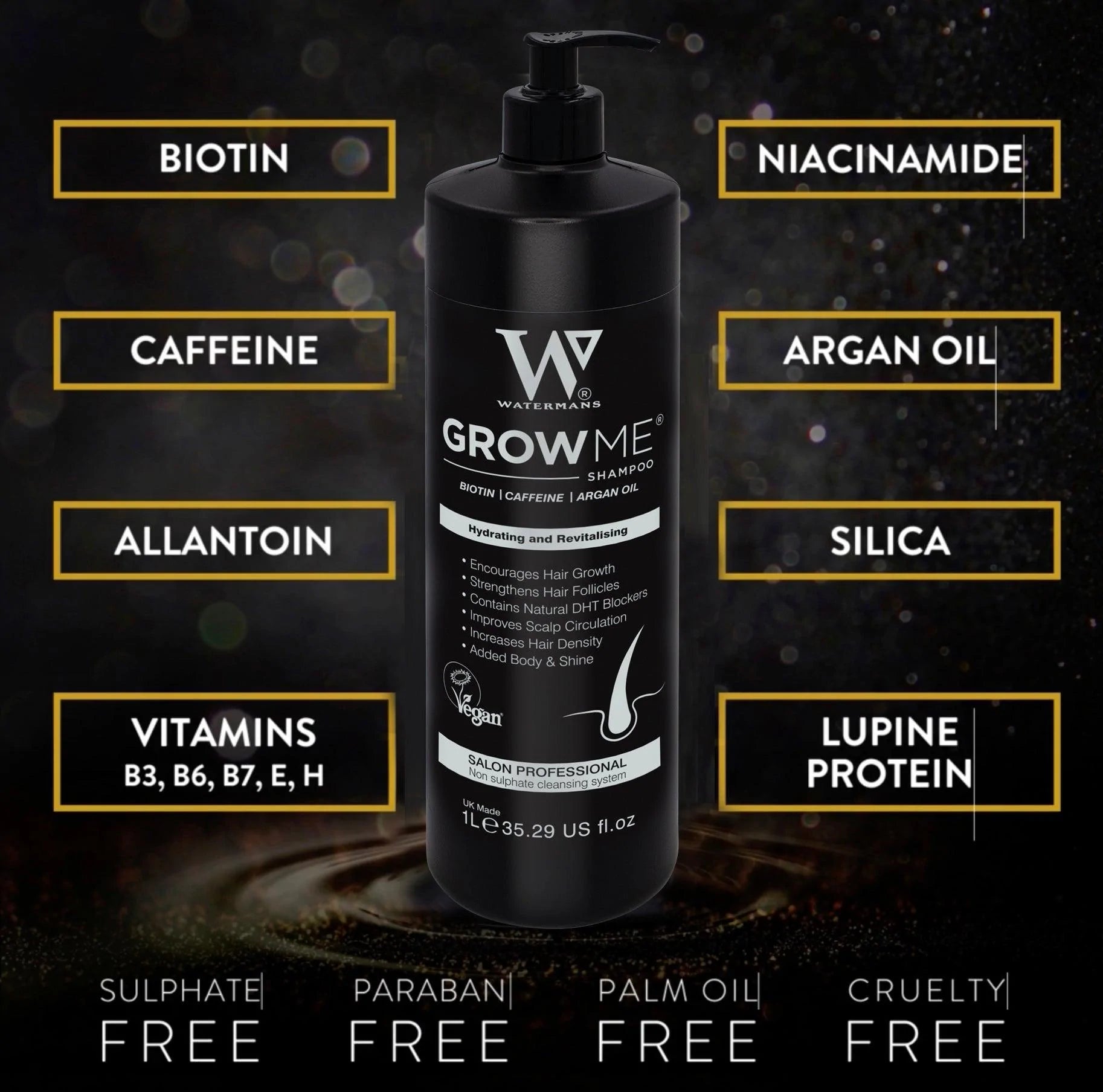
Grow Me hair growth shampoo, 14.95 pounds
A sulfate free shampoo with biotin, caffeine, rosemary, niacinamide and hydrolysed lupine protein. It supports a healthy scalp environment and reduces breakage, so the hair you still have looks fuller and thicker while density is coming back. Vegan and made in the UK.
Being straight with you: a shampoo cannot raise a low B12 level, and it is no substitute for the blood test. This is cosmetic care for the months while the shortfall is being corrected.
When should you see a GP?
See a GP if you have persistent unexplained fatigue, a sore or smooth red tongue, pins and needles, unsteadiness on your feet, or diffuse hair shedding lasting more than three months. Book sooner if you have any numbness, weakness or balance problems, since neurological symptoms are the ones where delay carries a real cost. If your question is about products or a routine rather than a medical one, you can talk to Gail Waterman, our co-founder, as an AI avatar on the Watermans homepage.
Ask specifically for a full blood count, serum B12, folate, ferritin and thyroid function. Bring a list of every medicine you take, including any acid reducer and any diabetes medicine, and mention every supplement too. If you are vegan or have had gastric or bowel surgery, say so at the start of the appointment, because it changes which tests make sense.
Frequently asked questions about vitamin B12 deficiency hair loss
Will taking B12 stop my hair falling out?
Only if a B12 deficiency was genuinely contributing to the shedding. Correcting a real shortfall can allow follicles to return to normal cycling over 3 to 6 months. If your B12 is already normal, taking more will not reduce shedding, because there is no shortage for it to correct.
How long does it take to correct a B12 deficiency?
Blood levels usually respond within days to weeks of starting B12, and blood counts normalise over roughly 8 weeks. Symptom recovery lags behind: energy and mouth symptoms improve first, nerve symptoms slowest. If the cause is ongoing, such as pernicious anaemia, the support continues for life rather than ending.
Can you have B12 deficiency with normal blood test results?
Yes. Serum total B12 measures both active and inactive forms, so it can read normal while the usable fraction is low. If symptoms strongly suggest deficiency despite a normal result, ask about active B12 (holotranscobalamin), methylmalonic acid or homocysteine, which reflect function rather than total quantity.
Is B12 deficiency the same as anaemia?
No. Anaemia is a low red blood cell count or low haemoglobin, and B12 deficiency is one of several possible causes of it. You can have early B12 deficiency with neurological symptoms and no anaemia at all, which is exactly why relying on a full blood count alone misses cases.
Can you take too much vitamin B12?
B12 is water soluble and excess is generally excreted in urine, so toxicity is rare and no upper limit has been set in the UK. That is not a reason to take large doses casually, though, since high intakes can complicate the interpretation of blood tests and mask an absorption problem that a GP needs to find.
Do vegans always need a B12 supplement?
Effectively yes, unless they consistently eat fortified foods such as fortified plant milks, cereals or nutritional yeast. Plant foods contain no reliable active B12, and seaweed and spirulina contain analogues that do not function as B12 in humans. The Vegan Society advises a supplement or reliable fortified intake.
Which is more likely to cause my hair shedding, iron or B12?
Iron deficiency is considerably more common as a cause of diffuse shedding, particularly in menstruating women, so ferritin is usually the higher yield test. That is an argument for testing both together rather than guessing, since the symptoms overlap heavily and the two deficiencies often coexist.
Should I stop biotin supplements before a blood test?
Tell your clinician what you take and follow their advice. High dose biotin is known to interfere with some laboratory immunoassays, which can produce misleadingly high or low results for certain thyroid, cardiac and B12 tests. Many labs advise pausing biotin for a few days before testing.
What is the bottom line on vitamin B12 deficiency hair loss?
Vitamin B12 deficiency hair loss is diffuse shedding, not patches and not a receding hairline, and it almost never appears without fatigue, a sore tongue or pins and needles alongside it. The UK reference intake is 1.5 micrograms a day, the liver holds two to five years of stores, and the first line test is serum B12 with a full blood count and folate. Ask for ferritin and thyroid function in the same appointment, because iron deficiency is the more common cause of diffuse shedding. Get tested before you supplement, because taking B12 first can lift the result and hide the real problem.
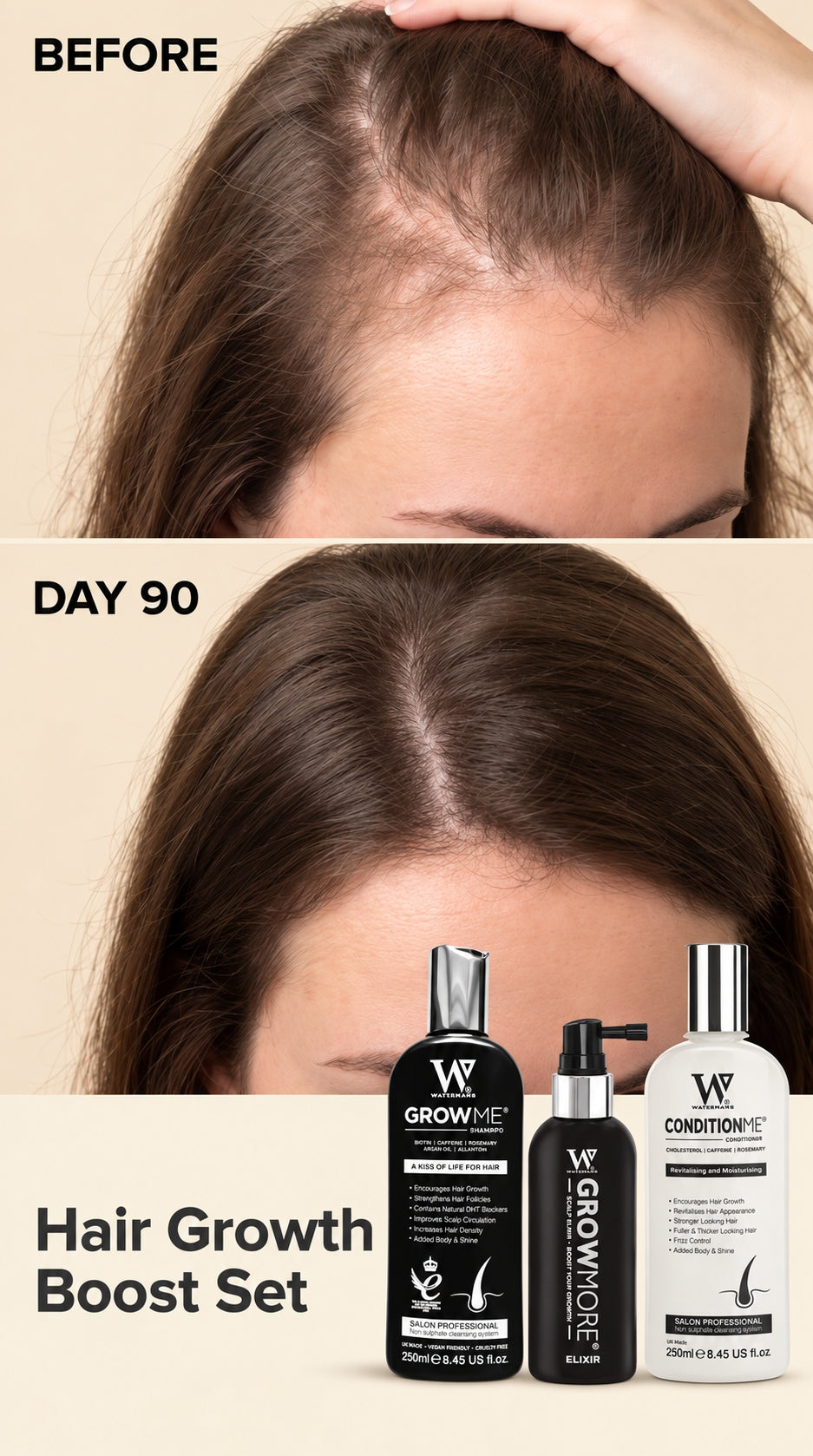
While density is coming back over those 3 to 6 months, a hair growth shampoo is the cosmetic half of the job: it reduces breakage so the hair you have looks fuller. The blood test is the other half, and it is the one that matters more.
Sources & references
- Vitamin B12 or folate deficiency anaemia, NHS, for causes and risk groups.
- Symptoms, NHS, for the fatigue, sore tongue and neurological picture.
- Treatment, NHS, for tablets versus injections and how long it continues.
- Vitamin B12 deficiency in over 16s, NG239, NICE, for testing thresholds and second line tests.
- Vitamin B, NHS, for the 1.5 microgram reference intake and food sources.
- Telogen effluvium, DermNet, for the diffuse shedding pattern and its 2 to 3 month lag.
- Hair loss, NHS, for when shedding needs a GP.
- Blood tests, NHS, for what to expect from the panel above.
Watermans products are 100% cosmetic and do not treat medical hair loss. Individual results may vary.
Test first, then support the basics
If your hair is shedding diffusely, a blood test costs you one appointment and rules several things in or out at once. For everyday nutritional support alongside a normal diet, Watermans makes vegan, sugar free hair, skin and nails gummies in the UK, part of a range with over 6.5 million bottles sold since 2012.