

Powder Sunscreen: Does It Actually Work? An Honest Guide
Read this first
Powder sunscreen should not be your only sun protection. In normal use it delivers a small fraction of the SPF printed on the tin, because nobody applies the thick, opaque layer used in laboratory testing. Treat it as a top-up over a proper cream or lotion sunscreen, never as a replacement for one. If you are relying on powder alone on a bright day, you are almost certainly under-protected.
Short answer: powder sunscreen works, but far less well than the label suggests, and there is no such thing as activating it. It is genuinely useful for topping up over makeup, for oily skin, and for the scalp parting and hairline that liquid sunscreens make greasy. It is not a base layer, and it should not be relied on for a day in the sun.
Key takeaways
- Activation is not a real step. Mineral filters work by physically sitting on the skin. Buffing in circles does not switch anything on.
- SPF is measured at 2 mg per square centimetre. For a powder that is a thick, visible, chalky layer that essentially nobody applies in real life.
- Powder is a top-up format. Its best use is refreshing protection over makeup at lunchtime, on skin that already has cream sunscreen underneath.
- Loose powders carry an inhalation caution. Avoid puffing them near the face of a small child, and apply in still air rather than a breeze.
- Where powder genuinely wins is the scalp parting, the hairline and the tops of the ears, places a lotion leaves greasy and most people therefore skip.
- More product, not thinner layers. The original advice to build several very thin layers is backwards for a format that is already under-applied.
Is activating powder sunscreen a real thing?
No. This is worth stating plainly, because the idea circulates widely and it is not correct.
Correcting a common claim
The claim: buffing powder sunscreen in circular motions activates the minerals so they form a protective barrier.
The reality: the mineral filters in these products, zinc oxide and titanium dioxide, work by sitting on the surface of the skin and scattering, reflecting and absorbing ultraviolet light. They are inert particles. There is no chemical reaction to trigger and no activation step. Buffing helps you spread the powder evenly, which is genuinely worth doing, but it does not change what the ingredients do. Even chemical filters in liquid sunscreens, which do need a few minutes to settle into a uniform film, are not activated by rubbing either.
Why does the myth matter? Because it puts the emphasis in the wrong place. It suggests the technique is what determines your protection, when the thing that actually determines it is how much product ends up on your skin.
Why the SPF on the tin is not the SPF you get
All sunscreen SPF values, in the UK and everywhere else, are measured under a standardised test that applies 2 milligrams of product per square centimetre of skin. For a face and neck that is roughly a third of a teaspoon of cream, which is already more than most people use.
Now picture applying that same weight as a powder. It would be a thick, obvious, chalky coating that nobody would wear out of the house. Studies of real-world sunscreen use consistently find people apply between a quarter and a half of the tested amount even with creams, and the shortfall is not proportional. Halving the amount does not halve the SPF, it reduces protection considerably more than that.
| Format | How close real use gets to the test amount | Sensible role |
|---|---|---|
| Cream or lotion | Usually a quarter to a half, and easy to improve if you measure | Your base layer. This is the one that does the work |
| Stick | Reasonable if you do several passes rather than one swipe | Excellent for ears, nose, eye area and children on the move |
| Spray | Often poor, and worse outdoors where wind carries product away | Acceptable if you spray close and then rub it in |
| Powder | The furthest away of any format, by a wide margin | Top-up over an existing layer, never the layer itself |

The inhalation question nobody mentions
Loose mineral powders become airborne when you tap, puff or brush them, which means some of what you apply near your face can be breathed in. The particles involved, titanium dioxide in particular, have been assessed as a possible carcinogen when inhaled as an airborne dust, an assessment that concerns occupational dust exposure rather than skincare. Regulators have also flagged that powder sunscreens have not been through the same evidence review as conventional formats.
This is a reason for sensible caution, not alarm. Practical steps:
- Apply in still air, indoors or in a sheltered spot, rather than in a breeze.
- Hold your breath briefly during application and keep your eyes closed.
- Do not puff loose powder around the face of a baby or small child. Use a cream or a stick on children.
- If you have asthma or another respiratory condition, a pressed compact or a cream is the more sensible choice than a loose brush applicator.
So what is powder sunscreen actually good for?
Plenty, provided you use it for the right job. It has three genuine strengths.
1. Topping up over makeup
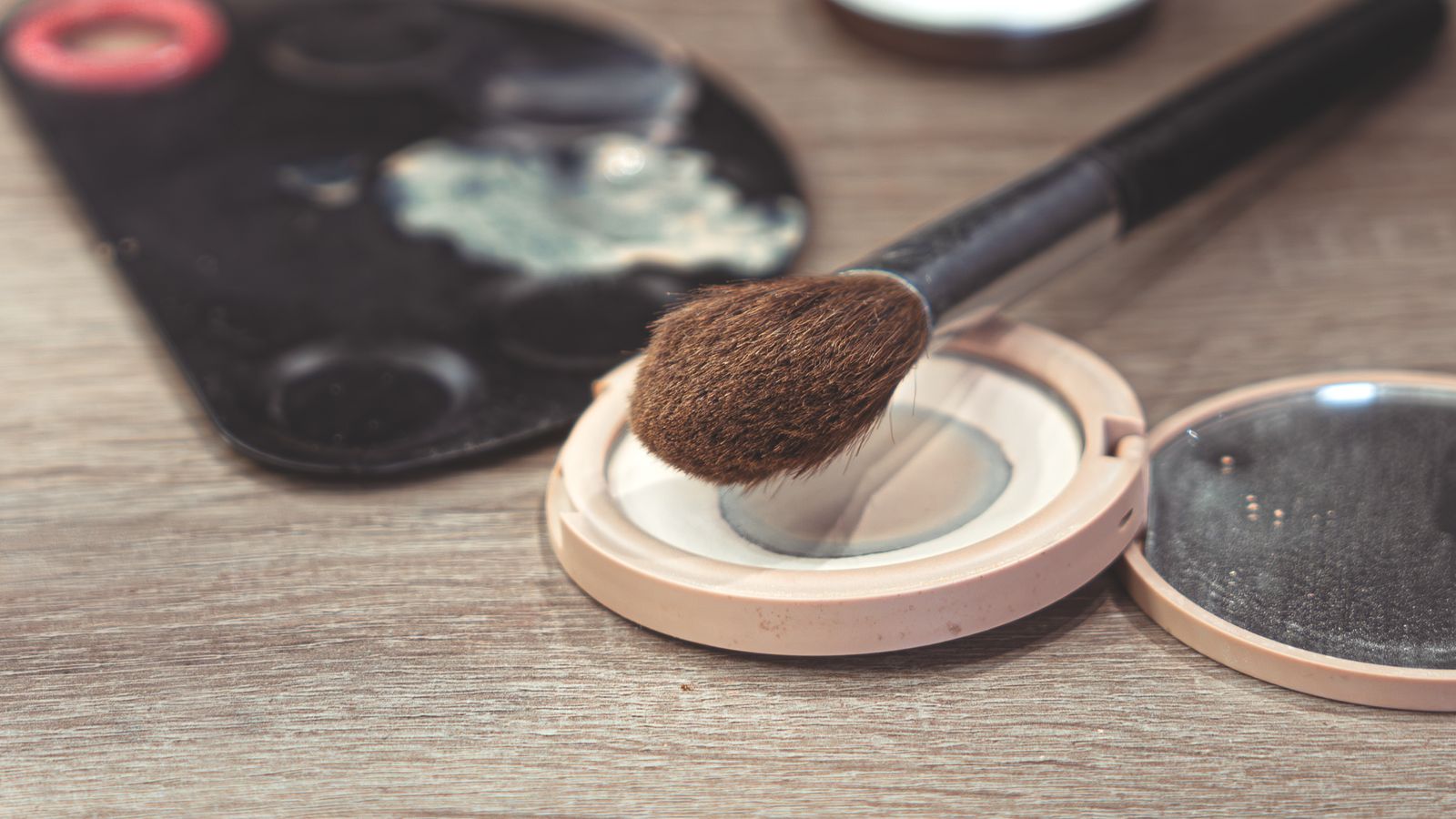
This is the strongest case for it. Reapplying cream sunscreen at midday over foundation is unpleasant and usually means redoing your face. A powder refreshes protection without wrecking the makeup underneath. It is not as good as reapplying a cream, but it is far better than the realistic alternative, which is doing nothing.
2. Oily and shine-prone skin
Powder absorbs surface oil while it sits there, so it can genuinely improve how skin looks in the afternoon. If shine is why you avoid reapplying sunscreen at all, a powder solves a behavioural problem, and a sunscreen you actually reapply beats a better one you leave in a drawer. If oiliness is your wider concern, we cover the routine side in our guide to choosing a moisturiser for oily skin.
3. The scalp, parting and hairline
This is where powder is not just acceptable but genuinely the best tool available, and it deserves its own section.

Sun protection for the scalp and parting
The scalp is one of the most commonly burnt and least commonly protected areas on the body. A parting is a strip of completely exposed skin pointing straight at the sky, and the crown gets more direct overhead sun than almost anywhere else. People with thinning hair, a widening parting, a receding hairline or a shaved head are the most exposed of all, and this is exactly the group that tends to skip it, because rubbing a lotion into hair is unpleasant.
Powder solves that. Brushed along a parting it is invisible, it does not make hair greasy, and it is quick enough that people actually do it. Practical approach:
- Brush powder directly along the parting, then part your hair a centimetre to the side and repeat, because the exact line moves through the day.
- Do not forget the tops of the ears and the back of the neck, which are among the most common sites of sun damage.
- On a shaved or very short head, use a cream sunscreen. There is no styling to protect, so use the format that works better.
- A hat beats all of it. A wide brim protects the scalp, ears, nose and neck at once, needs no reapplication, and does not wash off.
Sunburn on the scalp is genuinely uncomfortable, and repeated burning is a risk factor for skin damage over time. Keeping the scalp in good condition is worth the small effort, and we cover the broader routine in our guide to keeping your scalp healthy for longer, stronger hair.

How to use powder sunscreen properly
- Put a proper sunscreen on first. A cream or lotion, applied generously, in the morning. This is the layer that provides your actual protection.
- Let it settle. Give a cream a few minutes before anything goes on top, so you are not dragging it around.
- Use more powder than feels natural. Several passes, not one polite dusting. The single biggest failure with this format is under-application, so the old advice to build very thin layers is the wrong instinct.
- Press as well as sweep. Pressing with a puff deposits more product than a light brush stroke, which mostly redistributes what is already there.
- Cover the missed spots. Parting, hairline, ears, sides of the neck, and the bridge of the nose.
- Reapply every two hours in strong sun, and sooner after sweating, swimming or towelling. Powder is not water resistant in any meaningful sense.
- Store it dry and check the date. Sunscreen filters do degrade, and a compact that has been rattling around a hot car all summer is not the one to rely on next year.
Retinoid users, take note. Retinoids and exfoliating acids make skin more sun sensitive, so this is the worst possible combination to pair with a format that under-delivers. If you use one, wear a proper cream sunscreen and treat powder purely as the midday top-up. Our guide to tretinoin versus adapalene covers this in more detail.
Understanding the label: SPF, UVA and the UV index
Two numbers matter, and they measure different things.
- SPF refers to protection against UVB, the wavelength most responsible for burning. SPF 30 and SPF 50 are the sensible everyday choices. The difference between them is smaller than the numbers suggest, and both are undermined far more by under-application than by the gap between them.
- UVA protection is shown in the UK by a star rating on the bottle, or by the letters UVA in a circle. UVA penetrates more deeply and is associated with ageing changes as well as damage. Look for four or five stars, or the circled UVA mark.
- The UV index is the practical guide to when this matters. In the UK it is generally worth protecting exposed skin when the index reaches 3 or above, which typically means April through September, roughly 11am to 3pm. It appears in most weather apps.
Cloud is not protection. A meaningful proportion of UV passes through light cloud, which is why people burn on overcast summer days and are surprised by it.
Does the sun damage hair as well as skin?
It does, though differently, and the distinction is worth being clear about. Ultraviolet light degrades the keratin proteins in the hair shaft and breaks down both natural pigment and artificial colour. The visible results are familiar: dryness, roughness, split ends, brassiness in blondes, faster fading in dyed hair, and a straw-like feel after a fortnight of sun and sea.
What sunlight does not do is cause hair loss. Hair is not living tissue above the scalp, so sun exposure damages the fibre rather than the follicle. If you are shedding or thinning, the sun is not the explanation and it is worth looking properly at the cause. Our guide to what causes hair damage separates the fibre problems from the follicle ones.
Practical summer hair care is simple: rinse with fresh water after swimming, put a leave-in conditioner on before you go out, wear a hat, and do not add heat styling on top of sun exposure. Chlorine and salt both dry hair further, and colour-treated hair suffers most.

Protect Me Leave-In Conditioner
A lightweight leave-in spray with panthenol, niacinamide and sunflower oil. Helps reduce moisture loss, soften the feel of dry summer hair and support colour vibrancy between washes.
This is not a sunscreen. It carries no SPF, makes no UV protection claim, and does nothing for your scalp skin. For that, use a proper sunscreen or a hat.
Powder sunscreen: the honest verdict
It is a useful product sold with an unrealistic promise. As a way of refreshing protection over makeup at 1pm, or of getting sunscreen onto a parting that would otherwise get nothing at all, it earns its place in a bag. As the thing standing between your face and a July afternoon, it is not enough, and no amount of buffing changes that.
Watermans is a hair care company and we do not sell sunscreen, so we have nothing to gain from telling you which one to buy. Buy a cream SPF 30 or 50 with good UVA protection, use more of it than feels necessary, and keep a powder for the top-ups.
When to see a GP
Book an appointment if you notice a new mole, a mole that is changing in size, shape or colour, a sore or scab on the scalp or face that does not heal within a few weeks, or a rough scaly patch that keeps coming back. The scalp, ears and nose are common sites for skin changes and are easy to miss, so it is worth asking someone to look at your scalp if you cannot see it yourself. Nothing on this page is medical advice.
Frequently asked questions
Do you have to activate powder sunscreen?
No. There is no activation step. The mineral filters work by physically sitting on the skin and blocking ultraviolet light, so they do not need to be triggered. Buffing simply spreads the powder evenly, which is worth doing for coverage but does not change how the ingredients behave.
Is powder sunscreen as good as cream?
No. The SPF on any sunscreen is measured using a thick, standardised amount of product, and powder is the format applied furthest below that in real life. Use a cream as your base layer and treat powder as a top-up.
Can powder sunscreen be my only sun protection?
It should not be. On a day with any real sun exposure you will be under-protected. Powder is best used over an existing layer of cream or lotion sunscreen.
Is it safe to breathe in powder sunscreen?
Occasional cosmetic use is not the same as occupational dust exposure, but it is sensible to reduce what you inhale. Apply in still air, hold your breath briefly, and do not use loose powders near a baby or small child. Choose a cream or stick if you have a respiratory condition.
How often should I reapply powder sunscreen?
Every two hours in strong sun, and sooner after sweating, swimming or wiping your face. It is not water resistant in any useful sense.
What is the best sunscreen for a hair parting?
A powder or a dedicated scalp spray is usually the most practical, because a lotion leaves hair greasy and therefore tends not to get used. Brush it along the parting and again a centimetre either side. A wide brimmed hat is better than all of them.
Does the sun cause hair loss?
No. Sunlight damages the hair fibre, causing dryness, roughness and colour fade, but the hair above the scalp is not living tissue and sun exposure does not cause follicles to stop producing hair. Persistent shedding or thinning has another cause and is worth investigating.
Do I need sunscreen in the UK?
Yes, when the UV index reaches 3 or above, which typically covers April through September in the middle of the day. Light cloud does not block a meaningful amount of ultraviolet, which is why overcast summer days still cause burns.