Hair Recovery After Weight Loss: Signs It Is Turning Around
Last updated: August 2026
Recovery from shedding after weight loss is real, it is the normal outcome rather than the lucky one, and it begins several months before you can see any difference in the mirror. That gap between recovery starting and recovery being visible is the hardest part of the whole experience, and it is where most people conclude wrongly that nothing is working. The signs that things have turned around are specific and you can check them yourself this week. The density taking longer than you want is arithmetic, not a bad sign.
One honest note, because many people arrive at this page from a search about a specific weight management medicine. We are a British cosmetic hair care company. We do not sell medicines and we cannot advise on yours, so anything to do with your prescription belongs with your GP or the clinician managing your weight care. What this page covers is the recovery side of the hair itself: how to tell the shed has stopped, what the first evidence of new growth actually looks like, how long the visible part takes, and how to get through the months in between without losing your nerve.
Key takeaways
- Shedding stopping and density returning are two separate events, usually six to nine months apart. Most despair happens in that gap.
- The first real evidence is a halo of short hairs standing up along your hairline and parting, not a change in thickness.
- Hair grows roughly 1cm a month. New hair needs about a year to reach shoulder length, so patience is not optimism, it is maths.
- Count your daily loss on both a wash day and a non wash day. Washing releases hairs that had already detached and makes one day look far worse than it is.
- New growth is fragile. Short, fine hairs snap easily, and breaking them is the one way to genuinely delay your recovery.
- A shorter cut is the fastest visual improvement available because removing length concentrates what you have.
- If shedding is still worsening at six months, the trigger is probably still running or something else is going on. That is a GP conversation.
- Nothing you buy shortens the biological timeline. Good care protects the new growth so you actually keep it.
How do you know the shedding has actually stopped?
People rarely notice the shed stopping, because the absence of an alarming thing is much harder to perceive than its presence. So you have to measure rather than sense it.
Collect everything you lose across one full day: the shower drain, the brush, the pillow, what comes out when you run your hands through it. Normal daily loss is roughly 100 to 150 hairs. A shedding episode typically runs at 300 or more. Do this on a wash day and again on a non wash day, because washing releases hairs that had already detached days earlier. Skipping washes does not reduce shedding, it just batches it up so the next wash looks catastrophic. Repeat the count a fortnight later. Two consecutive counts under about 150 means the episode has passed, whatever your hair still looks like.
The other useful check is the direction of travel over a month rather than a day. Shedding is naturally variable, so a single bad Tuesday means nothing. What matters is whether the average across four weeks is lower than the average across the previous four. Almost everyone underestimates how much better things have got, because the memory of the worst day dominates.

The five signs recovery has started
These appear in a fairly reliable order, and none of them is "my hair looks thicker". That comes last, months later.
1. A halo of short hairs along the hairline
Stand under a bright light with your back to a mirror and use your phone camera to look at your hairline and the front of your parting. You are looking for short, fine, often slightly wiry hairs standing up at an angle, one to three centimetres long, refusing to lie flat. These are new hairs that have re-entered the growing phase. They are the single most reliable early sign, and they are also the thing people mistake for damage and breakage. Breakage produces broken pieces at varying lengths across the whole head. New growth is concentrated at the hairline and parting and each hair tapers to a fine point at the tip rather than a blunt snap.
2. The shedding count drops below 150 and stays there
Covered above, and worth doing properly because it is objective at a moment when your own perception is not.
3. Your ponytail circumference stops shrinking
Measure it with a tape measure at the same point every month, gathering the hair the same way. It will not increase for a long time, but the month it stops decreasing is a real milestone.
4. Hair stops coming out when you run your hands through it
During an active shed, a gentle pass through dry hair yields several hairs almost every time. When that becomes occasional and then rare, the wave has passed.
5. Texture at the roots changes before density does
Many people notice their hair holds a style slightly better, or feels denser right at the scalp when they push it around, well before the mirror shows anything. That is the new growth adding body at the root without yet adding visible length.
The recovery timeline, month by month
Counting from the point the shedding stops rather than from the weight loss itself.
| Time | What is happening | What you can see | What to do |
|---|---|---|---|
| Month 0 to 1 | Follicles re-entering the growing phase | Nothing. Shedding easing is the only clue | Start counting. Take a baseline photo of your parting |
| Month 2 to 3 | New hairs push through the scalp | The halo of short wiry hairs at the hairline | Stop pulling them back. They snap easily |
| Month 4 to 6 | New hairs reach 4 to 6cm | A visible fringe of shorter hair. Frizzy, hard to style | The awkward stage. Styling, not products, is the answer |
| Month 6 to 9 | New hairs thicken as they mature | Genuine density improvement at the roots | Compare against your month 0 photo, not against memory |
| Month 9 to 18 | New hair reaches useful length | Ponytail back towards its old circumference | Normal care. The episode is behind you |
The photograph in month zero is the most useful thing on that table. Human memory for your own appearance is unreliable and biased towards the worst you have looked, so at month six people routinely conclude nothing has changed while holding a photo that plainly shows it has.
Why recovery feels invisible for so long
Scalp hair grows at roughly 1cm a month, occasionally a little more. That single number explains almost all of the frustration.
| Months since new growth started | Approximate length | How it reads |
|---|---|---|
| 3 months | 3cm | Fluffy halo, easily mistaken for frizz |
| 6 months | 6cm | A short layer that will not sit down |
| 12 months | 12cm | Chin length. Finally contributes to how full hair looks |
| 18 months | 18cm | Blends into mid length hair. Episode invisible |
The trap worth avoiding. Month four to six is when people abandon a perfectly good recovery and start buying things, because the halo of short hair looks like frizz and damage rather than progress. That is the moment to do nothing dramatic. A hair that is 5cm long is doing exactly what a hair that is 5cm long should be doing.
Getting through the awkward stage
Months four to nine are cosmetically the worst part, which is counter-intuitive given that it is also when things are going well. You have a layer of short hair that will not lie flat, sitting on top of length that thinned out, and the contrast makes both look worse.
Styling solves more of this than any product. A shorter cut is the single most effective move, because density is a ratio between how much hair you have and how much length it is spread over. Taking length off does not add hair, but it concentrates what you have and the effect is immediate rather than in nine months. Blunt ends read as thicker than heavily layered or tapered ends, so ask for a blunter line if your stylist has been thinning the ends out.
Beyond the cut: move your parting a couple of centimetres, since a parting worn in one place for years develops a permanently wider look. Avoid scraping hair back tightly, which pulls the new hairs flat against the scalp and shows every gap. A light texturising spray or dry shampoo at the roots gives lift, and lift reads as density. Blow drying with your head tipped forward for the last minute does the same thing for free.

For the specific days when it matters more, concealing fibres close the gap faster than anything else available. They are coloured keratin fibres that cling to the hair you have and darken the contrast between hair and scalp, which is the thing the eye actually reads as thinning. They do nothing biologically, they wash out with your next shampoo, and on a day you have somewhere to be they are the difference between thinking about it constantly and forgetting about it.

Hair Building Fibres 23g
Coloured keratin fibres that cling to your existing hair and cover the contrast at the parting and roots. Purely cosmetic, and they wash out with your next shampoo. Genuinely useful for the months between the shedding stopping and the new hair being long enough to count for anything.
Available in a range of shades
Get a discount on your next order
Join the Watermans mailing list and we will email a discount code straight to your inbox. Vegan, made in the UK, over 6.5 million bottles sold since 2012.
Looking after fragile new growth
This is the part where hair care genuinely earns its place, and it is worth being precise about why. Nothing in a bottle speeds up the follicle. What you can do is avoid snapping off the new hairs, and that is not a trivial concern, because a 4cm hair that breaks costs you four months of waiting. During recovery you are carrying two very different populations of hair at once: short fragile new growth at the roots, and older lengths that have been through the whole episode and are usually dry and worn at the ends.
They need different handling. The new growth needs to be left alone: no tight styles, no aggressive brushing at the roots, no elastics that grip. The older lengths need moisture and repair, because damaged ends snap and make the whole head look thinner than it is. Conditioning the mid lengths and ends every single wash, and detangling from the ends upwards with a wide tooth comb while conditioner is still in, deals with most of it.

Condition Me Hair Growth Conditioner
Strengthens and detangles for fuller looking hair. The everyday workhorse through recovery, because detangling is where new growth gets snapped off. Mid lengths and ends each wash, combed through in the shower while the hair is slippery, never yanked when dry.
Vegan and made in the UK

Masque Me Deep Conditioning Hair Mask
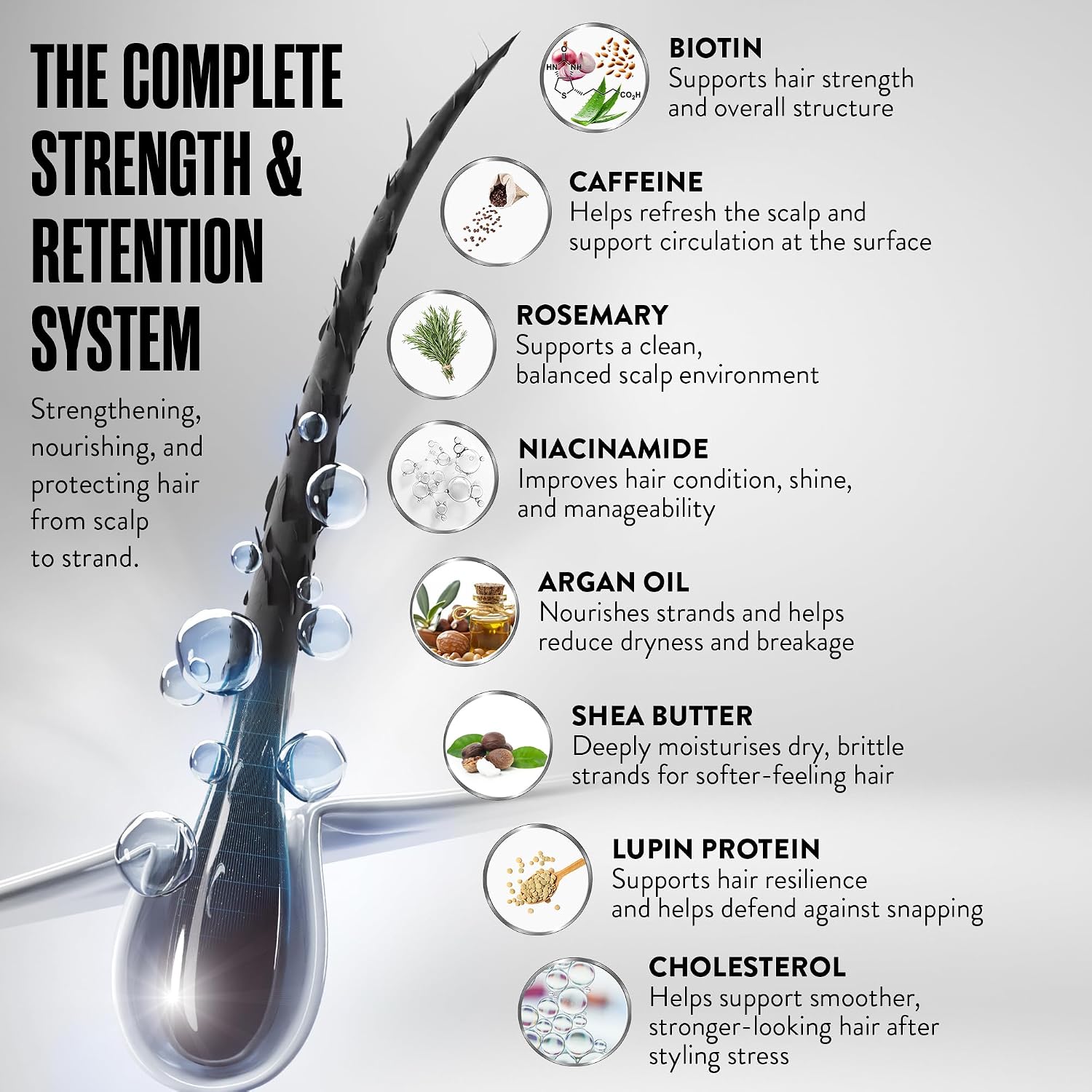
An 8 in 1 deep conditioning mask with rosemary, caffeine, hydrolysed lupine protein, niacinamide, provitamin B5 and argan oil. For the older lengths that went through the shed with you, once a week. Softer, less brittle ends mean less breakage, and less breakage means the length you kept actually stays.
Vegan and made in the UK
When recovery has stalled
Most recoveries follow the pattern above. A few do not, and it is worth knowing the difference rather than waiting indefinitely and hoping.
The most common reason for a shed that will not settle is that the trigger is still running. If you are still in a substantial calorie deficit, still losing weight quickly, or your protein intake is still low, the follicles are still receiving the same signal, and the episode simply repeats. In that situation, more hair care is not the answer and the fix is upstream. Our guides to protecting your hair while losing weight and hair loss after weight loss cover the nutrition and rate of loss side in detail.
The second reason is that what looked like a temporary shed has unmasked pattern thinning that was already developing underneath. A shed removes camouflage, so the widening parting that was going to become obvious in three years becomes obvious now. The tell is the pattern: pattern thinning concentrates at the parting and the temples and does not fully recover, while a temporary shed is diffuse and does. What causes telogen effluvium goes through how to tell them apart.
Book in with your GP if the shedding is still worsening after six months, if there are smooth completely bare patches anywhere, if your scalp is red, sore, scaly or has pustules, if you are also losing eyebrows, eyelashes or body hair, or if you have other symptoms such as exhaustion, feeling cold, low mood or changed periods, which can point towards thyroid or iron problems. Take a photograph of your parting with you. If you have had weight loss surgery, absorption needs long term monitoring by your clinical team and hair changes are a reason to speak to them.
Watermans products are 100% cosmetic and do not treat medical hair loss. Individual results may vary.
Frequently asked questions
How long does hair take to recover after weight loss?
Shedding typically settles within three to six months of the trigger easing, and new hairs appear at the scalp within two to three months of that. Reaching a length that visibly restores density takes a further six to twelve months, so most people are back to normal somewhere between twelve and eighteen months from the original trigger.
What are the first signs that hair is growing back?
A halo of short, fine, often wiry hairs standing up along the hairline and the front of the parting, usually one to three centimetres long and refusing to lie flat. They taper to a fine point at the tip, which is how you tell them from breakage, which snaps bluntly at varying lengths across the whole head.
Is the short frizzy hair at my hairline new growth or damage?
Look at the tips under a bright light with your phone camera. New hairs taper to a fine point and cluster at the hairline and parting. Broken hairs have blunt ends, appear all over the head rather than in a band, and often come with split ends further down the length.
Why does my hair still look thin even though shedding stopped?
Because those are two different events separated by months. Shedding stopping means no more hair is being lost. Density returning requires the replacement hairs to grow to a useful length, and at roughly 1cm a month that takes the best part of a year. Nothing has gone wrong.
Can I speed up hair recovery after weight loss?
Not the biology itself. The cycle runs at its own pace and no product changes it. What you can influence is whether the trigger has genuinely stopped, whether you are eating enough protein and are not short of iron, and whether you are breaking off the new growth through rough handling and tight styles.
Should I cut my hair while it is recovering?
Usually yes, and it is the fastest visible improvement available. Density is hair spread over length, so removing length concentrates what you have. Ask for a blunter line rather than heavily tapered ends, since blunt ends read as considerably fuller.
Will my hair be as thick as it was before?
For most people, yes, because a shed like this redirects the hair cycle rather than damaging the follicle. The exceptions are where the original trigger never stopped, and where the shed exposed pattern thinning that was developing anyway. The pattern is the clue: diffuse recovers, and thinning concentrated at the parting and temples usually does not.
Do hair vitamins help recovery?
They help if you are genuinely short of something, which is common after a period of reduced eating, and they do nothing at all for a nutrient you were never low on. A blood test comes before the purchase. Never supplement iron without testing first, since too much is harmful.
What to do this week
Take a photograph of your parting under consistent light, and diarise another for three months from now, because that comparison will tell you more than daily mirror checks ever will. Count your daily shedding across one wash day and one non wash day so you know objectively where you are. Then look carefully at your hairline for the halo of short hairs, because if it is there, the answer to the question you came here with is already yes.
After that the job is simply not to undo it. Leave the new growth alone, condition the older lengths every wash, detangle from the ends upwards, and get a cut that concentrates what you have rather than spreading it thin. Watermans is a British hair care brand, vegan and made in the UK, with over 6.5 million bottles sold since 2012.