Hairline Breakouts: Why Spots Follow Your Hairline
Hairline breakouts are spots in a band that follows the edge of your hair, across the forehead or around the temples, and the usual cause is your hair routine rather than your face. Conditioner, styling product or dry shampoo sits on skin it was never meant to sit on, or shampoo is not fully rinsed away. Most hairline breakouts clear up by changing the order of your shower and where you place product, not by buying anything new.
Our hair growth shampoo
Grow Me® Hair Growth Shampoo, £14.95. A sulphate free daily shampoo that supports a healthy scalp environment and helps reduce breakage, so lengths hold on and look fuller.

Key takeaways
- Spots in a band that follows your hairline are usually caused by hair products, not by your face routine.
- The giveaway is the pattern: it traces where your hair touches skin, and stops where your hair stops.
- Rinsing is the most common failure. Conditioner running down your forehead is the classic cause.
- Wash your face after you wash your hair, never before. Order alone fixes a lot of cases.
- Heavy leave-in products, dry shampoo and styling waxes are the worst offenders at the boundary.
- If it is painful, deep, spreading or scarring, that is a GP question rather than a routine question.
Why do hairline breakouts happen when the rest of your face is fine?
Because the hairline gets a completely different set of products applied to it than the rest of your face, and nobody plans for that. Everything you put on your hair passes across that strip of skin on its way down, and a fair amount of it stays there. Meanwhile the skin itself is no different from the skin two centimetres lower, so it responds exactly as your cheek would if you smeared conditioner on it and left it overnight.
The specific problem is that most hair products are formulated to cling. That is the point of them. A conditioner is designed to deposit and stay put, a styling cream is designed to hold, a dry shampoo is designed to sit on the surface and absorb. Those are all excellent properties for hair and unhelpful ones for pores. Add the fact that the hairline is warm, often covered by a fringe, and rubbed by pillows, hats and hands, and you have a small zone that is doing considerably more work than the skin around it.
There is a longstanding name for the classic version of this, sometimes called pomade acne, which describes exactly this pattern of small uniform bumps along the hairline and forehead in people using heavy hair products. It is not a reflection of how clean you are, and washing your face harder does not solve it, because you are cleaning one side of a problem that is being reapplied from the other side every morning. Related reading: our guide to pomade acne.
Which products cause hairline breakouts most often?
Ranked roughly by how often they are the answer:
| Product | Why it causes trouble | The fix |
|---|---|---|
| Conditioner and masks | Runs down the forehead in the shower and rinses last | Keep them off the scalp entirely, mid-lengths and ends only |
| Styling wax, pomade, clay | Heavy, occlusive, applied right at the front | Apply from the mid-lengths back, wash out the same day |
| Dry shampoo | Sits on skin, builds up over consecutive days | Never two days running without a wash in between |
| Hair oils | Migrate onto the face overnight | Ends only, and rinse out pre-wash oils properly |
| Hairspray | Overspray lands on the whole forehead | Shield your face with a hand or a card |
| Heavy sunscreen at the parting | Thick creams clog where hair is sparse | Use a scalp-specific spray or a powder on partings |
Note what is not on that list: shampoo. Shampoo is a rinse-off product and rarely the cause on its own, with one exception, which is not rinsing it out properly. That leads neatly to the single most common mistake of all.

What is the single biggest fix for hairline breakouts?
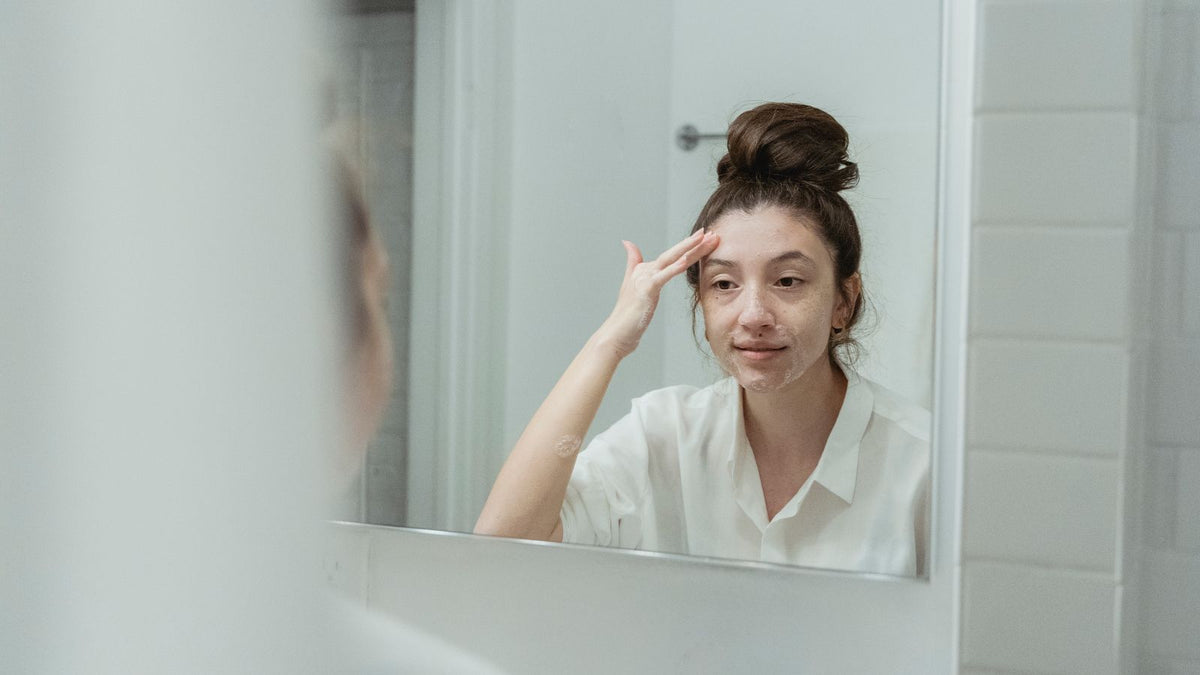
Change the order of your shower. Most people wash their face first, then do their hair, then get out. That means the last thing to touch your facial skin is the runoff from your conditioner, and it then dries there and sits for the rest of the day.
Swap them round. Wash and condition your hair, rinse it thoroughly, and only then wash your face. It takes no extra time, costs nothing, and for a surprising number of people it is the entire solution. If you do nothing else on this page, do this.
Alongside that, rinse for longer than feels necessary. Most people stop rinsing when the hair stops feeling slippery, but the hairline is the last place the water reaches and the first place product pools. Tip your head back, let the water run across the hairline specifically, and give it an extra fifteen seconds. Then run a clean flannel along the hairline afterwards as a final check.
The rest of the routine, in order of how much difference it makes
- Keep conditioner off your scalp. It has no job there. Start at the ears and work down.
- Wash your pillowcase weekly, more often if you use leave-in products. It is the surface your hairline spends eight hours pressed against.
- Take hats and headbands off when you get in. Warm, occluded and rubbing is the worst combination for that strip of skin.
- Tie hair back at night if you use leave-in products, so it is not lying across your face.
- Stop touching it. Pushing a fringe out of your eyes forty times a day transfers oil from your hands straight onto the affected area.
- Clean your hairbrush and your phone screen. Both spend time against the sides of your face.
- Give any change three to four weeks. Skin turns over on roughly a month-long cycle, so a fortnight tells you very little.
Is it spots, or is it something else?
Not everything along the hairline is a breakout, and the responses are different enough to be worth separating.
- Small uniform bumps in a band, following the hairline: most likely product related, as above.
- Flaking with redness underneath, often greasy and yellowish rather than dry and white: more likely a flaky scalp condition extending onto the face, and washing less will make it worse rather than better. Our guide to a flaky scalp covers what actually helps.
- Itching and irritation without spots, shortly after starting something new: more likely a sensitivity to an ingredient. We look at that in whether hair products can cause scalp itching.
- Tiny bumps at the follicle openings, sometimes with a hair through the middle: irritation of the follicle itself, often from friction, tight styles or sweat under a hat.
- Painful lumps under the skin, spreading redness, or anything that scars: stop guessing and see your GP.

Get a discount on your next order
Join the Watermans mailing list and we will email a discount code straight to your inbox. Made in the UK, over 6.5 million bottles sold since 2012.
How do you find the product behind your hairline breakouts?
By removing things one at a time, in the order of how likely they are, and giving each step long enough to mean something. Four weeks per step feels slow and is the only approach that gives you a real answer.
- Weeks 1 to 4: change nothing except the shower order and how thoroughly you rinse. Keep conditioner off the scalp. A large share of people stop here because the problem goes.
- Weeks 5 to 8: if it has not, drop all leave-in styling products, waxes and dry shampoo. Keep washing and conditioning exactly as before so you are only changing one variable.
- Weeks 9 to 12: if it persists, switch to a simpler, sulphate-free shampoo and see whether the skin settles.
- Then reintroduce, one product at a time, four weeks apart. This is the part everyone skips, and it is the part that tells you which single product to avoid forever rather than making you avoid all of them.
Photograph the area at the start of each block, same light, same angle. Skin is even harder to judge from memory than hair is.
Where do hair products fit if you are prone to this?
You do not need to give up hair care. You need products that rinse cleanly and a habit of keeping the heavy ones away from skin. A sulphate-free shampoo is worth considering here for a specific reason: harsher detergents strip the skin barrier, and a compromised barrier is more reactive to everything else you put near it, so gentler washing tends to leave the hairline calmer even though the shampoo was never the direct cause. There is more on that trade-off in our guide to switching to sulphate-free shampoo.

Grow Me® Shampoo
Sulphate-free, so it cleans the scalp and hairline without stripping the skin barrier, and it rinses out cleanly rather than leaving a film. If you have moved to washing more often while sorting this out, a gentler daily wash is the sensible base to do that on.
Shop Grow Me Shampoo
Condition Me® Conditioner
A lighter conditioner than a heavy mask, which matters when runoff is the problem. Apply from the ears down, never at the roots, and rinse for longer than feels necessary. Used that way it does its job on the lengths without ever reaching the skin that is giving you trouble.
Shop Condition MeWatermans is a UK family business and has sold over 6.5 million bottles since 2012. Every product is cruelty free and made in the UK.
When should hairline breakouts be seen by your GP?
Most hairline breakouts are a routine problem and resolve once the source is removed. Speak to your GP or a pharmacist if the spots are painful or deep rather than surface bumps, if they are leaving marks or scars, if the area is spreading, hot or weeping, if nothing has changed after three months of genuinely working through the elimination steps above, or if you are losing hair from the affected area rather than simply having spots in it. None of those are things to keep experimenting on at home.
Frequently asked questions
Why do I only get spots along my hairline?
Because that strip of skin receives your hair products as well as your skin products, and most hair products are designed to cling rather than rinse away. The pattern following your haircut rather than your face is the giveaway.
Should I wash my face before or after my hair?
After. If you wash your face first, the last thing to touch that skin is conditioner runoff, which then dries there. Swapping the order round is the single highest value change on this page and it costs nothing.
Can shampoo cause forehead spots?
Rarely on its own, because it rinses off. Shampoo left in, or not rinsed thoroughly at the hairline where water reaches last, absolutely can. Rinse for an extra fifteen seconds with your head tipped back.
Is dry shampoo bad for your hairline?
It is one of the more common culprits, because it is designed to sit on the surface and it accumulates across consecutive days. Try not to use it two days running without washing in between.
Should I stop conditioning my hair?
No. Change where you put it. Conditioner belongs on mid-lengths and ends, which is where the damage is, and it has no useful job at the roots or scalp at all.
How long before I see a difference in hairline breakouts?
Give any single change three to four weeks, since skin turns over on roughly a month-long cycle. Judging it after a week will mislead you in both directions.
Can hair products cause spots on my back?
Yes, and the mechanism is identical. Conditioner runs down your back in the shower and is rinsed off before the length of your hair is. Washing your body after your hair fixes the same problem in a different place.
Does a fringe make hairline breakouts worse?
Often, because it keeps the area warm and covered, holds product against the skin, and rubs. It does not mean you have to cut it off, but pinning it back at home and at night usually helps.
Are hairline spots a sign of hair loss?
Not by themselves. Spots and hair loss are separate things. If you are seeing genuine thinning or a receding line in the same area, that is worth a conversation with your GP rather than an assumption that the two are connected.
What is the bottom line on hairline breakouts?
Hairline breakouts are a boundary problem, not a face problem. Wash your hair before your face, rinse the hairline for longer than feels necessary, keep conditioner and heavy styling products off the roots and the front, and wash your pillowcase. Then, if it is still there, eliminate one product at a time over four week blocks rather than changing everything at once. Be gentle with the skin while it settles, and take anything painful, deep or scarring to your GP. If your question is about products or a routine rather than a medical one, you can talk to Gail Waterman, our co-founder, as an AI avatar on the Watermans homepage.
If you want a gentler base to work from while you sort it out, the sulphate-free Grow Me Shampoo is the sensible place to start.
Sources and References
- NHS, Acne, for what spots are, self care measures and when to speak to a GP.
- Taylor and colleagues, A review of acne in ethnic skin, Journal of Clinical and Aesthetic Dermatology, 2010, for pomade acne, the classic hairline and forehead pattern caused by heavy hair products.
- Dreno and colleagues, The influence of exposome on acne, Journal of the European Academy of Dermatology and Venereology, 2018, for cosmetics and external factors as contributors to spots.
- A case control study exploring the association between cosmetic use and acne risk, Clinical, Cosmetic and Investigational Dermatology, 2025, for the link between product use habits and breakouts.