How to Stop Hair Fall Due to Thyroid: A Practical Care Plan
If you are asking how to stop hair fall due to thyroid trouble, the honest answer is that the hair follows the thyroid. Shedding linked to an underactive or overactive thyroid settles once your levels are stable and under the care of your GP, usually over several months. Nothing you put on your hair changes thyroid hormones. What good hair care does is protect the length you still have while the shedding runs its course.
Our hair growth shampoo
Grow Me® Hair Growth Shampoo, £14.95. A sulphate free daily shampoo that supports a healthy scalp environment and helps reduce breakage, so lengths hold on and look fuller.
Key takeaways
- Both an underactive thyroid and an overactive one can push a wave of follicles into their resting phase, so the shedding is diffuse rather than patchy.
- The step that matters most is a blood test and ongoing care with your GP. Hair care supports that, it does not replace it.
- Shedding often continues, and can briefly increase, in the first weeks after your care begins. That is expected and is not a sign it is failing.
- Most people see the shedding settle over three to six months once levels are stable, with visible density taking longer.
- Iron, ferritin and vitamin D are worth asking your GP about, because low stores are common alongside thyroid problems and make shedding worse.
- Never start iodine or thyroid supplements on your own. Some can make certain thyroid conditions worse.
Why does a thyroid problem make hair fall out?
Understanding the mechanism is what makes how to stop hair fall due to thyroid trouble a realistic plan rather than a shopping list. The thyroid gland sets the pace of the hair cycle along with everything else. Thyroid hormones act directly on the hair follicle, and laboratory work has shown that thyroid hormone signalling helps control hair follicle stem cell behaviour, which is the machinery that decides whether a follicle keeps growing or takes a rest. When levels run too low or too high, more follicles than usual leave their growing phase together and enter the resting phase.
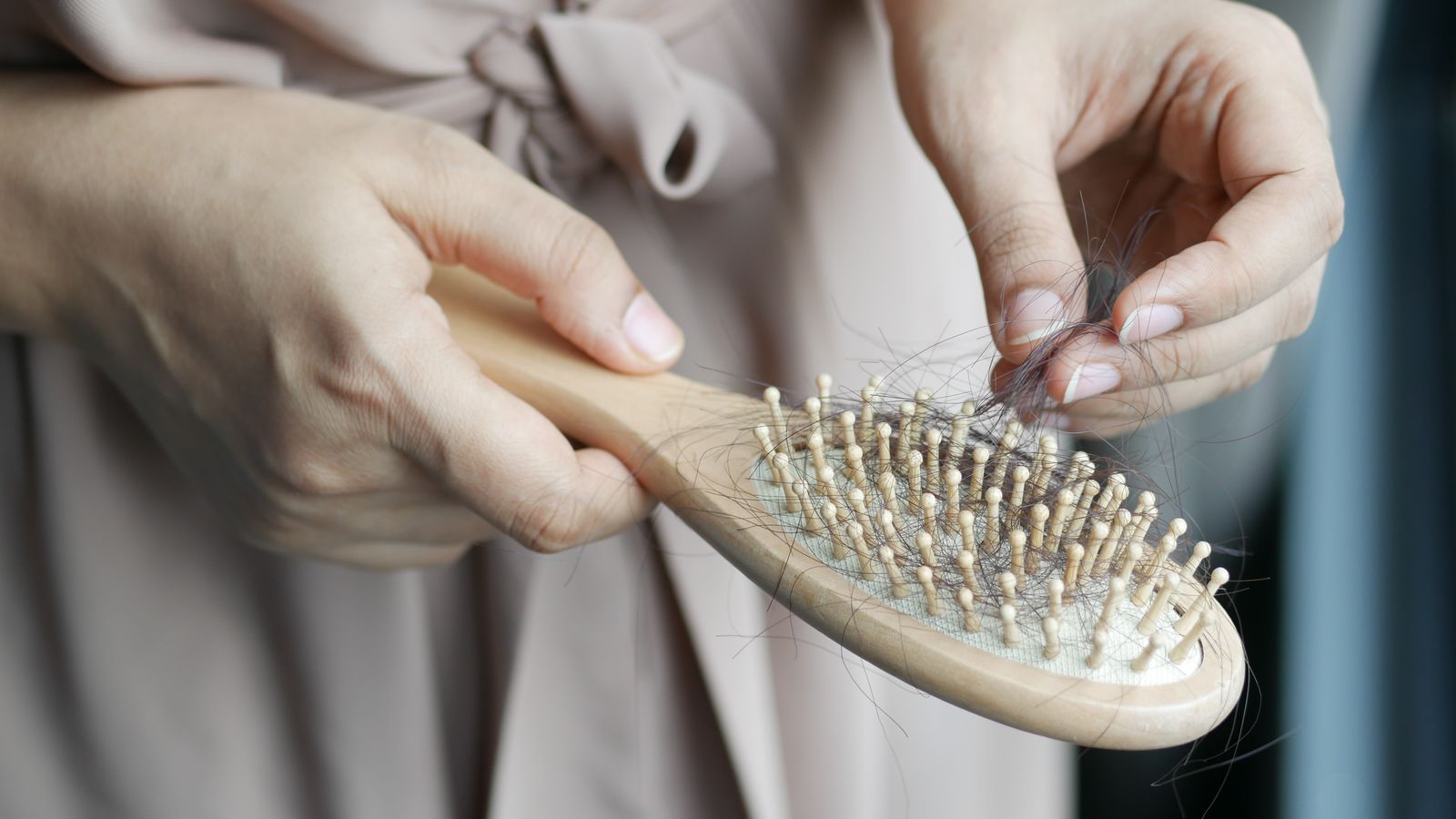
Roughly three months later, those resting hairs are released and you notice the result all at once, in the brush, the shower and on your pillow. That delay is why the shedding often begins when you are already starting to feel better, and why people wrongly blame the medicine rather than the months that came before it.
Two patterns are worth knowing. An underactive thyroid tends to produce coarse, dry, brittle hair with diffuse thinning across the whole scalp, and some people notice the outer third of their eyebrows thinning too. An overactive thyroid tends to produce fine, soft hair that comes away easily when washed. Both are diffuse. Neither creates bald patches, so patchy loss needs a separate look from your GP.
Is it hair loss, shedding or breakage?
These three get muddled constantly, and the answer changes what you should do next. Look closely at the hairs you are picking up.
| Type | How to spot it | What it needs |
|---|---|---|
| Hair shedding (the thyroid pattern) | Full length hairs with a small pale bulb, more than usual, from all over the head | Time, and stable thyroid levels under your GP |
| Hair loss (follicular) | Patches of bare scalp, or a parting that keeps widening over months | A medical assessment. This is not a cosmetic problem |
| Hair breakage (fibre) | Short bulbless pieces, split ends, dry straw like texture | Conditioning, gentler handling, less heat and tension |
Thyroid hair trouble often serves up two of these at once: a shedding wave from the cycle, and breakage because an underactive thyroid leaves the fibre dry and rough. Handling both at once is what makes the difference to how your hair looks in the mirror.
Get a discount on the thyroid related shedding range
Join the Watermans mailing list and we will email a discount code straight to your inbox, so you can try the thyroid related shedding range for less. Made in the UK, over 6.5 million bottles sold since 2012.
What should you ask your GP?
Go in with a short, specific list, because the appointment is the single most useful step in how to stop hair fall due to thyroid problems. Ask for a thyroid function blood test, usually TSH with T4, and ask what your numbers are rather than accepting "normal". Ask about ferritin and iron, since low iron stores are common and worsen shedding independently of the thyroid. Ask about vitamin D and B12 if you have been tired for a long time. Ask whether anything you already take could be contributing.
Bring dates. When did the shedding start, how much hair a day are you noticing, what else changed in the six months before it began. If you have had a baby, a serious illness, a big weight loss or an operation in that window, say so, because that alone can cause a shedding wave and it can sit on top of a thyroid problem rather than instead of it.
If your thyroid tests come back normal and the shedding continues, that is still worth pursuing. Our guide to what causes telogen effluvium covers the other common triggers, and our explainer on thyroid related hair loss goes deeper into the symptoms and mechanisms behind it.

How to stop hair fall due to thyroid problems day to day: what helps?
Here is the practical plan while your levels settle. None of it is dramatic, and all of it is within your control.
- Keep your appointments and your blood tests. Stable levels are the thing that ends the shedding wave, and stability takes a few rounds of testing to reach.
- Eat enough, with enough protein. Hair is one of the first things the body deprioritises when energy or protein intake drops. Aim for a protein source at every meal, plus iron rich foods such as red meat, lentils, beans and dark leafy greens with a source of vitamin C.
- Ask about iron rather than guessing. Iron supplements taken without a blood test can be harmful, and iron also interacts with thyroid medicines, so timing matters. Let your GP decide.
- Handle wet hair like silk. Comb from the ends upward with a wide tooth comb on conditioned hair. Never brush hair straight out of the shower.
- Turn the heat down. Air dry when you can, keep irons at or below 170 degrees, and always use a heat protectant. Dry thyroid hair breaks easily.
- Loosen everything. No tight ponytails, no daily tight buns, no elastic bands with metal joins. Traction adds a second problem you do not need.
- Protect your sleep and your stress levels. Both push more follicles into the resting phase, and both are usually already under strain when your thyroid is playing up.
Notice what is not on that list: no supplement claiming to fix thyroid hair, no miracle serum, no scalp device. If you want the fuller version of the gentle handling routine, our guide to stopping hair breakage naturally at home is the companion piece to this one.

How long until the shedding settles?
Expect months rather than weeks, and expect the timeline to be uneven. A follicle that has entered its resting phase stays there for two to four months before the hair is released, and the British Association of Dermatologists describes a shedding phase that typically runs for three to six months once it starts. Because of that queue, shedding can even rise for a few weeks after your care begins, when the hairs that gave up months ago finally let go.
| Stage | What is usually happening |
|---|---|
| First 4 to 8 weeks after care starts | Shedding continues and may briefly increase. Energy and other symptoms often improve first. |
| 3 to 6 months | Shedding slows towards your normal daily loss. Short new hairs appear along the parting and hairline. |
| 6 to 12 months | Density visibly improves as the new hairs gain length. Texture usually improves alongside it. |
| Beyond 12 months | If heavy shedding is still going and your levels are stable, go back to your GP. Something else may be involved. |
Where does hair care honestly fit?
In one place only: keeping the hair you have in good condition so that a thinner head of hair still looks and feels its best. A shampoo cannot alter thyroid hormones, and any product sold to you on that basis is not being straight with you. What a gentle, sulphate free routine does is reduce the breakage that piles on top of the shedding, which is a real and visible difference when every strand counts.

A gentle sulphate free everyday wash with biotin, caffeine and rosemary. Cosmetic support for a comfortable scalp and fuller looking hair while you and your GP sort out the underlying cause.

Breakage defence for hair that has turned dry and rough. Cholesterol, shea butter and glycerin make detangling far less destructive, which matters most when shedding is already high.

When should you go back to your doctor?
Book another appointment if the shedding is still heavy 12 months after your levels became stable, if you develop patches of bare scalp, if your scalp is sore, scaly or itchy in the same areas the hair is coming from, or if your other symptoms return. Also go back if you feel worse rather than better after starting your care, since dose adjustments are normal and expected in the first year.
Watermans products are 100% cosmetic and do not treat medical hair loss. Individual results may vary.
Frequently asked questions
Is thyroid related hair fall permanent?
Usually not. The follicles are still there, they have simply been pushed into the resting phase together, so hair generally comes back once levels are stable. Long standing untreated thyroid problems and a genetic pattern of thinning underneath can both make the recovery less complete.
How to stop hair fall due to thyroid problems while I wait for my levels to settle?
You cannot stop the shedding wave itself, because it was set in motion months ago. What you can do is stop adding to it: gentle wet handling, less heat, loose styles, enough protein and iron rich food, and a mild sulphate free wash.
Will a shampoo or supplement fix thyroid hair fall?
No. Cosmetic products work on the strand, not on the gland. Supplements only help if you are genuinely low in something, which is why it is worth asking your GP for iron and vitamin D tests rather than guessing.
Why did my shedding get worse after I started my medicine?
Because of the delay in the hair cycle. Hairs that entered the resting phase during the months you were unwell are released around three months later, which often lands just as you start feeling better.
Can hair fall be the only sign of a thyroid problem?
It can be the sign you notice first, though there are usually other clues on questioning, such as tiredness, temperature sensitivity, weight change or altered periods. A blood test settles it, so ask for one rather than wondering.
Are my eyebrows involved too?
Sometimes. Thinning of the outer third of the eyebrows is a recognised feature of an underactive thyroid. Mention it to your GP, because it is a useful clue.
Should I take iodine for my thyroid and my hair?
Not without medical advice. Iodine can worsen some thyroid conditions, and taking it on your own is a genuine risk rather than a harmless experiment.
Does stress make thyroid hair fall worse?
Yes, in the sense that stress can trigger its own shedding wave on top of the thyroid one. Sleep, food and load management are not a cure, but they stop you stacking a second problem on the first. Our guide to stress and hair loss covers that overlap.
Is it worth seeing a specialist?
If your levels are stable, your iron is fine and heavy shedding continues past a year, ask your GP whether a referral to a dermatologist is appropriate. We do not run clinics and cannot assess your scalp ourselves. If your question is about products or a routine rather than a medical one, you can talk to Gail Waterman, our co-founder, as an AI avatar on the Watermans homepage.
What is the bottom line on how to stop hair fall due to thyroid?
The realistic answer to how to stop hair fall due to thyroid problems is that the thyroid leads and the hair follows. Get tested, stay in your GP's care until your levels are genuinely stable, and give the hair cycle three to six months to catch up. In the meantime, protect what you have: gentle wet handling, far less heat, loose styles, enough protein and iron rich food, and a mild sulphate free wash with a conditioner that keeps the comb moving. If heavy shedding continues once your levels have been stable for a year, go back and ask again. Watermans is made in the UK, and has sold over 6.5 million bottles since 2012.
Sources and References
- NHS, Underactive thyroid (hypothyroidism), for symptoms, blood testing and what care involves.
- NHS, Overactive thyroid (hyperthyroidism), for the same on the overactive side.
- British Thyroid Foundation, Hair loss and thyroid disorders, for the pattern and timeline of thyroid related shedding.
- British Association of Dermatologists, Telogen effluvium leaflet, for the resting phase of two to four months and the three to six month shedding phase.
- Contreras Jurado and colleagues, Thyroid hormone signaling controls hair follicle stem cell function, Molecular Biology of the Cell, 2015, for thyroid hormone acting directly on the follicle.