How to Stop Hair Breakage Naturally at Home
The honest answer to how to stop hair breakage naturally at home is that most of it happens before you buy anything. Hair breakage is mechanical: the fibre snaps because something pulled, rubbed or dried it past what it could take. Change the handling and you remove the cause. Then use natural oils and conditioning to make the fibre more able to withstand the friction that is left. Keeping length is half of looking thicker, and we set out the rest in how to thicken hair naturally in a month.
Our hair and body oil
Camellia & Black Castor Hair & Body Oil, £24.95. Adds hydration and shine to dry lengths and smooths the hair before a blow dry, without weighing fine hair down.
That order matters, and it is the opposite of how most advice is written. A weekly mask on hair you are still brushing from the roots down, tying tightly in the same place and rubbing dry with a bath towel is a mask fighting a losing battle. Fix the handling first, and everything else starts working. Our guide to choosing a microfibre hair towel explains what to look for and how to use one.
Key takeaways
- Most of how to stop hair breakage naturally at home is handling, not products. The changes that matter most are free.
- Detangle from the ends upward, never from the roots down. This is the single biggest one.
- Coconut oil is the one natural oil with published evidence for reducing protein loss.
- Protein and moisture is a balance. Guessing wrong makes breakage worse, so use the wet stretch test.
- Breakage gives short pieces with no bulb. Whole strands with a pale bulb are shedding, which is different.
Is it breakage, shedding or hair loss?
This takes thirty seconds and saves months, because the three problems look similar in the plughole and need completely different responses.
| Hair breakage | Hair shedding | Hair loss | |
|---|---|---|---|
| Where it happens | Along the fibre, above the scalp | At the follicle, the whole hair is released | At the follicle, gradually |
| What you find | Short broken pieces, no bulb on either end | Whole strands with a small pale bulb at one end | Fewer and finer hairs in one area |
| Other signs | Rough ends, flyaways at the crown, hair will not gain length | More hair than usual for a few months, often after illness, stress or childbirth | A widening parting, a thinning crown, a receding line |
| What helps | Everything on this page | Time, and dealing with the trigger | Your GP, because the causes are medical |
The quick test
Pick up a few of the hairs you have lost today and look at the ends. A small pale bulb at one end means the hair came out of the follicle, which is shedding. No bulb, and a length much shorter than your hair, means it snapped, which is breakage. You can have both at once.

How to stop hair breakage naturally at home: which handling changes matter most?
These are free, they take no extra time once they are habit, and between them they prevent more breakage than any product on the market.
Detangle from the ends upward
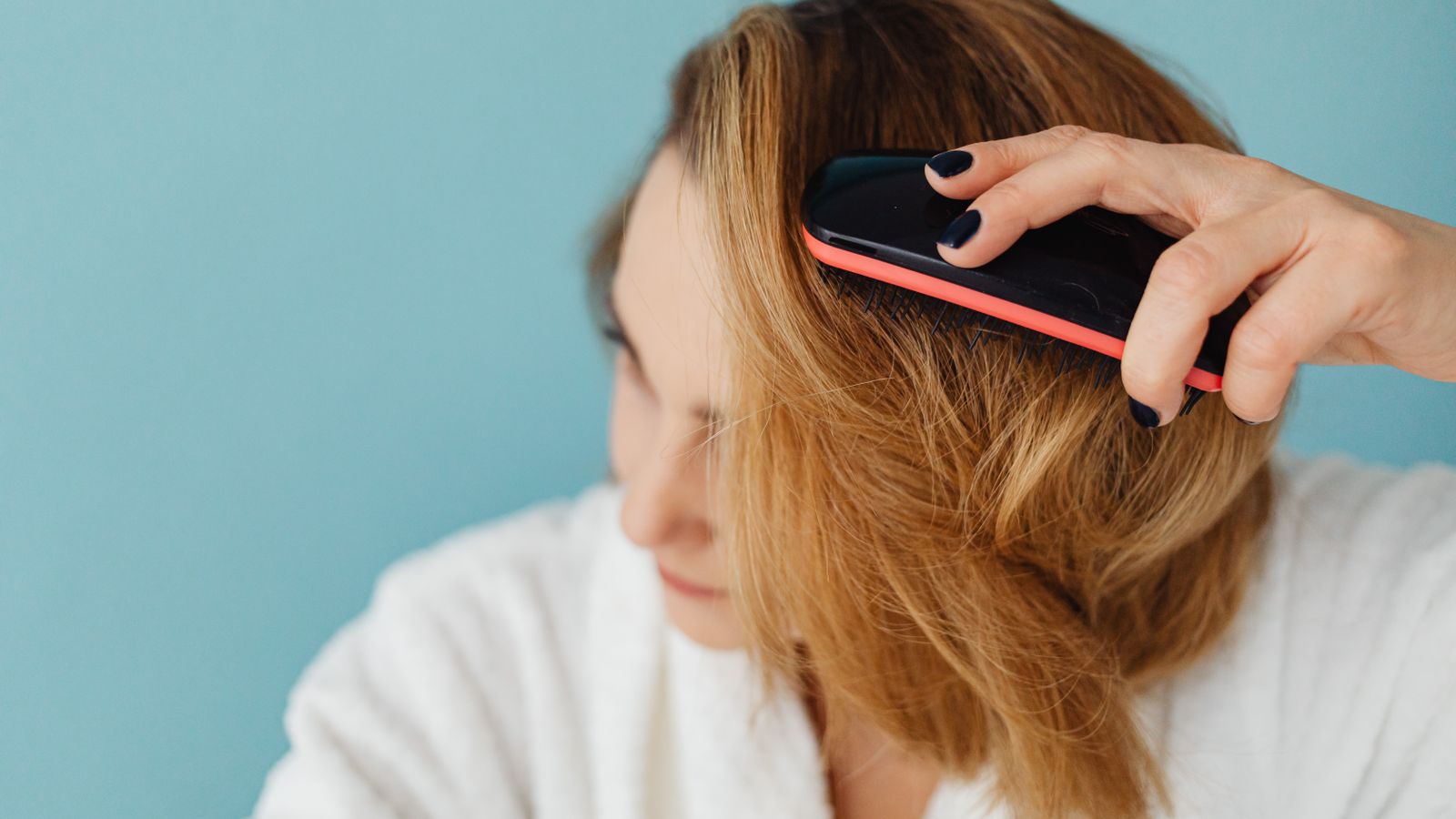
This is the most important line on the page. Brushing from the roots down gathers every knot and pushes it into a tighter and tighter ball, and then you pull it through. Instead, take a wide tooth comb, start at the last few centimetres, work those tangles out, then move up a section and repeat. Do it with conditioner still in, in the shower, where there is slip to help.
Move the ponytail, and loosen it
Hair breaks at the tie line because that is where the tension concentrates, and wearing the same tight style daily puts that stress in exactly the same place every day. Vary the height, use a soft fabric tie rather than an elastic with a metal join, and let it out in the evening.
Squeeze, do not rub
Wet hair is at its weakest, swollen and easy to stretch out of shape. Vigorous rubbing with a rough bath towel while it is in that state does real damage. Squeeze the water out with a microfibre towel or an old cotton t shirt instead, and skip the towel turban, which adds both weight and friction.
Reduce overnight friction
Eight hours is a third of the day, and every one of those hours has hair dragging against fabric. A loose braid, a smoother pillowcase, or both, is a small change that removes a large amount of cumulative friction from the same lengths night after night.

Turn the heat down, and use protection
Heat is the other mechanical stress. Water inside the fibre turns to steam and forces the cuticle open, and repeated often enough that surface never lies flat again. Use the lowest temperature that works, one pass rather than five, and never irons on damp hair. Interestingly, air drying is not the automatic safe option either: one study of repeated washing and drying found that the internal cell membrane complex was damaged only in the group left to dry naturally, because hair stays swollen and vulnerable for as long as it is wet. A medium setting, moving, at a distance, is a sensible middle.
Which natural remedies genuinely strengthen hair?
With the handling sorted, the product side of how to stop hair breakage naturally at home is short. Here it is in the order of how much evidence sits behind each one.
For moisture and protection: coconut oil
Coconut oil is the standout, and unusually for a folk remedy it has published support. A study comparing mineral oil, sunflower oil and coconut oil on hair found that only coconut oil reduced protein loss, in both damaged and undamaged hair and both before and after washing. The reason is structural: its main fatty acid is small enough, and has enough affinity for hair protein, to get inside the fibre rather than sitting on the surface the way heavier oils do.
Use it as a pre wash treatment. Warm a small amount, work it through the lengths and ends, leave it for an hour or overnight, then shampoo as normal. Sunflower and olive oils are pleasant surface conditioners but did not show the same protein sparing effect.


Camellia & Black Castor Hair & Body Oil £24.95
A blend of black castor and camellia oils for use as a pre wash treatment or a light finish on the ends. Camellia oil is high in oleic acid, which behaves like the penetrating oils rather than the purely surface ones.
For protein, used sparingly
Protein firms up a weakened fibre by filling the gaps, but it is easy to overdo. Hydrolysed proteins in a formulated conditioner or mask are the useful kind, because they are broken down small enough to get into the hair. Whole egg and mayonnaise masks, despite their popularity, contain proteins far too large to penetrate anything, so they coat and smooth rather than strengthen.
The wet stretch test
Take one wet strand and pull it gently between two fingers. Healthy hair stretches around a third and springs back. A long stretch with no spring back means it needs protein. An instant snap with no stretch means it needs moisture. Check every fortnight rather than guessing, because using the wrong one is the most common way home routines make breakage worse.

Condition Me® Conditioner £13.95
A breakage defence conditioner with cholesterol, shea butter, glycerin and hydrolysed lupine protein. The slip is what matters for breakage specifically: hair that combs through without dragging loses far fewer strands to the comb.
Get a discount on the hair breakage range
Join the Watermans mailing list and we will email a discount code straight to your inbox, so you can try the hair breakage range for less. Made in the UK, over 6.5 million bottles sold since 2012.
To smooth and seal
Once moisture is in, something needs to keep it there and keep the cuticle lying flat. A weekly deep mask does the heavy work, and a very small amount of oil on the ends afterwards seals it. The mistake here is quantity: hair needs a fraction of what most people apply, and excess oil simply attracts dirt and weighs the hair down.

Masque Me® Hair Growth Mask £24.95
An 8 in 1 deep conditioning mask with hydrolysed lupine protein, provitamin B5 and argan oil. Use it weekly in place of conditioner rather than in addition to it, which is the schedule most people get wrong.
If your ends have already split, no mask closes them permanently, and preventing split ends covers the habits that stop them recurring. For a broader look at where the damage came from, what causes hair damage works through the four types, and how to repair damaged hair matches each type to its fix.
Does what you eat affect hair breakage?
Less dramatically than supplement marketing suggests, but not nothing. Hair is made of protein, and it is one of the first things the body deprioritises when nutrition is genuinely inadequate. What that means in practice is narrow: if your diet is broadly adequate, more protein or more supplements will not give you stronger hair. If it is genuinely lacking, correcting that will help.
| Nutrient | Why it matters for hair | Where to get it |
|---|---|---|
| Protein | Hair is largely keratin, a protein | Meat, fish, eggs, pulses, tofu, dairy |
| Iron | Low iron is a recognised contributor to hair changes, particularly in women | Red meat, pulses, dark leafy greens, fortified cereals |
| Zinc | Involved in hair follicle function and tissue repair | Shellfish, meat, seeds, nuts, wholegrains |
| Vitamin D | Widely low in the UK over winter | Sunlight in summer, oily fish, and the government advises a supplement in winter |
| Omega 3 fats | Contribute to normal cell membranes and scalp comfort | Oily fish, walnuts, flaxseed |
The NHS advises that adults in the UK consider a daily vitamin D supplement during autumn and winter, which is sensible general advice rather than a hair recommendation. Do not start iron supplements on a hunch: too much iron is harmful, and a blood test through your GP is the way to know.
What does a realistic weekly routine look like?
Putting how to stop hair breakage naturally at home together, a week that works for most people looks like this.
| When | What | Why |
|---|---|---|
| Once a week, before washing | Coconut or camellia oil on lengths for an hour | The one pre wash step with evidence behind it |
| Every wash | Shampoo at the scalp only, conditioner mid lengths to ends | The ends are oldest and need no direct detergent |
| Every wash | Detangle in the shower, ends upward, wide tooth comb | Where most avoidable breakage is prevented |
| Once a week | Deep mask in place of conditioner | The main conditioning step |
| Every fortnight | Wet stretch test, adjust protein against moisture | Stops you treating the wrong problem |
| Nightly | Loose braid or smoother pillowcase | Removes a third of the day of friction |
| Every 8 to 12 weeks | Trim the ends | Splits travel upward if they are left |
When should you stop and see someone?
How to stop hair breakage naturally at home is the right approach for breakage. It is the wrong approach for anything happening at the follicle, and it is worth knowing where that line sits.
Speak to your own GP if your parting is getting wider, your crown is thinning, you have been shedding heavily for more than three months, or you have scalp soreness, flaking, redness or any patch of hair missing entirely. Those are scalp and follicle matters with medical causes, and no conditioner reaches below the skin. Getting them looked at early generally means more options rather than fewer.
What is the bottom line on stopping breakage at home?
How to stop hair breakage naturally at home is mostly about subtraction rather than addition. Stop brushing from the roots down. Stop the same tight tie in the same place. Stop rubbing wet hair with a rough towel. Stop the maximum heat setting. Those four remove most of the mechanical stress that was snapping the fibre.
Then add the few things with genuine support behind them: a coconut or camellia oil pre wash, a weekly deep mask, protein used sparingly and guided by the wet stretch test, and a decent diet rather than a cupboard of supplements. Give it eight weeks, get the split ends trimmed, and check the plughole occasionally to make sure you are still dealing with breakage rather than something at the follicle. For the full daily routine behind these habits, how to reduce hair breakage step by step covers wash day, heat, hairstyles and night-time care.
Frequently Asked Questions
What is the difference between hair breakage and hair loss?
Hair breakage happens along the fibre, above the scalp, so you find short broken pieces with no bulb on the end. Hair loss happens at the follicle, below the scalp, so you find whole strands with a small pale bulb, and over time a widening parting or thinning crown. Breakage responds to hair care. Hair loss does not, and belongs with your GP. If your question is about products or a routine rather than a medical one, you can talk to Gail Waterman, our co-founder, as an AI avatar on the Watermans homepage.
What is the cheapest way to work out how to stop hair breakage naturally at home?
Change how you handle it, which is free and accounts for most of the improvement. Detangle from the ends upward with a wide tooth comb rather than brushing from the roots down. Stop wearing tight ties in the same spot. Squeeze hair dry with an old cotton t shirt instead of rubbing with a towel. Sleep in a loose braid. Those four changes alone stop a great deal of breakage.
Which natural oil is actually best for breakage?
Coconut oil, and it is not close. A 2003 study comparing mineral, sunflower and coconut oils found only coconut oil reduced protein loss from hair, because its main fatty acid is small enough to penetrate the fibre rather than sit on the surface. Applied to the lengths an hour before you shampoo, it is the one kitchen remedy that earns its place.
Is my hair breaking because it needs protein or moisture?
Stretch one wet strand gently. Hair that stretches a long way and does not spring back needs protein. Hair that snaps almost immediately with no stretch needs moisture. Getting this backwards is the most common reason a home routine makes breakage worse rather than better.
How often should I do these treatments?
A deep conditioning mask once a week, in place of your normal conditioner rather than in addition to it. A pre wash oil treatment once a week or fortnight. Protein sparingly, roughly once a fortnight unless your hair is bleached. More is not better here, and over conditioned hair goes soft and formless.
Does stress cause hair breakage?
Not directly. Stress is linked to increased shedding from the follicle, which is a different mechanism. What stress does do is change behaviour: more pulling, twisting and touching, worse sleep and less consistent care, and those habits do cause breakage.
Can breakage make hair look thinner?
Yes, and this catches a lot of people out. Widespread breakage near the crown leaves short broken pieces that stick up and a ponytail that feels noticeably thinner, without a single follicle being affected. The give away is that you can see the short broken pieces, and the ponytail circumference shrinks while the parting stays the same width. Conditioner is the half of the routine that reduces snapping, and we have written separately on whether a shampoo and conditioner set is worth the money.
When should I stop treating this at home and see someone?
If your parting is widening, your crown is thinning, you are shedding heavily for more than three months, or you have any scalp soreness, flaking or bald patches, speak to your own GP. Those are follicle and scalp matters. Nothing in a home routine reaches them, and getting them looked at early gives you more options.
If brushing is the part that costs you hair, our breakage defence hair growth conditioner is the sensible swap. Made in the UK, with over 6.5 million bottles sold since 2012.
Watermans products are 100% cosmetic and do not treat medical hair loss. Individual results may vary.
Sources & References
- Rele AS, Mohile RB. Effect of mineral oil, sunflower oil, and coconut oil on prevention of hair damage. Journal of Cosmetic Science, 2003;54(2):175 to 192, only coconut oil reduced protein loss, in damaged and undamaged hair, before and after washing
- Lee Y et al. Hair shaft damage from heat and drying time of hair dryer. Annals of Dermatology, 2011;23(4):455 to 462, surface damage rose with dryer temperature, while cell membrane complex damage appeared only in the naturally dried group
- Gavazzoni Dias MFR. Hair cosmetics: an overview. International Journal of Trichology, 2015;7(1):2 to 15, how hydrolysed proteins, conditioning agents and oils act on the hair fibre
- NHS, Vitamins and minerals: Vitamin D, UK advice on a daily vitamin D supplement in autumn and winter
- NHS, Hair loss, when hair change belongs with a GP rather than a hair care routine