Menopause Shampoo: How to Choose One That Actually Helps
A good menopause shampoo is simply a gentle one. Scalp oil production falls at this stage while the strand gets finer, so the formula you want is sulfate free, mildly acidic and low on heavy silicones, used less often than you used to wash. There is no special menopause ingredient. What separates a helpful bottle from a wasted one is whether it cleans without stripping and leaves enough slip that fine hair survives the comb.
Which shampoo, in one line
Grow Me® Shampoo, £14.95, sulphate free and made in the UK, or the Menopause Kit, which pairs it with the matching conditioner for hair that has become finer and drier. Why, and what else changes, is below.
Key takeaways
- There is no regulated definition of this product category. Any brand can print the word on a bottle, so read the ingredients rather than the front label.
- The two changes that matter are less sebum and a finer strand. That points to a gentler surfactant system and more conditioning, not to a volumising range built to strip weight away.
- Sulfate free is a reasonable default at this stage, though it is a comfort decision rather than a proven one, and some sulfate free formulas clean poorly in hard water.
- Wash technique matters as much as the bottle. Shampoo belongs on the scalp, conditioner on the lengths, and the comb belongs in the shower with conditioner still in.
- Grey and white hair picks up yellow tones from water, product and sun. A violet toning shampoo used occasionally fixes that, and used weekly it makes hair dull and dry.
What should a menopause shampoo actually do?
It should remove sebum, sweat and product without removing the lipids that keep a drier scalp comfortable. That sounds obvious, but it is the opposite of what most shampoos are designed for. Mainstream formulas are built around strong surfactants because most buyers are washing an oily scalp. Once oestrogen falls, sebaceous glands become less active, and the same bottle now leaves the scalp tight and the lengths rough.
The second job is slip. As the strand diameter reduces, hair becomes easier to snap, and the single largest source of breakage for most women is combing or brushing wet hair with no conditioning in it. A shampoo that leaves hair squeaking is a shampoo that has set you up to break it two minutes later.
The label means nothing on its own
There is no legal definition of a menopause shampoo in the UK. The word describes the target buyer, not the formula. Two bottles carrying it can contain completely different surfactant systems at completely different price points, so the ingredient list is the only thing worth reading. Our guide to shampoo for older hair is the place to go next on that.

How do you read the ingredients list?
Ingredients are listed in descending order by weight, so the first five or six tell you nearly everything. Water comes first in almost every shampoo. What sits immediately after it is the surfactant system, and that is the decision you are actually making.
| What you see near the top | What it is | Suits a menopausal scalp? |
|---|---|---|
| Sodium lauryl sulfate | A strong anionic surfactant, very effective and quite stripping | Rarely. Useful once a month at most if you have heavy build up |
| Sodium laureth sulfate | Milder than the above but still a firm cleanser | Sometimes, if your scalp still runs oily and hair feels coated |
| Cocamidopropyl betaine | A mild amphoteric surfactant, often paired with gentler cleansers | Yes, a good sign near the top of the list |
| Sodium cocoyl isethionate, coco glucoside, decyl glucoside | Mild sulfate free cleansers | Yes, this is the profile most women find comfortable at this stage |
| Dimethicone high in the list | A silicone that coats the strand for smoothness and shine | In moderation. Good slip, but heavy use plus poor cleansing leaves hair limp |
| Panthenol, glycerin, hydrolysed proteins | Humectants and conditioning agents | Yes, these do the softening and slip work |
One honest caveat. The case against sulfates is largely about comfort and dryness rather than safety, and a badly formulated sulfate free shampoo can clean so poorly that build up leaves fine hair flatter than a gentle sulfate one would. We set out both sides in our piece on whether sulphate free shampoo is really better. Judge by how your scalp feels on day two, not by the marketing.
Volumising or moisturising: which menopause shampoo should you pick?
Pick moisturising if your hair is dry, rough or breaking, and volumising only if it is genuinely limp and greasy. This is the most common shopping mistake at this stage. Volumising shampoos create lift by removing weight, which usually means less conditioning and more astringent cleansing. On hair that is already dry and fine, that produces a brief morning of body followed by static, tangling and split ends.
If you want both, the workable compromise is a gentle moisturising shampoo used on the scalp only, a conditioner kept strictly to the mid lengths and ends, and volume created at the roots by drying with your head tipped forward. That gives lift without stripping the parts of the hair that need help.

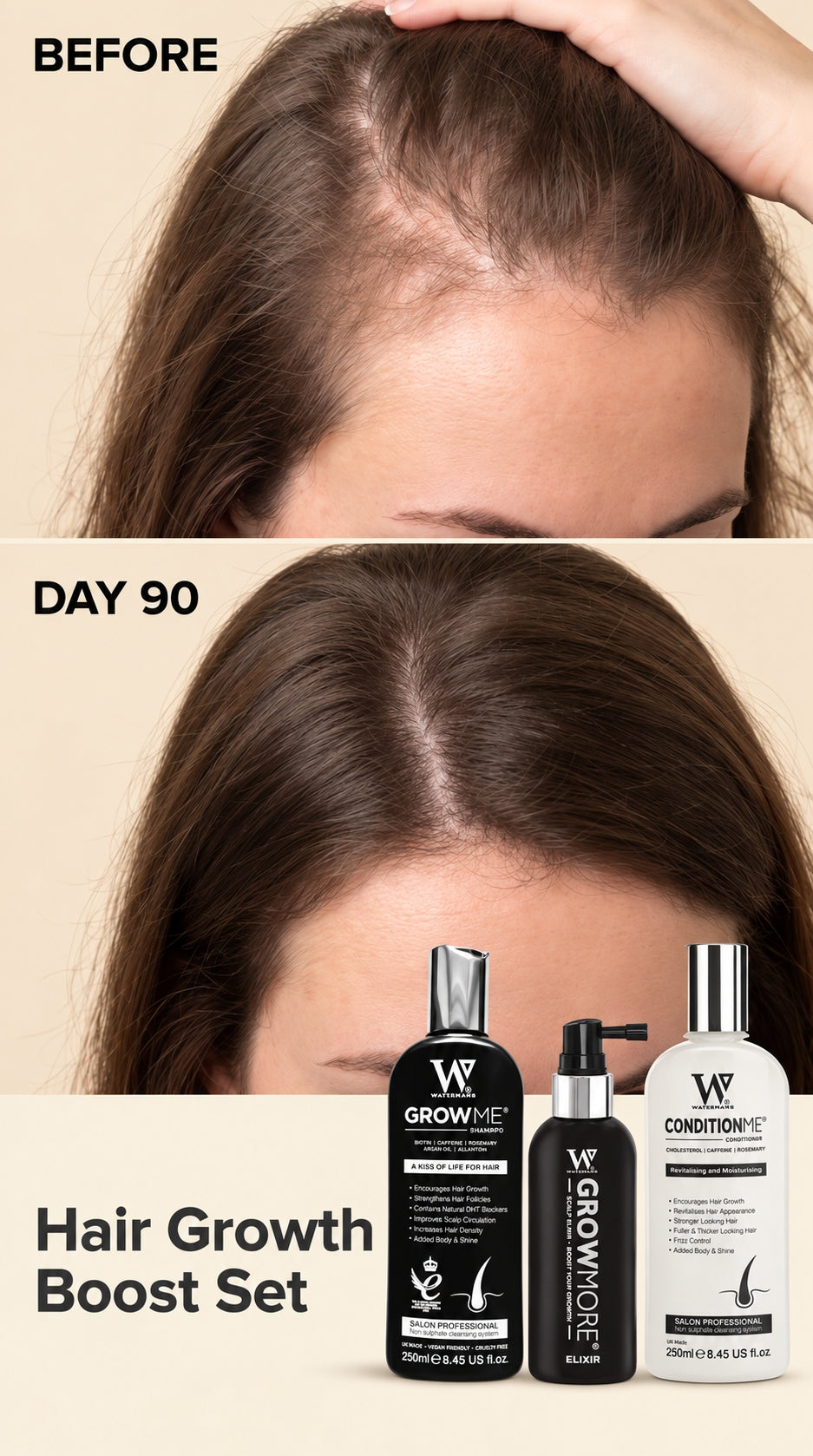
Grow Me® Hair Growth Shampoo £14.95
Sulfate free daily shampoo with biotin, caffeine, rosemary and niacinamide. Cleans thoroughly without stripping, which is exactly the balance a drier menopausal scalp needs. Vegan and made in the UK.

Condition Me® Conditioner £13.95
The other half of the decision. Cholesterol, shea butter and hydrolysed lupine protein give enough slip that the comb passes through fine hair instead of snapping it.

How often should you wash, and how?
Wash when your scalp tells you to, which for most women at this stage is every second or third day. Frequency is less important than technique, because every wash involves handling and handling is where fine hair breaks. The method below removes most avoidable damage.
- Detangle before you get wet. Hair is at its weakest when saturated, so remove knots dry with a wide tooth comb.
- Shampoo the scalp only. Use fingertips, never nails, and let the rinse water carry the lather down the lengths. The lengths do not need direct shampoo.
- One wash, not two, unless you have used a heavy styling product or dry shampoo.
- Conditioner from the ears down, left for the time on the bottle, then combed through while it is still in. This is the single biggest breakage saving in the whole routine.
- Rinse cool at the end and squeeze rather than rub with the towel. A microfibre towel or an old cotton t shirt beats terry cloth.
Hard water matters more than people think
In hard water areas, calcium and magnesium leave a film that makes hair feel rough and dull no matter which bottle you buy. If your kettle furs up quickly and your hair feels coated, a monthly chelating wash or a shower filter will do more than switching menopause shampoo again.
Get a discount on the menopause hair care range
Join the Watermans mailing list and we will email a discount code straight to your inbox, so you can try the menopause hair care range for less. Made in the UK, over 6.5 million bottles sold since 2012.
What about grey and white hair going brassy?
Yellowing in grey and white hair comes from mineral deposits, product residue, smoke, sun and heat, not from the hair itself. A violet toned shampoo neutralises that yellow cast optically, which is why it works instantly and why the effect washes out. It is a genuinely useful product used correctly.
Used incorrectly it causes problems. Most violet shampoos are more astringent than a conditioning one, and using them at every wash on hair that is already dry leaves it dull, coarse and sometimes faintly lilac. Once every third or fourth wash, left on for the time stated and followed by conditioner, is the sensible pattern. Alternate it with your regular menopause shampoo rather than replacing that shampoo entirely.

Can any shampoo do something about thinning?
A shampoo cannot change what a follicle is doing, and it is important to be plain about that. What it can genuinely change is how much of the hair you grow survives to a decent length. Hair that snaps at the mid lengths gives you a thin, wispy ends look that reads as thinning even when the follicle count is unchanged.
So the mechanism to expect from a good menopause shampoo is retention rather than density: less breakage, better slip, a comfortable scalp and lengths that hold together. That is a real cosmetic benefit and a modest one. Anything promising more than that is making a claim a cosmetic product is not permitted to make. For the wider routine around the shampoo, see our companion guide to choosing menopause hair products across the whole routine.
Hair loss, hair shedding or hair breakage?
These three need separating before you buy anything, because only one of them responds to a shampoo. Hair loss means follicles producing progressively finer hair, which is what female pattern hair loss does and what often becomes noticeable in the years around menopause. Hair shedding means whole hairs leaving the scalp in unusual numbers, commonly after illness, weight loss or low ferritin, and it usually settles by itself. Hair breakage means the strand snapping while the root stays in place.
Check a fallen hair. A tiny pale bulb at one end means it was shed. A blunt or frayed end with no bulb means it broke. If most of what you find has no bulb, your problem is mechanical and a better conditioner plus a cooler dryer will help more than any scalp product. Our explainer on the three mechanisms behind thinning hair and our guide to menopausal hair thinning both go into this properly.

Menopause Hair Care Kit £69.99
If you would rather not assemble the routine yourself, this five step kit pairs the shampoo and conditioner with a scalp elixir, a supplement and a skin cream. Sensible if you are replacing a whole shelf of products that no longer suit your hair.
When should you speak to your GP?
Speak to your GP if the change is fast, patchy or painful. Specifically: hair coming out in distinct patches, a parting widening month on month, a scalp that is sore, scaly or intensely itchy, or hair changes alongside fatigue, feeling cold, weight change or low mood. Heavy perimenopausal periods are a common cause of low ferritin, and thyroid changes are common in this age group. Both are simple blood tests and neither is something a shampoo addresses.
NICE guidance covers how menopausal symptoms are assessed and managed, and your GP can talk through the options for those symptoms as a whole. We sell cosmetics, not medicines, and we cannot advise on that side of it.
Important: Watermans products are 100% cosmetic and do not treat medical hair loss. Individual results may vary.
What is the bottom line on menopause shampoo?
The right menopause shampoo is a gentle, sulfate free, well conditioned one used every second or third day, with a conditioner combed through the lengths at every single wash. Skip volumising ranges unless your hair is genuinely oily, add a violet toning shampoo occasionally if grey hair is picking up yellow, and deal with hard water if your kettle furs up. Expect less breakage, better shine and hair that holds its length. Do not expect a change in density, because no shampoo delivers that, and get your ferritin and thyroid checked if the change has been sudden. If you want the whole thing laid out week by week, we have a practical menopause hair care routine that focuses on what you can actually change. For the bigger picture, our overview of hair changes in the menopause explains causes, GP checks and a full routine.
Frequently Asked Questions
What is the best menopause shampoo for thinning hair?
The best one is a gentle sulfate free shampoo paired with a conditioner used at every wash. Look for cocamidopropyl betaine or glucoside cleansers near the top of the ingredients, plus panthenol, glycerin or hydrolysed proteins. That combination reduces breakage so you keep more length, which is what makes hair look fuller.
Does menopause shampoo really work, or is it marketing?
The category name is marketing, because there is no legal definition and no special menopause ingredient. The underlying idea is sound: a drier scalp and a finer strand genuinely need gentler cleansing and more conditioning. Buy the formula rather than the label.
Should I switch to sulfate free during menopause?
It suits most women at this stage, because sebum production falls and stronger surfactants leave the scalp tight. It is a comfort decision rather than a proven one, and a poorly formulated sulfate free shampoo can leave build up in hard water. Judge by how your scalp feels on day two.
How often should I wash menopausal hair?
Every second or third day works for most people once you are no longer stripping the scalp. Wash sooner if your scalp is itchy or flaky, which is a sign of too little washing rather than too much. Technique matters more than frequency.
Can I use purple shampoo on grey menopausal hair?
Yes, but occasionally rather than daily. Violet pigment cancels yellow tones optically and works immediately. Most formulas are more astringent than a conditioning shampoo, so once every third or fourth wash, followed by conditioner, avoids leaving grey hair dry and dull.
Will a shampoo stop my hair getting thinner?
No. Shampoos work on the hair fibre and the scalp surface, not on what the follicle produces. A good one reduces breakage so less of the hair you grow snaps off, which improves how full your hair looks. Density itself is a different question and worth discussing with your GP. If your question is about products or a routine rather than a medical one, you can talk to Gail Waterman, our co-founder, as an AI avatar on the Watermans homepage.
Is dry shampoo a problem at this stage?
Used occasionally it is fine. Used daily on a scalp that is already dry it builds up, absorbs what little oil there is and can leave the scalp itchy. If you rely on it more than twice between washes, the honest fix is usually washing slightly more often with a gentler shampoo.
Do I still need conditioner if my hair feels greasy at the roots?
Yes, but only on the lengths. Greasy roots and dry ends is a very common menopausal pattern. Keep shampoo on the scalp, keep conditioner from the ears down, and the two problems stop competing with each other.
For the everyday version of all this, our sulphate free hair growth shampoo does the scalp work while you get on with the rest.