Steroid Medication Hair Shedding: Why It Happens and What Helps
Steroid medication hair shedding is the diffuse, all-over thinning many people notice two to four months after starting or stopping a course of steroid tablets. It is almost always telogen effluvium, a temporary shift that pushes more hairs than usual into the resting phase at once. The hair follicles themselves are not lost, so density usually returns on its own within six to nine months once the underlying trigger settles.
Our hair growth shampoo
Grow Me® Hair Growth Shampoo, £14.95. A sulphate free daily shampoo that supports a healthy scalp environment and helps reduce breakage, so lengths hold on and look fuller.
Key Takeaways
- Shedding that starts two to four months after a change in steroid medication is usually telogen effluvium, not permanent balding.
- It is diffuse, meaning it comes from all over the scalp, rather than from one patch or a receding hairline.
- The follicles stay alive, so hair normally comes back over six to nine months once the trigger settles.
- The illness that led to the steroid course, plus low iron and thyroid changes, can drive shedding just as hard as the medicine.
- Never stop or change a steroid medicine yourself. Speak to the doctor who started it.
- Cosmetic hair care cannot change what is happening in the follicle. It can reduce breakage so the hair you keep looks fuller.
What is steroid medication hair shedding?
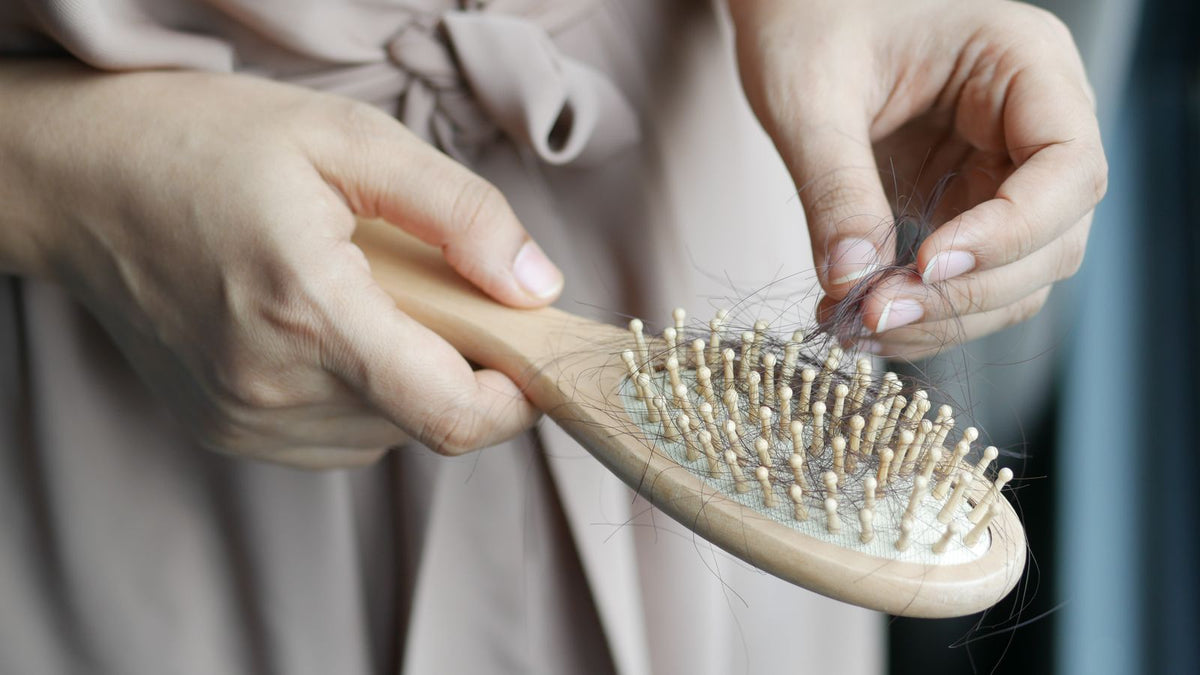
Steroid medication hair shedding is a diffuse, temporary increase in daily hair fall that follows a change in a course of oral steroids, either starting one or coming off one. Hair fall is spread evenly across the whole scalp rather than concentrated in a patch. Most people first notice it in the shower drain, on the pillow or in the brush, and the ponytail feels thinner in the hand before anything is visible in the mirror.
The mechanism has a name: telogen effluvium. At any moment roughly 85 to 90 percent of scalp hairs are in the growing phase, called anagen, and around 10 to 15 percent are in the resting phase, called telogen. A systemic shock, and a significant change in steroid medication counts as one, can push an unusually large share of follicles into telogen at the same time. Those hairs sit quietly for around three months and then release together, which is why the shedding shows up long after the event that caused it. We have a separate guide to hair shedding after steroid treatment if that is the part you need.
Two points matter for anyone worried about this. The follicle is not destroyed, and the scalp is not scarred. That is the structural difference between this kind of shedding and a scarring alopecia, and it is the reason the outlook is good.
Why does steroid medication hair shedding start months after the course?
The delay exists because a hair that has entered the resting phase does not fall out immediately. It stays anchored in the follicle for roughly three months while the next hair forms underneath, and it is the arrival of the new hair that pushes the old one out. So the shedding you see in March was set in motion around December.
This lag catches people out constantly. Someone finishes a steroid course, feels physically better, and then hair starts falling in handfuls weeks later, which feels like it must be something new. It usually is not. When you are working out what caused a shedding episode, look back two to four months, not at last week.

Work backwards, not forwards
Write down what was happening in your life and your health two, three and four months before the shedding started. Illness, surgery, a high fever, rapid weight loss, a new medicine, childbirth and severe stress all produce the same delayed pattern. More than one trigger often stacks in the same window.
Is this hair loss, hair shedding, or hair breakage?
These three are not the same thing, and telling them apart changes what you should do next. Confusing them is the single most common reason people buy the wrong product.
Hair shedding is a cycle problem. Whole hairs leave the scalp with a small pale bulb at the root, in larger numbers than usual, from all over the head. This is what a change in steroid medication tends to cause, and it is self-limiting.
Hair loss is a follicle problem. In pattern hair loss the follicles themselves shrink over years, a process called miniaturisation, so hairs come back progressively finer and shorter until they stop surfacing. It is patterned, affecting the crown and the temples or the parting, not the whole scalp evenly, and it does not resolve by itself.
Hair breakage is a fibre problem. The hair snaps part way along its length, so you find short broken pieces with no bulb, along with split ends and a rough feel. Heat, bleach, tight styling and rough detangling cause it. Breakage is the one type that hair care products genuinely address.
| Sign | Shedding (telogen effluvium) | Pattern hair loss | Breakage |
|---|---|---|---|
| What you find | Full-length hairs with a pale bulb | Gradually finer, shorter hairs | Short snapped pieces, no bulb |
| Where | Evenly, all over the scalp | Crown, temples or widening parting | Wherever heat or tension is worst |
| Onset | Sudden, 2 to 4 months after a trigger | Slow, over years | Follows a styling or colour change |
| Outlook | Usually settles in 6 to 9 months | Progressive, needs medical advice | Improves once handling changes |
If what you are seeing looks patterned rather than diffuse, our guide to the three mechanisms behind thinning hair walks through how to tell which one you are dealing with.
Get a discount on the thinning hair range
Join the Watermans mailing list and we will email a discount code straight to your inbox, so you can try the thinning hair range for less. Made in the UK, over 6.5 million bottles sold since 2012.
How long does steroid medication hair shedding last?
Most episodes of this kind of shedding run for three to six months and then stop, with visible density recovering over the following six to nine months. The total arc from first noticing it to feeling normal again is commonly around a year, which is far longer than anyone wants to hear but is genuinely the usual course.
Recovery has a distinctive look. As follicles restart together, a fringe of short, fine, upright new hairs appears along the hairline and parting. People often mistake these for breakage or frizz. They are the opposite: they are the sign the cycle has reset. They will thicken and lengthen over the following months.
Shedding that carries on beyond six months is called chronic telogen effluvium, and at that point the trigger is usually still active or a second cause has joined in. That is the point to go back to your GP rather than wait it out.
What else could be causing the shedding at the same time?
The medicine is rarely the only thing going on. The condition that led to a steroid course is itself a systemic stress on the body, and it can drive shedding just as hard as the medication. Several other causes commonly stack in the same window.
- Low iron stores. Ferritin, the storage form of iron, can be low enough to affect hair while a standard full blood count still reads as normal. Ask specifically about ferritin, not just about anaemia.
- Thyroid changes. Both an underactive and an overactive thyroid cause diffuse shedding, and both are simple blood tests. Our guide to thyroid related hair loss covers the pattern in detail.
- The illness itself. A high fever, a hospital stay, surgery or a flare of an inflammatory condition are all classic triggers on their own.
- Rapid weight loss or low protein intake. Hair is one of the first things the body deprioritises when energy or protein is short.
- Severe or prolonged stress. Covered in our guide to stress related hair loss.
Because these overlap so often, it is worth reading what causes telogen effluvium before deciding you know which trigger is yours.

What should you ask your GP about?
Bring three things to the conversation: when the shedding started, what changed two to four months before that, and roughly how much hair is coming out. A rough count over a few days is more useful than an estimate.
Reasonable things to raise with your GP include a ferritin level, a full blood count, thyroid function and vitamin D. If you take a steroid medicine regularly, ask whether the shedding pattern fits the timing of your course.
Never change a medicine on your own
Stopping oral steroids suddenly can be dangerous. Whatever you read online, and whatever this page says, the decision about a steroid medicine belongs to the doctor who started it. Hair is not a reason to take that risk without advice.
See your GP sooner rather than later if the shedding lasts beyond six months, if you can see scalp through the hair in defined patches, if the scalp is painful, scaly or itchy, or if you have other symptoms such as fatigue, weight change or heavy periods.
How should you care for hair while it recovers?
The goal during a shedding phase is retention. You cannot speed up the cycle from the outside, but you can avoid losing extra length to breakage, which is what makes hair look thinner than the shedding alone would explain. Hair going through a shed is also more fragile, so handling matters more than usual.
- Wash as often as suits your scalp. Washing does not cause shedding, it just collects hairs that had already released. Avoiding washing simply means more comes out at once, which is more alarming, not less.
- Detangle with a wide tooth comb on conditioned hair, working from the ends upwards.
- Turn heat styling down and use it less often. Air dry to around 80 percent first where you can.
- Keep styles loose. Tight ponytails, buns and braids add tension to hair that is already releasing.
- Pause bleach and strong chemical processing until the shed has settled.
- Eat enough protein and enough overall energy. This is basic, and it is the part most often skipped during illness.
For a fuller routine, see our guide to the everyday habits that reduce breakage.

What can cosmetic hair care actually do for steroid medication hair shedding?
Cosmetic hair care works on the fibre and the scalp surface, not on the hair cycle. That is a real limit and it is worth being straight about it. No shampoo can change what a systemic trigger has done inside the follicle, and anyone selling you one for that reason is overselling.
What good products can do is reduce breakage, so the hair you still have keeps its length and looks denser, and keep the scalp comfortable while the cycle resets. During a shed, that is a genuinely useful job.

Grow Me® Hair Growth Shampoo £14.95
A sulfate-free everyday shampoo with caffeine, biotin, niacinamide and rosemary. Cleanses gently while you are shedding, and supports a healthy scalp environment without stripping fragile hair.

Condition Me® Hair Growth Conditioner £13.95
A breakage-defence conditioner with hydrolysed lupine protein, shea butter and glycerin. Makes detangling far easier, which is where a lot of avoidable length is lost during a shedding phase.
Watermans is a British brand. Everything we make is made in the UK, and we have sold over 6.5 million bottles since 2012.
Important: Watermans products are 100% cosmetic and do not treat medical hair loss. Individual results may vary.
What mistakes make the shedding look worse?
Four habits reliably make a recovering head of hair look thinner than it needs to.
- Washing less. The most common one. It concentrates the shed into fewer, bigger episodes and lets scalp oil and product build up, which flattens the hair.
- Switching products every fortnight. A shed runs on a three to six month clock. Changing shampoo every two weeks tells you nothing, and it means you never see whether anything helped.
- Adding several supplements at once. Without a blood test you do not know what is low, and taking more of a nutrient you already have enough of does nothing. High dose supplements can cause harm.
- Pulling hair back tightly to hide it. Understandable, and it adds tension exactly when the hair is least able to take it.
Sources & References
- NHS, Hair loss, for causes, expected course and when to see a GP.
- NHS, Steroids, for how steroid medicines are used and why they should not be stopped abruptly.
- DermNet, Telogen effluvium, for the hair cycle mechanism and the two to four month delay.
- British Association of Dermatologists, Telogen effluvium information leaflet.
- NHS, Iron, for iron requirements and the limits of supplementing without testing.
- NHS, Underactive thyroid, for the thyroid symptoms that overlap with diffuse shedding.
Where sources differ, they differ on duration. DermNet and the British Association of Dermatologists both describe most episodes settling within six months, while some clinical reviews report a meaningful minority running longer than a year before density fully returns. We have given the common range and flagged the longer tail rather than picking the more reassuring number.
Frequently asked questions
How long does steroid medication hair shedding last?
Most episodes of steroid medication hair shedding run for three to six months, with visible density recovering over the following six to nine months. Shedding that continues past six months is worth raising with your GP, because the trigger may still be active or a second cause may have joined it.
Will my hair come back to how it was?
In telogen effluvium the follicles are not destroyed, so hair normally returns to its previous density. Recovery is gradual and often uneven at first, with short new hairs appearing along the hairline and parting before the overall thickness catches up.
Should I stop my medicine because of the shedding?
No. Never stop or change a steroid medicine because of hair. Stopping oral steroids abruptly can be dangerous. Raise the shedding with the doctor who started the course and let them decide what, if anything, should change.
Is it normal to lose more hair when I wash it?
Yes. Washing does not cause shedding, it collects hairs that had already released from the follicle. Washing less simply means more hairs come out at once on the days you do wash, which looks worse rather than better.
How much hair loss per day is too much?
Losing 50 to 100 hairs a day is normal. During a shedding episode people commonly lose two to three times that for a period of weeks. What matters more than the exact number is whether the rate is settling over time and whether your parting is widening.
Can a shampoo help with this kind of shedding?
A shampoo cannot change the hair cycle, so it will not shorten the shed. A gentle, non-stripping shampoo and a good conditioner reduce breakage and keep the scalp comfortable, which means the hair you keep holds its length and looks fuller while the cycle resets.
Should I take supplements for it?
Only if a blood test shows you are low in something. Taking more of a nutrient you already have enough of does not help hair, and some supplements cause harm at high doses. Ask your GP about ferritin, full blood count, thyroid function and vitamin D first.
What if the shedding is in patches rather than all over?
Diffuse, all-over shedding fits telogen effluvium. Well defined round or oval bald patches are a different picture and should be seen by a GP, as should any shedding with a painful, scaly or scarred looking scalp.
What is the bottom line on steroid medication hair shedding?
Steroid medication hair shedding is frightening to live through and, in the great majority of cases, temporary. It arrives two to four months after the trigger, comes from all over the scalp rather than from one patch, and settles over six to nine months because the follicles were never lost. Check ferritin and thyroid with your GP, never change a steroid medicine on your own, protect the length you have from breakage, and give it the time the hair cycle actually needs. If your question is about products or a routine rather than a medical one, you can talk to Gail Waterman, our co-founder, as an AI avatar on the Watermans homepage.
If you want a routine built around retention while you wait, our six habits for healthier hair is the practical next step, and the Grow Me shampoo and Condition Me conditioner are the gentle everyday pair we would use ourselves during a shed.