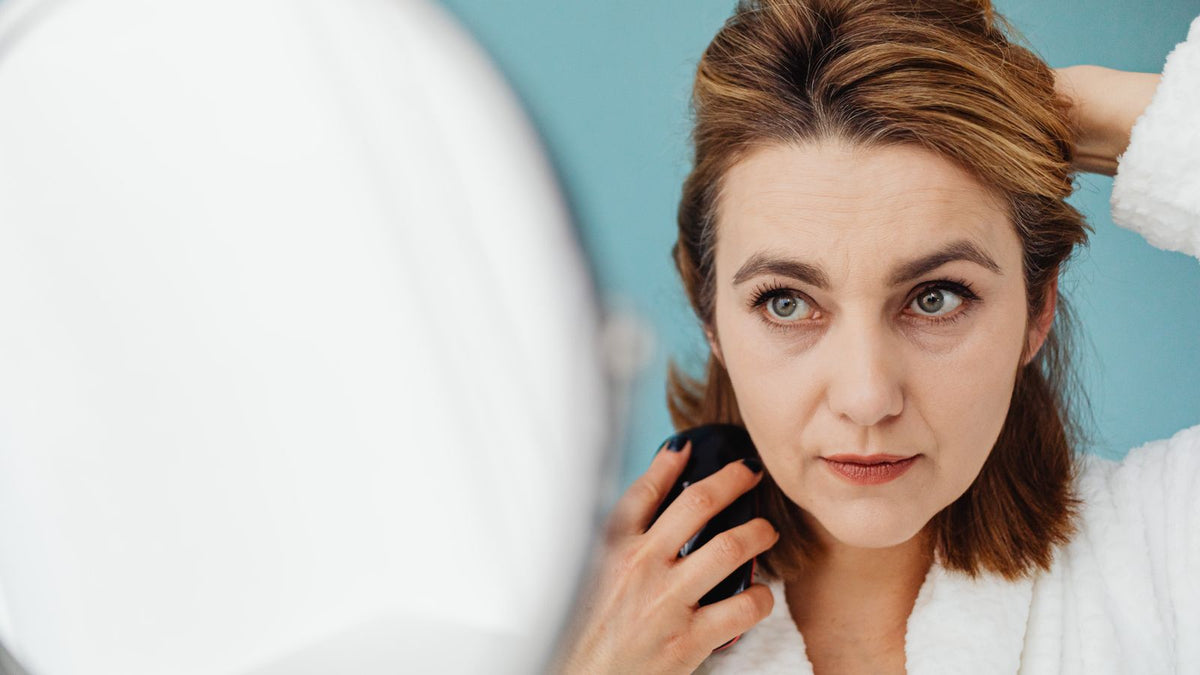
Excess Hair Shedding: How Much Is Too Much?
Excess hair shedding means losing noticeably more than the normal 50 to 100 hairs a day, usually in sudden handfuls rather than a slow decline. It is almost always telogen effluvium: a wave of follicles pushed into the resting phase together by a trigger two to three months earlier. The trigger has usually passed by the time you notice. Most cases settle within six to nine months once the cause is dealt with.
Our hair growth shampoo
Grow Me® Hair Growth Shampoo, £14.95. A sulphate free daily shampoo that supports a healthy scalp environment and helps reduce breakage, so lengths hold on and look fuller.
Key takeaways
- 50 to 100 hairs a day is normal. On a wash day after three days, several hundred can be normal too.
- The trigger sits two to three months in the past, not in the week the shedding started.
- Whole hairs with a small pale bulb are shedding. Broken fragments are breakage, which is a different problem.
- Low ferritin, thyroid problems, illness, childbirth, surgery and rapid weight loss are the usual culprits.
- Most telogen effluvium recovers. Density typically returns over six to twelve months.
- Shedding that lasts beyond six months, or a parting that widens, needs your own GP rather than another product.

What counts as excess hair shedding?
Excess hair shedding is a change from your own baseline, not a fixed number. The commonly quoted figure of 50 to 100 hairs a day is a reasonable average for an adult scalp carrying around 100,000 hairs, of which roughly 85 to 90 percent are in the active growing phase and 10 to 15 percent resting at any moment. Shedding that rises every autumn is usually seasonal, and our Reading guide to seasonal hair shedding explains when it is worth a trichologist or GP visit.
The number misleads people for two reasons. First, if you wash twice a week you are collecting three or four days of released hairs in one go, so 300 in the shower can be entirely normal. Second, 100 hairs looks enormous in a wet clump on a tile.
Better questions than counting: has the ponytail got thinner to hold? Do you need an extra turn of the elastic? Has this been going on for more than three months? Those tell you far more than a headcount.
The 60 second test
Run your hands through dry hair, from front to back, gathering gently, five times. Count what comes away. Under about ten hairs is unremarkable. Consistently over about fifteen, repeated over several days, alongside a noticeably thinner ponytail, is worth investigating.
Then look at what you collected. A whole hair has a tiny pale bulb at one end. Snapped fragments with two blunt ends are not shedding at all, they are breakage, and the fix is completely different.
Is it shedding, hair loss or breakage?
These three get lumped together constantly, and the distinction decides what to do next.
| Which | Pattern | Outlook |
|---|---|---|
|
Hair shedding Follicles resting early, in a wave. |
Sudden, diffuse, all over the scalp. Whole hairs with a bulb. Starts abruptly. | Usually temporary. Recovers once the trigger clears. |
|
Hair loss Follicles making fewer, finer hairs. |
Gradual over years. Parting widens, crown thins. Daily fall may be normal. | Progressive. Medical assessment needed. |
|
Hair breakage The fibre snapping. |
Short broken pieces, frizz at the crown, lengths that never get longer. | Improves quickly once handling changes. |
They also happen together. A stressful year can produce genuine excess hair shedding while the same stress leads to rougher handling and more breakage. If you are unsure which is dominant, our three clue self-check and our guide to hair breakage separate them out.

What causes excess hair shedding?
Telogen effluvium is the mechanism behind most of it. Something disturbs the body enough that a large batch of follicles cuts the growing phase short and moves to rest together. Those hairs are then released about two to three months later, all at once.
That delay is the single most useful fact in this article. When shedding starts, do not look at last week. Look at what happened in the two or three months before.
- Illness with a fever, including flu and covid. One of the most common triggers.
- Childbirth. Postpartum shedding usually peaks around three to four months after delivery and settles by around a year.
- Surgery or a general anaesthetic.
- Rapid weight loss or severe dieting. Very low calorie or very low protein intake is a classic cause.
- Low iron stores. Ferritin can be low enough to affect hair while a standard full blood count still looks normal.
- Thyroid problems. Both underactive and overactive thyroid affect hair.
- Severe or sustained psychological stress, bereavement, or a period of very poor sleep.
- Stopping or changing certain medicines. Never stop anything on your own. Raise it with whoever started it.
Where good sources differ. Dermatology guidance regards iron as important mainly where there is genuine deficiency, while some sources argue for a higher ferritin target specifically for hair. There is no settled UK threshold. The practical answer is to have ferritin measured and discuss the number with your own GP rather than self-supplementing towards a figure you read online.
How long does excess hair shedding last?
Acute telogen effluvium usually runs for two to four months of noticeable shedding, then eases. Because a hair grows roughly one centimetre a month, the new growth is not visible as density for another six months or so. You often see it first as a halo of short new hairs around the hairline and parting, which people mistake for breakage. It is the opposite: it is the recovery. Shedding sits alongside growth rather than replacing it, and our guide to the normal hair growth rate puts the everyday figures in context.
A rough timeline, assuming the trigger has passed:
- Months 0 to 3. Heavy shedding. Nothing you do speeds this part up.
- Months 3 to 4. Shedding slows. Wash days stop being alarming.
- Months 4 to 8. Short new hairs appear at the front and along the parting.
- Months 8 to 12. Ponytail thickness starts to return. Density looks more normal.
Chronic telogen effluvium, where shedding continues on and off beyond six months, is a different pattern and deserves proper assessment rather than patience.
Get a discount on the hair shedding range
Join the Watermans mailing list and we will email a discount code straight to your inbox, so you can try the hair shedding range for less. Vegan, made in the UK, over 6.5 million bottles sold since 2012.
What should you actually do about excess hair shedding?
In order of how much difference each makes.
1. Find the trigger, looking back two to three months
Write down what happened in that window. Illness, an operation, a bereavement, a new baby, a diet, a house move, a punishing work period. Naming the trigger tells you whether to expect recovery or to keep looking.
2. Get ferritin and thyroid function checked
These are the two that most often turn out to be the answer and both are simple to correct. Ask your own GP. Take a note of when the shedding started and what happened before it. If your question is about products or a routine rather than a medical one, you can talk to Gail Waterman, our co-founder, as an AI avatar on the Watermans homepage.
3. Eat properly, especially protein
If a diet caused this, the diet is the thing to change. Aim for a real protein source at every meal. The NHS iron guidance is 14.8mg a day for women aged 19 to 49 and 8.7mg for men and women over 50, and food sources count. If that sounds familiar, our piece on how stress and sleep affect hair shedding. Fast carbohydrates hide in a lot of diet products, as set out in whether maltodextrin is bad for you.
4. Stop adding breakage on top
You cannot afford to lose length as well as density. Lower the heat, always use a heat protectant, detangle from the ends up with a wide tooth comb, and loosen tight styles. This is the fastest visible improvement available to you.
5. Sleep, and take the stress seriously
Not a platitude in this context. Physiological stress is a documented trigger for telogen effluvium, and poor sleep sustains it.
6. Leave the routine alone for six months
Changing shampoo every three weeks tells you nothing. Pick something gentle you can use often and stay with it.

What do not help, despite the marketing?
- Washing less. The hairs are already released. You are just choosing where you find them.
- Loading up on supplements you may not need. Excess vitamin A and excess selenium can both make shedding worse.
- Any product promising a percentage or a fixed timeline. Hair does not work to a schedule, and no shampoo changes a follicle.
- Cutting it all off. A shorter style can look fuller, which is a fine reason to do it, but it does not affect how much you shed.
- Waiting silently past six months. The one genuinely costly mistake on this list.
What cosmetics can honestly do is reduce breakage, keep the scalp comfortable and help the hair you still have look fuller while the cycle resets. That is worth having during a shed. It is not a fix for the shed itself.

Grow Me Strength & Retention Shampoo
A gentle daily shampoo formulated to reduce breakage so the hair you have looks fuller. Vegan, made in the UK, over 6.5 million bottles sold since 2012.

Grow Me Shampoo & Conditioner Set
The pair, for the consistent six month routine this article keeps recommending. Conditioner on mid-lengths and ends, where breakage does the damage.
When should you speak to your own GP?
Make the appointment rather than waiting it out if:
- Shedding has continued beyond six months.
- Your parting is visibly wider, or scalp shows at the crown in ordinary light. That points to hair loss rather than shedding.
- There are smooth, coin-sized bare patches, which suggests alopecia areata and is a different condition.
- Your scalp is sore, itchy, scaly or scarring.
- You also have fatigue, feeling cold, weight change, heavy periods or a racing heart. Those point at thyroid or iron.
- It is a child or teenager shedding heavily.
Take a photo of your parting in the same light once a month. It is the single most useful thing you can bring to a ten minute appointment. There is more on what is and is not normal in is hair loss normal for a woman, and on the mechanism in what causes telogen effluvium.
Frequently asked questions
How many hairs a day counts as too much?
Consistently more than about 100 a day over several weeks, judged against your own usual amount. Because wash frequency changes what you collect, the more reliable signals are a thinner ponytail and shedding that has lasted more than three months.
Why did my shedding start out of nowhere?
It did not. Telogen effluvium releases hairs roughly two to three months after the trigger, so the cause sits in the past. Look back at illness, surgery, childbirth, dieting or a hard period rather than at the week it began.
Will the hair grow back after excess hair shedding?
In most cases of acute telogen effluvium, yes, provided the trigger has been dealt with. Expect shedding to slow by around four months and density to look more normal somewhere between eight and twelve months.
Is postpartum shedding the same thing?
Yes, and it is very common. Pregnancy holds more hairs in the growing phase, and after delivery they move to rest together. Peak shedding is usually around three to four months postpartum, settling by about a year.
Does heavy shedding mean I am going bald?
Usually not. Shedding is diffuse and temporary. Pattern hair loss is gradual and concentrated at the parting and crown. If both are happening, the shedding can unmask thinning that was already there, which is why it feels worse.
Should I take a hair supplement while shedding?
Only for a shortfall you have actually confirmed. Correcting genuinely low iron or vitamin D helps. Taking a broad supplement on spec does not, and high doses of vitamin A or selenium make hair worse.
Can hard water or a new shampoo cause shedding?
Neither causes true shedding. Both can affect how hair feels and how much it tangles and breaks, which changes how much comes out on a brush. That is breakage, not follicles resting early.
What is the bottom line on excess hair shedding?
Excess hair shedding is frightening precisely because it arrives all at once, but it is usually the most recoverable of the three hair problems. Check it really is shedding by looking for the pale bulb, look two to three months back for the trigger, get ferritin and thyroid tested, eat enough, stop adding breakage, and hold a gentle routine for six months. If it is still going at six months, or the parting is widening, that is the point to stop shopping and speak to your own GP. For the recovery half of that story, including what the first new hairs look like, see hair recovery after weight loss.
Most routines fall over because they are complicated, so start with the Grow Me hair growth shampoo and nothing else.
Watermans products are 100% cosmetic and do not treat medical hair loss. Individual results may vary. This article is general information, not medical advice. If you are worried about your hair, speak to your own GP.
Sources & References
- British Association of Dermatologists. Telogen effluvium. Trigger to shedding delay of two to three months.
- NHS. Hair loss. Common causes and when to seek help.
- NHS. Vitamins and minerals: Iron. 14.8mg a day for women 19 to 49, 8.7mg for men and women over 50.
- NHS. Iron deficiency anaemia.
- NHS. Underactive thyroid (hypothyroidism).
- British Association of Dermatologists. Alopecia areata. Distinguishing patchy loss from diffuse shedding.