
Trichologist Kingston upon Thames: What to Tell Your Hairdresser First
Before you pay for a trichologist Kingston upon Thames, talk to the person who already handles your hair every six weeks. A hairdresser sees your scalp wet, under good light, and knows what your hair was like last year. A stylist cannot give you a medical verdict, but can usually tell snapping mid lengths from hair leaving at the root, which is the single most useful thing to establish first.
Our heat protection spray
Protect Me® Heat Protection Spray, £13.95. A leave in spray that shields hair from heat styling, helps control frizz and keeps colour looking fresher for longer.
Key takeaways
- Your stylist is a free first opinion who has seen your hair over years, which no first visit to a trichologist Kingston upon Thames can match.
- Breakage, shedding and hair loss are three different problems: short blunt stubs, full length hairs with a pale root bulb, and a widening parting.
- The NHS puts normal loss at 50 to 100 hairs a day, so a bad wash day on its own means very little.
- Shedding after illness, surgery or a birth usually peaks two to four months later and settles over six to nine months.
- Go to a trichologist Kingston upon Thames when shedding is still rising after three months or your parting has visibly widened.
- Check any trichologist against the Institute of Trichologists register, which is accredited by the Professional Standards Authority.
What can a hairdresser spot before you need a trichologist Kingston upon Thames?
A hairdresser can quickly spot four things: whether hair is snapping in the mid lengths, whether the parting has widened, whether the scalp is inflamed or flaking, and whether your hair feels different in the hand from last time. Stylists handle hair wet, which is exactly when weakened fibre gives way, under lighting far better than a bathroom mirror. For the postpartum version of the same question, see our guide to sudden shedding and a Merton trichology appointment.
None of that is a medical verdict, and a stylist should not offer one. What it gives you is a starting point. Someone who has cut your hair for three years has a memory of your hair that a first visit cannot replicate, and that history is the most valuable free information available to you. A stylist can also tell you something uncomfortable but useful: that the thinning you are worried about is the same as it was in March, and the change you are seeing is in how you are wearing it.
The limits matter too. A stylist cannot tell you why a follicle has shrunk, cannot order blood tests, and should never comment on a medicine you are taking. Scalp conditions that persist, bleed or spread belong with a GP. A trichologist Kingston upon Thames sits between those two: more time and more scalp specific training than a stylist, without the medical authority of a doctor.
Ask this at your next appointment
Say: "Can you look at my parting and my mid lengths and tell me whether my hair is snapping or coming out at the root?" It takes a stylist thirty seconds and it decides which of two completely different problems you are dealing with.
How do you tell hair breakage from hair shedding and real hair loss?
Hair breakage, hair shedding and hair loss are three separate problems with three different answers: breakage is the fibre snapping along its length while the follicle underneath stays healthy, shedding is a change in the hair cycle that pushes more hairs than usual into the resting phase, and hair loss means follicles are producing finer hair or none at all.
DermNet describes the normal cycle clearly: about 85 per cent of scalp follicles are actively growing at any time and about 15 per cent are resting, with a growing phase of roughly four years followed by about four months of rest. When something shocks the system, as many as 70 per cent of growing hairs can be pushed into the resting phase, which flips the usual ratio and produces the sudden heavy shedding known as telogen effluvium.
| What you see | What it usually is | Where it is happening | What actually helps |
|---|---|---|---|
| Short blunt stubs of different lengths, hair feels rough, ends split | Breakage | The fibre above the scalp | Cutting the damaged ends, less heat and tension, conditioner and masks |
| Lots of full length hairs with a tiny pale bulb at one end | Shedding | The hair cycle, usually after a trigger | Time, dealing with the trigger, gentle handling while it settles |
| Parting looks wider, scalp shows more in photos, hairs are finer | Hair loss | The follicle itself | A proper assessment, and cosmetic support for what you still have |
| Sore, scaly, weeping or spreading scalp | A skin problem, not a hair problem | The scalp skin | Your GP, before any colour or bleach |

The practical test is the root. Pick up five or six of the hairs that worry you and look at one end under a lamp. A small pale swelling means the hair completed its cycle and was released, which points to shedding. A clean squared off break at both ends means the fibre snapped, which points to breakage. Mixed results are common, because someone with heat damaged ends can also be shedding after a stressful autumn.
The NHS puts normal daily hair loss at 50 to 100 hairs. Most people who count for the first time are reassured rather than alarmed.
What should you actually say to your stylist at the basin?
Say the specific thing you have noticed and when it started, rather than asking the vague question of whether your hair is thinning, because stylists hear the vague version constantly and tend to reassure, and reassurance is not information. The basin is the right moment for a precise question, since your hair is wet and your scalp is visible.
Four sentences cover it. Tell them when you first noticed the change. Tell them what you are seeing, whether that is hair on the pillow, a wider parting or ends that will not grow past your shoulders. Tell them what has changed in your life or your routine in the last six months. Then ask them to look at the root end of the hair in the basin.
It is also worth telling your stylist what you are not willing to do. If you are not going to stop using straighteners, say so, and a good stylist will work with that rather than giving advice you will ignore. Honesty about heat, colour and how often you actually wash your hair changes the advice you get. Someone who bleaches every eight weeks and blow dries daily has a breakage problem to solve before anything else is worth trying, as the guide to heat and colour breakage in thinning hair sets out in more detail.
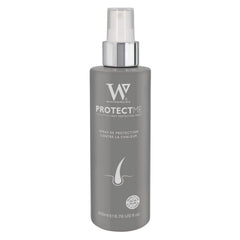
Protect Me Heat Protection Spray
A leave-in spray that gives heat protection up to 230C along with colour and frizz control, so straighteners and dryers do less damage to hair that is already fragile. Useful if you are not willing to give up heat styling, which most people are not.
Which questions will a good stylist answer honestly?
A good stylist will answer four questions honestly and should decline the fifth: whether your hair is snapping or shedding, whether your parting looks different from last time, whether your colour schedule is realistic for the hair you have, and whether a different cut would look fuller. All four sit squarely within a hairdresser's trade.
The question a stylist should refuse is what is causing hair loss at the follicle. Anyone who confidently names a cause and then sells you the answer to it in the same breath has stopped being useful. Stylists who take this seriously tend to say some version of "I can see it, I cannot tell you why, and here is who to ask."

Watch what happens when you ask about products. A stylist recommending a bond builder for snapping ends is giving reasonable advice about the fibre. A stylist recommending the same bond builder for a widening parting is selling you something that cannot help, because bond builders work on hair you already have rather than on follicle density. The difference between those two conversations tells you a lot about whether to trust the rest of the advice.
Get a discount on the hair breakage range
Join the Watermans mailing list and we will email a discount code straight to your inbox, so you can try the hair breakage range for less. Made in the UK, over 6.5 million bottles sold since 2012.
When does a stylist hand you over to a trichologist or a GP?
Three situations should end with a referral rather than a product: hair coming away at the root in increasing quantities for more than three months, a parting that has clearly widened in photographs, and any scalp that is sore, scaly, weeping or losing hair in defined patches. The first two suit a trichologist, while the third belongs with a GP first.
Timing matters because shedding has a predictable shape. Increased hair fall is noticed two to four months after a triggering event, reaches a peak, then tapers back to normal over six to nine months in most cases according to DermNet. Booking in month one often means paying to be told to wait. Booking in month four, with photographs from month one, means arriving with information.
A GP route costs nothing and can rule out the common general causes through blood tests, which is why it is worth doing first or alongside. The guide to telling breakage from real hair loss covers how to make that judgement yourself, and the page on split ends and hair that stops growing deals with the specific case of length that never seems to increase.
What a trichologist gives you that a stylist cannot
More time, magnified examination of the scalp, and scalp specific training. The Institute of Trichologists runs a Level 5 course over two and a half years that includes 126 hours of hands-on clinical work, and its register is the only UK trichology register accredited by the Professional Standards Authority.
What does a haircut do for thinning hair that a bottle cannot?
A haircut removes the damaged part of the fibre, which no product can do, and that matters because split and weakened ends carry on splitting upwards, so hair snapping at the shoulder keeps snapping at the shoulder however much conditioner goes on it. Cutting above the damage stops the process, which is often why length finally shows.
Cutting also changes how thin hair reads to the eye. Blunt ends look denser than tapered ones because the same number of hairs ends in a solid line rather than fading out. Shorter lengths carry less weight, so fine hair sits away from the scalp instead of lying flat and showing skin. A stylist who understands thinning hair will cut for that effect deliberately, as the guide to haircuts and styling for thinning hair explains.
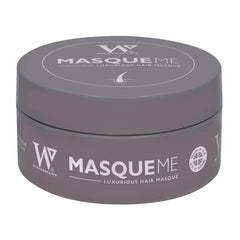
An eight in one mask with rosemary and caffeine, used once a week on the mid lengths and ends rather than the scalp. Worth having if your hair snaps when you comb it wet, which is the point at which most breakage actually happens.
How should you look after fragile hair between salon visits?
Fragile hair needs less force, less heat and more slip, in that order, and most of the damage happens while the hair is wet, because wet hair stretches considerably further than dry hair before it finally gives way under a comb or a brush. Combing from the ends upwards with a wide tooth comb, blotting rather than rubbing with a towel and loosening your hair ties beats any product you add.
Conditioner is not optional on fragile hair. A conditioner with cholesterol, shea butter and glycerin coats the fibre so that combs and brushes slide instead of catching, which is the mechanical reason conditioned hair breaks less. Tension is the other half: the page on hair ties, clips and breakage covers which fastenings cause the damage seen at the hairline and nape.

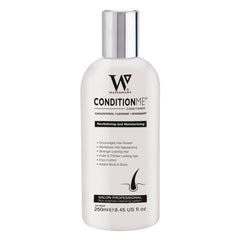
Condition Me Hair Growth Conditioner
A breakage defence conditioner with cholesterol, shea butter and glycerin that adds slip so wet combing does less damage. This is the one to use every wash if your ends are snapping and your hair feels rough in the hand.
Frequently asked questions
Do I need a referral before I see a trichologist Kingston upon Thames?
No referral is needed. Trichology is not a regulated profession in the way medicine is, so anyone can book directly. The Institute of Trichologists keeps a register accredited by the Professional Standards Authority, which is the practical way to check that the person you have found has completed recognised training rather than a weekend course.
Can my hairdresser tell the difference between breakage and hair loss?
A good stylist can usually tell, because the two look different at the root. Breakage leaves short blunt stubs of varying length across the mid lengths, while shedding produces full length hairs with a small pale bulb at one end. A stylist sees both dozens of times a week and handles your hair wet, which is when fragile hair gives way.
How many hairs a day is normal to lose?
The NHS puts normal daily hair loss at between 50 and 100 hairs, often without you noticing. Wash days look worse because four or five days of already shed hair leaves at once. Counting what collects in the plughole on a wash day and comparing it week to week is more useful than a single alarming morning.
Will cutting my hair make it grow back thicker?
Cutting changes nothing at the follicle, because growth happens under the scalp and a haircut works on the fibre above it. What a cut does do is remove split, weakened ends so hair stops snapping further up, which makes length gains visible for the first time in months. Thickness at the root is set by the follicle, not the scissors.
How long should I wait before booking a trichologist Kingston upon Thames?
Give a sudden increase in shedding about three months. Shedding triggered by illness, surgery, a birth or a crash diet typically shows two to four months after the event and then eases back over six to nine months. If shedding is still increasing after three months, or your parting is visibly wider than a year ago, that is the point to get it looked at.
Is it worth paying for a salon bond builder if my hair is snapping?
Bond builders and protein masks are worth it for breakage, not for thinning at the root. They work on the hair fibre you already have by reinforcing damaged areas, so they reduce further snapping. They do nothing for follicle density, which is why a person with early pattern thinning can spend a lot on them and see no change in their parting.
Can a stylist do anything if my scalp is sore rather than my hair thinning?
A stylist can stop making a sore scalp worse, which matters, but a persistently sore, scaly or weeping scalp belongs with your GP. Tell your stylist before they shampoo so they can skip strong products and avoid scrubbing. Colour and bleach should be postponed until the skin has settled rather than worked around. If your question is about products or a routine rather than a medical one, you can talk to Gail Waterman, our co-founder, as an AI avatar on the Watermans homepage.
What should I bring to a first trichology visit?
Bring three things: photographs of your parting under the same light a few months apart, a note of when the change started, and a list of what you use on your hair. A stylist can help you gather the first two on a normal salon visit, which makes the paid hour far more productive than starting from memory.
What is the bottom line on trichologist Kingston upon Thames?
Talk to your hairdresser before you pay a trichologist Kingston upon Thames, because a stylist sees your wet scalp regularly and remembers what your hair was like a year ago. Use that conversation to establish whether hair is snapping in the mid lengths, leaving at the root, or coming from follicles that are producing finer hair. Breakage is a fibre problem you can act on immediately with cutting, less heat and less tension. Increasing shedding that has not settled after three months, or a parting that is visibly wider in photographs, is worth a paid hour with someone whose register you have checked. Arrive with dated photographs and a list of what you use, and the hour becomes useful rather than exploratory.
If your ends are snapping while you work out the rest, start with a breakage defence conditioner: Condition Me hair growth conditioner adds the slip that stops wet combing pulling fragile hair apart.
Watermans products are 100% cosmetic and do not treat medical hair loss. Individual results may vary.
Sources & references
- NHS, Hair loss (normal daily hair loss of 50 to 100 hairs; NHS wig durations).
- DermNet, Telogen effluvium (85 per cent anagen to 15 per cent telogen ratio, four year growing phase, shedding two to four months after a trigger, tapering over six to nine months).
- DermNet, Female pattern hair loss (accelerated shedding phases of three to six months followed by periods of stability).
- The Institute of Trichologists, professional register and training (Professional Standards Authority accredited register; Level 5 course over two and a half years including 126 hours of clinical practice).