Trichologists Stockport: Split Ends and Hair That Stops Growing
Hair that reaches your shoulders and then refuses to go any further? Here is why it happens, and who can actually help.
If you are looking at trichologists Stockport because your hair never seems to grow past a certain length, your roots are almost certainly still growing, at about 1 cm a month. The problem is usually the ends: they split and snap about as fast as new growth arrives. Gentler detangling, lower heat, spaced-out colour and small, regular trims help hair keep its length. Handfuls of shedding, bald patches or a sore scalp point to something else, so see your GP first.
Our hair growth conditioner
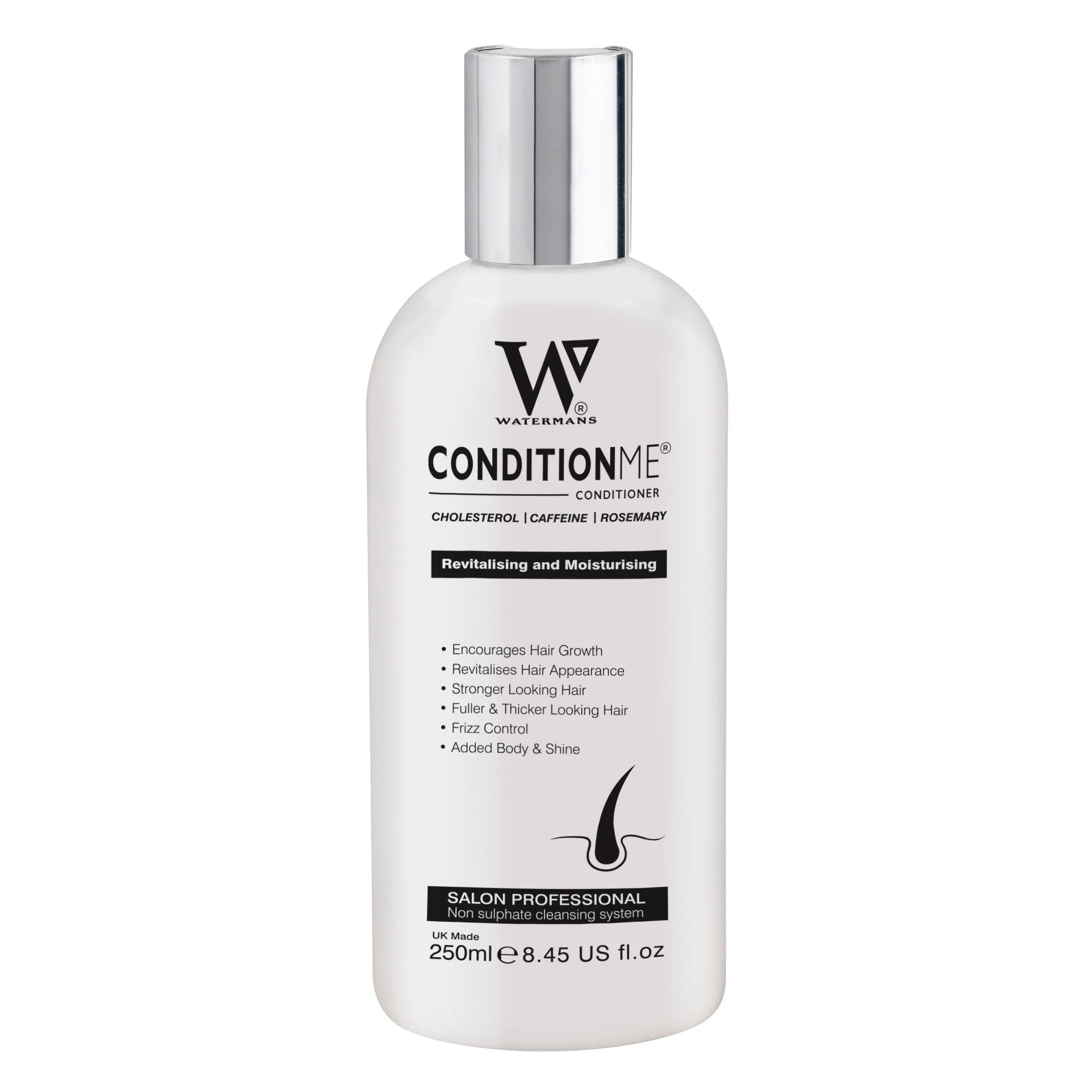
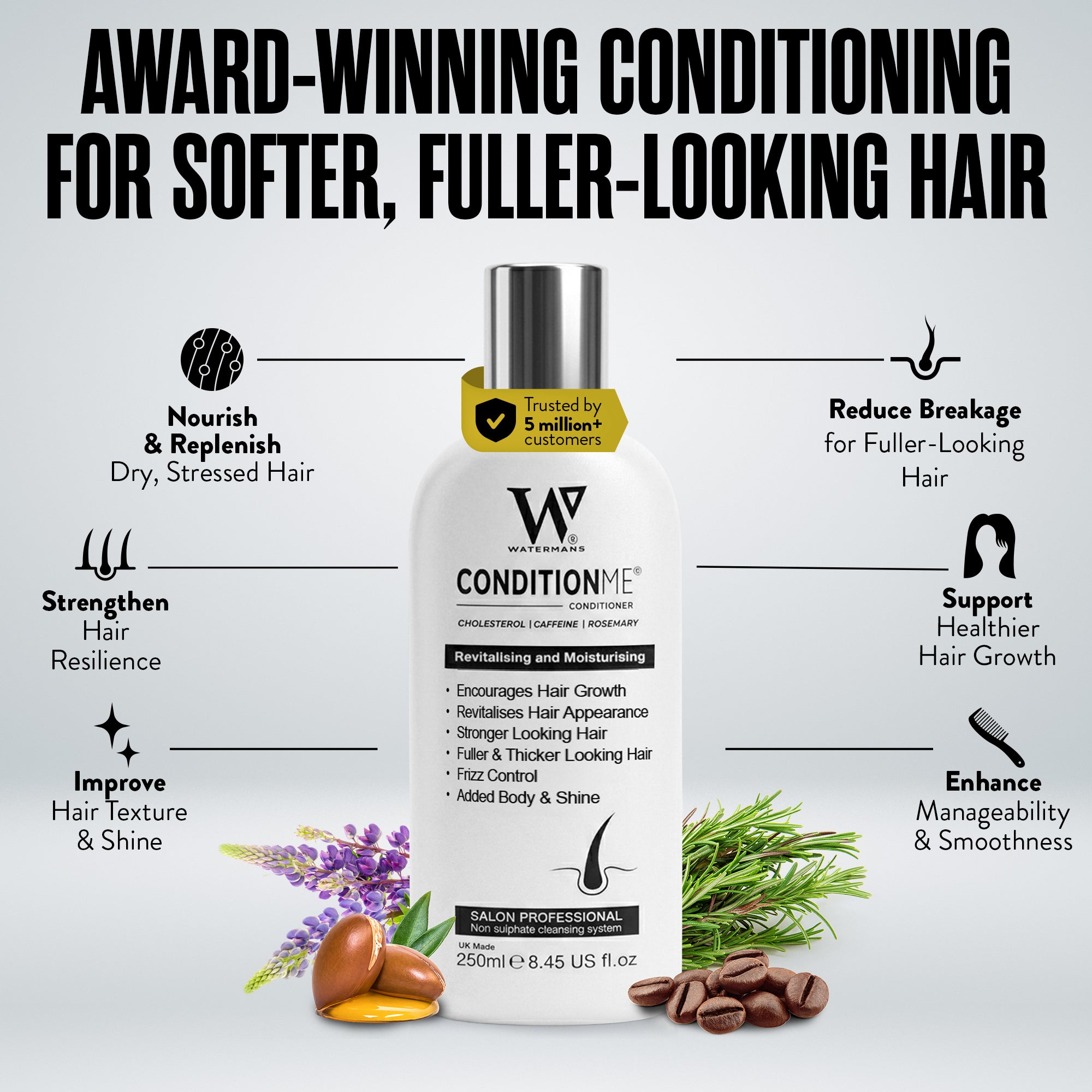
Condition Me® Hair Growth Conditioner, £13.95. Detangles and strengthens the hair fibre so lengths snap less on the brush and look thicker through the ends.
Key takeaways
- Scalp hair grows about 1 cm a month, and DermNet says the growing phase can last up to 6 years or longer, which sets the longest your hair can get.
- Hair 30 cm long has ends roughly two and a half years old: close to 400 washes at three a week.
- Snapped pieces with no bulb mean breakage; whole hairs with a white bulb mean shedding; a widening parting suggests genuine hair loss.
- Trims do not speed up growth at the root, but trimming less than your roots add between cuts still gains length.
- Shedding in handfuls, bald patches or a sore, scaly scalp deserve a GP visit before you contact any of the trichologists Stockport searches bring up.
Why does hair seem to stop growing past a certain length?
Hair seems to stop growing past a certain length because the ends are breaking off about as fast as the roots grow, or, less often, because your growth phase is naturally short, so each hair falls out before it reaches the length you want, even though the follicle is working normally.
DermNet explains that a hair shaft grows at about 1 cm per month, driven by cell division in the hair bulb at the base of the follicle, and that hair length depends on the duration of anagen, the active growing phase. Anagen lasts up to 6 years or longer on the scalp but only around a month for eyebrows and arm hair. Growth speed also genuinely differs between people: a 2016 study of 2,249 young adults from 24 ethnic groups found Asian hair tended to grow faster and African hair more slowly. Whether anything can speed that rate up is a separate question, which our Aylesbury guide to how fast hair grows answers with the evidence on trims and supplements.
There are two possible ceilings:
- The growth-phase ceiling. If your anagen lasts three years, the longest a hair can get at 1 cm a month is roughly 36 cm before it rests and sheds. No product changes this, but it is less common than people assume.
- The breakage ceiling. If the tips lose about as much each month to splitting and snapping as the roots add, length stalls even though the roots are growing normally. This one is common, and handling changes it.
| Length from the root | Rough age of the ends | Washes, at three a week |
|---|---|---|
| 30 cm (around the shoulders) | About 2.5 years | About 390 |
| 45 cm (around the bra strap) | About 3.75 years | About 585 |
| 60 cm (mid-back) | About 5 years | About 780 |
The figures use DermNet's average of 1 cm a month, so treat them as a rough guide. Our guide to how long the anagen phase of hair growth lasts goes deeper into the growth-phase ceiling.

Is it breakage, shedding or genuine hair loss?
Breakage, shedding and genuine hair loss look alike in the plughole but are different problems: breakage means the fibre snaps along its length, shedding means whole hairs are released from the growth cycle, and hair loss means the follicles themselves are producing fewer, finer or shorter hairs over time.
Collect the hairs from your brush and pillow for a few days and look at both ends of each one.
| Sign | Hair breakage | Hair shedding | Hair loss |
|---|---|---|---|
| What you collect | Short pieces of different lengths, with no bulb | Full-length hairs with a tiny white bulb at one end | Not always more hair; new hairs grow finer and shorter |
| Where it shows | See-through, frizzy or uneven ends; ponytail thins towards the tips | Spread evenly across the whole scalp | Widening parting, thinner ponytail at the base, receding temples |
| Typical timing | Builds slowly with heat, colour and rough handling | Often starts around 3 months after illness, stress or childbirth, says the BAD | Gradual, over months or years |
| What is normal | Some fraying at the tips of long hair | 50 to 100 hairs a day, says the NHS | Not something to ignore |
| First step | Gentler handling and a trim of the damaged tips | Often settles by itself; see your GP if it is heavy or does not settle | Your GP |
The British Association of Dermatologists says that around 15% of scalp follicles are normally in the resting phase, and in telogen effluvium, the medical name for excessive shedding, that can rise to 30% or more. If you are still unsure which one you are dealing with, our Coventry guide to breakage versus real hair loss walks through the home checks in more detail.
What makes the ends split and snap faster than the roots grow?
The ends split and snap faster than the roots grow because they are the oldest part of the hair, and every wet comb-through, rough towel dry, hot tool, bleach session and sunny day wears away more of the protective cuticle, until the inner cortex frays into a split or breaks off entirely.
DermNet lists excessive brushing, hairdryer heat, relaxing chemicals and bleach among the injuries that cause acquired hair shaft defects, and the research on each tells you where to start:
- Wet handling. The American Academy of Dermatology says hair is delicate when wet, so detangle with a wide-tooth comb, starting at the ends and working up.
- Heat. In a 2011 Yonsei University study of hair washed and dried 30 times, surface damage rose with dryer temperature, but a dryer held 15 cm away and kept moving did less damage than drying naturally.
- Bleach and colour. A 2019 laboratory study found bleaching and dyeing wore away the cuticle with high protein loss, whatever the curl pattern of the hair.
- Alkaline cleansers. A 2014 analysis of 123 shampoos found pH values from 3.5 to 9.0, and noted that alkaline pH increases friction between fibres, which may lead to cuticle damage and breakage.
Heat and colour damage get a full guide of their own; see our Luton guide to heat and colour breakage. For how oils help dry ends resist snapping, see our Gillingham guide to hair oiling and breakage.

A conditioner with cholesterol, shea butter, glycerin and hydrolysed lupine protein, £13.95. Work it through the lengths and ends every wash and detangle with a wide-tooth comb while it is still in, for more slip and less breakage.
Get a discount on the hair breakage range
Join the Watermans mailing list and we will email a discount code straight to your inbox, so you can try the hair breakage range for less. Made in the UK, over 6.5 million bottles sold since 2012.
Do regular trims make hair grow faster?
Regular trims do not make hair grow faster, because growth happens in the bulb at the base of the follicle, not at the tips, but trimming away split ends before they fray further up the strand can help you keep more of the length your roots are already producing.
The maths is simple. At about 1 cm a month, your roots add roughly 2 cm in 8 weeks. Trim 1 cm at the end of those 8 weeks and you are still about 1 cm longer than before; trim 3 cm and you end up shorter than you started.
The end-check before your next trim
Hold a small section of dry hair up to the light and look for splits, thin see-through tips and ends that snap when gently stretched. Ask your hairdresser to cut just above the highest point of damage, not a set number of centimetres.
A split cannot be glued back together permanently, so the only lasting fix is to cut it off. Our guide on how to prevent split ends covers trimming schedules in more detail. What bond-building products and protein masks can and cannot do for damaged lengths between trims is covered in our Rotherham guide to repairing breaking hair.
Which daily habits help hair keep its length?
Hair keeps its length best with habits that reduce friction, heat and chemical stress on the oldest part of the strand: detangling gently with a wide-tooth comb, blotting instead of rubbing, conditioning the lengths every wash, using the lowest heat that works and spacing out colour, relaxer and perm services.
Whether or not you end up contacting one of the trichologists Stockport has, try this routine first, most of it from American Academy of Dermatology advice:
- Detangle in the right state. For straight hair, the AAD suggests letting it dry a little before combing; for textured hair or tight curls, comb while damp, ideally in the shower with conditioner still in.
- Blot, do not rub. The AAD suggests wrapping hair in a towel or T-shirt instead of rubbing it dry.
- Condition every wash. Fine or straight hair only needs conditioner on the ends; dry or curly hair benefits from it along the full length.
- Turn the heat down. Air-dry when you can, use the lowest setting that works, and limit hot combs and curling irons to once a week or less, as the AAD advises. Keep a hair dryer about 15 cm away and moving.
- Space out chemical services. The AAD suggests one service at a time, stretching touch-ups to every 8 to 10 weeks or longer in winter, and relaxing or perming 2 weeks before colouring if you want both.


Protect Me® Heat Protection Spray
A leave-in spray with panthenol, niacinamide and sunflower oil that protects hair from heat up to 230°C, £13.95. Mist it through the lengths before blow-drying or straightening, and still use the lowest setting that gets the job done.

A deep conditioning mask with hydrolysed lupine protein, provitamin B5, niacinamide and argan oil, £24.95. Leave it on the mid-lengths and ends, the most weathered part of long hair, for softer, smoother and stronger-looking tips.
Can protective styles help hair keep its length, or cause traction hair loss?
Protective styles can help hair keep its length when they are loose, because braids, low buns and twists keep the ends tucked away from friction and daily handling, but the same styles cause traction alopecia when worn tight or for too long, which damages the follicle and can become permanent.
The British Association of Dermatologists says tight ponytails tend to cause hair loss at the front and sides of the scalp, tight buns at the sides and back, and tight braids such as cornrows between the braids, with weaves and extensions another common cause. The risk rises when tight styles are combined with chemical relaxers. The BAD adds that traction alopecia can get better if the pulling stops after only a few weeks or months, but long-term, repeated tension can make it permanent. DermNet notes it can even come from the weight of very long hair. The same pulling risk applies to rough scalp massage, which our Oldham guide to scalp massage without breakage or traction explains.
- Keep it loose. The AAD suggests wearing hair loosely pulled back and using covered bands made for hair.
- Limit extensions. Choose light weaves and extensions, and keep a professional set in for 2 to 3 months at most, the AAD advises.
Tightly curled and Afro-textured hair is often more prone to breakage, and the BAD notes it may also be more susceptible to traction alopecia. A 2007 dermatology review found no known structural or chemical difference to explain that fragility, pointing instead to handling and styling practices.

When is length loss worth a GP or trichologists Stockport visit?
Length loss is worth a GP visit first when it comes with heavy shedding, bald or thinning patches, a sore, red or scaly scalp, or tiredness alongside a restricted diet, and worth one of the trichologists Stockport searches bring up when breakage continues after months of gentler handling and medical causes are ruled out.
The NHS lists illness, stress, weight loss and iron deficiency among the causes of temporary hair loss, and says to see a GP if you are worried about your hair. The NHS also advises seeing a GP to get an idea of what is causing hair loss before thinking about a commercial hair clinic. The AAD adds that too little iron, protein or zinc can lead to noticeable hair loss. A GP can arrange blood tests and, where needed, refer you to NHS dermatology.
- What a trichologist can do. Take a history of your routine and styling, examine the hair shaft and scalp under magnification, and track change over months.
- What they cannot do. Give you medicines or run blood tests. Most trichologists are not doctors, so anything medical goes back to your GP.
See your GP first if
You are shedding whole hairs in handfuls; you have smooth bald patches or a widening parting; your scalp is sore, red, scaly or weeping; a tight style has thinned your hairline; or breakage came with tiredness or a restricted diet.
How do you check the trichologists Stockport searches bring up?
The trichologists Stockport searches bring up are private practitioners, so check membership of a recognised professional body before you pay: the Institute of Trichologists runs a public Find a Trichologist register, and the Trichological Society is the other main UK professional body, so ask which one they belong to and confirm it.
The Institute of Trichologists publishes registration classes and continuing professional development (CPD) requirements for the practitioners on its register, and links to the Professional Standards Authority from its governance pages. For a length or breakage problem, ask four questions:
- Will you look at the hair shaft and the ends under magnification, not only the scalp?
- Can you tell me whether this is breakage, shedding or thinning, and how you worked that out?
- If it looks like shedding or a medical issue, will you send me back to my GP?
- Are you recommending products you sell, and can I keep using my own?
We sell hair care, so weigh our view accordingly. Masque Me is vegan, and Watermans hair care is made in the UK, with over 6.5 million bottles sold since 2012. They are cosmetic: they help hair look and feel healthier and reduce breakage, but they cannot lengthen your growth phase or change what is happening at the follicle.
What are the most frequently asked questions about split ends and length?
Should I see one of the trichologists Stockport searches list for hair that will not grow?
Not straight away. Check whether the hairs you lose are snapped pieces or whole hairs with a bulb. Breakage usually improves with gentler handling, lower heat and small trims. See your GP for heavy shedding or patches, and a registered trichologist if breakage persists.
Can split ends be repaired?
No product can permanently fuse a split end back together, so the only lasting fix is a trim. Conditioners, masks and oils smooth the cuticle so ends look neater and snap less, and early trims keep splits from fraying further along the strand.
How often should I trim my hair if I am growing it?
There is no fixed rule. Hair grows roughly 2 cm in 8 weeks, so trimming 1 cm every 8 to 12 weeks still gains length, while cutting 3 cm every 8 weeks loses it. Ask for just the damaged tips.
Is it breakage or hair loss if my ponytail is getting thinner?
Short pieces without a bulb, with a ponytail thinning towards the ends, suggest breakage. Full-length hairs with a white bulb suggest shedding. A ponytail thinner at the base, with a widening parting, suggests genuine hair loss worth raising with your GP.
Can tight braids or extensions stop hair growing?
Tight braids, ponytails, buns, weaves and extensions can cause traction alopecia, where constant pulling damages the follicles. The British Association of Dermatologists says it can get better if tension stops early, but long-term pulling can make it permanent, so keep styles loose.
Does heat protection spray help with split ends?
A heat protection spray puts a layer between hot tools and the hair, which helps reduce heat damage to the ends, but it does not make high heat safe. The AAD recommends the lowest heat setting and hot tools once a week or less.
Sources & references
- NHS, Hair loss
- British Association of Dermatologists, Telogen effluvium
- British Association of Dermatologists, Traction alopecia
- DermNet, Hair loss
- DermNet, Traction alopecia
- American Academy of Dermatology, Tips for healthy hair
- American Academy of Dermatology, 10 hair care habits that can damage your hair
- American Academy of Dermatology, Hair loss: Who gets and causes
- Loussouarn G et al. Diversity in human hair growth, diameter, colour and shape: an in vivo study on young adults from 24 different ethnic groups. Eur J Dermatol, 2016
- Lee Y et al. Hair shaft damage from heat and drying time of hair dryer. Ann Dermatol, 2011
- Bloch LD et al. Chemical and physical treatments damage Caucasian and Afro-ethnic hair fibre: analytical and image assays. J Eur Acad Dermatol Venereol, 2019
- Gavazzoni Dias MF et al. The shampoo pH can affect the hair: myth or reality? Int J Trichology, 2014
- McMichael AJ. Hair breakage in normal and weathered hair. J Investig Dermatol Symp Proc, 2007
- The Institute of Trichologists, Find a Trichologist
- The Trichological Society
What is the bottom line on trichologists stockport?
Hair that stalls at one length is usually still growing at the roots and breaking at the ends, so the fix starts with handling: detangle gently, blot instead of rubbing, condition every wash, turn the heat down, space out colour and trim only the damaged tips. Heavy shedding, patches or a sore scalp need your GP. Save the trichologists Stockport searches bring up for breakage that persists after those changes and once medical causes are ruled out. If your question is about products or a routine rather than a medical one, you can talk to Gail Waterman, our co-founder, as an AI avatar on the Watermans homepage.
For the ends between trims, a deep conditioning hair mask such as Masque Me, with hydrolysed lupine protein, provitamin B5 and argan oil, adds slip and softness to the oldest part of your hair so it tangles and snaps less.
Watermans products are 100% cosmetic and do not treat medical hair loss. Individual results may vary.